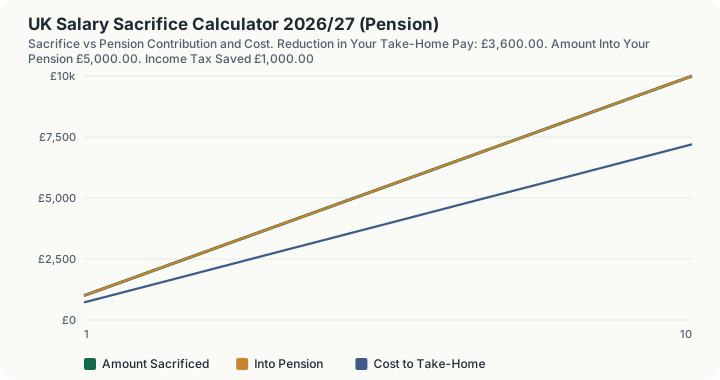
Quick Answer: On a £50,000 salary, sacrificing £5,000 into your pension reduces your take-home pay by £3,600.00. You save £1,000 of Income Tax and £400 of National Insurance, so £5,000 lands in your pension for a net cost of £3,600: effective relief of 28%. The same £5,000 through a personal pension would cost £4,000, because that route saves no National Insurance.
What does this calculator do?
Salary sacrifice works by reducing your gross pay in exchange for an employer pension contribution. Because the money never counts as your salary, it escapes both Income Tax and National Insurance.
That second saving is the entire point. A personal pension contribution gets Income Tax relief but no NI relief, so it costs more for the same amount in your pension. On a basic rate salary the gap is 8 percentage points; the arrangement is worth more the higher your marginal rate.
It also cuts your employer's NI bill by 15% of the sacrificed amount. Some employers add that saving to your pension, which materially improves the deal. Many keep it.
How is this calculated?
Step 1: Reduce the gross salary. The sacrificed amount is subtracted from gross pay before anything else happens.
Step 2: Recompute Income Tax and National Insurance on the reduced salary, using the bands for your region. Both fall.
Step 3: The cost to you is the difference between your take-home pay before and after:
Cost = take-home before − take-home after
Step 4: Compare with a personal pension. A personal contribution of the same gross amount saves Income Tax but not National Insurance, so its net cost is the contribution less the Income Tax saved. The difference between the two routes is exactly the NI saved.
Step 5: Employer NI. Sacrifice reduces the employer's secondary Class 1 liability at 15% on the amount given up. If they pass it on, it is added to the pension.
Worked Example
£50,000 salary, £5,000 sacrificed:
- Take-home before: £39,519.60. Take-home after: £35,919.60
- Cost to you: £3,600
- Income Tax saved: £1,000 (20% of £5,000). NI saved: £400 (8% of £5,000)
- £5,000 into the pension for £3,600 is 28% effective relief
- Via a personal pension the cost would be £4,000, so sacrifice is £400 better
- Employer saves £750 of NI (15% of £5,000)
£70,000 salary, £10,000 sacrificed:
- Higher rate taxpayer: 40% Income Tax plus 2% NI above the Upper Earnings Limit
- Cost to you: £5,800 for £10,000 in the pension, 42% effective relief
£120,000 salary, £20,000 sacrificed:
- This income sits in the £100,000 to £125,140 band where the Personal Allowance is withdrawn
- Sacrificing restores the allowance, so relief is the 60% effective rate plus 2% NI
- Cost to you: £7,600 for £20,000 in the pension, 62% effective relief, the best available anywhere in the UK tax system
Stepping Through the £100,000 Line
The 62% figure above is not a rate that applies to a whole sacrifice; it applies only while the reduced salary is still inside the taper. The moment the sacrifice pushes you out of it, every further pound is worth a great deal less. On a £120,000 salary, sacrificing in £1,000 steps:
| Sacrifice | Cost to take-home | Cost of that £1,000 | Effective relief |
|---|---|---|---|
| £18,000 | £6,840.00 | 62.00% | |
| £19,000 | £7,220.00 | £380.00 | 62.00% |
| £20,000 | £7,600.00 | £380.00 | 62.00% |
| £21,000 | £8,180.00 | £580.00 | 61.05% |
| £22,000 | £8,760.00 | £580.00 | 60.18% |
| £24,000 | £9,920.00 | £580.00 | 58.67% |
Each £1,000 sacrificed costs £380.00 up to £20,000, and £580.00 after it. The 20,001st pound costs 58 pence of take-home instead of 38 pence, a 53% increase in the price of the same pension contribution. The Income Tax saved line makes the mechanism explicit: at a £20,000 sacrifice it reads £12,000.00, which is 60% of the amount given up; at £21,000 it reads £12,400.00, so the extra £1,000 attracted only £400 of relief.
The reverse question, answered exactly. From a £120,000 salary, £20,000 is the sacrifice that drains the taper band and not a pound more. Sacrifice less and you leave 62% relief on the table; sacrifice more and the marginal price jumps to 58p in the pound. The headline "Reduction in Your Take-Home Pay" at that point is £7,600.00 for £20,000.00 into the pension.
Where Sacrifice Gets Less Valuable Higher Up
The National Insurance Upper Earnings Limit is £50,270, and above it employee NI falls from 8% to 2%. Whether that makes sacrifice worse depends entirely on the region, and the two runs disagree.
England, Wales and Northern Ireland, £55,000 salary. At a sacrifice of £4,729 the cost is £2,742.82; at £4,730 it is £2,743.40; at £4,731 it is £2,744.12. The pound before the boundary costs 58 pence, the pound after costs 72 pence. Relief falls from 42% to 28% at exactly £4,730 of sacrifice, the point at which the reduced salary hits £50,270. Here the UEL and the higher rate threshold are the same figure, so the 20-point Income Tax step swamps the 6-point NI step and sacrifice gets worse as you sacrifice further down.
Scotland, £60,000 salary. The same walk runs the other way. At £9,729 of sacrifice the cost is £5,448.24, at £9,730 it is £5,448.80 and at £9,731 it is £5,449.30. That is 56 pence for the pound above the UEL and 50 pence for the pound below it: relief rises from 44% to 50%. Scotland's higher rate begins at £43,663 and its advanced rate at £75,001, so neither boundary coincides with the £50,270 UEL, and the band between £43,663 and £50,270 carries 42% Income Tax and the full 8% NI at once. Sacrificing salary that sits above the UEL is genuinely the less valuable pound in Scotland. In £1,000 steps the cost runs at £560.00 per £1,000 up to £9,730 of sacrifice and £500.00 per £1,000 beyond it.
Pricing the Personal Pension Alternative
The calculator returns both routes side by side, so the common mistake of treating a personal pension contribution as equivalent can be priced directly. "Net Cost via a Personal Pension Instead" is the sacrifice less the Income Tax saved only; the National Insurance is not recovered.
- £50,000 salary, £5,000 contribution. Sacrifice costs £3,600.00. Personal pension costs £4,000.00. Advantage £400.00, which is 8% of £5,000: the employee NI main rate.
- £70,000 salary, £10,000 contribution. Sacrifice costs £5,800.00. Personal pension costs £6,000.00. Advantage only £200.00 on double the contribution, because the whole £10,000 sits above the Upper Earnings Limit where NI is 2%.
- £120,000 salary, £20,000 contribution. Sacrifice costs £7,600.00, personal pension £8,000.00, advantage £400.00.
The higher earner's advantage per pound contributed is a quarter of the basic rate earner's, which is the opposite of the usual assumption that sacrifice matters more the more you earn. What matters more at high income is the Income Tax relief, which both routes get.
Scotland changes the size of the prize, not the gap. A Scottish taxpayer on £50,000 sacrificing £5,000 has a cost of £2,500.00 against £2,900.00 through a personal pension: the same £400.00 advantage, but on effective relief of 50.00% rather than the 28.00% an rUK taxpayer gets on identical figures, because £50,000 is already inside the Scottish higher rate band.
And the employer's 15%. On the default £50,000 and £5,000, the employer saves £750.00 of secondary Class 1 NI. Switching "Employer Adds Their NI Saving to the Pension" to yes leaves the cost to take-home unchanged at £3,600.00 while the pension receives £5,750.00, lifting effective relief from 28.00% to 37.39%. Note that the engine computes employer NI with no Employment Allowance applied, so a small employer whose £10,500 allowance is not already exhausted will save less than £750.00 in practice.
What does this calculator not account for?
- The £60,000 annual allowance, and its taper for high earners, which caps how much can go into a pension with relief in a year.
- The National Minimum Wage floor. Sacrifice cannot reduce pay below the minimum wage, which limits it for lower earners.
- Effects on other pay-linked figures. Reduced gross pay can lower mortgage borrowing capacity, death-in-service cover, redundancy pay and maternity pay, all of which are usually calculated on salary.
- State benefit entitlements. Sacrificing below the Lower Earnings Limit can affect National Insurance credits toward the State Pension.
- Whether your employer offers it. Salary sacrifice requires a contractual variation and an employer willing to operate it.
- Non-pension sacrifice, such as electric cars, cycle to work, or childcare vouchers, which have their own rules.
- Scottish intermediate and advanced rates, which are applied by the engine but produce marginal rates that differ from the rUK examples above.
- Announced changes. Sacrifice has been reviewed repeatedly by successive governments, and its NI advantage is not guaranteed indefinitely.
What mistakes do people make with this?
- Comparing sacrifice with a personal pension on tax alone. The Income Tax relief is identical. The whole advantage is the National Insurance, which is why the two routes cost different amounts for the same pension contribution.
- Assuming the employer's NI saving reaches your pension. They save 15% of whatever you sacrifice, but they are not obliged to pass it on, and many do not. It is worth asking.
- Forgetting it reduces your stated salary. Mortgage lenders assess post-sacrifice pay. Sacrificing heavily just before a mortgage application can reduce what you can borrow.
- Missing the 60% band opportunity. Between £100,000 and £125,140 the effective relief is 62%. If you are in that band and not sacrificing, this is usually the single most valuable thing available to you.
- Sacrificing below the minimum wage. Not permitted, and the arrangement will be unwound.
- Ignoring the annual allowance. Contributions above £60,000, or a lower tapered figure for high earners, attract a charge that can undo the benefit.
Frequently Asked Questions
How is salary sacrifice better than just paying into a pension?
What is the effective relief rate?
Does my employer have to pass on their NI saving?
Will it affect my mortgage application?
Is there a limit?
Does it work the same in Scotland?
Sources
- GOV.UK guidance: "Rates and thresholds for employers 2026 to 2027", employer secondary rate of 15% above the £5,000 Secondary Threshold. gov.uk/guidance/rates-and-thresholds-for-employers-2026-to-2027
- GOV.UK: "Salary sacrifice for employers", the contractual basis and the National Minimum Wage restriction. dol.gov/agencies/whd/minimum-wage/state
- HM Revenue and Customs (HMRC), the official authority for the national tax authority this calculator relates to. gov.uk/government/organisations/hm-revenue-customs
All figures verified on 30 August 2026 and mirrored in engine/tables/2026/uk-2026-27.json
Also consulted: GOV.UK: "Income Tax rates and Personal Allowances" and gov.scot for the Scottish bands; GOV.UK: "National Insurance rates and categories", Class 1 employee rates of 8% and 2%.