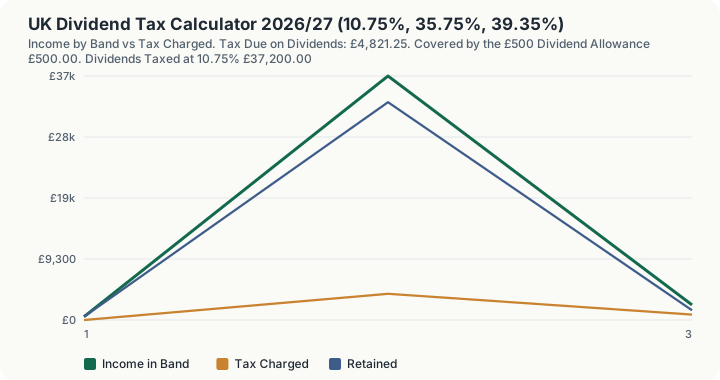
Quick Answer: A director taking a £12,570 salary and £40,000 in dividends pays £4,821.25 in dividend tax for 2026/27. The first £500 is covered by the dividend allowance, £37,200 is taxed at the 10.75% ordinary rate, and the remaining £2,300 at the 35.75% upper rate. Both of those rates rose by two percentage points on 6 April 2026.
What does this calculator do?
Dividends are taxed separately from salary, at their own three rates, after their own allowance. For 2026/27 the rates are 10.75% ordinary, 35.75% upper and 39.35% additional, and the dividend allowance is £500.
The ordinary and upper rates each rose by two percentage points on 6 April 2026. The additional rate did not move. Many published calculators still show the old 8.75% and 33.75% figures, which understates the tax on a typical director's dividends by several hundred pounds.
Dividends are taxed last, on top of all other income. That means your salary determines which dividend rate applies, and it is why the same £40,000 of dividends can cost very different amounts depending on what else you earn.
How is this calculated?
Step 1: Other income first. Salary and other non-dividend income are taxed first, using up the Personal Allowance and then the basic rate band.
Step 2: The dividend allowance. The first £500 of dividends is taxed at 0%. Critically, it still occupies band space. If your other income has already used most of the basic rate band, the allowance consumes what remains and pushes the rest of your dividends into the upper rate.
Step 3: The remaining dividends are charged according to where they sit in the band structure:
- 10.75% where they fall within the basic rate band (taxable income up to £37,700)
- 35.75% where they fall in the higher rate band (up to £125,140)
- 39.35% above that
Scotland. Dividend income is reserved to Westminster, so Scottish taxpayers pay the same dividend rates as everyone else in the UK. Only the salary portion of the calculation uses Scottish rates. A Scottish higher rate taxpayer pays 42% on salary but 35.75% on dividends.
Worked Example
£12,570 salary plus £40,000 dividends (the common director profile):
- The £12,570 salary is entirely covered by the Personal Allowance, so no tax on it and none of the basic rate band is used
- Dividend allowance: first £500 at 0%, which occupies the first £500 of band space
- Ordinary rate: the basic rate band runs to £37,700, and £500 of it is used, leaving £37,200 → £37,200 × 10.75% = £3,999.00
- Upper rate: the remaining £40,000 − £500 − £37,200 = £2,300 → £2,300 × 35.75% = £822.25
- Total dividend tax: £4,821.25, an effective rate of 12.05% on the dividends
£50,000 salary plus £20,000 dividends:
- Salary taxable £37,430 uses almost all of the basic rate band, leaving only £270
- The £500 allowance consumes that £270 and crosses into the higher band
- All £19,500 of remaining dividends is taxed at 35.75% = £6,971.25
The second case pays more tax on half the dividends, purely because the salary has already used the basic rate band.
Walking the Band Edges, Pound by Pound
Everything below is the calculator's own output, stepped one pound or one thousand pounds at a time with the £12,570 salary held constant unless stated.
Where the ordinary rate actually stops. Not at £37,700 of dividends' worth of band, but at £37,200 of dividends. Run the calculator at any dividend figure above the edge and "Dividends Taxed at 10.75%" is pinned at £37,200.00 and never moves higher. The missing £500 is the dividend allowance, which is charged at 0% but occupies the front of the basic rate band anyway. This is the single most misunderstood mechanic on the page, and it is worth pricing.
At £37,700 of dividends, the tax is £3,999.00. At £37,701 it is £3,999.36. One extra pound cost 36 pence, because that pound is the first to be charged at the 35.75% upper rate.
The same £500 costs two different amounts. Going from £37,000 to £37,500 of dividends moves the tax from £3,923.75 to £3,977.50, a cost of £53.75. Going from £37,700 to £38,200 moves it from £3,999.00 to £4,177.75, a cost of £178.75. Identical £500 of dividends, £125.00 more tax, entirely because the 0% allowance had already consumed the band space in front of it. That £125.00 is what "the allowance still occupies band space" costs a director who sits near the edge.
The next £1,000 at the default profile. At £40,000 of dividends the tax is £4,821.25; at £41,000 it is £5,178.75. Each additional £1,000 of dividends costs £357.50 while you remain in the upper band.
The reverse question. With a £12,570 salary, £37,700 is the largest dividend that avoids the upper rate entirely, and it costs £3,999.00. With a £50,000 salary the answer is nil: the calculator returns £0.00 in the "Dividends Taxed at 10.75%" line, because taxable salary of £37,430 plus the £500 allowance has already cleared the basic rate band, so the very first taxable dividend pound is charged at 35.75%.
The Second Cliff: Where the Personal Allowance Burns Away
The band edges are not the only steps this engine produces. Because dividends count toward adjusted net income, large dividends destroy the Personal Allowance at £1 for every £2 above £100,000, and the calculator shows the result directly.
At £87,430 of dividends total income reaches exactly £100,000 and the tax is £21,777.48. At £88,430 it is £22,259.98. The next £1,000 costs £482.50, not the £357.50 it cost lower down: an effective 48.25% marginal rate on dividends nominally charged at 35.75%.
At £112,570 of dividends the tax is £33,907.53 and "Dividends Taxed at 39.35%" still reads £0.00. At £112,571 that line reads £1.00. The additional rate opens at £112,570 of dividends rather than at anything resembling £125,140, because the Personal Allowance has already been tapered to nil and the whole £12,570 salary is now sitting inside the taxable bands underneath the dividends.
And then the marginal rate falls. From £112,570 to £113,570 the tax moves to £34,301.03, a step of £393.50 per £1,000. Crossing into the 39.35% additional rate is cheaper at the margin than the 48.25% taper zone below it, because there is no allowance left to lose. The engine models this taper in full; it does not model Gift Aid or personal pension contributions extending the basic rate band, which is the usual way of stepping back out of the 48.25% zone.
Proving Scotland Does Not Touch the Dividends
Two runs, identical except for the region field, £50,000 salary and £20,000 dividends:
- England, Wales or Northern Ireland: dividend tax £6,971.25, salary tax £7,486.00, total £14,457.25
- Scotland: dividend tax £6,971.25, salary tax £8,982.05, total £15,953.30
The dividend charge is identical to the penny. The entire £1,496.05 difference sits in the salary line, which is exactly what "dividend income is reserved to Westminster" means in figures. Applying the Scottish 42% higher rate to the £19,500 of taxable dividends instead of 35.75% would add £1,218.75 of tax that is not due.
What does this calculator not account for?
- National Insurance. Dividends are not subject to NI, which is the main reason the salary-plus-dividends structure exists. NI on the salary portion is calculated separately.
- Corporation Tax already paid. Dividends are paid out of post-tax company profits. The total burden on company earnings is Corporation Tax plus dividend tax, and looking at dividend tax alone understates it.
- Whether a dividend is lawful. Dividends can only be paid from distributable reserves. This calculator assumes the dividend was validly declared.
- Dividends inside ISAs or pensions, which are not taxable and should not be entered here.
- Foreign dividends and any double taxation relief.
- Directors' loan account charges under section 455, which frequently arise alongside dividend planning.
What mistakes do people make with this?
- Using the old 8.75% and 33.75% rates. They rose to 10.75% and 35.75% on 6 April 2026. On £40,000 of dividends that is roughly £790 of additional tax, and it is the single most common error on this topic right now.
- Treating the £500 allowance as worth £500 times your marginal rate. It is 0%-rated but still uses band space, so near a band boundary it is worth less than it appears.
- Forgetting dividends are taxed last. The same dividend costs 10.75% or 35.75% depending entirely on the salary sitting underneath it.
- Applying Scottish rates to dividends. Dividends are reserved. A Scottish taxpayer pays 42% on salary and 35.75% on dividends, and applying 42% to both overstates the bill.
- Comparing salary and dividends on tax alone. Salary is deductible for Corporation Tax and builds a National Insurance record; dividends are neither. The comparison is not just about the personal rate.
- Assuming the allowance is per company. It is £500 per person per tax year, across all dividends from all sources.
Frequently Asked Questions
Why did my dividend tax go up this year?
Is the £500 dividend allowance really tax free?
Do Scottish taxpayers pay Scottish rates on dividends?
Should I take salary or dividends from my company?
Do dividends inside an ISA count?
Sources
- HM Revenue and Customs (HMRC), the official authority for the national tax authority this calculator relates to. gov.uk/government/organisations/hm-revenue-customs
All figures verified on 30 August 2026 and mirrored in engine/tables/2026/uk-2026-27.json
Also consulted: GOV.UK: "Tax on dividends", dividend allowance £500 and the three dividend rates; GOV.UK: "Change to tax rates for property, savings and dividend income, technical note", ordinary and upper rates raised by 2 percentage points from 6 April 2026, additional rate unchanged; GOV.UK: "Income Tax rates and allowances", the band boundaries that determine which dividend rate applies.