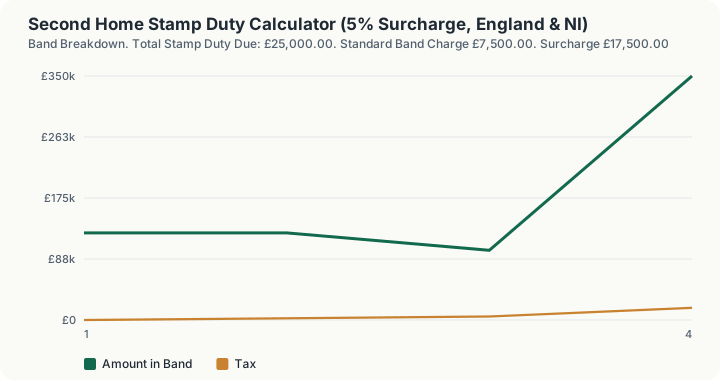
Quick Answer: A £350,000 second home or buy-to-let attracts £25,000.00 of Stamp Duty in England and Northern Ireland. That is £7,500 on the standard bands plus a £17,500 surcharge, because the 5% additional dwelling charge applies to the whole price rather than just the portion above a threshold. A home-mover buying the same property pays £7,500.
What does this calculator do?
Buying a property when you already own one triggers the additional dwelling surcharge, raised from 3% to 5% on 31 October 2024. It is charged on the entire purchase price, not banded, which is why it dominates the bill on ordinary properties.
On a £350,000 purchase the surcharge is more than twice the standard charge. The effective rate rises from 2.14% for a home-mover to 7.14% for a second-home buyer on an identical property.
This calculator covers England and Northern Ireland. Scotland and Wales operate entirely separate taxes with their own rates and surcharges.
How is this calculated?
Step 1: The standard banded charge. Each slice of the price is taxed at its own rate:
- Nothing on the first £125,000
- 2% from £125,001 to £250,000
- 5% from £250,001 to £925,000
- 10% from £925,001 to £1.5 million
- 12% above £1.5 million
Step 2: First-time buyer relief, where it applies: nothing to £300,000, then 5% to £500,000. The relief is withdrawn entirely above a £500,000 purchase price.
Step 3: The surcharge. If you will own more than one residential property at the end of the day of completion, 5% of the whole price is added:
Surcharge = 0.05 × Price
Step 4: The non-resident surcharge. A further 2% of the whole price for non-UK residents, which stacks on top, giving 7% in total.
Worked Example
£350,000 second home:
- Band 1: £125,000 at 0% = £0
- Band 2: £125,000 at 2% = £2,500
- Band 3: £100,000 at 5% = £5,000
- Standard charge: £7,500
- Surcharge: £350,000 × 5% = £17,500
- Total: £25,000, an effective rate of 7.14%
The same property as a home-mover: £7,500, an effective rate of 2.14%. The surcharge alone costs £17,500 more.
The same property as a first-time buyer: nothing to £300,000, then £50,000 at 5% = £2,500.
As a non-UK resident second-home buyer: the surcharge becomes 7% of £350,000 = £24,500, so £32,000 in total.
The First-Time Buyer Cliff at £500,000
This is the sharpest step the calculator produces, and it is a genuine cliff rather than a band edge, because relief is withdrawn in full rather than tapered.
At a £500,000 purchase price a first-time buyer owes £10,000.00, being nothing on the first £300,000 and 5% on the next £200,000. At £500,001 the bill is £15,000.05. One extra pound of purchase price costs £5,000.05 in tax, because the relief is lost entirely and the standard bands take over from the first pound of the price.
At the bottom of the relief the step is trivially small, which makes the contrast plain: £300,000 returns £0.00 and £300,001 returns £0.05. Between those two points the marginal rate is 5p in the pound; at the top it is £5,000 for a single pound.
Where the Surcharge Actually Starts, and What Each Band Edge Costs
The additional dwelling surcharge is not banded. In this engine it is 5% multiplied by the whole price, with no floor at all, so it bites from the first pound rather than at any threshold.
At a £35,000 second home the total tax is £1,750.00 and the effective rate is 5.00% even though the standard bands charge nothing at all below £125,000. At £40,000 it is £2,000.00, still 5.00%. Every £5,000 of price in this range adds exactly £250.00. Below £125,000 the entire bill is surcharge and nothing else.
That is a real divergence from the statute and worth naming precisely: the £40,000 minimum consideration below which the surcharge does not legally apply is not implemented here, so any figure this page returns under £40,000 overstates the tax by the whole surcharge.
The band edges above that are ordinary steps, and the sweep prices each one:
| Price | Total tax | Standard band charge | Effective rate |
|---|---|---|---|
| £125,000 | £6,250.00 | £0.00 | 5.00% |
| £126,000 | £6,320.00 | £20.00 | 5.02% |
| £250,000 | £15,000.00 | £2,500.00 | 6.00% |
| £251,000 | £15,100.00 | £2,550.00 | 6.02% |
| £925,000 | £82,500.00 | £36,250.00 | 8.92% |
| £926,000 | £82,650.00 | £36,350.00 | 8.93% |
The marginal cost of the next £1,000 of price. At the £350,000 default, moving to £351,000 raises the tax from £25,000.00 to £25,100.00: each additional £1,000 of price costs £100.00, being 5% band plus 5% surcharge. Above £925,000 the same £1,000 costs £150.00, from the £82,500.00 and £82,650.00 pair above.
The reverse question. A first-time buyer can pay up to £500,000 before relief disappears, and the tax at that exact price is £10,000.00. A second-home buyer has no equivalent ceiling to aim at: because the surcharge has no threshold in this engine, there is no price at which the purchase escapes it, and the effective rate never falls below 5.00%.
Four Buyer Types, One £350,000 House
Changing only the buyer type on an identical £350,000 property, every figure straight from the calculator:
| Buyer type | Total stamp duty | Effective rate | Price plus stamp duty |
|---|---|---|---|
| First-time buyer | £2,500.00 | 0.71% | £352,500.00 |
| Replacing an only home | £7,500.00 | 2.14% | £357,500.00 |
| Second home or buy-to-let | £25,000.00 | 7.14% | £375,000.00 |
| Non-UK resident second home | £32,000.00 | 9.14% | £382,000.00 |
The "Extra Cost Versus a Home-Mover" line reads £17,500.00 for the second-home buyer and minus £5,000.00 for the first-time buyer. The spread between the cheapest and the most expensive buyer of the same house is £29,500.00 of tax, more than three times the entire bill a home-mover faces.
The non-resident surcharge stacks rather than replaces. For a non-UK resident second-home buyer the "Surcharge Rate Applied" line reads 7% and the surcharge is £24,500.00 on the £350,000 price. For a non-UK resident who is replacing their only home the same line reads 2% and the surcharge is £7,000.00, taking the total to £14,500.00. The 2% is worth exactly £7,000 on this price whichever it is added to.
Pricing the Most Expensive Mistake on This Page
The common error is treating the 5% surcharge as though it were another band, charged only on the slice above £250,000. On the £350,000 default that would put £100,000 in scope and produce a surcharge of £5,000, for a total of £12,500.
The calculator returns £25,000.00. Applying the surcharge to the excess rather than the whole price understates the bill by £12,500.00, which is exactly half the tax due and, for most buyers, the difference between a deal that completes and one that does not. The "Surcharge" output line reads £17,500.00 against a "Standard Band Charge" of £7,500.00, and it is the larger of the two on every price below £1.1 million: at £1,100,000 the surcharge is £55,000.00 against a band charge of £53,750.00, and at £1,150,000 the band charge overtakes it at £58,750.00 against £57,500.00.
What does this calculator not account for?
- Scotland and Wales. Scotland charges Land and Buildings Transaction Tax with its own Additional Dwelling Supplement, and Wales charges Land Transaction Tax. Neither is calculated here.
- The 36-month replacement rule. If you are replacing your main residence but have not yet sold the old one, the surcharge is payable and then reclaimable if you sell within 36 months.
- Mixed-use and non-residential rates, which are lower and apply to properties with a genuine commercial element.
- Multiple dwellings relief, abolished for transactions from 1 June 2024.
- The £40,000 threshold, below which the surcharge does not apply at all.
- Purchases by companies, and the 15% flat rate on dwellings over £500,000 bought by certain corporate bodies.
- Linked transactions, where several purchases between the same parties are aggregated.
- Leasehold purchases, where any net present value of rent may attract a separate charge.
- Shared ownership, where the buyer can elect to pay on the full market value or in stages.
What mistakes do people make with this?
- Assuming the surcharge is banded. It is not. It is a flat 5% of the whole price from the first pound, which is why it is so large relative to the standard charge on modest properties.
- Using the old 3% rate. The surcharge rose to 5% on 31 October 2024. On a £350,000 purchase that change alone added £7,000.
- Thinking it only applies to buy-to-let. It applies to any purchase leaving you owning more than one residential property, including holiday homes, a property bought for a child, and inherited shares in a property.
- Forgetting the replacement rule works in both directions. If you buy before selling your existing home, you pay the surcharge and reclaim it after the sale, provided that happens within 36 months.
- Applying English rates in Scotland or Wales. Both have separate taxes with different bands and different surcharge rates.
- Overlooking that non-resident status stacks. A non-resident buying a second home pays 7% on top of the banded charge, not 5%.
Frequently Asked Questions
Is the 5% surcharge charged on the whole price?
When did it go up to 5%?
What if I am replacing my main home but have not sold yet?
Does it apply if I inherit a share of a property?
Do these rates apply in Scotland or Wales?
Is there a minimum price?
Sources
- HM Revenue and Customs (HMRC), the official authority for the national tax authority this calculator relates to. gov.uk/government/organisations/hm-revenue-customs
All figures verified on 30 August 2026, mirrored in engine/tables/2026/uk-2026-27.json and cross-checked against the live engine constants by uk-table-consistency.test.ts
Also consulted: GOV.UK: "Stamp Duty Land Tax: residential property rates", band thresholds, first-time buyer relief, the 5% additional dwelling surcharge and the 2% non-resident surcharge; HM Treasury, Autumn Budget 2024, the additional dwelling surcharge raised from 3% to 5% with effect from 31 October 2024.