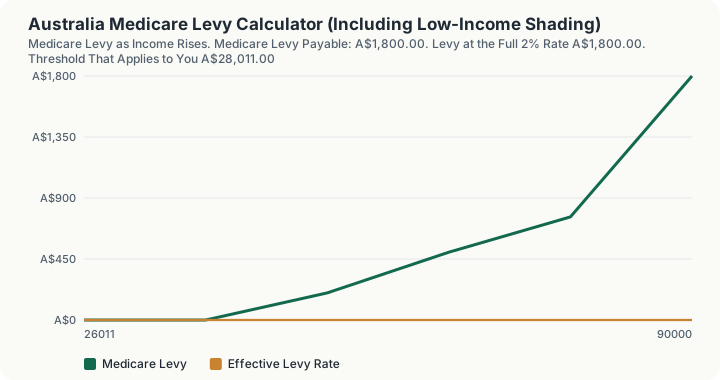
Quick Answer: On a taxable income of A$90,000 with no spouse or dependants, the Medicare levy is A$1,800.00: the full 2% rate under s 6(1) of the Medicare Levy Act 1986, because A$90,000 is well above the A$35,013 phase-in limit.
What does this calculator do?
Most Medicare levy calculators multiply taxable income by 2% and stop. That is correct for the majority of taxpayers and wrong for everyone near the bottom of the scale, because the levy does not switch on at full rate. Section 7 of the Medicare Levy Act 1986 charges nothing at all at or below a threshold amount of A$28,011, and between that threshold and a phase-in limit of A$35,013 it caps the levy at 10% of the excess over the threshold. Inside that A$7,002-wide band a taxpayer faces an effective marginal levy rate of 10%, five times the headline rate, and a levy that is far below 2% of income.
The shading rule appears twice in the Act in two different disguises. Section 7(2) states it directly as a 10% cap on the excess. Section 8, which applies instead where the person has a spouse or dependants, states a reduction: 2% of the family income threshold, less 0.08 times the amount by which family income exceeds that threshold. Those look like separate rules. They are the same rule. This page shows the algebra.
Every dollar figure here was read from Compilation No. 53 of the Medicare Levy Act 1986, compilation date 1 July 2026. The thresholds were raised by Schedule 5 of the Treasury Laws Amendment (Delivering an Efficient and Trusted Tax System) Act 2026, headed "Increasing the Medicare levy low-income thresholds", whose item 14 applies them to assessments for 2025-26 and later years. There are no unverified figures in this calculator.
How is this calculated?
Using the defaults: taxable income A$90,000, no spouse or dependants, not a senior or pensioner, no exemption.
- Step 1: Check for an exemption. No exemption is selected, so the levy is computed. Exempt = false
- Step 2: Compute the levy at the full statutory rate (s 6(1)). A$90,000 x 2% = A$1,800.00
- Step 3: Select the threshold amount (s 3(1)). With no spouse or dependants, s 7 applies; not a senior or pensioner, so paragraph (c) of the definition gives the general figure. Threshold = A$28,011, phase-in limit = A$35,013
- Step 4: Test against the threshold (s 7(1)). No levy is payable at or below the threshold amount. A$90,000 > A$28,011, so the levy is not nil
- Step 5: Test against the phase-in limit (s 7(2)). The 10% cap on the excess applies only up to the limit. A$90,000 > A$35,013, so the shading-in cap does not apply
- Step 6: Take the full-rate levy. Above the phase-in limit the s 6 rate applies in full and the reduction is nil. A$1,800.00 - A$0.00 = A$1,800.00
- Step 7: Compute the effective levy rate. A$1,800.00 / A$90,000 = 2.0000%
Worked Example
The shading rules matter below A$35,013, and the family formula reproduces them exactly. Take two cases.
A single person on A$30,000.
- Levy at the full rate: A$30,000 x 2% = A$600.00.
- Excess over the threshold: A$30,000 - A$28,011 = A$1,989.00.
- Section 7(2) cap: A$1,989.00 x 10% = A$198.90.
- The lesser of the two applies: A$198.90. The reduction is A$600.00 - A$198.90 = A$401.10, and the effective rate is 0.663%, not 2%.
A family on A$50,000 of family income, no dependants.
- The family income threshold in s 8(5) is A$47,238.
- Levy at the full rate on the person's own taxable income: A$50,000 x 2% = A$1,000.00.
- Section 8(2) reduction: (A$47,238 x 2%) - 0.08 x (A$50,000 - A$47,238) = A$944.76 - A$220.96 = A$723.80.
- Levy: A$1,000.00 - A$723.80 = A$276.20.
Now check that against s 7(2) run on the same figures: 10% x (A$50,000 - A$47,238) = 10% x A$2,762 = A$276.20. Identical. The algebra is the reason: writing FI for family income and FIT for the threshold, the s 8 result is 0.02 x FI - 0.02 x FIT + 0.08 x (FI - FIT), which collects to 0.10 x (FI - FIT). The 0.08 coefficient in s 8(2) is simply 10% less the 2% levy rate, chosen so that the family reduction shades in at exactly the same 10% as the individual rule. The two sections state one policy twice.
A two-income couple. Where your spouse earns enough to pay the levy in their own right (more than A$28,011 of taxable income), s 8(3) splits the reduction between you by taxable income. Take two partners on A$30,000 each with two dependants: family income A$60,000, threshold A$47,238 + 2 x A$4,338 = A$55,914. The s 8(2) reduction is A$1,118.28 - 0.08 x A$4,086 = A$791.40, and you keep A$30,000 / A$60,000 of it, A$395.70. The reduction comes off the levy you would pay after s 7, which on A$30,000 is already shaded down to A$198.90, so your levy is A$0.00. When your spouse's income is at or below A$28,011, you keep the whole reduction.
That order matters for anyone whose own income is in the s 7 range. Section 7 applies to every person, and s 8 then reduces what is left. An earner on A$33,000 whose spouse earns A$20,000 pays A$498.90 under s 7, less a family reduction of A$483.80, which leaves A$15.10.
What does this calculator not account for?
- The Medicare levy surcharge. This page computes the s 6 levy only. The additional 1%, 1.25% or 1.5% surcharge on higher earners without private hospital cover is a separate charge under ss 8B to 8D, with its own income test.
- The spouse's side of a shared reduction. Under s 8(3) the calculator gives you your share of the family reduction. If your share is more than your own levy, s 8(4) passes the excess to your spouse's levy; that transfer shows up on your spouse's assessment, not here. The spouse is tested against the same threshold amount as you, which is exact unless only one of you is entitled to the seniors and pensioners tax offset.
- Partial-year exemptions. The exemption input is all or nothing. In practice an exemption can apply for part of a year and the levy is apportioned across days, which is not modelled.
- The half levy for a person with an exempt spouse or dependants. Where family circumstances give a partial exemption rather than a full one, the Act can charge half the levy. Only full exemption is available here.
- Family income where the family thresholds are engaged but no spouse income is entered. Family income is the sum of the two taxable incomes entered; leaving the spouse income at zero when a spouse has income will understate the levy.
- Whether a person is in fact a dependant. The dependant count is taken as entered. Section 8(5) defines the qualifying persons by reference to Subdivision 961-A of the ITAA 1997, and that eligibility test is not applied.
- Future threshold changes. The Medicare levy low-income thresholds are re-set periodically by amending Act rather than by an indexation formula. The figures here are the most recent enacted amounts, as at the 1 July 2026 compilation, not a projection.
What mistakes do people make with this?
- Assuming the levy is always exactly 2%. Between A$28,011 and A$35,013 it is capped at 10% of the excess, which is a smaller amount but a much steeper marginal rate. A dollar of extra income inside that band costs ten cents of levy.
- Assuming the levy jumps from nil to A$700 at the threshold. It does not. The shading rule exists precisely so that the levy starts at nil at A$28,011 and rises smoothly to the full 2% at A$35,013, where both formulas give A$700.26.
- Thinking tax offsets reduce the levy. They do not. LITO and SAPTO reduce income tax imposed under the Income Tax Assessment Acts; the levy is imposed by the Medicare Levy Act 1986 and is unaffected.
- Using the individual threshold when there is a spouse. Having a spouse or dependants switches the test entirely: from your own taxable income against A$28,011 to combined family income against A$47,238 plus A$4,338 per dependant.
- Forgetting that seniors get a different threshold. Entitlement to the ITAA 1936 s 160AAAA rebate raises the individual threshold to A$44,268 and the family threshold to A$61,623, which is why a senior on A$40,000 pays nothing where a non-senior pays A$800.00.
Frequently Asked Questions
What income is the levy charged on?
Where exactly does the shading band end?
How do dependants change the family threshold?
Why does a senior on A$40,000 pay nothing?
Are these thresholds current?
Sources
- Medicare Levy Act 1986, series C2004A03351, Compilation No. 53, compilation date 1 July 2026, ss 3(1), 6, 7 and 8: legislation.gov.au/C2004A03351/latest/text
- Treasury Laws Amendment (Delivering an Efficient and Trusted Tax System) Act 2026, No. 58, 2026, Schedule 5 ("Increasing the Medicare levy low-income thresholds"): legislation.gov.au/C2026A00058/latest/text
- Income Tax Assessment Act 1936, series C1936A00027, Compilation No. 192, s 160AAAA: legislation.gov.au/C1936A00027/latest/text
- Income Tax Assessment Act 1997, series C2004A05138, Compilation No. 266, Subdivision 961-A: legislation.gov.au/C2004A05138/latest/text