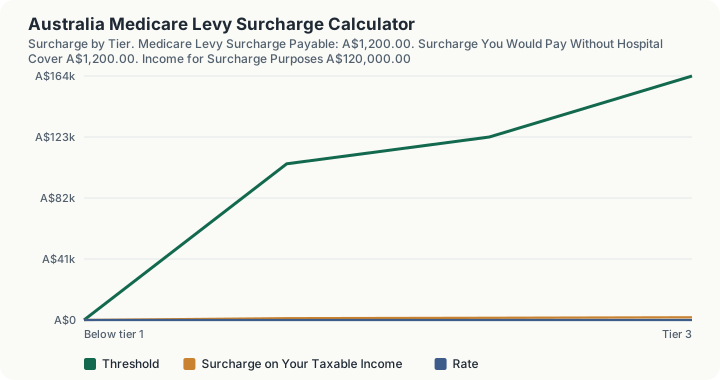
Quick Answer: On a taxable income of A$120,000 with no private hospital cover, the 2026-27 surcharge is A$1,200.00: tier 1 at 1% of taxable income, because A$120,000 is above the A$105,000 singles tier 1 threshold but not above the A$123,000 tier 2 threshold.
What does this calculator do?
This calculator rests on two sets of figures from two different places.
The surcharge rates are in the Act. Section 8B(2) of the Medicare Levy Act 1986 charges "1% of the person's taxable income"; s 8B(3) adds "0.25 of a percentage point" for a tier 2 earner and s 8B(4) adds "0.5 of a percentage point" for a tier 3 earner. Sections 8C and 8D carry the same structure for other categories of person. That gives 1%, 1.25% and 1.5%, read directly from Compilation No. 53 of the Act, compilation date 1 July 2026.
The tier income thresholds are indexed every year. Section 3(1) of the Medicare Levy Act defines them by reference to the Private Health Insurance Act 2007 (series C2007A00031). Section 22-35 of that Act states A$90,000, A$105,000 and A$140,000 "for the 2021-22 and 2022-23 financial year", and s 22-45 indexes them for later years by an earnings-based factor rounded down to the nearest A$1,000. The indexed amounts are published by the Australian Government's Private Health Insurance Ombudsman at privatehealth.gov.au. For 2026-27 (1 July 2026 to 30 June 2027) they are:
| Tier | Singles | Families | Rate |
|---|---|---|---|
| Base | up to A$105,000 | up to A$210,000 | 0% |
| Tier 1 | A$105,001 to A$123,000 | A$210,001 to A$246,000 | 1% |
| Tier 2 | A$123,001 to A$164,000 | A$246,001 to A$328,000 | 1.25% |
| Tier 3 | A$164,001 or more | A$328,001 or more | 1.5% |
These are the calculator's defaults. The three singles thresholds stay editable, so you can enter another year's figures; for 2025-26 they were A$101,000, A$118,000 and A$158,000.
A second distinction runs through the Act and catches people out. Liability is tested on income for surcharge purposes, which is taxable income plus reportable fringe benefits and reportable employer superannuation contributions. The surcharge is then charged on taxable income. The two are different numbers whenever benefits are reported, which is why salary sacrificing into superannuation cannot lift you out of a tier.
How is this calculated?
Using the defaults: taxable income A$120,000, no reportable fringe benefits, no hospital cover, the 2026-27 singles thresholds of A$105,000, A$123,000 and A$164,000, no family thresholds.
- Step 1: Compute income for surcharge purposes. Taxable income plus reportable fringe benefits and reportable employer super contributions. A$120,000 + A$0 = A$120,000.00
- Step 2: Apply the family conversion if it applies (PHI Act s 22-40). The family thresholds are not engaged here, so the singles thresholds are used unchanged. Tier 1 = A$105,000, tier 2 = A$123,000, tier 3 = A$164,000
- Step 3: Check for complying private patient hospital cover (s 8B(1)(c)). No cover is held, so the exclusion does not apply. Cover held = false
- Step 4: Test against the tier 1 threshold. Below or at it, no surcharge is imposed at all. A$120,000.00 > A$105,000, so the person is liable
- Step 5: Determine the tier. Above tier 1 but not above tier 2. A$105,000 < A$120,000.00 <= A$123,000, so tier 1
- Step 6: Select the rate (s 8B(2)). Tier 1 is the unincreased 1%; s 8B(3) would add 0.25 of a percentage point for tier 2 and s 8B(4) 0.5 for tier 3. 1%
- Step 7: Charge the rate on TAXABLE INCOME, not on income for surcharge purposes. A$120,000 x 1% = A$1,200.00
- Step 8: Compare against the premium entered. The default premium is A$1,600. A$1,200.00 - A$1,600.00 = -A$400.00, so on cost alone the surcharge is the cheaper of the two
- Step 9: Show the ordinary levy alongside it (s 6(1)). The surcharge is in addition to the 2% levy, not instead of it. A$120,000 x 2% = A$2,400.00, giving a total Medicare cost of A$3,600.00
Worked Example
Two features of the Act only appear once you change the defaults.
Reportable benefits can trigger the surcharge on their own. Take taxable income of A$100,000 with A$10,000 of reportable fringe benefits and no cover.
- Income for surcharge purposes: A$100,000 + A$10,000 = A$110,000.00.
- That exceeds the A$105,000 tier 1 threshold but not A$123,000, so tier 1 applies at 1%.
- The charge is on taxable income: A$100,000 x 1% = A$1,000.00.
Taxable income alone was below the threshold, so nothing in the pay figure would have warned you, and the A$10,000 of benefits added A$1,000.00 of surcharge without adding a dollar to the base the rate is charged on.
The s 8D(3)(c) floor protects a low-earning spouse. Section 8D(3) makes a married person liable only where the couple's combined income for surcharge purposes exceeds the family tier 1 threshold and "the person's income for surcharge purposes exceeds A$28,011", a figure raised from A$27,222 by Act No. 58 of 2026. Consider a couple on A$225,000 combined, above the A$210,000 family tier 1 threshold, where one spouse earns A$200,000 and the other A$25,000. The high earner is liable; the low earner is not, because A$25,000 does not exceed A$28,011, however high the household income goes. Separately, because s 22-40 doubles each singles threshold, a couple on A$200,000 combined pays nothing at all even though A$200,000 would be tier 3 for a single person.
What does this calculator not account for?
- Other years' thresholds. The defaults are the 2026-27 thresholds. For any other year, enter that year's singles thresholds from privatehealth.gov.au.
- Part-year cover. The cover question is all or nothing here. In law the surcharge is imposed for the days on which cover was not held, so someone insured for part of the year pays a proportion.
- What counts as complying cover. No test of the policy is applied. Extras-only cover does not remove the surcharge, and nor may a hospital policy with an excess above the statutory limit.
- The private health insurance rebate. The rebate that reduces the premium you actually pay is income-tested on the same tiers and is not modelled, so step 8 uses the gross premium you enter.
- The dependant definition. Dependent children are taken as entered; no eligibility test is applied.
- The ordinary levy shown alongside. It is shown for context, not as a full levy calculation.
What mistakes do people make with this?
- Confusing the surcharge with the levy. The 2% Medicare levy applies to nearly everyone. The surcharge is an additional charge, only on people above tier 1 who do not hold complying hospital cover, and it does not replace the levy.
- Assuming the surcharge is charged on the income that was tested. It is not. Section 8B(2) charges a percentage of taxable income; income for surcharge purposes only decides liability and tier.
- Salary sacrificing to get under a threshold. Reportable employer superannuation contributions are added back into income for surcharge purposes, so the sacrifice does not move the test.
- A low-earning spouse assuming they are liable. The s 8D(3)(c) floor of A$28,011 means a spouse below that figure is not liable however high the couple's combined income.
- Using an old year's thresholds. They rise every year with earnings; A$120,000 was tier 2 on the 2021-22 base amounts but is tier 1 in 2026-27.
Frequently Asked Questions
What are the 2026-27 surcharge thresholds?
What are the verified rates?
How do the family thresholds work?
Is the surcharge worth avoiding by buying cover?
Sources
- Private Health Insurance Ombudsman, Medicare Levy Surcharge: income thresholds and rates (2026-27 and 2025-26 tables): privatehealth.gov.au/health_insurance/surcharges_incentives/medicare_levy.htm
- Medicare Levy Act 1986, series C2004A03351, Compilation No. 53, compilation date 1 July 2026, ss 3(1), 3A, 6 and 8B to 8G: legislation.gov.au/C2004A03351/latest/text
- Private Health Insurance Act 2007, series C2007A00031, Compilation No. 41, compilation date 1 April 2026, ss 22-30, 22-35, 22-40 and 22-45: legislation.gov.au/C2007A00031/latest/text
- Treasury Laws Amendment (Delivering an Efficient and Trusted Tax System) Act 2026, No. 58, 2026 (raised the s 8D(3)(c) floor to A$28,011): legislation.gov.au/C2026A00058/latest/text