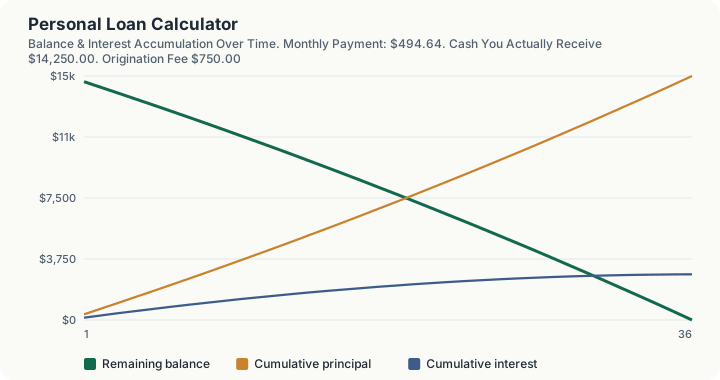
Quick Answer: A $15,000 personal loan at 11.5% APR over 36 months costs $494.64 a month, and with a 5% origination fee you actually receive $14,250.00 in cash.
Overview
A personal loan is an unsecured installment loan: no collateral backs it, the lender approves you based on income and creditworthiness, and you repay it in equal monthly installments over a fixed term, typically two to seven years. People use them to consolidate higher-rate credit card debt, cover a large one-time expense, or finance a purchase without tying it to a specific asset the way a car loan or mortgage is tied to the vehicle or home.
The part that trips people up isn't the monthly payment, it's the origination fee. Most personal loans deduct a one-time fee, commonly 1% to 8% of the loan amount, from your proceeds before the money ever reaches your account. You still owe, and still pay interest on, the full loan amount. The fee doesn't reduce your debt, it reduces your cash. That distinction matters a lot if you're borrowing a specific amount to cover a specific bill.
This calculator runs the standard loan amortization math to get your monthly payment, and separately calculates the origination fee and the actual cash you'll receive, so both numbers are visible before you accept an offer.
How This Is Calculated
The monthly payment is calculated using the standard fixed-rate amortization formula, applied to the full loan amount, not the amount you'll actually receive:
`
PMT = P × i / (1 − (1 + i)^−n)
`
where P is the loan amount, i is the monthly interest rate (APR divided by 12), and n is the term in months. You owe and repay the full P, plus interest, regardless of any fee withheld at funding.
The origination fee is calculated separately as a percentage of the loan amount and subtracted from that amount to determine your actual proceeds:
`
Origination Fee = Loan Amount × Fee Percent
Amount Received = Loan Amount − Origination Fee
`
The total cost of the loan is the sum of every scheduled payment plus the origination fee, since both are real money leaving your pocket over the life of the loan, even though the fee is paid on day one instead of spread across the term.
If you would rather start from the payment you can afford, choose "How much I can borrow". The calculator then runs the same formula in reverse, solving for the loan amount instead of the payment. The largest loan a monthly payment supports is the present value of that payment stream:
`
P = PMT × (1 − (1 + i)^−n) / i
`
The origination fee is then taken from that loan, so the amount received shows what the payment actually buys. At 11.5% over 36 months, a $400 monthly payment supports a loan of $12,130.03.
A full month-by-month amortization schedule is generated so you can see exactly how each payment splits between principal and interest, and how the balance declines to zero by the final payment.
Worked Example
Take a $15,000 personal loan at 11.5% APR, over a 36-month term, with a 5% origination fee:
- Monthly interest rate: 11.5% ÷ 12 = 0.0095833
- Monthly payment: solving the amortization formula for $15,000 over 36 months at that rate gives $494.64
- Origination fee: $15,000 × 5% = $750.00
- Cash you actually receive: $15,000 − $750.00 = $14,250.00
- Total of all 36 payments: $494.64 × 36 = $17,807.04
- Total interest paid: $17,807.04 − $15,000 = $2,807.04
- Total cost of credit (interest plus fee): $2,807.04 + $750.00 = $3,557.04
Notice the gap between what you borrowed on paper ($15,000), what you actually received ($14,250.00), and what you'll pay back in total ($17,807.04). If you need exactly $15,000 in hand for a specific expense, you'd need to borrow more than $15,000 to cover the fee, or find a lender that charges a lower fee or none at all.
What This Does Not Account For
- Whether the origination fee is deducted from proceeds or added to the loan balance. Some lenders finance the fee into the loan amount instead of deducting it from proceeds. This calculator assumes the more common structure, deduction from proceeds, which is what determines the "amount received" figure. If your lender adds the fee to the balance instead, your loan amount, payment, and interest would all be based on the higher combined figure.
- Prepayment penalties. Most personal loans don't charge one, but some do. This calculator assumes the loan runs its full scheduled term with no early payoff.
- Autopay or relationship interest rate discounts. Many lenders shave a fraction of a percentage point off the APR for enrolling in automatic payments or holding another account with them. Enter the rate you'd actually be quoted after any such discount.
- Late fees and default rate increases. This tool models on-time, as-scheduled payments only. Missing payments can trigger fees and, on some loans, a higher penalty rate.
- Impact on credit utilization or credit score. Consolidating revolving credit card debt into an installment loan changes your credit mix and utilization ratio in ways this calculator doesn't model.
Common Pitfalls
- Comparing loan offers by monthly payment alone. A lower monthly payment from a longer term can still cost more in total interest and fees. Compare the total cost of credit, not just the payment, across offers.
- Forgetting the origination fee when budgeting for a specific expense. If you need $15,000 for a project and take out a $15,000 loan with a 5% fee, you'll only receive $14,250.00. Borrow enough to cover both the expense and the fee if you need the full amount in hand.
- Assuming a lower APR always means a cheaper loan. A loan with a slightly lower APR but a much higher origination fee can cost more overall than a loan with a slightly higher APR and no fee, especially on shorter terms where the fee makes up a larger share of total cost.
- Not checking whether the fee is deducted from proceeds or added to the balance. These two structures produce different loan amounts, payments, and total interest, even at the same stated fee percentage and rate.
- Using a personal loan to pay off credit cards without addressing the underlying spending. Consolidation lowers the rate on existing debt but doesn't prevent new balances from accumulating on cards that are now paid off and available again.
Frequently Asked Questions
Why did I receive less money than the loan amount I agreed to?
Is a personal loan a good way to consolidate credit card debt?
What's a typical interest rate range for a personal loan?
Do all personal loans charge an origination fee?
Can I pay off a personal loan early to save on interest?
Sources
- Consumer Financial Protection Bureau (CFPB): Personal loan disclosure requirements, origination fee treatment, and APR calculation standards under Regulation Z (Truth in Lending Act). ecfr.gov/current/title-12/chapter-X/part-1026
- Federal Trade Commission (FTC): Consumer guidance on personal loans, fees, and debt consolidation. consumer.ftc.gov