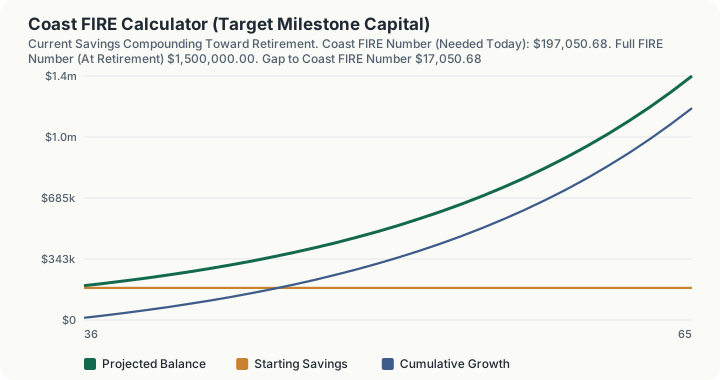
Quick Answer: Coast FIRE is the amount you need invested right now so that compound growth alone, with no further contributions, carries your portfolio to your full FIRE number by traditional retirement age, and this calculator computes that number and shows whether your current savings already clears it.
Overview
"FIRE" (Financial Independence, Retire Early) planning usually centers on one big number: the portfolio size needed to fund your expenses indefinitely at a safe withdrawal rate. Coast FIRE reframes that goal around a different, often more motivating, milestone: the amount you need invested today such that you could stop contributing entirely, right now, and still reach your full FIRE number purely through compound growth by the time you hit traditional retirement age.
Once you clear your Coast FIRE number, continued saving becomes optional rather than required for that specific retirement-age target. Many people who reach Coast FIRE choose to keep working and keep contributing anyway, simply with less financial pressure, since any further retirement account is now upside rather than a strict requirement. Others use it as the moment they downshift to lower-paying, more fulfilling, or more flexible work, since their long-term retirement number is already effectively locked in by compounding alone. This makes Coast FIRE the natural companion concept to Barista FIRE: Coast FIRE is about your investment portfolio being large enough to self-complete, while Barista FIRE is about earning supplemental income to bridge the gap between where you are and full retirement, right now, rather than years from now.
How This Is Calculated
The calculation starts by establishing your full FIRE number using the standard safe-withdrawal-rate formula:
`
Full FIRE Number = Annual Expenses in Retirement / Safe Withdrawal Rate
`
Then it works backward from that target. If a lump sum invested today grows at your expected annual return for the number of years remaining until retirement, what lump sum today equals your full FIRE number at the end of that period? That is a straightforward present value calculation:
`
Coast FIRE Number = Full FIRE Number / (1 + r)ⁿ
`
where r is your expected annual return and n is the number of years until your traditional retirement age. This calculator solves that equation using the platform's present-value TVM solver, the same discounting math used throughout finance to translate a future dollar amount into its equivalent value today.
The calculator then compares your actual current savings against that Coast FIRE number, reports the gap (or surplus) either way, and separately projects what your current savings alone will grow to by retirement age with zero further contributions, so you can see whether that projection clears, matches, or falls short of your full FIRE number.
Worked Example
A 35-year-old with $180,000 invested wants to know whether they can stop contributing. They plan to retire at 65, expect $60,000 a year in expenses, use a 4% withdrawal rate, and assume 7% returns.
Step 1 -- The full FIRE number. $60,000 / 0.04 = $1,500,000
Step 2 -- Years of compounding available. 65 - 35 = 30 years
Step 3 -- The Coast FIRE number, discounting the target back. $1,500,000 / 1.07^30 = $197,050.68
Step 4 -- The gap. $197,050.68 - $180,000 = $17,050.68 still needed
Step 5 -- Where today's $180,000 lands at 65 with no further contributions. $180,000 x 1.07^30 = $1,370,205.91
Step 6 -- Shortfall against the full FIRE number. $1,370,205.91 - $1,500,000 = -$129,794.09
Watching the Two Curves Over the Next Two Years
The point of the schedule is that both numbers move. The balance compounds upward, and so does the threshold, because each year that passes is a year of compounding the portfolio no longer gets.
Step 7 -- Balance at age 36. $180,000 x 1.07 = $192,600
Step 8 -- Coast threshold at age 36, with 29 years left. $1,500,000 / 1.07^29 = $210,844.22
Step 9 -- Gap at age 36. $210,844.22 - $192,600 = $18,244.22
Step 10 -- Balance at age 37. $192,600 x 1.07 = $206,082
Step 11 -- Coast threshold at age 37, with 28 years left. $1,500,000 / 1.07^28 = $225,603.32
Step 12 -- Gap at age 37. $225,603.32 - $206,082 = $19,521.32
That is the finding this page exists for. Doing nothing does not close the gap -- it widens it, from $17,050.68 today to $18,244.22 next year to $19,521.32 the year after. The threshold rises 7% a year and so does the balance, but 7% of the larger threshold is more dollars than 7% of the smaller balance. Only contributions close it, and the amount required grows the longer they are deferred.
The Same Gap Ten and Twenty Years Out
Steps 7 through 12 show the gap widening over two years. Extending the same two curves makes the compounding cost of waiting hard to argue with.
Step 13 -- Balance at age 45. $354,087.24, of which $174,087.24 is growth on the original $180,000
Step 14 -- Coast threshold at age 45, with 20 years left. $387,628.50
Step 15 -- Gap at age 45. $387,628.50 - $354,087.24 = $33,541.26
Step 16 -- Balance at age 55. $696,543.20
Step 17 -- Coast threshold at age 55, with 10 years left. $762,523.94
Step 18 -- Gap at age 55. $762,523.94 - $696,543.20 = $65,980.74
The gap roughly doubles every decade, from $17,050.68 today to $33,541.26 at 45 to $65,980.74 at 55, even though nothing about the plan has changed. Both curves grow at 7%, so the shortfall between them grows at 7% too. Nothing closes it except contributions, and each year of delay raises the amount those contributions have to be.
What This Does Not Account For
- Inflation. All figures are treated as today's dollars. A real Coast FIRE plan spanning decades should account for expenses, and ideally the return assumption, in inflation-adjusted (real) terms rather than nominal terms.
- Sequence-of-returns risk and market volatility. The 7% return assumption is a smooth average. Real portfolios experience volatile years, and a market downturn in the years immediately before retirement can meaningfully change the outcome even if the long-run average holds.
- Any income between now and retirement. This calculator assumes zero further contributions once you hit your Coast FIRE number, which is the definition of coasting, but in practice many people continue contributing something, which would only help reach or exceed the full FIRE number sooner or by a larger margin.
- Taxes on investment growth and withdrawals, which vary by account type (Traditional, Roth, taxable brokerage) and are not modeled here.
- Changes to your expenses or retirement age over time. The calculation is a snapshot based on your current assumptions; revisit it periodically as your actual expenses, timeline, or return expectations change.
- Social Security or pension income, which could reduce the portfolio-funded share of retirement expenses and lower the effective FIRE number needed, but is not factored in here.
Common Pitfalls
- Confusing Coast FIRE with being done saving forever. Coast FIRE only means you have enough invested to reach your specific full FIRE number by your specific traditional retirement age assuming your return holds. It does not protect against a lower-than-expected return, a longer-than-planned time horizon, or higher-than-planned expenses.
- Using an overly optimistic return assumption. Because Coast FIRE math compounds over long time horizons (often 20 to 40 years), small differences in the assumed return produce large differences in the Coast FIRE number. A 7% assumption versus a 5% assumption over 30 years can change the required number by a wide margin.
- Ignoring taxes and fees, which act as a drag on the compounding rate. The return assumption used in this calculator should reflect your realistic net return after fund expenses, not a headline market index return before costs.
- Treating "reaching Coast FIRE" as static. Market swings mean your Coast FIRE status can move both directions. A strong market year can put you meaningfully ahead of your Coast FIRE number, while a downturn can put you behind it again.
- Not stress-testing a lower return scenario. Because the calculation is sensitive to the return assumption, it is worth checking your Coast FIRE number under a more conservative return (for example, 4% to 5%) to understand your downside exposure.
Frequently Asked Questions
What happens if I keep contributing after I hit Coast FIRE?
Does Coast FIRE assume I stop earning money entirely?
How sensitive is the Coast FIRE number to my return assumption?
What if I want to retire earlier than my "traditional" retirement age?
Is Coast FIRE the same as being financially independent right now?
Sources
- U.S. Securities and Exchange Commission, Investor.gov compound interest and time value of money educational resources. investor.gov
- U.S. Securities and Exchange Commission, Investor.gov compound interest reference. investor.gov/financial-tools-calculators/calculators/compound-interest-calculator
Also consulted: Trinity Study (Cooley, Hubbard, and Walz, 1998) and subsequent updates, foundational research behind the 4% safe withdrawal rate used to size the full FIRE number.