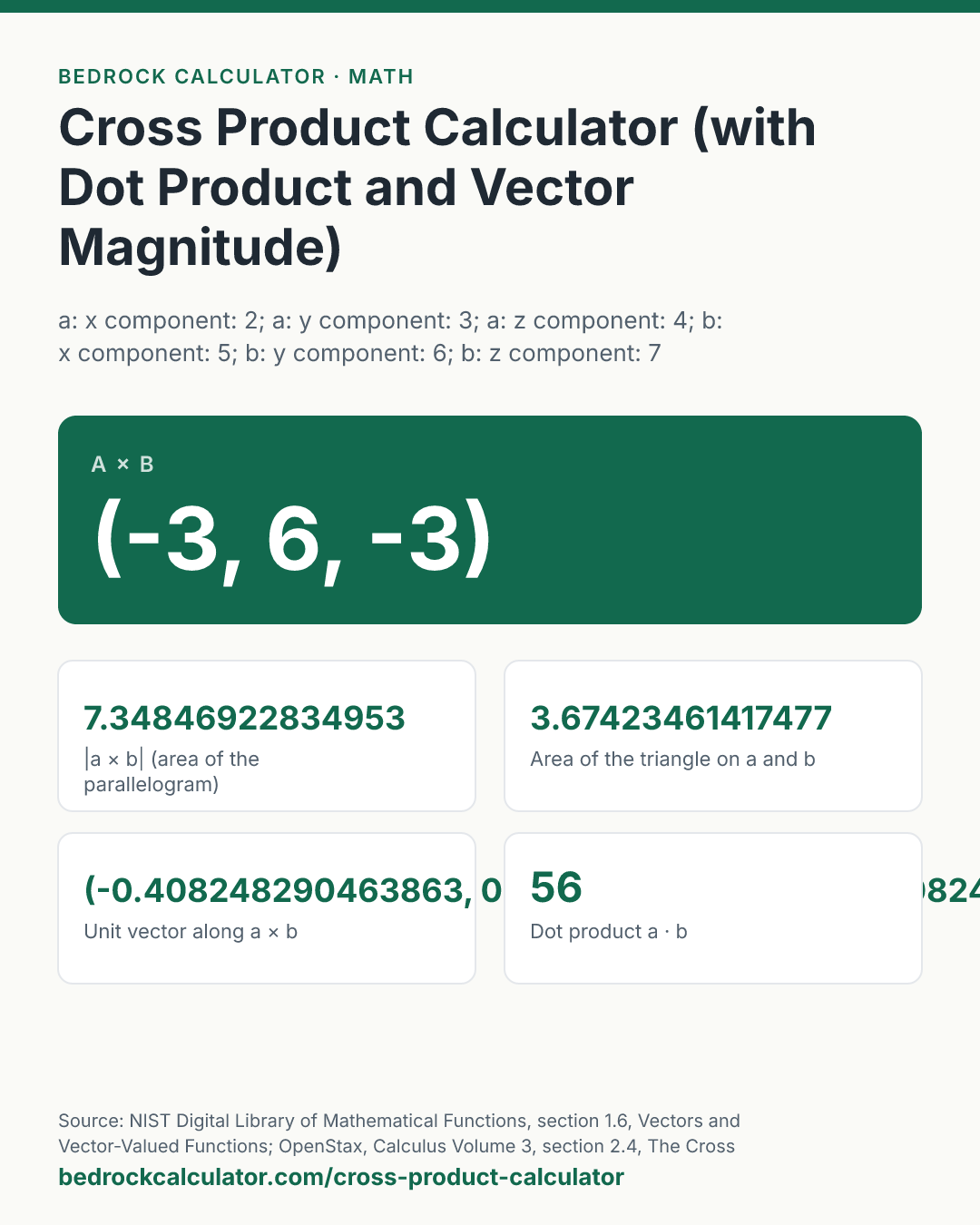

Quick Answer: The cross product of a = (2, 3, 4) and b = (5, 6, 7) is (-3, 6, -3). Its length, 7.3485, is the area of the parallelogram the two vectors span, and their dot product is 56.
What does this calculator do?
This cross product calculator multiplies two three-dimensional vectors and returns the cross product a × b, along with everything you usually need next: its magnitude (the area of the parallelogram on a and b), half that (the area of the triangle), the unit vector perpendicular to both, the dot product, the magnitude of each vector, and the angle between them.
The cross product of two vectors is a third vector at right angles to both. Its direction follows the right-hand rule: point the fingers of your right hand along a, curl them toward b, and your thumb points along a × b. Its length is |a||b| sin θ, which is largest when the vectors are perpendicular and zero when they are parallel. That makes it the tool for finding a normal to a plane, a torque, or an area in 3D.
The definitions follow section 1.6 of the NIST Digital Library of Mathematical Functions. Products of components are exact; square roots and the angle are computed to 34 significant digits and shown to 15.
Using the Cross Product Calculator
- Enter the x, y and z components of vector a.
- Enter the x, y and z components of vector b. For vectors in a flat plane, set both z components to 0.
- Read a × b at the top. The cards give the magnitudes, areas, unit normal, dot product, angle, a check that the result is perpendicular to both inputs, and b × a for comparison.
How is this calculated?
- Cross product by components. Each component of a × b comes from the other two components of a and b (DLMF 1.6.9). It is the expansion of a 3 × 3 determinant with i, j and k in the top row.
a × b = (a₂b₃ − a₃b₂, a₃b₁ − a₁b₃, a₁b₂ − a₂b₁)
- Dot product. The products of matching components, added (DLMF 1.6.2).
a⋅b = a₁b₁ + a₂b₂ + a₃b₃
- Magnitudes. The length of a vector is the square root of its dot product with itself (DLMF 1.6.3). The length of a × b is also the area of the parallelogram with sides a and b; half of it is the area of the triangle with those sides.
|a| = √(a₁² + a₂² + a₃²)
- Angle between the vectors. Computed as atan2(|a × b|, a · b), which gives the same angle as the textbook arccos(a · b / |a||b|) but stays accurate when the vectors are nearly parallel, where arccos loses digits.
- Unit normal. a × b divided by its own length, when that length is not zero.
- Perpendicular check. The dot products of a × b with a and with b, which should both be zero. Because the arithmetic is exact, they come out as exactly 0 for any decimal inputs.
Worked Example
Using the defaults, a = (2, 3, 4) and b = (5, 6, 7):
- x: 3 × 7 - 4 × 6 = 21 - 24 = -3.
- y: 4 × 5 - 2 × 7 = 20 - 14 = 6.
- z: 2 × 6 - 3 × 5 = 12 - 15 = -3.
- So a × b = (-3, 6, -3).
- |a × b| = √(9 + 36 + 9) = √54 = 7.34846922834953, the parallelogram area. The triangle area is 3.67423461417477.
- a · b = 10 + 18 + 28 = 56. |a| = 5.3851648071345 and |b| = 10.4880884817015.
- The angle between them is 7.47579063237942°: they point in nearly the same direction, which is why the cross product is short compared with the vectors themselves.
How Do You Find the Magnitude of a Vector?
Square each component, add the squares, and take the square root. The Magnitude of (3, 4, 12) preset gives |a| = √(9 + 16 + 144) = √169 = 13. In two dimensions, enter 0 for the z component, which drops that term. The magnitude is the vector's length, and it does not depend on which direction the vector points.
Cross Products of the Unit Vectors
The reference table lists the products of the axis unit vectors i, j and k. Going around the cycle i, j, k gives the next one: i × j = k, j × k = i, k × i = j. Going the other way gives the negative: j × i = -k. Any vector crossed with itself is the zero vector.
What does this calculator not account for?
- Vectors in more than three dimensions. The cross product as defined here exists only in three dimensions. For two-dimensional vectors, set z to 0; the answer then points straight along z, and its z component is the signed area.
- Units. Components are plain numbers. If they carry units (newtons and metres for a torque), the result's unit is the product of the two.
- Symbolic vectors. Only numerical components are accepted.
- Scalar triple products and projections. a · (b × c) and the projection of one vector onto another are not computed directly.
What mistakes do people make with this?
- Order matters. b × a is the negative of a × b. The card shows both.
- Sign of the middle component. In the determinant expansion, the j term carries a minus sign. Writing it as a3 b1 - a1 b3, as here, avoids the slip.
- Expecting a number. The cross product is a vector. The dot product is the number.
- Parallel vectors. If a × b is the zero vector, the vectors are parallel (or one is zero) and there is no unique normal. The Parallel vectors preset shows this with (1, 2, 3) and (2, 4, 6).
- Using degrees for sin θ by hand. If you check |a||b| sin θ yourself, make sure your calculator is in degrees for the angle shown.
Frequently Asked Questions
What is the cross product of i and j?
What does the cross product tell you?
What is the difference between the dot product and the cross product?
How do you find a vector perpendicular to two vectors?
Can you take the cross product of two 2D vectors?
Sources
- NIST Digital Library of Mathematical Functions, section 1.6, Vectors and Vector-Valued Functions: dot product (1.6.2), magnitude (1.6.3), angle (1.6.4) and cross product with the right-hand rule (1.6.9). dlmf.nist.gov/1.6
- OpenStax, Calculus Volume 3, section 2.4, The Cross Product: the determinant formula, the right-hand rule, and the magnitude as the area of the parallelogram. openstax.org/books/calculus-volume-3/pages/2-4-the-cross-product