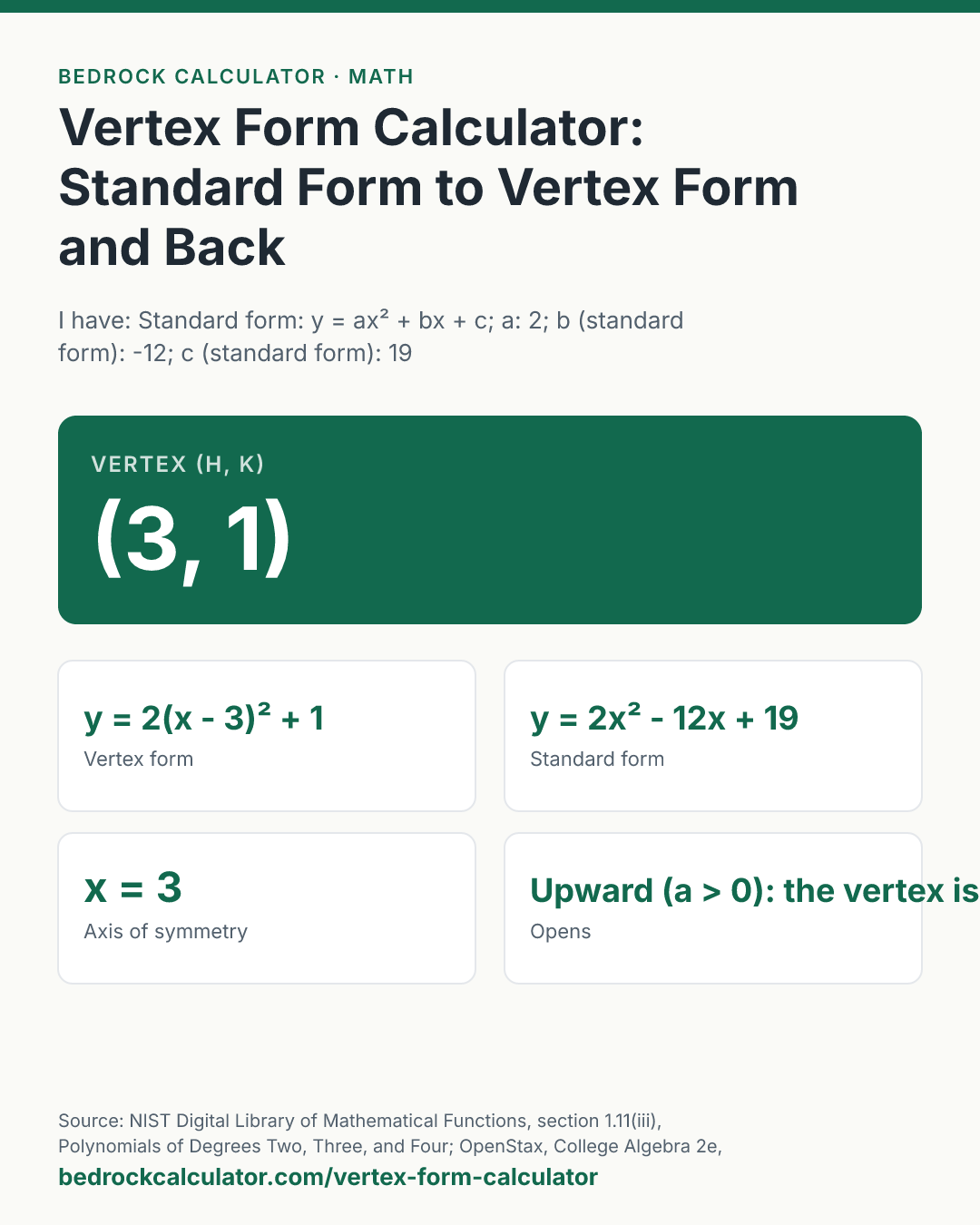

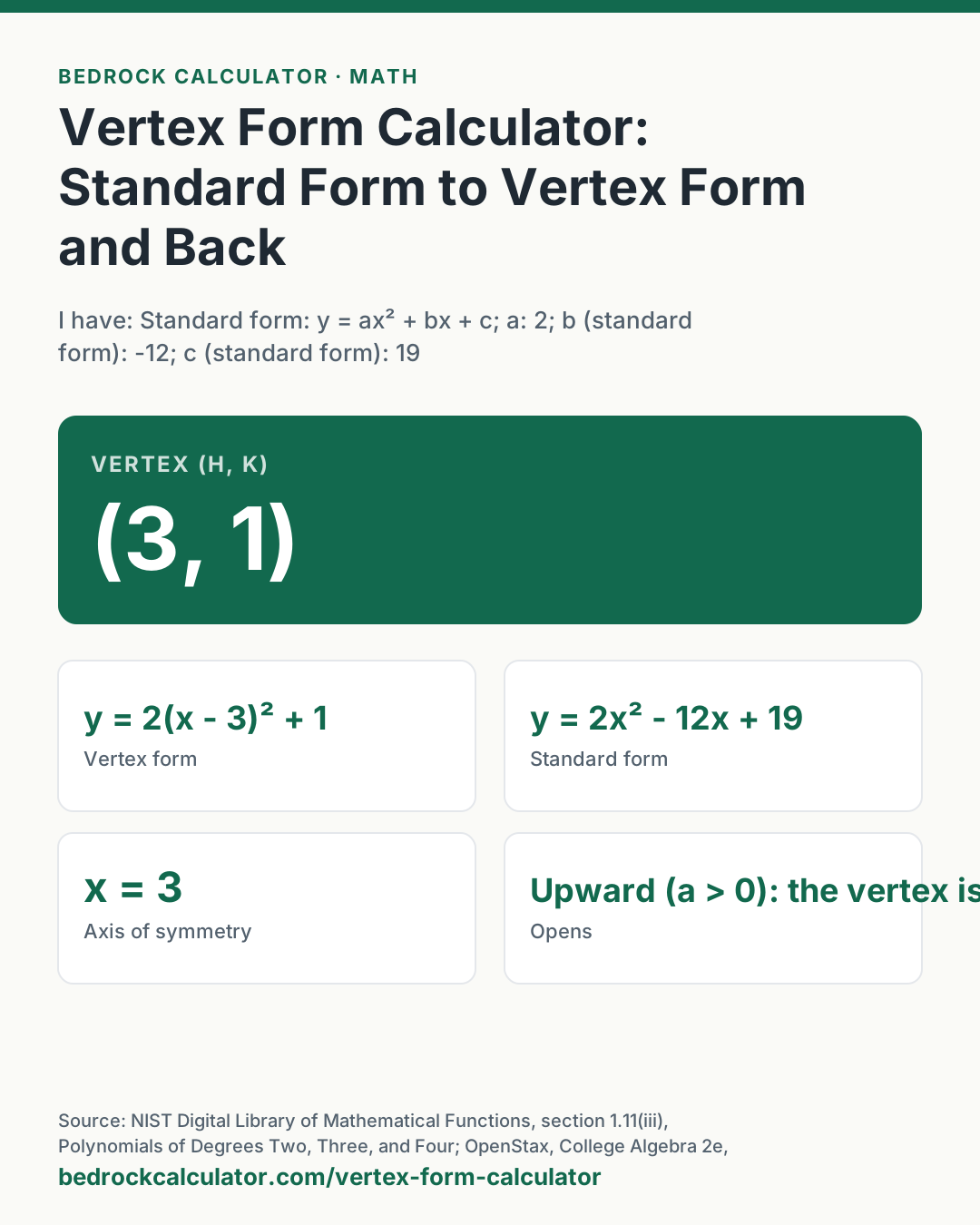
Quick Answer: y = 2x² - 12x + 19 in vertex form is y = 2(x - 3)² + 1, so its vertex is (3, 1). The parabola opens upward, its minimum value is 1, and it has no real roots.
What does this calculator do?
This vertex form calculator converts a quadratic between standard form, y = ax² + bx + c, and vertex form, y = a(x - h)² + k. It gives the vertex (h, k), the axis of symmetry, whether the parabola opens up or down, its minimum or maximum value, the discriminant, the roots and the y-intercept.
The vertex form of a quadratic equation puts the vertex on display: in y = a(x - h)² + k the turning point of the parabola is (h, k). The number a is the same in both forms. It sets how wide the parabola is and which way it opens: up when a is positive, down when it is negative. Standard form, in turn, shows the y-intercept, c, directly. Each form answers different questions, which is why courses ask you to move between them.
All coefficients are kept as exact fractions, so a vertex at (5/2, -1/4) is reported that way rather than as rounded decimals. Roots that are irrational are shown as decimals to 15 significant figures.
Using the Vertex Form Calculator
- Choose whether you have the standard form or the vertex form.
- Enter a, then b and c for standard form, or h and k for vertex form. Note that in y = 3(x + 1)² - 12, h is -1, because x + 1 is x - (-1).
- Read the vertex at the top and both forms of the equation below, with the axis, direction, extreme value, discriminant, roots and y-intercept.
How is this calculated?
- Make the coefficients exact. Each typed number becomes a fraction. If a is 0, the equation is a straight line, and the calculator says so.
- Standard form to vertex form, by completing the square. The vertex is at h = -b/(2a), and k is the value of y there, which simplifies to c - b²/(4a).
h = −b/2a; k = c − b²/4a
ax² + bx + c = a(x + b/2a)² + c − b²/4a
- Vertex form to standard form, by expanding. Multiplying out a(x - h)² + k gives b = -2ah and c = ah² + k.
a(x − h)² + k = ax² − 2ah x + (ah² + k)
- Discriminant and roots. The discriminant b² - 4ac decides the roots (DLMF 1.11.11). Positive: two real roots from the quadratic formula. Zero: one repeated root at x = h. Negative: no real roots, and the two complex roots h ± i√(4ac - b²)/(2|a|) are given. When the discriminant is the square of a fraction, the roots are given exactly; otherwise as decimals.
x = (−b ± √(b² − 4ac))/2a
- The rest. The axis of symmetry is the vertical line x = h. The y-intercept is (0, c). The vertex is a minimum when a is positive and a maximum when a is negative, and that value is k.
Worked Example
Using the defaults, y = 2x² - 12x + 19:
- h = -(-12)/(2 × 2) = 12/4 = 3.
- k = 19 - (-12)²/(4 × 2) = 19 - 144/8 = 19 - 18 = 1.
- Vertex form: y = 2(x - 3)² + 1. Vertex (3, 1), axis x = 3.
- a = 2 is positive, so the parabola opens upward and the minimum value is y = 1 at x = 3.
- Discriminant: (-12)² - 4 × 2 × 19 = 144 - 152 = -8, so there are no real roots. The complex roots are 3 ± 0.707106781186548i.
- y-intercept: (0, 19).
How Do You Convert Vertex Form to Standard Form?
Expand the square and add k. The y = 3(x + 1)² - 12 preset has a = 3, h = -1 and k = -12. Then b = -2 × 3 × (-1) = 6 and c = 3 × 1 + (-12) = -9, so the standard form is y = 3x² + 6x - 9.
Its discriminant is 144, a perfect square, so the roots are exact: x = -3 and x = 1.
What Is the Standard to Vertex Formula?
h = -b/(2a) and k = c - b²/(4a). Some books write k as f(h), the value of the function at h, which is the same number. For x² - 5x + 6, h = 5/2 and k = 6 - 25/4 = -1/4, so the vertex form is y = (x - 5/2)² - 1/4.
The parabola crosses the x-axis at x = 2 and x = 3, which are equally spaced either side of 5/2, as the axis of symmetry requires.
Vertex Form of Common Quadratics
The reference table lists the vertex form of a dozen quadratics. Look at x² + 2x + 1, whose vertex form is simply (x + 1)²: when k is 0, the vertex sits on the x-axis and there is one repeated root. And 3x² - 12 needs no completing at all, because with no x term the vertex is already on the y-axis.
What does this calculator not account for?
- Factored form. y = a(x - r₁)(x - r₂) is not written out, but the roots card gives r₁ and r₂ whenever they are real.
- Exact surds. Irrational roots are shown as decimals. In exact form, -x² + 4x + 1 has roots 2 ± √5; the calculator gives -0.23606797749979 and 4.23606797749979.
- Graphs. The parabola is not drawn.
- Contact lens vertex distance. In optometry, vertex distance is the gap between a spectacle lens and the eye, and a vertex calculator adjusts a prescription for it. That is unrelated to this page; ask an optician.
- Cubic and higher equations. Only quadratics are handled.
What mistakes do people make with this?
- Sign of h. In y = a(x - h)² + k, the vertex x-coordinate is h, so (x + 3)² means h = -3.
- Forgetting a when completing the square. Factor a out of the x terms first; the vertex form keeps the same a as the standard form.
- Dropping k. The constant outside the square is the y-coordinate of the vertex.
- Reading a negative discriminant as an error. It means the parabola does not reach the x-axis. The roots are complex, not missing.
- Mixing up maximum and minimum. Positive a opens upward and has a minimum; negative a opens downward and has a maximum.
Frequently Asked Questions
What is vertex form?
How do I find the vertex of a parabola?
What does the vertex tell you?
How do I tell if a parabola opens up or down?
What does the discriminant tell you?
Sources
- NIST Digital Library of Mathematical Functions, section 1.11(iii), Polynomials of Degrees Two, Three, and Four: roots of the quadratic equation and the discriminant (1.11.11). dlmf.nist.gov/1.11
- OpenStax, College Algebra 2e, section 5.1, Quadratic Functions: standard and vertex form, and the vertex at h = -b/(2a). openstax.org/books/college-algebra-2e/pages/5-1-quadratic-functions