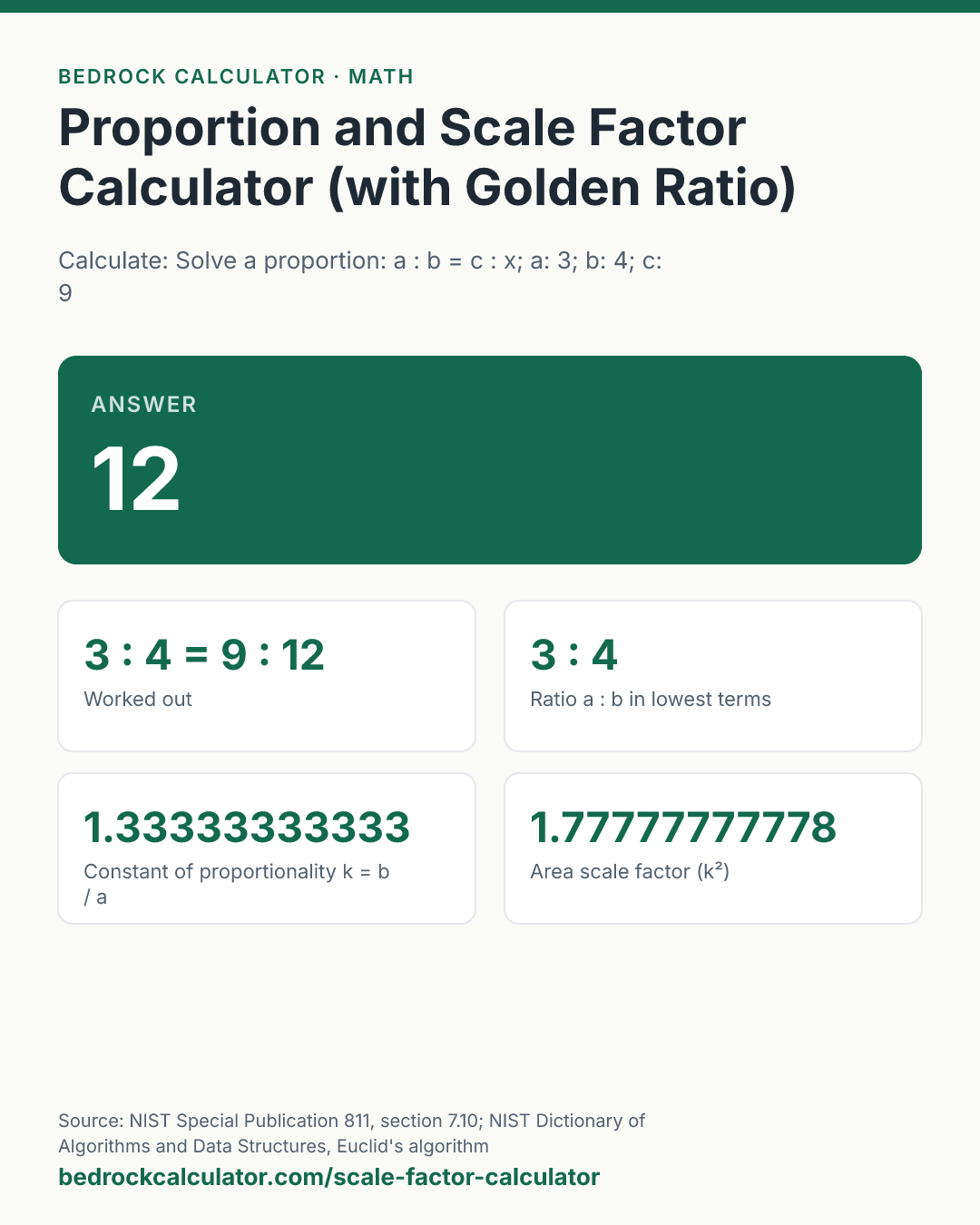

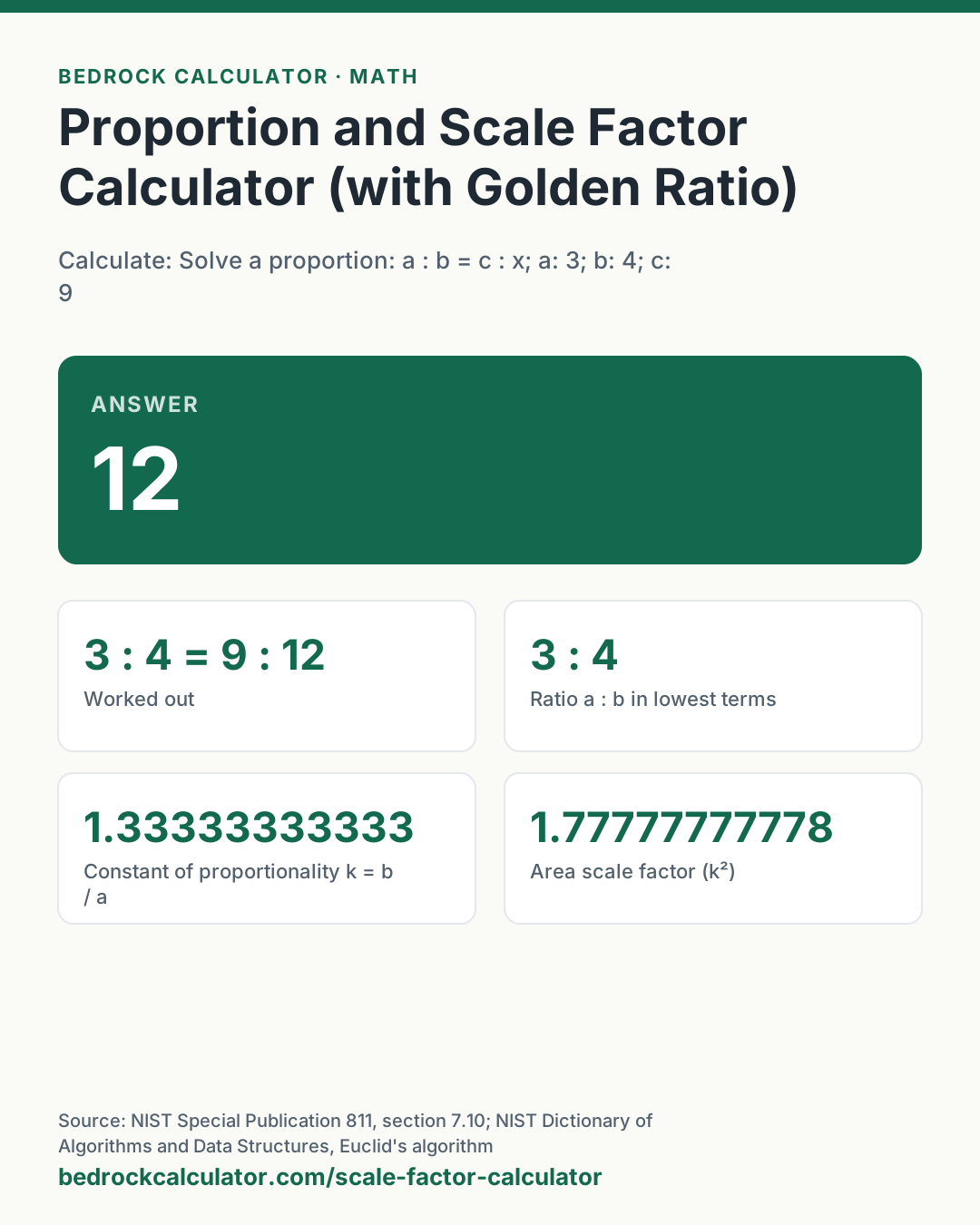
Quick Answer: In the proportion 3 : 4 = 9 : x, the missing term is 12, because 9 is three times 3 and so x is three times 4. The constant of proportionality, 4 divided by 3, is 1.3333.
What does this calculator do?
This proportion and scale factor calculator handles three closely related jobs. It solves a proportion a : b = c : x for the missing term, which is how recipes, maps, unit prices and similar triangles are scaled.
It finds the scale factor between an original and a copy, and with it the factors for area and volume, which grow faster than length. And it splits a length by the golden ratio.
A ratio compares two quantities of the same kind, and the result has no unit: the NIST Guide to the SI calls such quantities "of dimension one". A proportion says two ratios are equal. Every proportion has a constant of proportionality, k, the number you multiply the first quantity by to get the second. Knowing k answers every version of the problem at once.
Ratios are also reduced to lowest whole terms, so a ratio entered as 1.5 : 2.25 is shown as 2 : 3.
Using the Scale Factor Calculator
- Choose the job: solve a proportion, find a scale factor, or split a length by the golden ratio.
- For a proportion a : b = c : x, enter a, b and c.
- For a scale factor, enter the original length as a and the copy's length as b. Enter any other original length as c to see it scaled.
- For the golden ratio, enter the length to split as a.
- Read the answer at the top and the working, the reduced ratio, the constant k and the area and volume factors below.
How is this calculated?
- Solve the proportion. Cross-multiplying a : b = c : x gives a × x = b × c, so x is b times c divided by a. If a is 0 the proportion has no solution, and the card says so.
a/b = c/x ⟹ x = (b × c)/a
- Constant of proportionality. k = b / a, so that b = k × a. In a proportional relationship y = kx, k is the value of y when x is 1.
k = b/a
- Reduce the ratio. a and b are turned into exact fractions, divided, and the result is written in lowest whole terms.
- Scale factors for area and volume. Lengths scale by k, areas by k², and volumes by k³, because an area has two length dimensions and a volume three.
area factor = k²; volume factor = k³
- Golden ratio. φ = (1 + √5)/2 is computed to 34 digits. A length L is split so that the whole is to the longer part as the longer part is to the shorter, which makes the longer part L / φ and the shorter part L minus that.
φ = (1 + √5)/2; longer = L/φ
- Show the results. Values are rounded half up to 12 significant figures.
Worked Example
Using the defaults, 3 : 4 = 9 : x:
- Cross-multiply: 3 × x = 4 × 9 = 36.
- x = 36 ÷ 3 = 12.
- Check: 3 : 4 and 9 : 12 both reduce to 3 : 4.
- k = 4 ÷ 3 = 1.33333333333. Area factor k² = 1.77777777778; volume factor k³ = 2.37037037037.
A recipe, from the Recipe preset: 2 cups of flour serve 3 people, so how much for 7? Solve 3 : 2 = 7 : x. x = 2 × 7 ÷ 3 = 4.66666666667 cups, about 4⅔.
How Do You Find the Constant of Proportionality?
Divide one quantity by the other: k = y / x. If 3 notebooks cost $4, then k = 4 / 3, about $1.33 per notebook, and any number of notebooks costs k times that number.
The test for a proportional relationship is that this ratio is the same for every pair of values; if it changes, the relationship is not proportional (it may have a fixed starting amount, for instance).
How Do You Calculate a Scale Factor?
Divide the copy's length by the original's. The Model preset draws a 150 cm wall as 6 cm, so the scale factor is 0.04, a reduction to 4% of the original, which reduces to the ratio 25 : 1. Any other length scales the same way: 420 scales to 16.8.
Area and volume change faster. The Photo preset enlarges a 4-inch-wide photo to 10 inches, a scale factor of 2.5. The photo's area grows by 6.25 times, and if it were a solid object, its volume (and weight) would grow by 15.625 times.
What Is the Golden Ratio?
The golden ratio, φ, is 1.61803398875. Splitting a length so that the whole is to the longer part as the longer part is to the shorter gives that ratio. The Golden split of 100 preset divides 100 into 61.803398875 and 38.196601125. It appears in art and design, and as the limit of the ratio of consecutive Fibonacci numbers.
Scale Factors for Lengths, Areas and Volumes
The reference table shows how area and volume factors grow with the length scale factor. Doubling every length multiplies area by 4 and volume by 8; a tenfold scale multiplies volume by 1,000.
What does this calculator not account for?
- Units. The terms of a ratio must be in the same unit. A 1.5 m wall and a 6 cm drawing must be compared as 150 cm and 6 cm.
- Non-proportional relationships. A taxi fare with a fixed starting charge, or anything of the form y = kx + b with b not zero, does not satisfy a proportion.
- Map scales with units. A map scale of 1 : 25,000 is a scale factor of 1/25,000 with no unit; enter it as a = 25000, b = 1 to scale real distances down.
- Ratios of more than two terms. A : B : C ratios are not reduced here.
What mistakes do people make with this?
- Setting up the proportion upside down. Keep matching quantities in matching positions: people to people, cups to cups.
- Scaling area by the length factor. A model at 1/10 scale has 1/100 of the area and 1/1,000 of the volume.
- Mixing units. Convert first, then compare.
- Rounding k early. Use the full k for each scaled value.
- Reading a ratio as a fraction of the whole. A 3 : 4 ratio means 3 parts to 4 parts, so the first is 3/7 of the total, not 3/4.
Frequently Asked Questions
How do I solve a proportion?
What is a scale factor?
How do I simplify a ratio?
How does a scale factor affect area?
What is the golden ratio equal to?
Sources
- NIST Special Publication 811, section 7.10: quantities defined as the ratio of two comparable quantities are of dimension one. nist.gov/pml/special-publication-811/nist-guide-si-chapter-7-rules-and-style-conventions-expressing-values
- NIST Dictionary of Algorithms and Data Structures, Euclid's algorithm: the greatest common divisor used to reduce ratios. xlinux.nist.gov/dads/HTML/euclidalgo.html