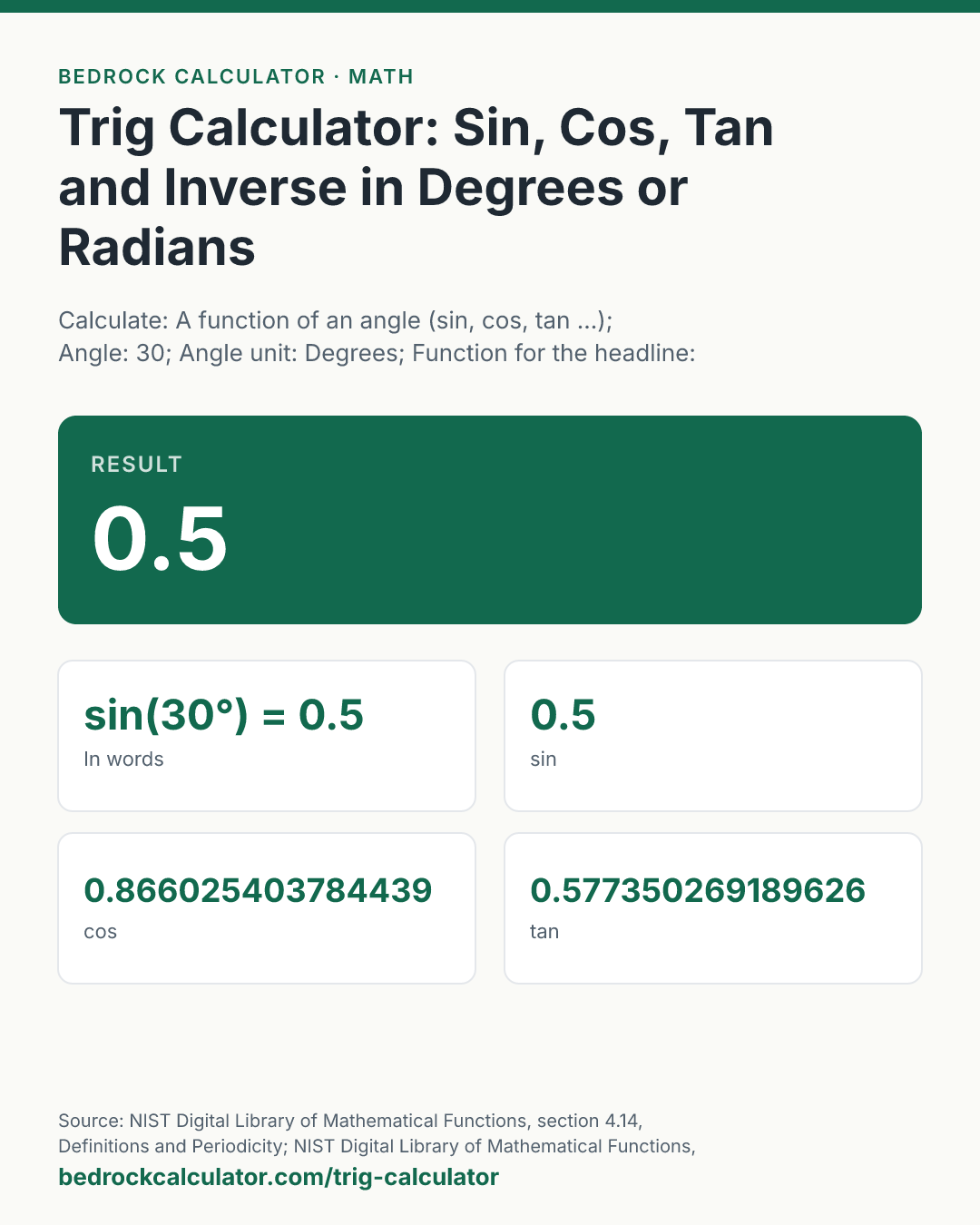

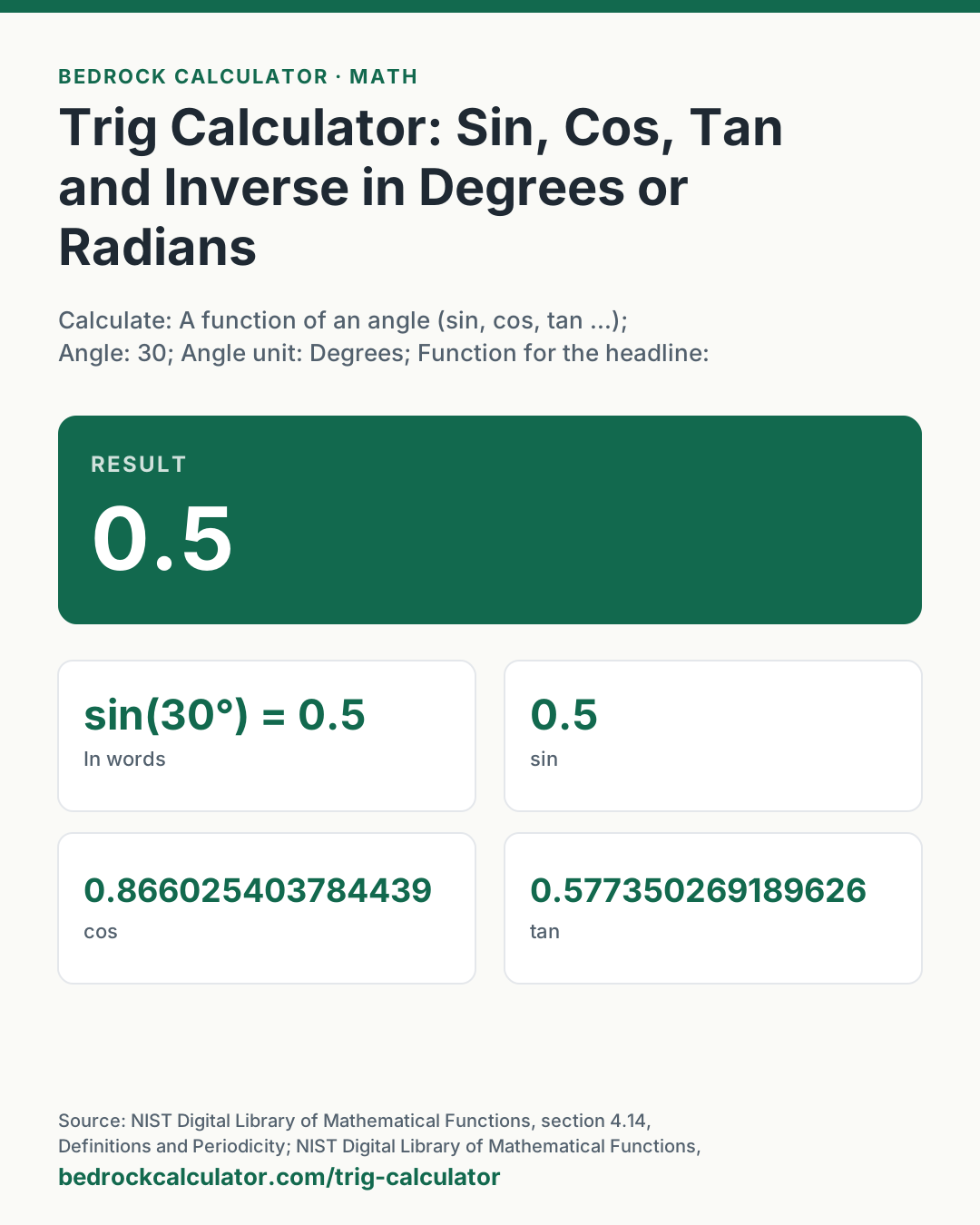
Quick Answer: sin 30° is 0.5. For the same angle, cos is 0.8660 and tan is 0.5774, and 30° is 0.5236 radians.
What does this calculator do?
This trig calculator gives all six trigonometric functions of an angle (sine, cosine, tangent, cosecant, secant and cotangent) in degrees or radians, and the three inverse functions (arcsin, arccos and arctan) of a value, with the angle in both units.
The most common mistake with trigonometry on a calculator is the angle unit. "cos 1" means the cosine of one radian (57.2957795130823 degrees) unless a degree sign is written, and the two answers are very different: cos 1 is 0.54030230586814, while cos 1° is 0.999847695156391. The calculator asks for the unit every time and shows the angle converted to the other unit, so the mix-up is easy to spot.
Values are computed to 34 significant digits from the series behind decimal.js's sine and cosine, with pi computed as the arc cosine of -1 rather than typed in, and shown to 15. Angles that are whole multiples of 90 degrees are treated exactly, so sin 180° is exactly 0 and tan 90° is reported as undefined rather than as an enormous number.
Using the Trig Calculator
- Choose a function of an angle, or an inverse function to find an angle from a value.
- For a function, type the angle, choose degrees or radians, and pick the function you want as the headline. All six appear in the cards.
- For an inverse function, type the value and pick arcsin, arccos or arctan. All three inverses of the same value appear in the cards, in degrees and radians.
How is this calculated?
- Convert the angle. An angle in degrees is converted to radians by multiplying by pi and dividing by 180. The other unit is shown on its own card.
θ_rad = θ_deg × π/180
- Exact quarter turns. If the angle is in degrees and is a whole multiple of 90, sine and cosine are set exactly to 0, 1 or -1 according to the quarter of the circle. Every other angle is evaluated from its radian value.
- Sine and cosine. For all other angles, decimal.js computes sin θ and cos θ to 34 significant digits.
- The other four functions. Tangent, cosecant, secant and cotangent are formed from sine and cosine, as DLMF section 4.14 defines them. Where the divisor is exactly zero, the function is undefined and the card says so.
tan θ = sin θ/cos θ csc θ = 1/sin θ sec θ = 1/cos θ cot θ = cos θ/sin θ
- Inverse functions. arcsin and arccos accept values from -1 to 1 only; arctan accepts any value. Each returns the principal value: arcsin from -90° to 90°, arccos from 0° to 180°, arctan strictly between -90° and 90°. The radian result is converted to degrees by multiplying by 180 over pi.
- Show the results. Values are rounded half up to 15 significant figures with trailing zeros dropped.
Worked Example
Using the defaults, sin 30°:
- 30° × π/180 = 0.523598775598299 radians.
- sin 30° = 0.5 and cos 30° = 0.866025403784439 (which is √3/2).
- tan 30° = 0.5 ÷ 0.866025403784439 = 0.577350269189626.
- csc 30° = 1 ÷ 0.5 = 2, sec 30° = 1.15470053837925 and cot 30° = 1.73205080756888.
An inverse, from the cos⁻¹(0.5) preset: the angle whose cosine is 0.5 is 60°, or 1.0471975511966 radians.
What Is Cos 1?
It depends on the unit. Read as radians, which is what "cos 1" means in mathematics and in most software, the cos 1 (radian) preset gives 0.54030230586814. Read as degrees, the cos 1° preset gives 0.999847695156391. One radian is 57.2957795130823°, so the radian answer belongs to a much larger angle.
The same goes for tan 1: in radians it is 1.5574077246549, in degrees 0.0174550649282176.
How Do You Find the Inverse Tangent?
Switch to inverse mode, enter the value and choose arctan. The tan⁻¹(1) preset gives 45°, or 0.785398163397448 radians, because the tangent of 45° is 1. The inverse cosine of the cosine of an angle returns the original angle only if it lies between 0° and 180°; outside that range, arccos returns the matching angle inside it.
Sine, Cosine and Tangent of Common Angles
The reference table lists sin, cos and tan for the angles that come up most, from 0° to 360°. The patterns are worth knowing: sin and cos swap between 30° and 60°, both equal 0.707106781186548 at 45°, and tan is undefined at 90° and 270°, where cosine is zero.
Which Functions Are Negative in Each Quadrant?
Sine is the y coordinate of a point on a circle of radius 1 and cosine is its x coordinate, so their signs follow the quadrant. From 0° to 90° all six functions are positive. From 90° to 180° only sine and cosecant are positive: cos 120° is -0.5 in the table.
From 180° to 270° only tangent and cotangent are positive, because sine and cosine are both negative and their ratio is positive, as tan 210° shows. From 270° to 360° only cosine and secant are positive. Knowing this lets you check the sign of any answer at a glance before trusting the digits.
What does this calculator not account for?
- Gradians. Only degrees and radians are offered. To convert gradians, multiply by 0.9 to get degrees.
- Exact surd forms. The calculator shows 0.866025403784439, not √3/2. The exact forms for special angles are standard and listed in any table of trigonometric values.
- All solutions of an equation. An inverse function returns one principal angle. sin θ = 0.5 has the solutions 30° and 150° in one turn, plus every multiple of 360° added to either.
- Angles in degrees, minutes and seconds. Convert to decimal degrees first: 30° 15′ is 30.25°.
- Hyperbolic functions. sinh, cosh and tanh are not computed.
What mistakes do people make with this?
- Wrong angle unit. The single most common error. Check the converted angle card.
- Reading sin⁻¹ as 1/sin. sin⁻¹ x means arcsin x. The reciprocal of sine is csc.
- Expecting tan 90° to be a number. It is undefined, because cos 90° is zero. A calculator that returns a huge number has rounded pi.
- Taking arcsin of a value above 1. No angle has a sine above 1, so arcsin 2 has no real answer.
- Forgetting the sign in each quadrant. Cosine is negative between 90° and 270°, sine between 180° and 360°.
Frequently Asked Questions
How do I calculate sin, cos and tan?
What is tan 45 degrees?
How do I convert degrees to radians?
What is the inverse of cosine?
Why is sec 90° undefined?
Sources
- NIST Digital Library of Mathematical Functions, section 4.14, Definitions and Periodicity: tan, csc, sec and cot in terms of sin and cos. dlmf.nist.gov/4.14
- NIST Digital Library of Mathematical Functions, section 4.23, Inverse Trigonometric Functions: principal values. dlmf.nist.gov/4.23
- NIST Special Publication 811, chapter 5, Table 6: the degree, 1° = (π/180) rad, accepted for use with the SI. nist.gov/pml/special-publication-811/nist-guide-si-chapter-5-units-outside-si