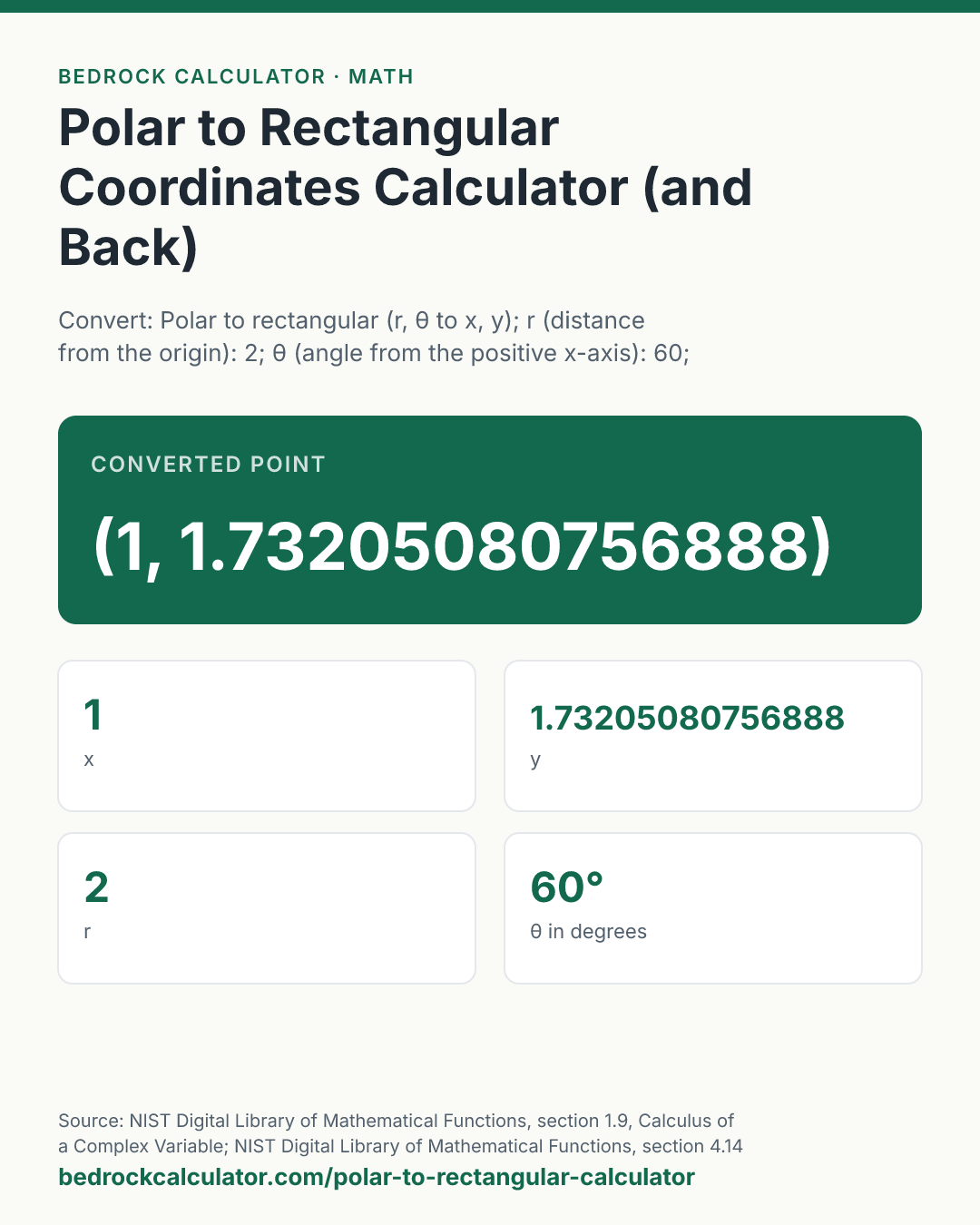

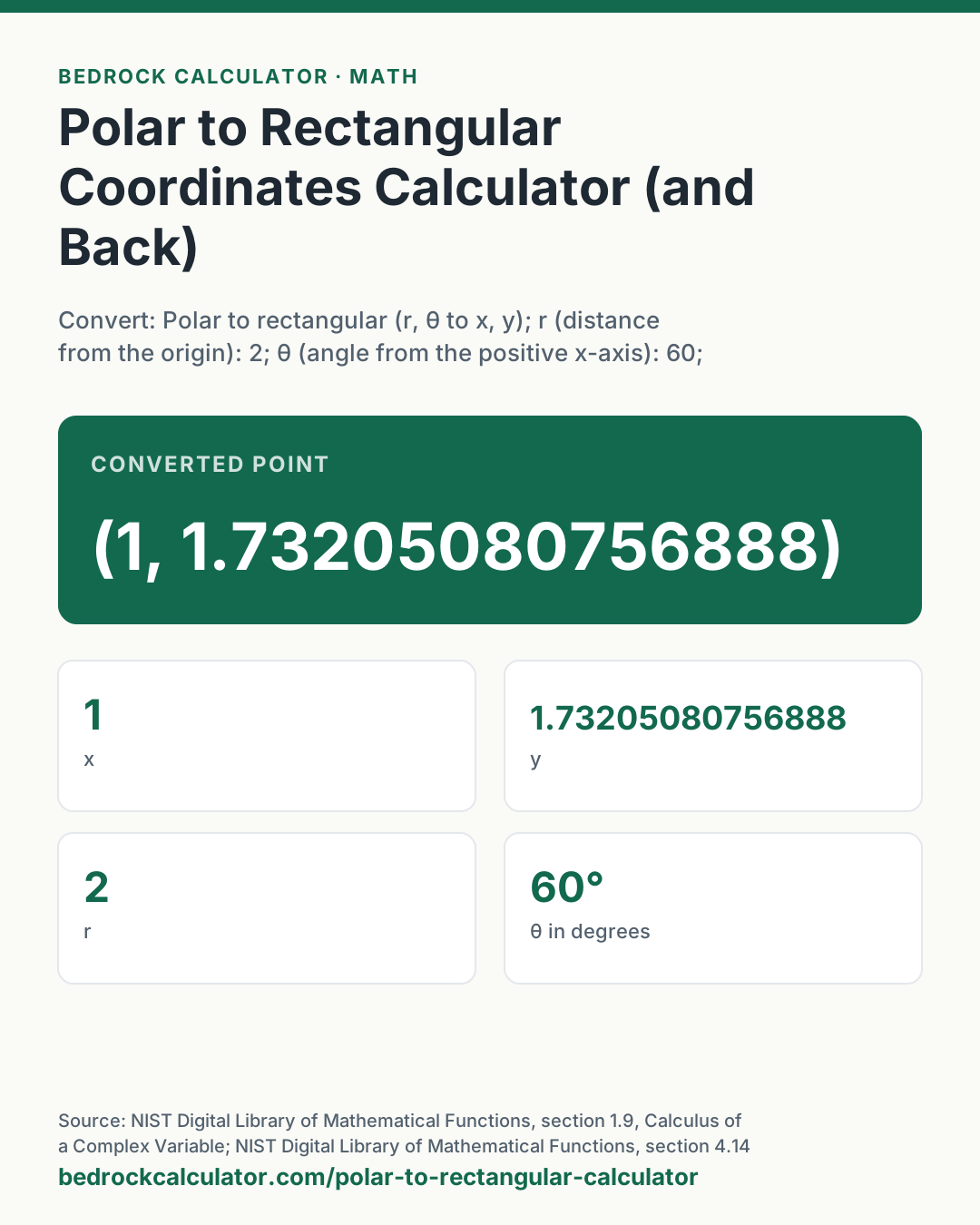
Quick Answer: The polar point r = 2, θ = 60° is (1, 1.7321) in rectangular coordinates: x = 2 cos 60° and y = 2 sin 60°. Going the other way, (-1, -1) is r = 1.4142 at θ = -135°, or 225°.
What does this calculator do?
This polar to rectangular coordinates calculator converts in both directions: polar to rectangular, and rectangular to polar. A point in polar form is described by its distance r from the origin and its angle θ from the positive x-axis, measured counterclockwise. In rectangular (Cartesian) form, the same point is described by its x and y coordinates.
The conversion also works for complex numbers, since a complex number x + yi can be plotted as the point (x, y). Its polar form r(cos θ + i sin θ) has r as the modulus and θ as the argument, so converting polar form to rectangular form gives x + yi, which the calculator shows on its own card.
The angle can be in degrees or radians. Angles that are whole multiples of 90 degrees are handled exactly, so (4, 90°) becomes exactly (0, 4), not a point with a tiny leftover x from rounding pi.
Using the Polar to Rectangular Coordinates Calculator
- Choose the direction: polar to rectangular or rectangular to polar.
- For polar to rectangular, enter r and θ and choose degrees or radians.
- For rectangular to polar, enter x and y. The angle unit sets how θ is shown in the headline.
- Read the point at the top. The cards show x, y, r, θ in degrees (from -180° to 180°), θ from 0° to 360°, θ in radians, and the complex form x + yi.
How is this calculated?
- Polar to rectangular. The angle is converted to radians if needed (unless it is a whole multiple of 90 degrees, which uses exact sines and cosines) and then, as in DLMF equation 1.9.3:
x = r cos θ; y = r sin θ
- Rectangular to polar: r. The distance from the origin is the square root of x² + y² (DLMF 1.9.4), computed to 34 significant digits.
r = √(x² + y²)
- Rectangular to polar: θ. The angle comes from the two-argument arctangent, atan2(y, x), which looks at the signs of both x and y and so puts the angle in the correct quadrant. A plain arctan(y/x) cannot tell (1, 1) from (-1, -1). Points on an axis get exact angles of 0°, 90°, 180° or -90°. The result runs from -180° to 180°, the principal value, and the 0° to 360° version adds 360° to negative angles.
θ = atan2(y, x)
- The origin. At (0, 0), r is 0 and the angle is not defined, since every direction points the same way from there. The calculator says so.
- Show the results. Values are rounded half up to 15 significant figures.
Worked Example
Using the defaults, r = 2, θ = 60°:
- cos 60° = 0.5, so x = 2 × 0.5 = 1.
- sin 60° = 0.866025403784439, so y = 2 × 0.866025403784439 = 1.73205080756888.
- The point is (1, 1.73205080756888), and as a complex number 1 + 1.73205080756888i.
- 60° in radians is 1.0471975511966.
Going the other way, the (-1, -1) to polar preset:
- r = √((-1)² + (-1)²) = √2 = 1.4142135623731.
- Both coordinates are negative, so the point is in the third quadrant. atan2(-1, -1) = -135°, which is 225° measured from 0° to 360°, or -2.35619449019234 radians.
How Do You Convert Rectangular to Polar?
Find r with the Pythagorean theorem and θ with the arctangent, adjusted for the quadrant. For the (3, 4) to polar preset, r = √(9 + 16) = 5 and θ = arctan(4/3) = 53.130102354156°, in the first quadrant because both coordinates are positive. If x is negative, add 180° to arctan(y/x); the calculator's atan2 does that automatically.
How Do You Convert Polar Form to Rectangular Form?
Multiply r by the cosine of the angle for x and by the sine for y. With the angle in radians, the (5, π/6 rad) to rectangular preset gives (4.33012701892219, 2.5). That is the same point as r = 5 at 30°, since π/6 radians is 30°.
Points on a Circle of Radius 1
The reference table converts r = 1 at common angles. Those are the points of the unit circle, and their coordinates are the cosine and sine of each angle: at 45° both are 0.707106781186548, and at 270° the point is (0, -1).
Where Are Polar Coordinates Used?
Anywhere a position is naturally described by a distance and a direction. Radar and sonar report a range and a bearing. A robot arm that swings about a joint is easiest to describe in polar form, while the table it reaches over is laid out in x and y, so its controller converts constantly.
In electrical engineering, an alternating voltage or an impedance is a complex number, and engineers switch between polar form (a magnitude and a phase angle) for multiplying and dividing, and rectangular form (a real and an imaginary part) for adding and subtracting. Spiral and circular shapes, such as a rose curve or the orbit of a planet, have far simpler equations in polar form than in x and y.
What does this calculator not account for?
- Several names for one point. In polar form, (2, 60°), (2, 420°) and (-2, 240°) are all the same point. The rectangular to polar direction always returns a positive r and the principal angle.
- Three dimensions. Cylindrical and spherical coordinates are not covered.
- Navigation bearings. Compass bearings are measured clockwise from north, not counterclockwise from the x-axis. Convert by taking 90° minus the bearing.
- Angle in degrees, minutes and seconds. Convert to decimal degrees first.
What mistakes do people make with this?
- Using arctan(y/x) without checking the quadrant. For (-1, -1), arctan(1) gives 45°, but the point is at 225°.
- Mixing angle units. cos 60 with the calculator in radians is the cosine of 60 radians. Check the unit select.
- Forgetting that x can be zero. arctan(y/x) divides by zero on the y-axis; atan2 does not.
- Rounding r before computing x and y. Keep r exact until the end.
- Treating -135° and 225° as different answers. They describe the same direction.
Frequently Asked Questions
What is the formula to convert polar to rectangular?
What is the formula to convert rectangular to polar?
What is (3, 4) in polar coordinates?
What is polar form of a complex number?
Can r be negative?
Sources
- NIST Digital Library of Mathematical Functions, section 1.9, Calculus of a Complex Variable: polar representation, x = r cos θ, y = r sin θ, r = (x² + y²)^(1/2), and the principal value of the phase. dlmf.nist.gov/1.9
- NIST Digital Library of Mathematical Functions, section 4.14: the sine and cosine. dlmf.nist.gov/4.14