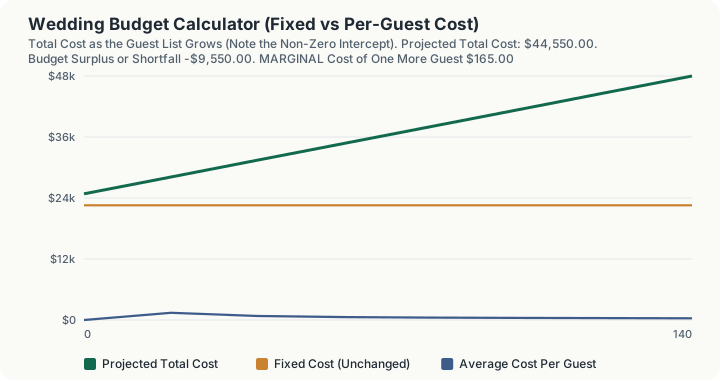
Quick Answer: On the placeholder prices supplied here, 120 guests produce a projected total cost of $44,550.00 against a $35,000 budget, a shortfall of $9,550. The average cost per guest is $371.25, but cutting a guest saves only $165.00, because 55.6% of the itemised budget does not move with the head count. This budget actually supports about 62 guests at these prices, 58 fewer than are invited.
What does this calculator do?
Before anything else: no price on this page comes from any authority. There is no statutory, regulatory or agency source for what a wedding costs. The widely quoted national averages come from vendor-marketplace surveys of self-selected users of those marketplaces, which is a sample biased toward people who hired vendors through a marketplace, and the figures vary by a factor of three across metro areas. Every default here is a placeholder to be overwritten with a real quote, and the page says so in its own output.
What the arithmetic can do honestly is the structure of the budget, which is the same everywhere regardless of price level. That structure has one property people consistently get wrong, and it costs them real decisions.
A wedding budget splits into costs that scale with the head count, being catering, bar, place settings, rentals and stationery, and costs that do not, being the venue fee, photography, attire, florals, music and rings. Divide the total by the head count and you get an average cost per guest. That number is used, constantly, to decide whether to cut the guest list, and it is always too high for that purpose, because cutting a guest saves only the variable per-head amount. The fixed half of the budget does not move.
Here the average is $371.25 and the marginal is $165.00. Cutting ten guests saves $1,650.00, not the $3,712.50 the average implies. That is a $2,062.50 error on a decision people make while looking at a spreadsheet that told them the wrong number.
The same arithmetic run backwards is the more useful question, and the page answers it too: given a budget, how many guests does it actually support.
How is this calculated?
Total = (F + v × g) × (1 + c)
Average per Guest = Total/g; Marginal per Guest = v × (1 + c)
g_max = (B/(1 + c) − F)/v
where $F$ is fixed cost, $v$ is the variable cost per head, $g$ is the guest count, $c$ is the contingency rate and $B$ is the budget.
Step 1: Total the per-head prices. $95 catering + $35 bar + $20 rentals, place settings and stationery = $150.00 per guest
Step 2: Extend that across the guest list. $150.00 x 120 = $18,000.00 of variable cost
Step 3: Total the fixed lines. $6,000 venue + $4,500 photography and video + $3,000 attire and beauty + $3,500 florals and decor + $2,500 music and entertainment + $3,000 rings, officiant and everything else = $22,500.00
Step 4: Add them for the itemised subtotal. $18,000.00 + $22,500.00 = $40,500.00
Step 5: Measure how much of that does not move with the head count. $22,500.00 / $40,500.00 = 55.56% fixed
Step 6: Add the contingency reserve. $40,500.00 x 10% = $4,050.00 $40,500.00 + $4,050.00 = $44,550.00 projected total
Step 7: Compare against the budget. $35,000.00 - $44,550.00 = a shortfall of $9,550.00, which is 127.29% of the budget used
Step 8: Compute the average cost per guest. $44,550.00 / 120 = $371.25
Step 9: Compute the marginal cost of one more guest. The reserve is a percentage of the subtotal, so an extra head carries its contingency too: $150.00 x 1.10 = $165.00
Step 10: Measure the overstatement. $371.25 - $165.00 = $206.25 per guest by which the average misleads
Step 11: Price a cut of ten guests both ways. Actually saved: $165.00 x 10 = $1,650.00 Implied by the average: $371.25 x 10 = $3,712.50
Step 12: Run it backwards to find the ceiling. $35,000.00 / 1.10 = $31,818.18 available before contingency $31,818.18 - $22,500.00 of fixed cost = $9,318.18 left for guests $9,318.18 / $150.00 = 62 guests 120 - 62 = 58 guests over the ceiling
Step 13: Build the funding plan. $44,550.00 - $8,000.00 already saved = $36,550.00 still to fund $36,550.00 / 14 months = $2,610.71 a month Against a stated capacity of $1,500 a month, that is a shortfall of $1,110.71 a month, so on these figures the plan does not fund itself.
Worked Example
The guest-list decision is where the arithmetic changes an outcome, so it is worth walking it as a couple would actually face it.
Step 1: Start from the shortfall. $9,550.00 over budget on a $35,000 budget.
Step 2: Reach for the obvious lever and check it. The spreadsheet says $371.25 a guest. Closing a $9,550 gap at that rate looks like cutting 26 people.
Step 3: Compute what cutting 26 people actually saves. 26 x $165.00 = $4,290.00 Less than half the gap. The cut that looked sufficient is not.
Step 4: Compute the cut that would actually close it. $9,550.00 / $165.00 = 57.9, so 58 guests, which is exactly the figure the ceiling calculation gives from the other direction.
Step 5: Price the alternative: cut fixed cost instead. Removing $4,000 of fixed cost removes $4,000 from the subtotal and $400 of contingency with it: $4,400.00 of the gap closed, from one decision, with no change to the guest list.
Step 6: Compare the two levers honestly. $4,400 from a single fixed-line renegotiation, against $4,290 from disinviting 26 people. On this budget structure, the fixed lines are where the money is, and they are also the lines people treat as fixed by name rather than by nature.
Step 7: Note the funding consequence either way. At $1,500 a month for 14 months you can fund $21,000, plus the $8,000 already saved, so $29,000 is the honest ceiling on what this couple can pay for without borrowing. That is a different and more useful number than the $35,000 budget they started with.
What does this calculator not account for?
- Sales tax and service charges, which vary by jurisdiction and by contract and are frequently 25% to 30% on catering. On $18,000 of catering and bar that is thousands of dollars, and it is not in any figure here unless you build it into the per-head prices.
- Vendor gratuities.
- Inflation between booking and the date, which on a 14-month horizon is real for food and labour.
- Deposit refundability and forfeiture terms, which decide what a cancellation or a date change actually costs.
- Contributions from family, except insofar as you include them in the total budget.
- Any interest cost if part of the wedding is financed.
- Guest-count-dependent fixed costs. Some venues price in bands: a room that holds 100 costs one amount and a room that holds 150 costs another. The model treats fixed costs as genuinely flat.
- Currency other than the one you enter, and destination-wedding travel for the couple or guests.
- Anything about what a wedding should cost, which is not an arithmetic question and on which this page has no view.
What mistakes do people make with this?
- Using the average cost per guest to decide the guest list. It is $371.25 here and the real figure is $165.00. This single error is the reason the page exists.
- Cutting guests when the fixed lines are the problem. 55.56% of the itemised budget does not move with the head count, and at 120 guests the fixed half is $22,500.
- Omitting the contingency. The default adds 10%, being $4,050, and weddings are among the most reliably over-budget projects a household undertakes.
- Forgetting service charges and sales tax. They are not modelled here and on catering they are frequently a quarter or more of the line. Build them into the per-head prices you enter.
- Budgeting against a total you cannot actually save. The funding check here says $2,610.71 a month is needed against $1,500 available. The budget is not $35,000; it is what you can fund.
- Treating a national average as a benchmark. No authority publishes one, and the marketplace surveys that produce the quoted figures sample the people most likely to spend through a marketplace.
- Assuming the per-guest price is the caterer's quote. It should include the bar, the place settings, the rentals and the stationery that scale with the head count, which is why three separate per-head fields exist.
Frequently Asked Questions
How much does a wedding cost?
How much does cutting the guest list actually save?
Why is my average cost per guest so much higher than the marginal cost?
How many guests can my budget support?
Should I cut guests or cut vendors?
How much should I set aside for contingency?
Sources
- U.S. Bureau of Labor Statistics, Consumer Expenditure Surveys. bls.gov/cex
Also consulted: No price, average or benchmark on this page comes from any authority, and this is stated in the calculator's own output. There is no statutory, regulatory or agency source for wedding costs; The national averages in general circulation come from vendor-marketplace surveys of self-selected users of those marketplaces. They are not a random sample of weddings, and they are not used here; Every dollar figure this page produces derives from prices you enter. The only reliable source for those prices is a written quote from the vendor you would actually book, in the market where the wedding will happen, on the date it will happen; Sales tax and service charge treatment on catering is set by your jurisdiction and your contract. Neither is applied here, and both should be built into the per-head prices you enter.