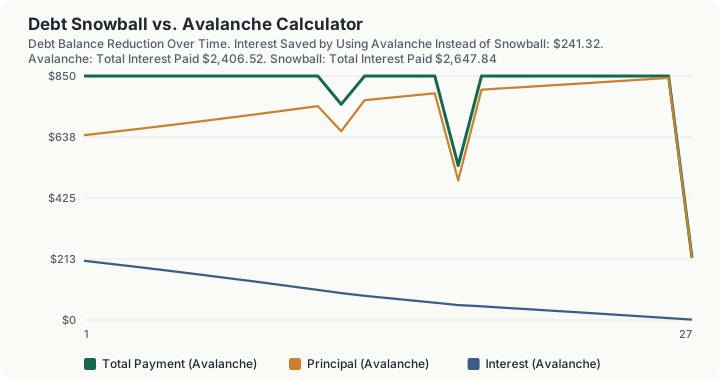
Quick Answer: On three debts totaling $19,500.00 (a $4,500 card at 24.99%, a $12,000 auto loan at 7.5%, a $3,000 personal loan at 15%) with $300.00 extra a month, avalanche pays $2,406.52 of total interest against snowball's $2,647.84, saving $241.32. Both clear all three debts in 27 months here, so the entire difference is interest, not time.
Overview
Both methods pay every debt's contractual minimum every month, no exceptions. The difference is entirely in where the extra, discretionary payment goes. Snowball sends it to whichever debt has the smallest current balance, regardless of interest rate. Avalanche sends it to whichever debt has the highest interest rate, regardless of balance. Once a debt is paid off under either method, its minimum payment doesn't disappear, it rolls into the extra-payment pool and joins the next round of prioritization, which is why payoff accelerates as debts fall away.
This calculator runs both simulations, month by month, on the same three debts with the same extra payment, and reports which one costs less in total interest and how many months each takes to reach zero balance across all debts.
Avalanche is mathematically guaranteed to cost the same or less total interest than snowball on any given debt portfolio, because it never leaves a higher-rate balance accruing interest while a lower-rate balance gets the extra payment instead. Snowball's case is behavioral, not mathematical: paying off a small debt completely, fast, produces a visible win that keeps people motivated through a payoff plan that might otherwise take years. Both are correct methods; they optimize for different things.
How This Is Calculated
Each month, for every active (non-zero-balance) debt:
- Interest accrues on the current balance at that debt's own periodic rate.
- The contractual minimum payment is applied to every active debt, reducing its balance by (minimum payment − interest).
- The extra payment, plus the minimum payments of any debts already paid off in a prior month, goes entirely to one "priority" debt:
- A debt is marked paid off the instant its balance reaches zero, and its minimum payment is freed to join the extra-payment pool for every subsequent month. The simulation runs until every debt reaches zero.
Worked Example
Using the calculator's default three debts:
| Debt | Balance | APR | Minimum |
|---|---|---|---|
| 1 (Credit Card) | $4,500.00 | 24.99% | $135.00 |
| 2 (Auto Loan) | $12,000.00 | 7.50% | $320.00 |
| 3 (Personal Loan) | $3,000.00 | 15.00% | $95.00 |
Extra monthly payment: $300.00
Month 1 (identical under both methods, since the starting balances are identical): 1. Interest: Debt 1 = $4,500.00 × (24.99% ÷ 12) = $93.71. Debt 2 = $12,000.00 × (7.5% ÷ 12) = $75.00. Debt 3 = $3,000.00 × (15% ÷ 12) = $37.50. Total interest: $206.21. 2. After minimums, balances are $4,458.71 / $11,755.00 / $2,942.50. 3. The $300 extra payment reduces whichever debt is prioritized by exactly $300, so total remaining debt after month 1 is $18,856.21 either way.
Where the methods diverge starting month 2: - Avalanche keeps directing the $300 extra at Debt 1 (24.99% APR, the highest rate) every month until it's paid off, then redirects both the extra and Debt 1's freed $135 minimum to whichever remaining debt has the next-highest rate (Debt 3 at 15%). - Snowball directs the $300 extra at Debt 3 ($3,000, the smallest balance) first, since it's smaller than Debt 1's $4,500, paying it off faster in isolation, then redirects to Debt 1.
Avalanche ends up paying less total interest over the full payoff because it spends fewer months carrying a balance on the 24.99% debt. Snowball typically finishes its first individual debt sooner, which is precisely the behavioral tradeoff it's designed around.
Where the Two Balances Separate and Rejoin
The divergence described above is small at first and closes again before the end, which is why the choice is easier to argue about than to measure.
Step 1 -- Month 1. Both methods pay $206.21 of interest and both close at $18,856.21.
Step 2 -- Month 2. Avalanche interest $196.86, avalanche balance $18,203.07; snowball balance $18,205.57. The gap after two months is $2.50.
Step 3 -- Cumulative avalanche interest after two months. $206.21 + $196.86 = $403.07
Step 4 -- Month 12, the widest point. Avalanche cumulative interest $1,818.66, avalanche balance $11,217.33 against a snowball balance of $11,371.49, a gap of $154.16.
Step 5 -- Month 17, where the balances converge. Both methods stand at $7,620.10, because snowball has by then cleared the 24.99% card too.
Step 6 -- Month 27, payoff under both. Avalanche total interest $2,406.52; snowball total interest $2,647.84.
The gap between the two paths never exceeds about $154 while they are running, and both finish in the same month, yet avalanche ends $241.32 ahead. The saving is not a shortcut; it is the accumulated effect of never letting the 24.99% balance sit while a 15% balance is cleared first. On these inputs the entire argument is worth 1.2% of the original $19,500 debt, which is real money and also a great deal less than the difference between following either plan and following neither.
Snowball vs. Avalanche: When Each Makes Sense
- Choose avalanche if you're confident you'll stick with a payoff plan on discipline alone and want to minimize total interest paid, full stop.
- Choose snowball if you've started and abandoned payoff plans before, or if the psychological win of eliminating an entire account fast is what will actually keep you going. The dollar cost of that motivation is usually modest relative to the behavioral benefit for people who need it.
- A hybrid approach works too: some people run avalanche but manually knock out any debt under a small dollar threshold (say, under $500) first for an early quick win, then switch to strict avalanche ordering afterward.
What This Does Not Account For
- Balance transfers and refinancing. Moving a high-rate credit card balance to a lower-rate consolidation loan or 0% promotional card changes the math entirely; this calculator assumes each debt's rate stays fixed for the life of the simulation.
- New charges added during payoff. The simulation assumes no new spending on any of these accounts; carrying a balance while continuing to charge the same card resets the payoff math.
- Variable interest rates. Many credit cards carry a variable APR tied to the prime rate; this tool assumes a fixed rate for the full payoff period.
- Payment due date timing and grace periods. The simulation compounds monthly on a simplified basis and does not model daily interest accrual or grace-period nuances specific to revolving credit.
- Tax-deductible interest. Some debts (certain student loans, for example) carry tax-deductible interest, which changes the effective after-tax cost and could shift the analysis, particularly relevant when deciding whether to prioritize a lower-rate but non-deductible debt over one with deductible interest.
Common Pitfalls
- Assuming snowball is always the "wrong" choice financially. The interest difference between the two methods is often smaller than people expect, particularly when balances and rates are close together; check your own numbers before assuming the gap is large.
- Forgetting that a paid-off debt's minimum payment must be redirected, not spent. The entire mechanism behind both strategies' acceleration depends on rolling freed-up minimum payments into the next debt; skipping that step turns either method into a much slower plan.
- Comparing only the headline interest-saved number without checking the months-to-debt-free figure. In some scenarios, snowball finishes only slightly slower than avalanche while paying meaningfully less in psychological cost; the total picture matters more than either number alone.
- Applying either method to debt with a 0% promotional rate as if it were high priority. A 0% APR balance transfer accrues no interest until the promotional period ends; under avalanche it should sit at the bottom of the priority list regardless of its size.
- Ignoring secured debt in the mix. Mixing an unsecured credit card with a secured auto loan in the same avalanche/snowball plan is mathematically fine, but missing a car payment carries repossession risk that a missed credit card minimum does not; never let either method's ordering logic override making every minimum payment on time.
Frequently Asked Questions
Does avalanche always save money compared to snowball?
If avalanche is always better, why does anyone use snowball?
What happens to a debt's minimum payment after it's paid off?
Can I use this for more than three debts?
Should I include a 0% promotional-rate balance transfer in this comparison?
Sources
- Consumer Financial Protection Bureau: guidance on choosing a debt payoff strategy. consumerfinance.gov
- Federal Trade Commission: guidance on managing debt and understanding APR on credit accounts. consumer.ftc.gov
- Gal, D. and McShane, B. B. (2012), "Can Small Victories Help Win the War? Evidence from Consumer Debt Management," Journal of Marketing Research 49(4). doi.org/10.1509/jmr.11.0272
- Amar, M., Ariely, D., Ayal, S., Cryder, C. E. and Rick, S. I. (2011), "Winning the Battle but Losing the War: The Psychology of Debt Management," Journal of Marketing Research 48. doi.org/10.1509/jmkr.48.spl.s38