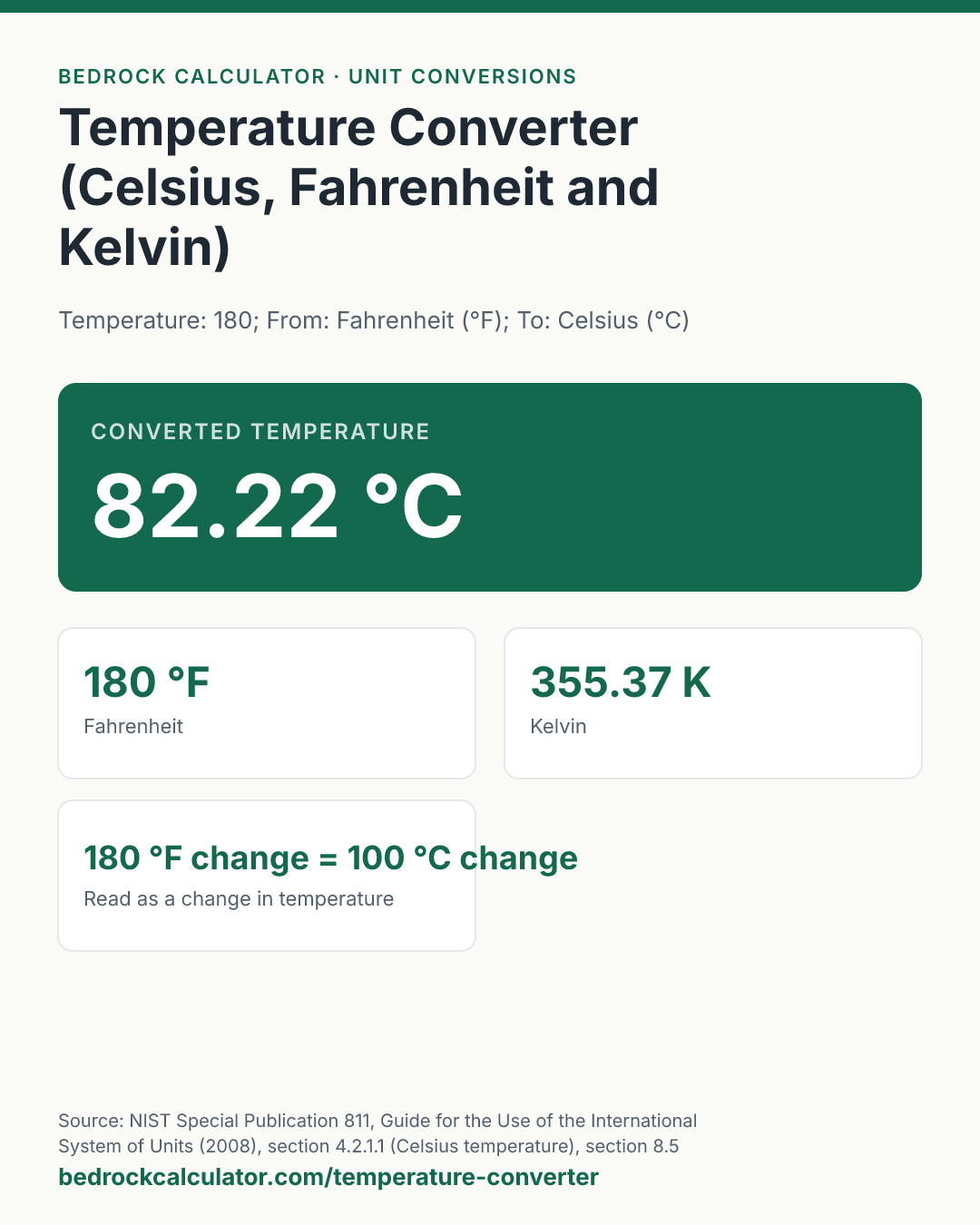
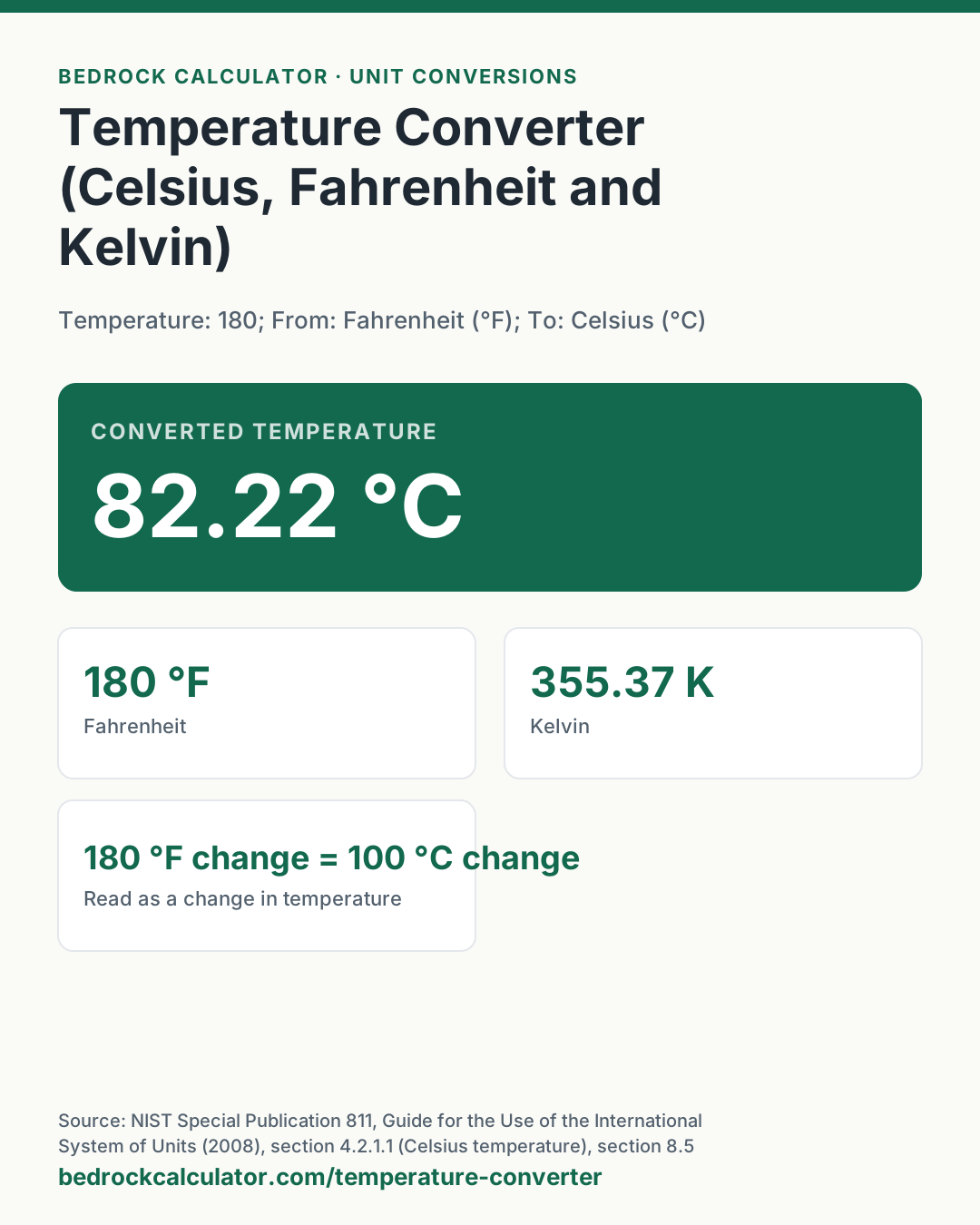
Quick Answer: 180 °F is 82.22 °C. Going the other way, a 180 °C oven is 356 °F, and 98.6 °F is 37 °C. The formulas are below.
What does this calculator do?
This temperature converter changes a reading between Celsius, Fahrenheit and kelvin in any direction. Pick the scale you have and the scale you want, type the number, and it shows the converted temperature with all three scales listed underneath.
Temperature is different from length or weight. Zero on the Celsius scale is not zero on the Fahrenheit scale, so you cannot convert by multiplying alone; you need an offset as well. The converter uses the defining relationships published by NIST: degrees Fahrenheit equal degrees Celsius times 9/5 plus 32, and kelvins equal degrees Celsius plus 273.15. Both are exact, so the only rounding is to two decimal places for display.
It also answers a question most converters get wrong: what a temperature change is in another scale. A rise of 10 °C is a rise of 18 °F, not 50 °F, because a change has no offset. The last card on the result reads your number as a change and converts it that way.
Using the Temperature Converter
- Type the temperature. Negative numbers are fine for Celsius and Fahrenheit.
- Choose the scale you have in From and the scale you want in To.
- Read the converted temperature at the top. The cards show the same reading in Celsius, Fahrenheit and kelvin, and the bottom card reads your number as a temperature change.
The preset buttons load a 180 °C oven, the 98.6 °F body temperature figure, -40 degrees, and 300 K. Below the converter are three tables: Celsius to Fahrenheit, Fahrenheit to Celsius, and kelvin to Celsius, each downloadable as a CSV file.
How is this calculated?
- Check the reading against absolute zero. Nothing can be colder than 0 K, which is -273.15 °C or -459.67 °F. A reading below that is raised to absolute zero, and the headline says the input was below it.
- Convert to Celsius. A Celsius reading is used as it is. A Fahrenheit reading has 32 subtracted and is multiplied by 5/9. A kelvin reading has 273.15 subtracted.
°C = (°F − 32) × 5/9; °C = K − 273.15
- Convert from Celsius to the scale you want. Fahrenheit is Celsius times 9/5 plus 32; kelvin is Celsius plus 273.15.
°F = °C × 9/5 + 32; K = °C + 273.15
- Read the number as a change. For the last card, the number you typed is treated as a difference between two temperatures. A degree Celsius and a kelvin are the same size, and a degree Fahrenheit is 5/9 of either, so the change is multiplied by that ratio with no offset added. This card uses your number as typed, before the absolute zero check, because a fall of 500 degrees is a valid change even though -500 °C is not a valid reading.
- Round for display only. Every scale is shown to two decimal places, rounded half up, with trailing zeros dropped. The arithmetic runs at 34 significant digits.
Worked Example
The default, 180 °F to Celsius:
- Subtract 32: 180 - 32 = 148.
- Multiply by 5/9: 148 × 5 ÷ 9 = 82.222..., shown as 82.22 °C.
- Kelvin: 82.222... + 273.15 = 355.37 K.
- Read as a change, 180 °F is a 100 °C change, because 180 × 5/9 = 100. That is why water warms by 180 °F between freezing and boiling.
A 180 °C oven in Fahrenheit: 180 × 9/5 = 324, plus 32 = 356 °F.
98.6 °F in Celsius: (98.6 - 32) × 5/9 = 37 °C, or 310.15 K.
300 K in Celsius: 300 - 273.15 = 26.85 °C, which is 80.33 °F.
Celsius to Fahrenheit: Common Values
| Celsius | Fahrenheit | Where you meet it |
|---|---|---|
| -40 | -40 | The two scales meet |
| -18 | -0.4 | Home freezer |
| 0 | 32 | Water freezes |
| 4 | 39.2 | Fridge |
| 20 | 68 | Room temperature |
| 37 | 98.6 | Body temperature figure |
| 100 | 212 | Water boils at sea level |
| 180 | 356 | Moderate oven |
| 200 | 392 | Hot oven |
| 230 | 446 | Very hot oven |
Fahrenheit to Celsius: Oven and Weather Values
| Fahrenheit | Celsius |
|---|---|
| 0 | -17.78 |
| 32 | 0 |
| 50 | 10 |
| 70 | 21.11 |
| 100 | 37.78 |
| 212 | 100 |
| 325 | 162.78 |
| 350 | 176.67 |
| 375 | 190.56 |
| 400 | 204.44 |
| 425 | 218.33 |
| 450 | 232.22 |
How Do You Convert Kelvin to Celsius?
Subtract 273.15. That is the whole kelvin to Celsius conversion, and it is exact, because the Celsius scale is defined as the kelvin scale shifted by 273.15. So 0 K is -273.15 °C, 273.15 K is 0 °C, and 373.15 K is 100 °C. Going from Celsius to kelvin, add 273.15.
The kelvin is written without a degree sign: 300 K, not 300 °K, and you say "300 kelvins" rather than "300 degrees kelvin".
What Is the Fahrenheit to Celsius Formula?
Subtract 32, then multiply by 5 and divide by 9. The order matters. Subtracting 32 removes the offset between the two zero points; multiplying by 5/9 accounts for a Fahrenheit degree being smaller than a Celsius degree. For a rough figure in your head, subtract 30 and halve.
It is close for weather temperatures and drifts further off for oven temperatures, so use the converter for cooking.
What does this calculator not account for?
- Gas marks and other oven scales. UK gas marks and fan oven adjustments are cooking conventions, not temperature scales, and the converter does not use them.
- Rankine and Réaumur. Only Celsius, Fahrenheit and kelvin are offered.
- The boiling point of water at altitude. Water boils at 100 °C only near sea level. At higher altitude it boils lower. The tables label 100 °C as the sea-level boiling point for that reason.
- Readings below absolute zero. These are not temperatures; the converter shows absolute zero instead and says so.
- More than two decimal places. Results are rounded to hundredths. A Fahrenheit figure converted to Celsius and back can differ in the last place because of that display rounding.
What mistakes do people make with this?
- Adding 32 at the wrong step. In Celsius to Fahrenheit, multiply first, then add 32. In Fahrenheit to Celsius, subtract 32 first, then multiply.
- Converting a change as if it were a reading. If the forecast says it will be 10 °C warmer tomorrow, that is 18 °F warmer, not 50 °F. Use the change card.
- Writing °K. The kelvin is an absolute unit and takes no degree sign.
- Assuming 98.6 °F is everyone's normal temperature. It is a converted round number, 37 °C, not a measured standard for every person.
Frequently Asked Questions
What is 180 °F in Celsius?
What is 180 °C in Fahrenheit?
At what temperature are Celsius and Fahrenheit the same?
How do I convert K to C?
Is 0 K the coldest possible temperature?
Is room temperature 20 or 25 °C?
Why is 37 °C body temperature exactly 98.6 °F?
Sources
- NIST Special Publication 811, Guide for the Use of the International System of Units (2008), section 4.2.1.1 (Celsius temperature), section 8.5 (temperature intervals) and Appendix B.8 and B.9 (degree Fahrenheit to degree Celsius). nist.gov/pml/special-publication-811
- BIPM, The International System of Units (SI Brochure, 9th edition, 2019): definition of the kelvin and the degree Celsius. bipm.org/en/publications/si-brochure