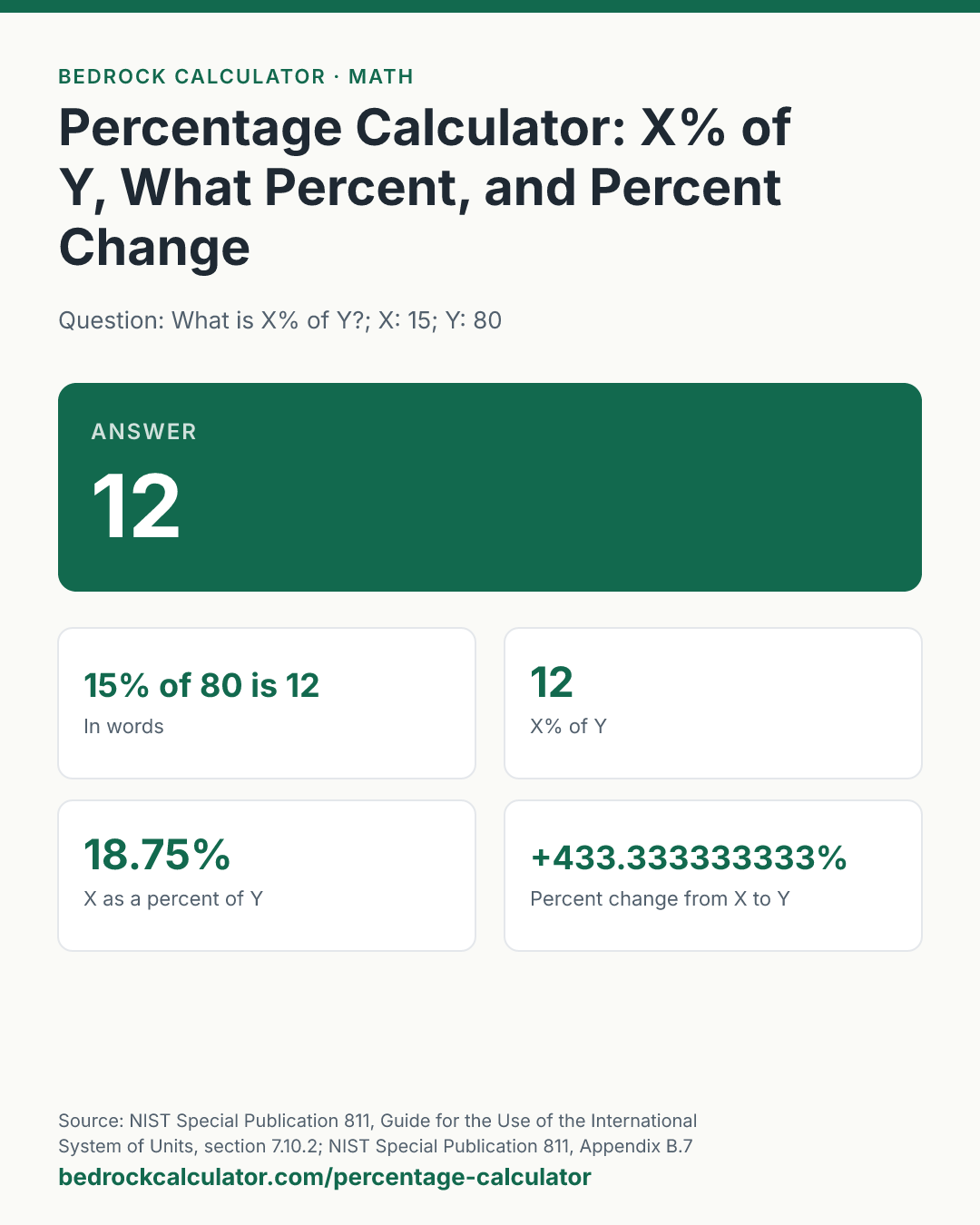
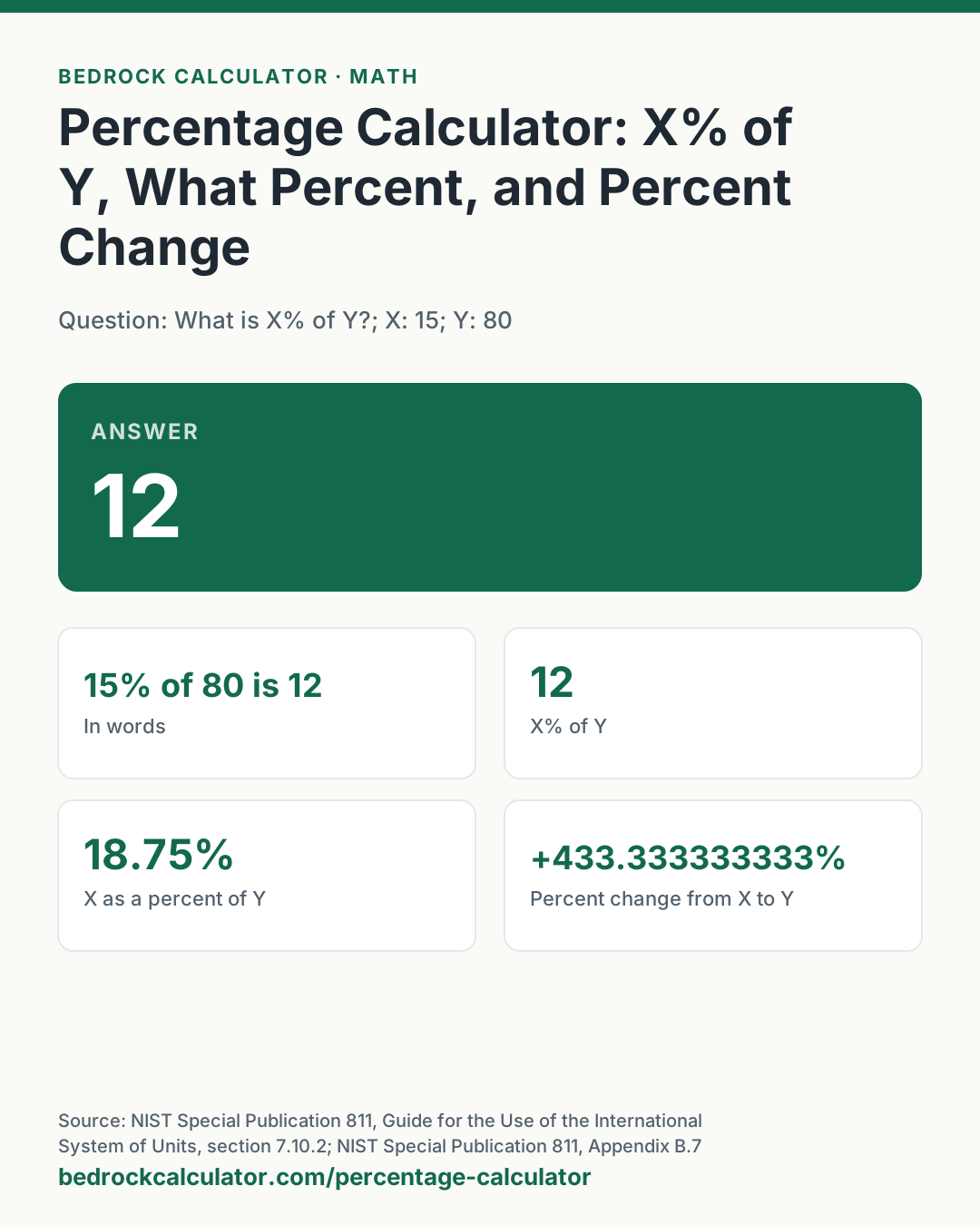
Quick Answer: 15% of 80 is 12: multiply 80 by 15 and divide by a hundred. The same two numbers give the other answers too: 15 is 18.75% of 80, 80 increased by 15% is 92, and 80 decreased by 15% is 68.
What does this calculator do?
This percentage calculator answers the questions people actually ask about percentages, using one pair of numbers, X and Y:
- What is X% of Y?
- X is what percent of Y?
- What is the percent change from X to Y?
- What is Y increased by X%?
- What is Y decreased by X%?
Pick the question you want as the headline, type the two numbers, and read the answer. The cards underneath answer all five questions for the same pair, which helps when a problem is worded in a way that makes it hard to tell which question it is. A sentence card spells the answer out in words, with the amount added or taken off.
A percent is a fraction with 100 as its denominator. The symbol % simply stands for the number 0.01, which is how the NIST Guide to the SI defines it, so 15% is 0.15 and "15% of 80" is 0.15 × 80. Everything on this page follows from that one fact.
Using the Percentage Calculator
- Choose the question from the list. The labels say which number plays which part.
- Enter X and Y. Decimals and negative numbers are both accepted.
- Read the headline. The In words card restates it as a sentence, which is a quick check that you entered the numbers the right way round.
- Glance at the other cards if your question is worded differently from the menu. "What percentage of 80 is 15?" and "15 is what percent of 80?" are the same question, and both answers appear whichever mode is selected.
The presets load six common problems: a part of a whole (30 out of 120), the "10 out of 30" question, a rise from 50 to 65, a fall from 80 to 60, a percent of a percent, and a 15% cut from 80.
How is this calculated?
- Read the two numbers exactly. X and Y are held as exact decimals, so 0.1 stays 0.1 rather than becoming the nearest binary fraction. No result is rounded until it is shown.
- X% of Y. The percentage is divided by 100 and multiplied by Y.
X% of Y = (X × Y)/100
- X as a percent of Y. X is divided by Y and multiplied by 100. When Y is 0 the division has no answer, and the card says so instead of showing a number.
percent = X/Y × 100
- Percent change from X to Y. The difference is divided by the size of the starting value. Using the absolute value of X means a move from -50 to -25 counts as a rise, which it is. A change from 0 has no percentage, and the card says so.
change = (Y − X)/|X| × 100
- Increase or decrease Y by X%. Y is multiplied by one plus or one minus the percentage as a fraction. The sentence card also shows the amount added or taken off, which is X% of Y.
Y_new = Y × (1 ± X/100)
- Show the result. Each answer is rounded half up to 12 significant figures, and trailing zeros are dropped. A result that terminates sooner, like 18.75, is shown in full; a repeating one, like a third written as a percent, is cut at 12 figures.
Worked Example
The default inputs are X = 15 and Y = 80.
- 15% of 80: 15 × 80 = 1,200, and 1,200 ÷ 100 = 12.
- 15 as a percent of 80: 15 ÷ 80 = 0.1875, and 0.1875 × 100 = 18.75%.
- 80 increased by 15%: 80 × 1.15 = 92, which is 80 plus the 12 from step 1.
- 80 decreased by 15%: 80 × 0.85 = 68, which is 80 minus 12.
A percent change, using the 50 to 65 preset: the difference is 65 minus 50, or 15. Divided by 50 that is 0.3, so the change is +30%. Going the other way, the 80 to 60 preset is a difference of -20 on a base of 80, a change of -25%.
What Percentage Is 10 Out of 30?
10 out of 30 is 33.3333333333%, which is one third. Divide the part by the whole, 10 ÷ 30, and multiply by 100. Because a third never terminates as a decimal, the calculator shows it to 12 significant figures; most people write it as 33.3% or 33⅓%.
The same steps answer "what percentage of X is Y" for any pair. 30 out of 120 is 25%, and the table below lists other common fractions of a whole.
How Do You Calculate Percent Change?
Subtract the old value from the new one, divide by the old value, and multiply by 100. A positive answer is a percentage increase and a negative one is a percentage decrease, so this mode also works as a percentage decrease calculator: 80 to 60 is -25%.
One trap catches almost everyone at some point. A rise and a fall of the same percentage do not cancel. 80 decreased by 15% is 68, but 68 increased by 15% is not 80, because the second 15% is taken of a smaller number. To undo a 15% cut you need a larger rise, which the percent change mode will give you: enter 68 as X and 80 as Y.
How to Find a Percent of a Percent
Treat the second percentage as an ordinary number. 20% of 50% is worked as 20% of 50, which the 20% of 50% preset gives as 10, so the answer is 10%. In words: a fifth of a half is a tenth.
This comes up with discounts stacked on discounts and with survey results, such as "20% of the 50% who replied". Multiplying the percentages as fractions gives the same thing: 0.2 × 0.5 = 0.1.
Common Percentages of 80
The first table lists familiar percentages of the default Y, 80. The second lists common parts of a whole as percentages. Both are computed by this calculator and can be downloaded as CSV files. To get the same figures for another number, change Y.
What does this calculator not account for?
- Percentage points. A rate that moves from 4% to 5% has risen by one percentage point, while its percent change (enter 4 as X and 5 as Y) is much larger. Both are correct; they answer different questions. This calculator gives the percent change. For the point difference, subtract the two percentages.
- Compounding. Increasing by 10% three times is not a 30% increase. Apply each step to the new value, one at a time, or use a growth calculator.
- Averages of percentages. The percent of a combined group is not the plain average of the group percentages unless the groups are the same size. Use a weighted average, with each group's size as its weight; the average calculator does this.
- Percent difference with no reference value. When neither number is the starting point, the symmetric percent difference (the gap divided by the mean of the two) is the usual measure. That is a different formula from percent change, and the difference calculator gives it.
- Very long repeating results. Results are shown to 12 significant figures. The arithmetic behind them is exact until that final rounding.
What mistakes do people make with this?
- Dividing by the wrong number. In a percent change the base is the starting value. 50 to 65 is +30%, but 65 back to 50 is a smaller fall than 30%, because the base is now 65.
- Mixing up "of" and "is". "15 is what percent of 80" divides 15 by 80. "What is 15% of 80" multiplies. The In words card shows which one you have.
- Forgetting the percent sign is a hundredth. 0.5% is half of one percent, or 0.005, not a half.
- Reversing a percentage change by applying the same percentage. As shown above, a 15% fall followed by a 15% rise leaves you below where you started.
- Rounding too early. If a percentage feeds another calculation, keep the full figure and round only the final answer.
Frequently Asked Questions
What is X percent of Y?
How do I work out what percent one number is of another?
How do I turn a decimal into a percent?
How do I calculate a win percentage?
How far am I toward a goal as a percentage?
How do I average several percentages?
Can a percentage be more than 100?
Why does the percent change card say "Not defined"?
Sources
- NIST Special Publication 811, Guide for the Use of the International System of Units, section 7.10.2: the symbol % stands for the number 0.01. nist.gov/pml/special-publication-811/nist-guide-si-chapter-7-rules-and-style-conventions-expressing-values
- NIST Special Publication 811, Appendix B.7: rules for rounding numbers, used for the 12-figure display. nist.gov/pml/special-publication-811/nist-guide-si-appendix-b-conversion-factors