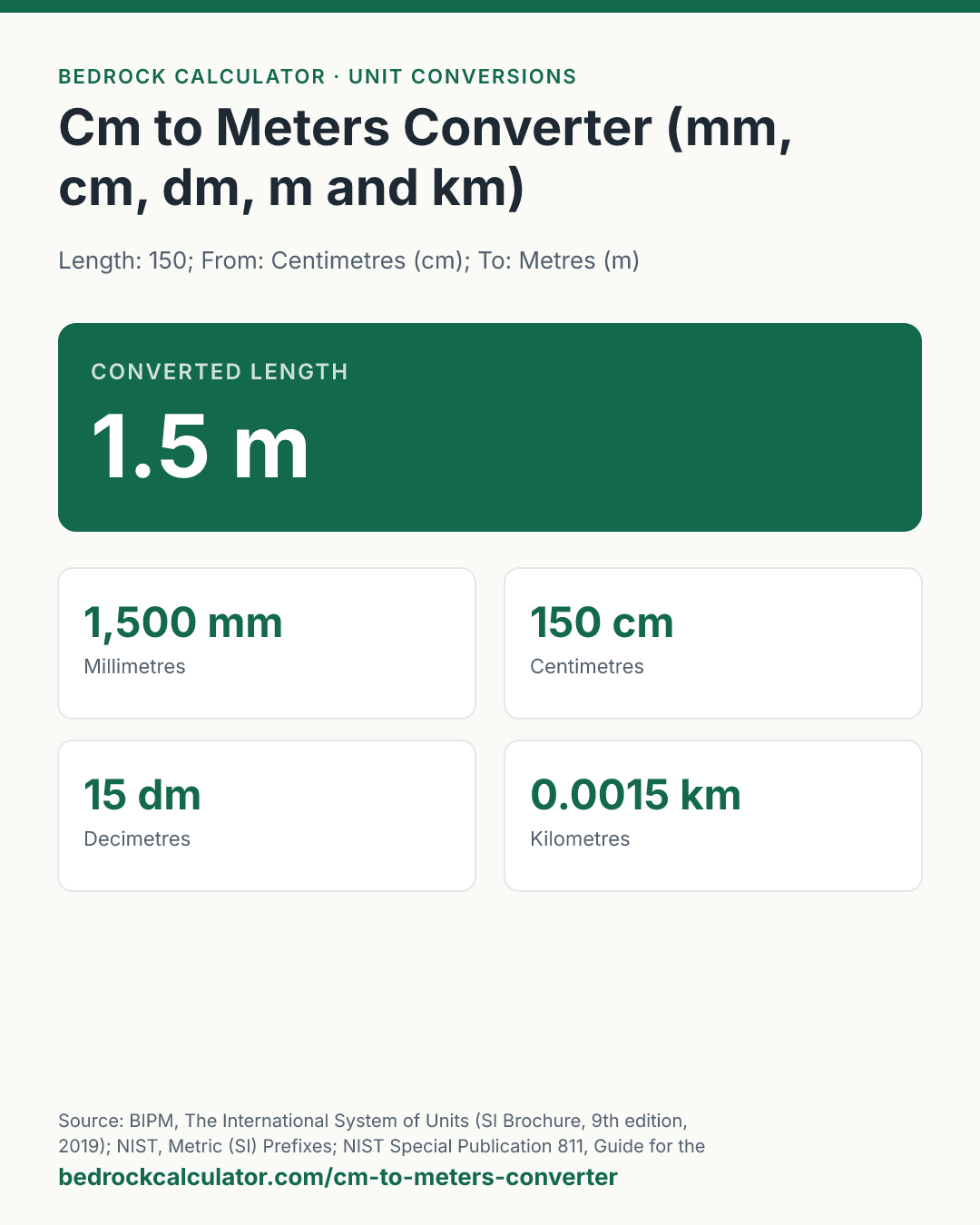
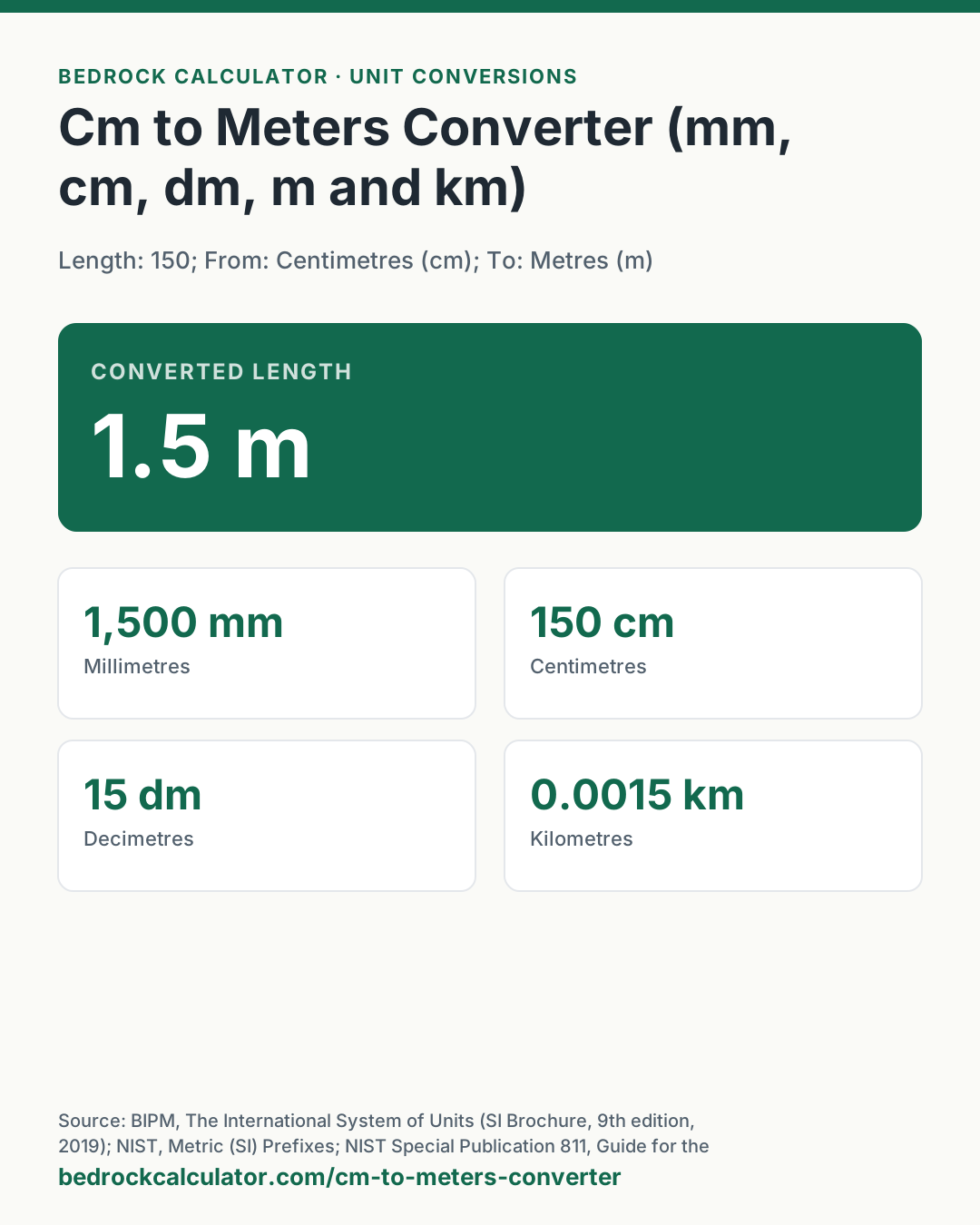
Quick Answer: 150 cm is 1.5 m. A metre is 100 centimetres, so divide centimetres by 100 to get metres; 2.75 m is 275 cm, 4.2 cm is 42 mm, and a metre has 10 decimetres.
What does this calculator do?
This cm to meters converter moves a length between the five everyday metric units: millimetres, centimetres, decimetres, metres and kilometres. Choose the unit you have and the unit you want, type the number, and it shows the converted length with all five units listed underneath.
Metric length is easy in principle, because every unit is the metre multiplied or divided by a power of ten. The prefixes are fixed by the International System of Units: milli means one thousandth, centi one hundredth, deci one tenth and kilo one thousand. In practice the mistakes come from moving the decimal point the wrong number of places, or in the wrong direction. Seeing the same length in all five units at once makes that kind of slip obvious.
Every conversion here is exact. Nothing is rounded unless your length has more than nine decimal places in the unit being shown.
Using the Cm to Meters Converter
- Type the length. Decimals are fine, such as 4.2 or 0.75.
- Choose the unit you have in From and the unit you want in To.
- Read the converted length at the top. The cards below show the same length in millimetres, centimetres, decimetres, metres and kilometres.
The preset buttons load 4.2 cm to millimetres, 1.5 cm to millimetres, one metre in decimetres, and 2.75 m to centimetres. The two tables below the converter list common lengths from centimetres to metres and from metres to centimetres, each downloadable as a CSV file.
How is this calculated?
- Choose the units. The From unit tells the converter what your number means; the To unit picks the headline. A negative length is read as zero.
- Convert through the metre. Each unit is stored once as its size in metres: 0.001 for the millimetre, 0.01 for the centimetre, 0.1 for the decimetre, 1 for the metre and 1,000 for the kilometre. The converter multiplies your number by the size of the unit you started in and divides by the size of the unit you want.
metres = (centimetres × 0.01)/1 = centimetres/100
millimetres = (centimetres × 0.01)/0.001 = centimetres × 10
- Show all five units. The same length is converted to each of the five units in the same way.
- Round for display only. Results are shown to up to nine decimal places, with trailing zeros dropped. Because the factors are powers of ten, any length typed with up to three decimal places is shown exactly in every unit, including kilometres.
Worked Example
The default, 150 cm to metres:
- Metres: 150 × 0.01 = 1.5 m.
- Millimetres: 1,500 mm. Decimetres: 15 dm. Kilometres: 0.0015 km.
4.2 cm to millimetres: 4.2 × 10 = 42 mm, which is also 0.042 m.
1.5 cm to millimetres: 15 mm.
2.75 m to centimetres: 2.75 × 100 = 275 cm, or 27.5 dm and 2,750 mm.
Metric Length Steps
| From | To | Multiply by | Example |
|---|---|---|---|
| Centimetres | Millimetres | 10 | 4.2 cm = 42 mm |
| Millimetres | Centimetres | 0.1 | 15 mm = 1.5 cm |
| Centimetres | Metres | 0.01 | 150 cm = 1.5 m |
| Metres | Centimetres | 100 | 2.75 m = 275 cm |
| Metres | Decimetres | 10 | 1 m = 10 dm |
| Metres | Kilometres | 0.001 | 1,000 m = 1 km |
Each step of the ladder mm, cm, dm, m is a factor of ten. The jump from metres to kilometres is a factor of a thousand, because there are no common units in between.
Common Centimetre to Metre Values
| Centimetres | Metres | Millimetres |
|---|---|---|
| 1 | 0.01 | 10 |
| 10 | 0.1 | 100 |
| 25 | 0.25 | 250 |
| 50 | 0.5 | 500 |
| 75 | 0.75 | 750 |
| 100 | 1 | 1,000 |
| 150 | 1.5 | 1,500 |
| 175 | 1.75 | 1,750 |
| 200 | 2 | 2,000 |
| 1,000 | 10 | 10,000 |
How Many Decimetres Are in a Metre?
There are 10 decimetres in a metre, so a decimetre is a tenth of a metre, or 10 centimetres. The decimetre is uncommon in everyday English but appears in school maths, in some European measurements, and in volume: a cubic decimetre is exactly one litre. To answer the reverse question, a decimetre is 0.1 metres.
How Do You Convert Centimetres to Metres?
Divide by 100, which is the same as moving the decimal point two places to the left. 150 cm becomes 1.50 m, and 25 cm becomes 0.25 m. To go from metres to centimetres, multiply by 100 and move the decimal point two places to the right.
For millimetres, the shift is three places from metres and one place from centimetres.
What does this calculator not account for?
- Customary units. Inches, feet, yards and miles are on other converters. The inches to cm converter and the meters to miles converter cover those.
- Micrometres and smaller. For nanometres, micrometres and angstroms, use the angstrom to nanometers converter.
- Areas and volumes. A square metre is 10,000 square centimetres, not 100, because both sides are converted. This page converts lengths only.
- More than nine decimal places. A length such as 0.0000000001 km is shown rounded to nine places in kilometres. The other units show it in full.
What mistakes do people make with this?
- Moving the decimal point the wrong way. Bigger units give smaller numbers. 150 cm is 1.5 m, not 15,000 m.
- Mixing up mm and cm. A 15 mm screw is 1.5 cm long. Tool and hardware sizes are usually in millimetres; tape measures often show both.
- Converting area with the length factor. 1 m² is 10,000 cm². Converting each side of a shape first and then multiplying avoids this.
- Reading a comma as a decimal point. Much of Europe writes 1,5 m for one and a half metres. This page uses a point for decimals and a comma to group thousands.
Frequently Asked Questions
How many centimetres are in a metre?
How many millimetres is 4.2 cm?
How many millimetres is 1.5 cm?
How many metres are in a decimetre?
What is 150 cm in metres?
Why is the metre split into tens?
Is it meter or metre?
Sources
- BIPM, The International System of Units (SI Brochure, 9th edition, 2019): the metre and the SI prefixes. bipm.org/en/publications/si-brochure
- NIST, Metric (SI) Prefixes: the prefix names, symbols and factors. nist.gov/pml/owm/metric-si-prefixes
- NIST Special Publication 811, Guide for the Use of the International System of Units (2008). nist.gov/pml/special-publication-811