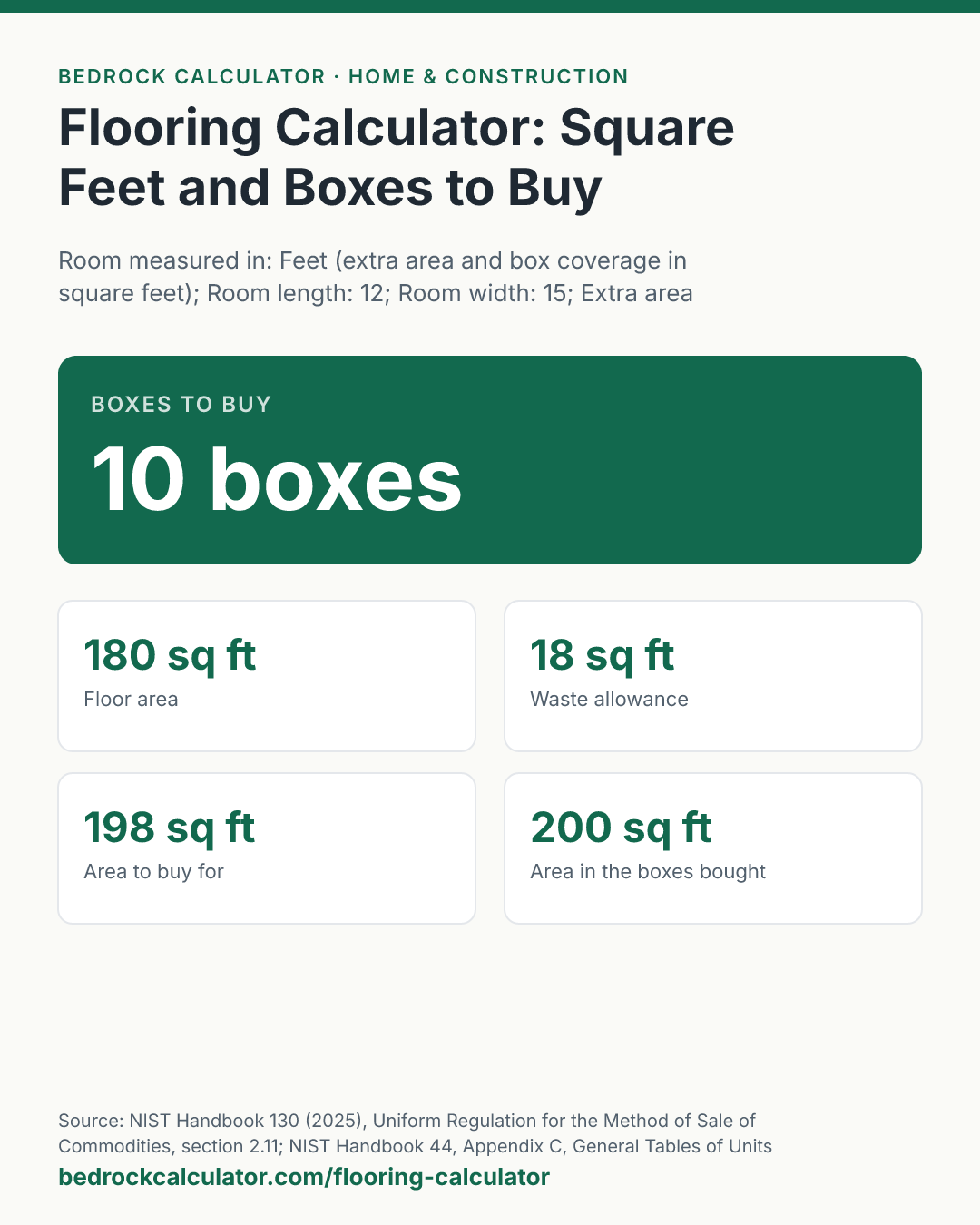
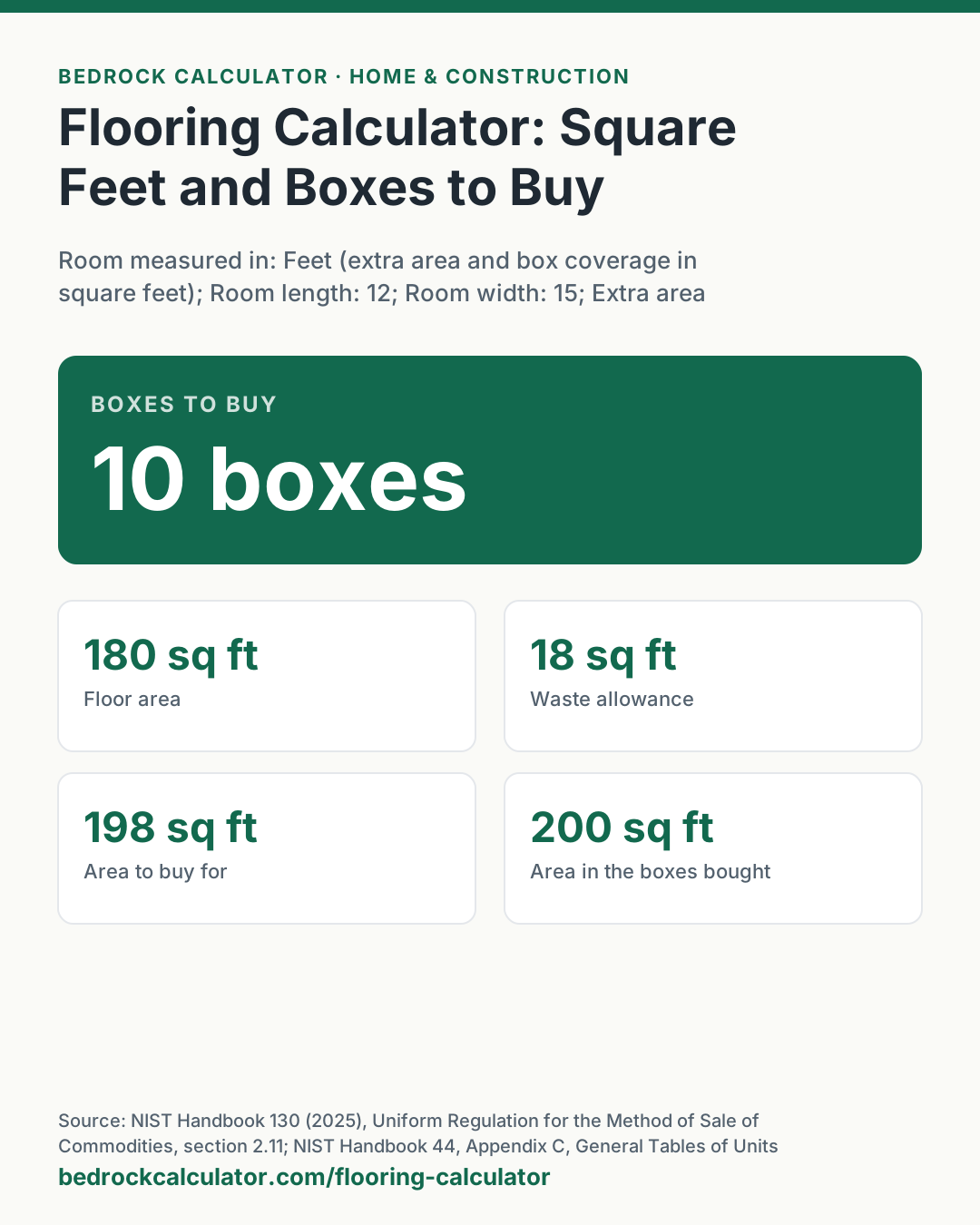
Quick Answer: A 12 by 15 foot room is 180 square feet. With a 10% waste allowance you need flooring for 198 square feet, which is 10 boxes at 20 square feet per box.
What does this calculator do?
This flooring calculator turns the size of a room into the number of boxes of laminate, vinyl plank, engineered wood or tile to buy. It works out the floor area, adds a waste allowance on its own line, and divides by the coverage printed on one carton, rounding up to whole boxes because stores sell flooring by the box.
It also shows the area you are actually buying, which is always a little more than you need because of that rounding, and a cost if you enter a price per square foot. For carpet and sheet vinyl, which are often priced by the square yard, it gives the area in square yards too.
Measure in feet or in metres. The coverage per box is in the same unit as the room: square feet in feet mode, square metres in metre mode, so a carton labelled 2.2 m² is entered as 2.2.
Using the Flooring Calculator
- Choose feet or metres and enter the room's length and width.
- Add any extra area, such as a closet or a hallway, worked out as an area in the same unit.
- Set the waste allowance. Ten percent is the starting value for straight layouts.
- Enter the coverage per box from the carton.
- Optionally enter the price per square foot.
- Read the number of boxes at the top and the areas below.
The presets show the same room with a closet added, the same room with a 15% allowance for a herringbone or diagonal layout, and a room measured in metres with boxes labelled in square metres.
How is this calculated?
- Find the floor area. Length times width, plus any extra area. Metric measurements, the box coverage included, are converted to square feet through the exact foot of 0.3048 metres.
- Add the waste allowance as its own line. The floor area times your percentage is the allowance; floor area plus allowance is the area to buy for.
A_buy = A_floor × (1 + waste)
- Divide by the coverage per box and round up. Partial boxes are not sold, so the count is rounded up. An exact fit is not rounded up.
boxes = ⌈A_buy/(coverage per box)⌉
- Find the area actually bought. Whole boxes times the coverage per box.
- Price it if asked. The area bought times your price per square foot.
- Convert. Square yards divide the area to buy for by 9; square metres use the exact factor of 0.09290304.
Worked Example
The default is a 12 by 15 foot room, 10% waste and 20 square foot boxes:
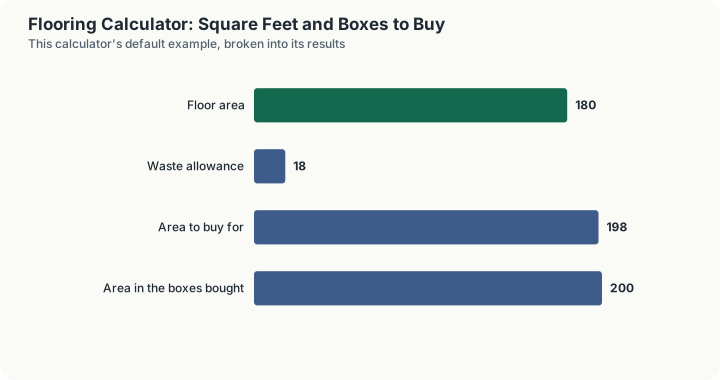
- Floor area: 12 × 15 = 180 sq ft.
- Waste: 18 sq ft. Area to buy for: 198 sq ft (22 square yards).
- Boxes: 198 ÷ 20, rounded up, is 10 boxes.
- Area in those boxes: 200 sq ft.
Add a 2 by 5 foot closet (10 square feet) and the area to buy for becomes 209 square feet, which takes 11 boxes. Keep the room as it is but plan a herringbone layout with a 15% allowance, and you need 207 square feet, also 11 boxes.
A room 4 by 3.5 metres is 14 square metres, or 150.69 square feet. With the 10% allowance that is 15.4 square metres, and boxes labelled 2.2 square metres fit it exactly: 7 boxes. Typing the box as a rounded 23.68 square feet instead tips it over to 8, which is why metric cartons are best entered in metric mode.
How Much Flooring Do I Need?
Measure the room wall to wall, multiply length by width, and add a waste allowance that suits the layout and how many cuts it needs. A plain rectangular room laid in straight rows wastes least; diagonal and herringbone patterns, rooms with many corners, and planks with long patterns waste more.
The calculator keeps the allowance visible so you can decide how much of it you need. The table below lists boxes for common room sizes at 10% waste and 20 square foot boxes.
How Many Boxes of Flooring Do I Need?
Divide the area including waste by the coverage on the carton and round up. Coverage varies a great deal between products, so always use the number printed on the box you plan to buy rather than a typical figure. Check that every box comes from the same production lot; colours can vary between lots.
What does this calculator not account for?
- Rooms that are not rectangles. Get the area of an L-shaped room or one with a bay from the square footage calculator and enter it as extra area with the length or width set to zero.
- Transitions, stairs and trim. Thresholds, stair nosings, quarter round and baseboard are sold by the piece or by length, not by area.
- Underlayment and adhesives. These are usually sold by the roll or bucket with their own coverage.
- Pattern matching and plank length. Long planks and patterned tile can waste more than a flat percentage suggests in small rooms.
- Spare stock. Many people keep a box for future repairs. Add it yourself.
What mistakes do people make with this?
- Measuring to the baseboard. Measure wall to wall at floor level; the flooring runs under the baseboard edge.
- Skipping the waste allowance. Every row ends with a cut, and the offcut is often too short to start the next row.
- Mixing units. A box labelled 2.2 m² holds 23.68 square feet, not 2.2. Enter it as 2.2 with the room in metres, or convert it to square feet with the room in feet.
- Forgetting closets and doorways. Floor under a door and inside a closet is still floor.
- Mixing lots. Buy all the boxes at once, from one lot.
Frequently Asked Questions
How do I calculate square footage for flooring?
How much extra flooring should I buy?
How many square feet are in a box of flooring?
Can I use the calculator for carpet?
What does the cost include?
Sources
- NIST Handbook 130 (2025), Uniform Regulation for the Method of Sale of Commodities, section 2.11: carpet sold with the price per square foot or square metre and the total. doi.org/10.6028/NIST.HB.130-2025
- NIST Handbook 44, Appendix C, General Tables of Units of Measurement: the square foot, square yard and the conversion to square metres. nist.gov/pml/owm/nist-handbook-44-current-edition