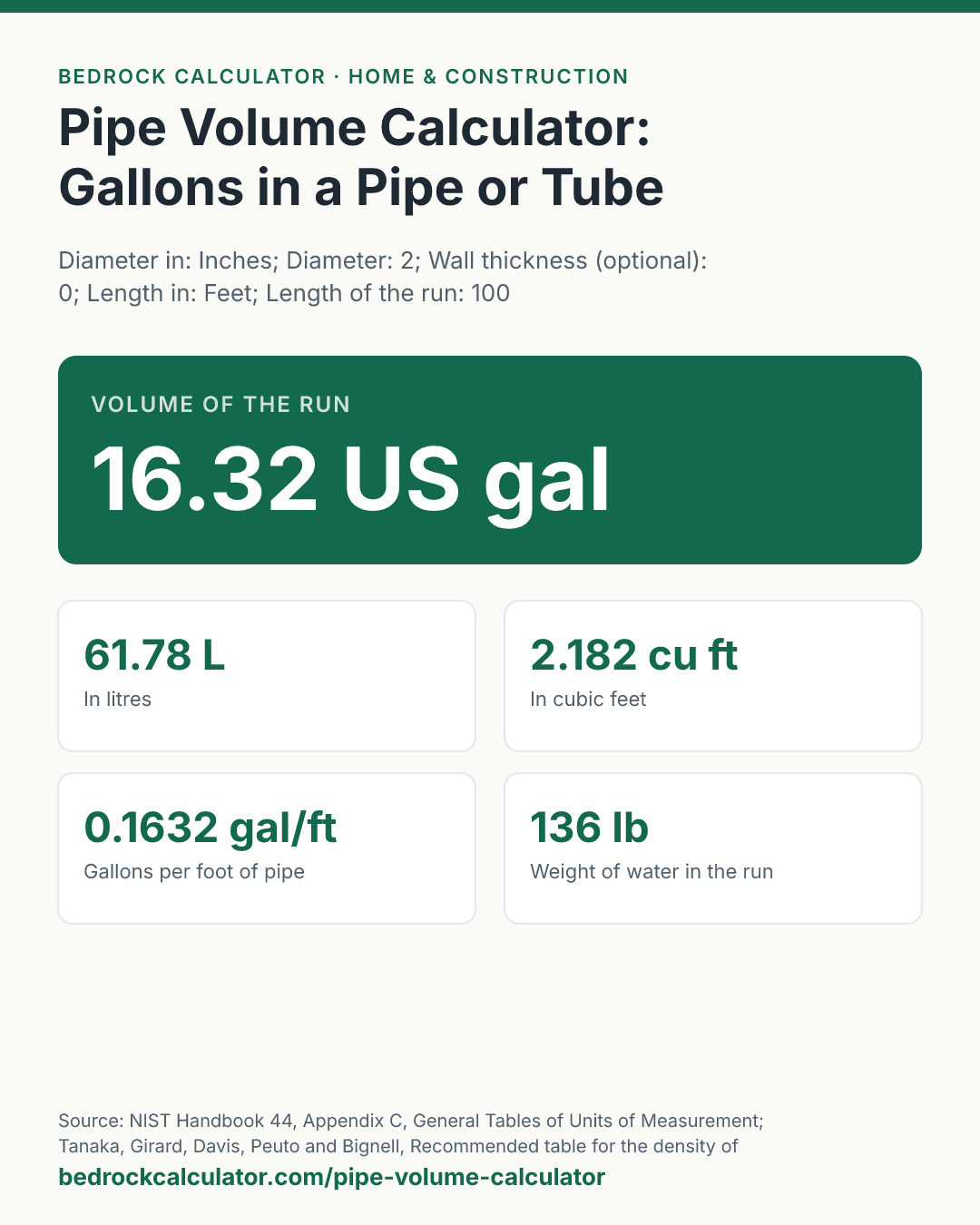
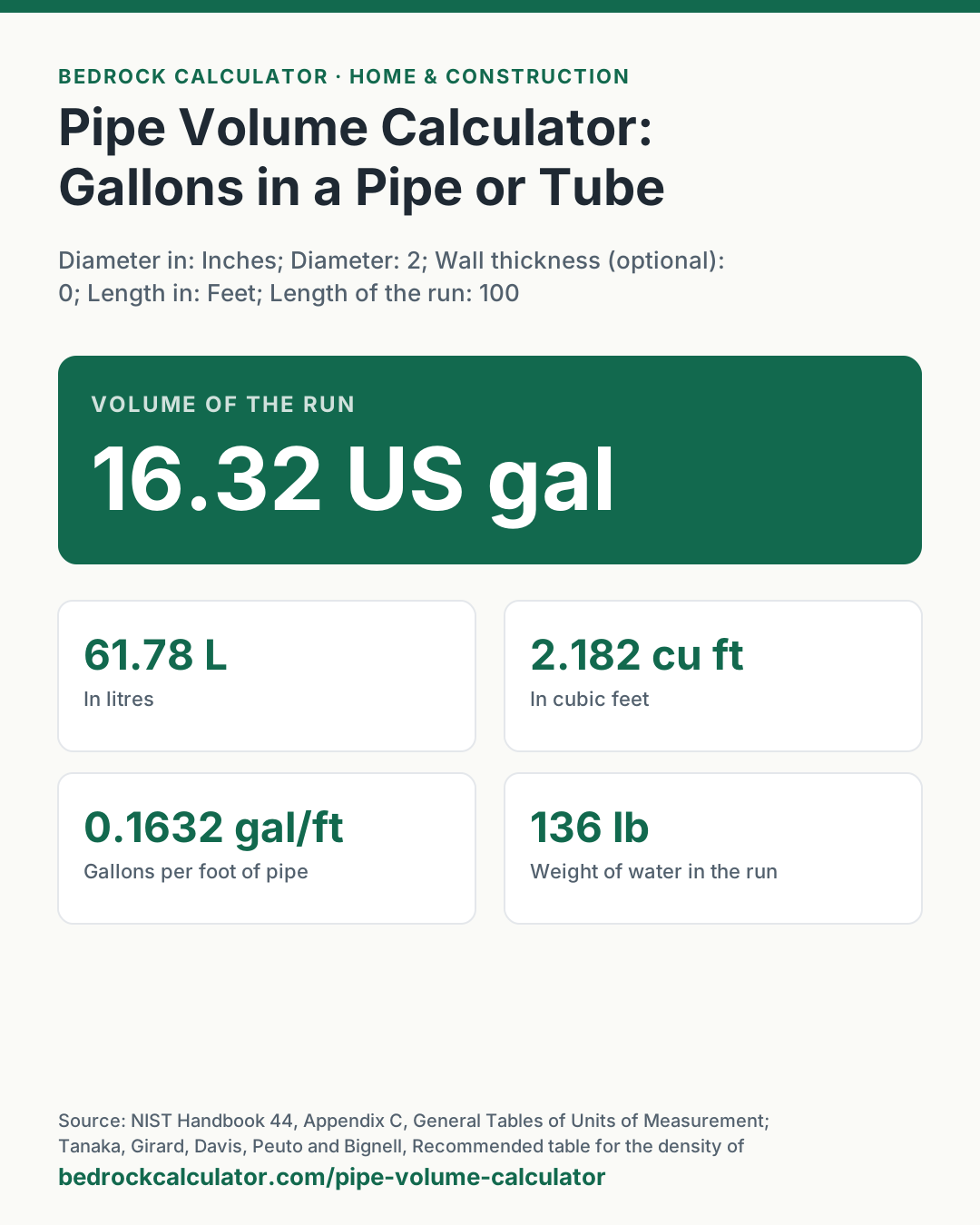
Quick Answer: 100 feet of pipe with a 2 inch inside diameter holds 16.32 US gal (61.78 litres), which is 0.1632 gallons per foot. The water in it weighs about 136 pounds.
What does this calculator do?
This pipe volume calculator works out how much liquid fits inside a pipe, hose or tube. Enter the inside diameter and the length of the run and it gives the volume in US gallons, litres and cubic feet, the volume per foot and per metre, and the weight of the water it holds.
People need this for a handful of practical jobs: working out how much antifreeze a hydronic heating loop or a solar water loop takes, how much water sits in a long run of irrigation line, how long to flush a new main before the water at the tap is fresh, or how much a filled pipeline adds to the load on its supports. In every case the answer is the volume of a cylinder: the area of the bore times its length.
The bore is what matters, not the size printed on the pipe. Nominal pipe sizes are names, and the inside diameter of a given nominal size changes with the wall thickness and the material. If you know only the outside diameter and the wall thickness, enter both and the calculator takes the walls off for you.
Using the Pipe Volume Calculator
- Choose inches or millimetres for the diameter.
- Enter the inside diameter. If you have the outside diameter instead, enter that and the wall thickness.
- Choose feet or metres for the length, and enter the length of the run.
- Read the volume at the top, with litres, cubic feet, volume per foot and per metre, and water weight below.
The presets load 50 feet of 5/8 inch garden hose, a tube given by its outside diameter and wall thickness, and a 30 metre run of pipe with a 100 millimetre bore.
How is this calculated?
- Find the inside diameter. If a wall thickness is given, two walls come off the diameter you entered. Otherwise the diameter is used as it is. It is then converted to inches (25.4 millimetres to the inch, exactly).
- Find the volume of the run. The inside of the pipe is a cylinder. Its volume is pi times the inside radius squared times the length, with the length converted to inches and pi carried to 34 digits.
V = π(d_inside/2)² × L
- Convert. Gallons are cubic inches divided by 231, the definition of the US gallon. Litres and cubic feet use the exact inch.
- Volume per unit length. The same cylinder 1 foot long gives gallons per foot; 1 metre long gives litres per metre.
- Weigh the water. The volume times the density of pure water at 20 °C (998.2067 kilograms per cubic metre, from the CIPM formula) gives the weight in pounds and kilograms.
Worked Example
The default is 100 feet of pipe with a 2 inch inside diameter:
- Radius: half of 2 inches is 1 inch. Length: 100 feet is 1,200 inches.
- Volume: pi × 1² × 1,200 cubic inches.
- Gallons: that divided by 231 is 16.32 US gallons, or 61.78 litres and 2.182 cubic feet.
- Per foot: 0.1632 gallons. Per metre: 2.027 litres.
- Water weight: 136 lb (61.7 kg).
50 feet of 5/8 inch garden hose holds 0.8 gallons, about 3.02 litres.
A tube 2.375 inches across the outside with a 0.154 inch wall has a 2.067 inch bore. A 100 foot run of it holds 17.43 gallons.
A 100 millimetre bore, 30 metres long, holds 235.62 litres, or 62.24 gallons, at 7.854 litres per metre.
How Do You Calculate the Volume of a Pipe?
Square half the inside diameter, multiply by pi and by the length, with everything in the same unit. In inches, divide the cubic inches by 231 for gallons. As a shortcut, one foot of pipe holds 0.0408 gallons times the inside diameter in inches squared: 0.0408 for a 1 inch bore, 0.1632 for 2 inches, 0.3672 for 3 inches.
The table below lists common bores from half an inch to a foot.
How Many Gallons Are in a Foot of Pipe?
It goes with the square of the inside diameter, so doubling the bore holds four times as much. A 1 inch bore holds 0.0408 gallons per foot, a 2 inch bore 0.1632, and a 4 inch bore 0.6528.
A 12 inch main holds 5.8752 gallons in every foot, which is why a long run of large pipe takes a surprising amount of water to fill or to flush.
What does this calculator not account for?
- Fittings, valves and equipment. Elbows, tees, pumps, boilers, heat exchangers and expansion tanks hold liquid too. Add their volumes from the manufacturers' data.
- Nominal sizes. The calculator does not look up the inside diameter for a nominal pipe size and schedule. Measure it, or take it from the maker's table.
- Liquids other than water. The volume holds for any liquid, but the weight is for pure water at 20 °C. Glycol mixes and salt water are heavier.
- Partly full pipes. Drains and sewers often run partly full. This assumes the pipe is full.
- Pressure and temperature. Water expands slightly as it warms and pipes stretch a little under pressure. Neither is modelled.
What mistakes do people make with this?
- Using the nominal size as the bore. The bore is often larger or smaller than the name suggests, and the difference is squared in the volume.
- Using the outside diameter without the wall. Enter the wall thickness, or the volume will be too large.
- Mixing feet and inches. The diameter and the length have separate unit menus. A 2 inch pipe 100 feet long is not 2 by 100 in the same unit.
- Forgetting the radius is half the diameter. Squaring the full diameter gives four times the true volume.
Frequently Asked Questions
How much water is in 100 feet of 2 inch pipe?
How much water does a garden hose hold?
What is the volume of a tube in litres?
How do I convert gallons per foot to litres per metre?
Can I use this for a duct?
Sources
- NIST Handbook 44, Appendix C, General Tables of Units of Measurement: the US gallon of 231 cubic inches, the inch and the foot. nist.gov/pml/owm/nist-handbook-44-current-edition
- Tanaka, Girard, Davis, Peuto and Bignell, Recommended table for the density of water between 0 °C and 40 °C, Metrologia 38 (2001) 301 to 309 (the CIPM formula used for water at 20 °C). doi.org/10.1088/0026-1394/38/4/3
- NIST Special Publication 811, Guide for the Use of the International System of Units, Appendix B: conversion factors for gallons, litres and cubic feet. nist.gov/pml/special-publication-811