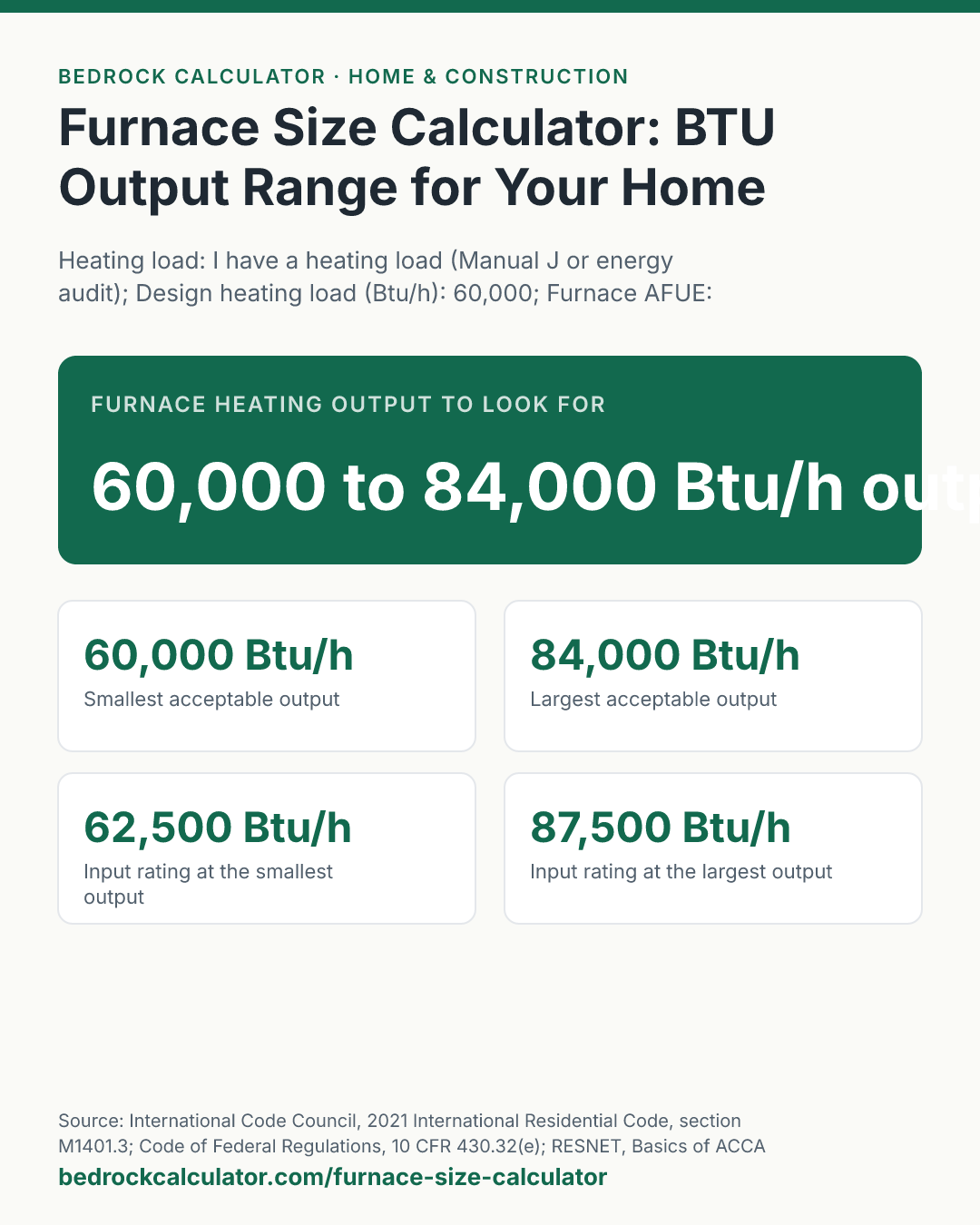
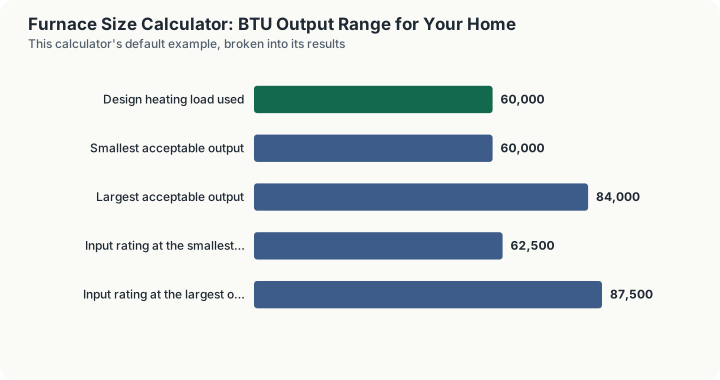
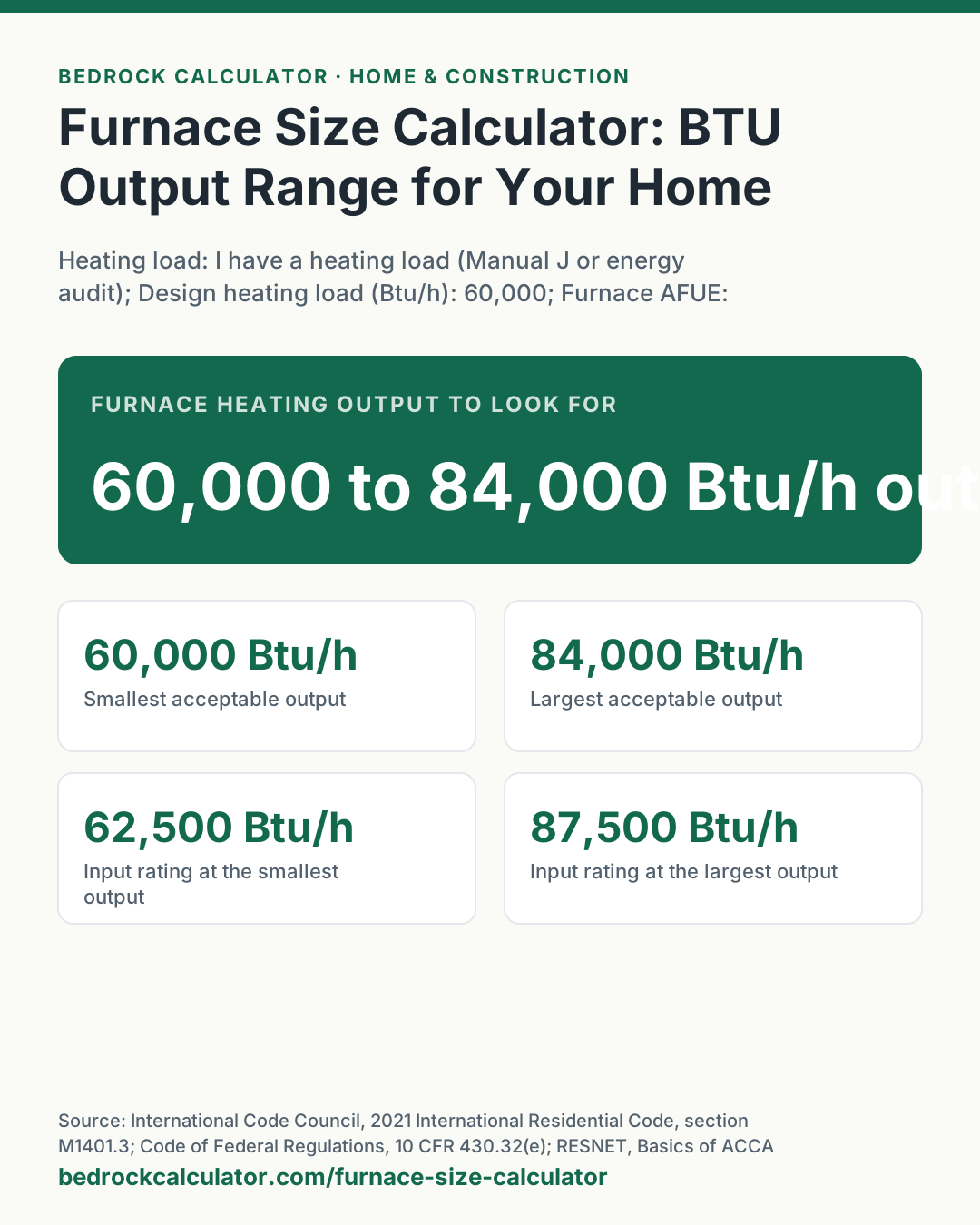
Quick Answer: For a design heating load of 60,000 Btu/h, look for a furnace with 60,000 to 84,000 Btu/h output. At 96% AFUE that is an input rating of about 62,500 to 87,500 Btu/h.
What does this calculator do?
This furnace size calculator turns a home's heating load into the range of furnace sizes that fit it. It follows the rule the building code points to. The International Residential Code requires heating equipment to be sized with ACCA Manual S, based on loads worked out with ACCA Manual J.
Manual S allows a furnace whose heating output is at least the design heating load and no more than 140% of it. The calculator applies that window to your load, and converts the output range into input ratings using the furnace's AFUE, because many furnaces are sold and labelled by input.
The weak link in any furnace sizing is the load itself. A proper load calculation looks at the climate, every wall, window, ceiling and floor, the insulation and the air leakage of the house. This calculator does not do that. It takes the load from a Manual J report or an energy audit if you have one. If you do not, it can estimate a load from floor area and a heat loss per square foot that you choose, and the page is plain that this estimate is not a Manual J calculation and should not be used to buy equipment on its own.
Using the Furnace Size Calculator
- Choose whether you have a heating load or want to estimate one.
- If you have one, enter the design heating load in Btu per hour. It is on the Manual J report, usually called the heat loss or heating load.
- If you are estimating, enter the heated floor area and a heat loss per square foot. There is no correct default; the starting value is only a placeholder.
- Enter the AFUE of the furnace you are considering, from its label or specification sheet.
- Read the output range at the top. Below it are the matching input ratings and the same range in kilowatts.
The presets show the default load with an 80% AFUE furnace, an estimate for 1,800 square feet at 25 Btu/h per square foot, and a small 32,000 Btu/h load for a tight, well-insulated house.
How is this calculated?
- Take the heating load. Either the figure you entered, or, in estimate mode, floor area times your heat loss per square foot.
load = A_(sq ft) × Btu/h per sq ft
- Apply the Manual S window. The smallest acceptable output is 100% of the load; the largest is 140%.
output_min = load; output_max = 1.4 × load
- Convert output to input. AFUE is the ratio of a furnace's annual heat output to its fuel input, as defined in the federal efficiency rules. Dividing output by AFUE gives the input rating that would deliver it.
input = output/AFUE
- Convert to kilowatts. One Btu per hour is 0.29307107 watts, using the International Table Btu of exactly 1,055.05585262 joules.
- Round for display. Btu/h figures are shown to the nearest whole number and kilowatts to two decimals.
Worked Example
The default is a 60,000 Btu/h design heating load and a 96% AFUE furnace:
- Smallest output: 60,000 Btu/h. Largest output: 1.4 × 60,000 = 84,000 Btu/h.
- Input range: 60,000 ÷ 0.96 = 62,500 Btu/h up to 84,000 ÷ 0.96 = 87,500 Btu/h.
- In kilowatts, the output range is 17.58 to 24.62 kW.
With an 80% AFUE furnace the output range is the same, but the input range rises to 75,000 to 105,000 Btu/h, because more of the fuel goes up the flue.
An estimate for 1,800 square feet at 25 Btu/h per square foot gives a 45,000 Btu/h load and an output range of 45,000 to 63,000 Btu/h.
A 32,000 Btu/h load calls for 32,000 to 44,800 Btu/h of output.
What Size Furnace Do I Need?
One whose heating output is at least your design heating load and no more than 140% of it. The size printed in a model name is often the input rating, so check the output on the specification sheet, or divide by AFUE as the calculator does.
The table below lists the output and input ranges for loads from 20,000 to 120,000 Btu/h at 96% and 80% AFUE.
Why Not Size a Furnace by Square Footage?
Because two houses of the same size can lose heat at very different rates. Climate, insulation, window area, air tightness and ceiling height all change the load. A heat loss per square foot borrowed from another house can be far off, and an oversized furnace short-cycles: it heats quickly, shuts off, and runs less efficiently and less comfortably.
That is why the code points to Manual J and Manual S, and why this calculator treats an area-based estimate as a placeholder rather than an answer.
What does this calculator not account for?
- The load calculation. The calculator does not perform Manual J. The load is yours to supply, and an estimate from area is rough.
- Altitude. Gas furnaces lose capacity at high altitude and are derated; the output on the label may not be what you get.
- Duct losses. AFUE excludes losses from ducts in unconditioned spaces, which can be large.
- Cooling and airflow. A furnace's blower also serves the air conditioner; Manual S checks cooling capacity and airflow too, which this does not.
- Multistage and modulating furnaces. The IRC allows exceptions to the Manual S limits for some multistage equipment.
- Heat pumps and boilers. Their sizing rules differ. This page covers furnaces only.
What mistakes do people make with this?
- Confusing input and output. At 80% AFUE, a furnace with a 75,000 Btu/h input delivers 60,000 Btu/h of output, as the table shows. Compare output to the load.
- Sizing up for safety. Manual S already allows up to 140%. Going larger usually makes comfort worse, not better.
- Replacing like for like. The old furnace may have been oversized, and the house may have been insulated since.
- Treating the estimate as a load calculation. It is a placeholder until someone runs Manual J.
Frequently Asked Questions
How many BTUs do I need to heat my house?
What is a Manual J calculation?
What does AFUE mean?
Is a bigger furnace better?
Can I use this for a heat pump?
Sources
- International Code Council, 2021 International Residential Code, section M1401.3: equipment sized in accordance with ACCA Manual S based on ACCA Manual J loads. codes.iccsafe.org/content/IRC2021P2/chapter-14-heating-and-cooling-equipment-and-appliances
- Code of Federal Regulations, 10 CFR 430.32(e): minimum AFUE for residential furnaces. ecfr.gov/current/title-10/chapter-II/subchapter-D/part-430/subpart-C/section-430.32
- RESNET, Basics of ACCA Manual S (2014): furnace heating capacity of 100% to 140% of the Manual J heating load. resnet.us/blog/wp-content/uploads/formidable/RESNET-Basics-of-Manual-S-v3-2014-02-21_PDF.pdf
- NIST Special Publication 811, Appendix B: the British thermal unit and the joule. nist.gov/pml/special-publication-811