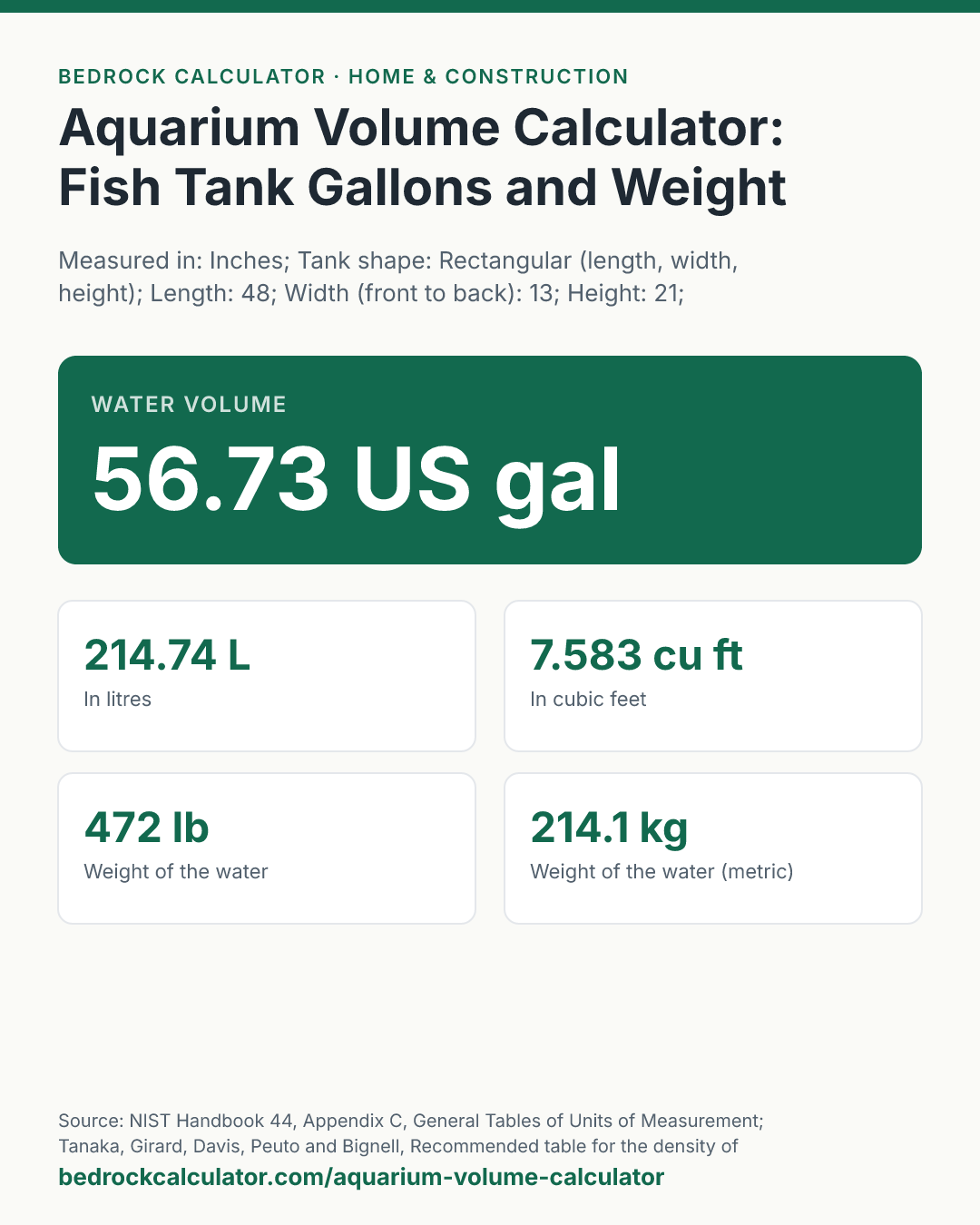
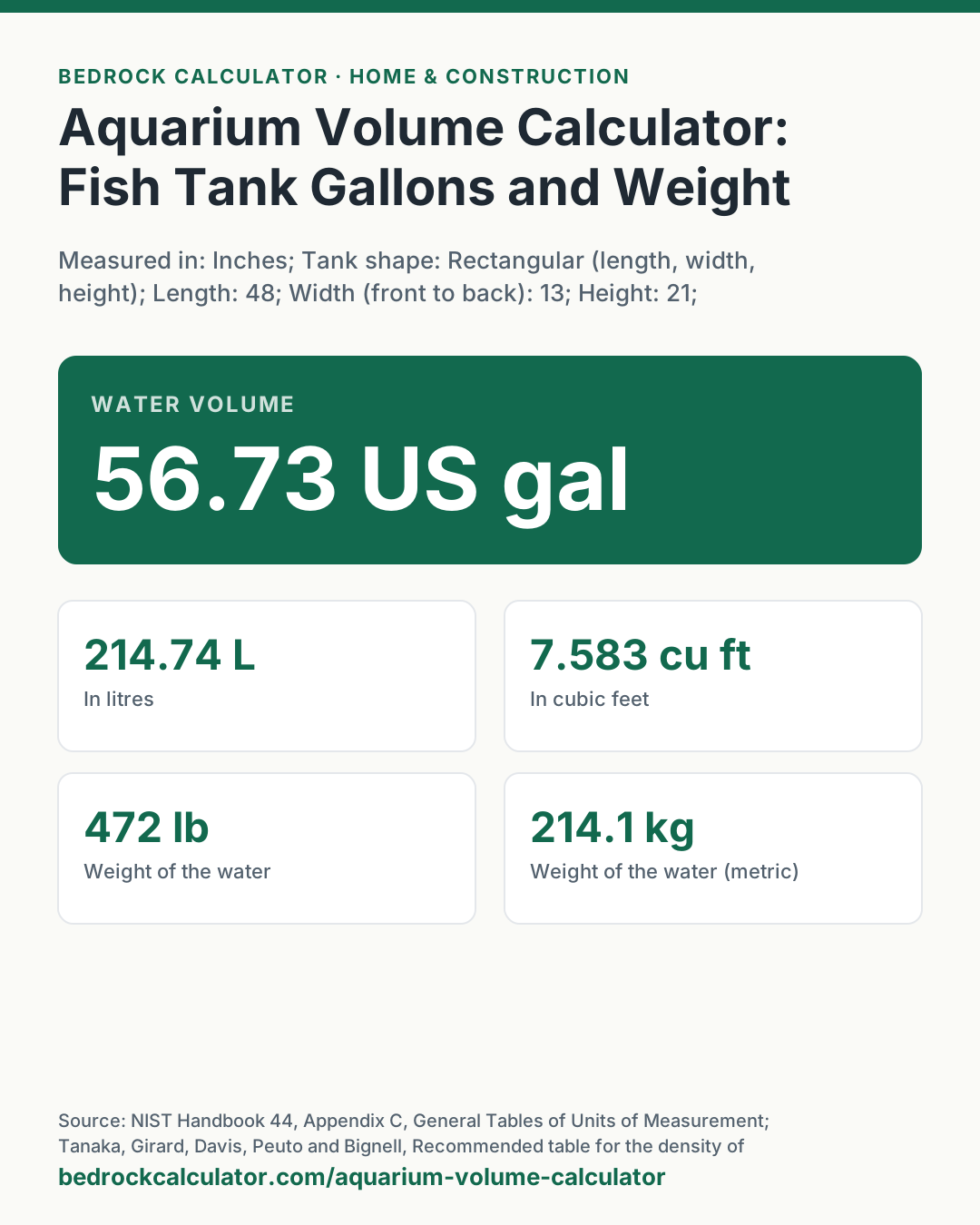
Quick Answer: A fish tank 48 inches long, 13 inches wide and 21 inches high holds 56.73 US gal (214.74 litres) when filled to the brim, and that much water at 25 °C weighs about 472 pounds.
What does this calculator do?
This aquarium volume calculator works out how much water a fish tank holds and how much that water weighs. Enter the length, width and height of a rectangular tank, or the diameter and height of a round column tank, and it gives the volume in US gallons, litres and cubic feet.
It also gives the weight of that water in pounds and kilograms.
The number on a tank's box is a nominal size. Real water volume is usually lower, because the glass takes up room, the substrate sits on the bottom and nobody fills a tank to the very rim. So the calculator lets you subtract the glass thickness if you measured the outside, and leave a gap below the top. That is the volume to use for medication and water conditioner doses, which are usually given per gallon or per litre.
The weight is worked from the density of pure water at the temperature you enter, using the international CIPM formula. It matters when you choose a stand or a spot on an upper floor: water is heavy.
Using the Aquarium Volume Calculator
- Choose inches or centimetres.
- Pick a rectangular tank or a round column.
- Enter the dimensions. Measure inside the glass if you can.
- If you measured the outside, enter the glass thickness; it is taken off both sides of each dimension and off the bottom.
- Enter how far below the top the water sits, if you want the volume you actually fill.
- Set the water temperature for the weight, then read the volume and weight.
The presets show the default tank measured outside with 3/8 inch glass and filled 1 inch low, a small 20 by 10 by 12 inch tank, a 100 by 40 by 50 centimetre tank, and a round column 18 inches across.
How is this calculated?
- Work out the inside dimensions. If you entered a glass thickness, two thicknesses come off the length, width or diameter, and one comes off the height for the bottom. The gap below the top also comes off the height. Nothing goes below zero.
- Find the water volume. A rectangular tank is a box: inside length × width × water height. A round tank is a cylinder: pi × radius² × water height, with the radius half the inside diameter.
V_rect = L × W × H_water; V_round = π(d/2)²H_water
- Convert to gallons and litres. The US gallon is 231 cubic inches exactly, so gallons are cubic inches divided by 231. Litres are cubic centimetres divided by 1,000, and an inch is exactly 2.54 centimetres.
US gal = (cubic inches)/231
- Find the water's density. The density of pure, air-free water at your temperature comes from the CIPM formula (Tanaka and others, Metrologia, 2001). At 25 °C it is 997.047 kg per cubic metre.
- Weigh the water. Volume times density gives the mass, shown in pounds and kilograms.
Worked Example
The default is a 48 by 13 by 21 inch tank, measured inside and filled to the top, at 25 °C:
- Volume: 48 × 13 × 21 = 13,104 cubic inches.
- Gallons: 13,104 ÷ 231 = 56.73 US gallons, or 214.74 litres (7.583 cubic feet).
- Weight: 214.74 litres at 997.047 kg per cubic metre is 214.1 kg, or 472 lb.
Measure the same tank outside with 3/8 inch glass and fill it 1 inch below the top, and the water space shrinks to 47.25 by 12.25 by 19.625 inches. That holds 49.17 gallons, weighing 409.2 pounds.
A 20 by 10 by 12 inch tank holds 10.39 gallons. A 100 by 40 by 50 centimetre tank holds exactly 200 litres, or 52.83 gallons. A round column 18 inches across and 21 inches tall holds 23.13 gallons.
How Do You Calculate Fish Tank Gallons?
Multiply length by width by height in inches and divide by 231. That gives US gallons, because a US gallon is defined as 231 cubic inches. In centimetres, multiply the three and divide by 1,000 for litres. For the water you actually have, use the inside dimensions and the height of the water rather than the glass.
The table below lists common tank sizes.
How Much Does a Fish Tank Weigh?
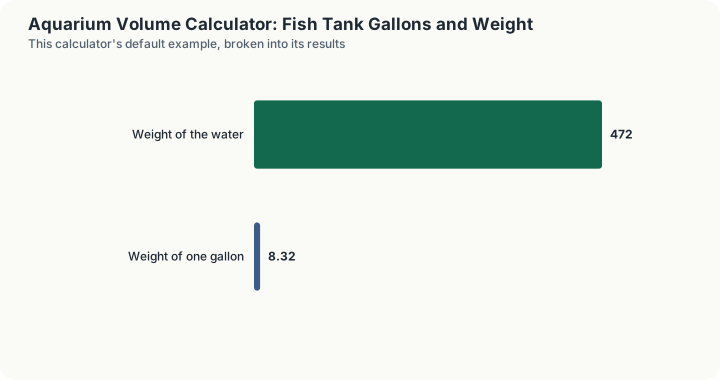
The water alone weighs 8.32 pounds per US gallon at 25 °C; the calculator works it out from the volume and the temperature you enter. A 56.73 gallon tank holds 472 pounds of fresh water. Add the glass or acrylic, the stand, gravel or sand, rock and equipment on top.
Before putting a large tank on an upper floor, check the floor's capacity with someone qualified.
What does this calculator not account for?
- Salt water. Sea water is denser than fresh water, so a reef or marine tank weighs more than shown. The volume is the same.
- Substrate, rock and decorations. These take up space and reduce the water volume. Their volume depends on how they are shaped and packed.
- Bow-front, corner and hexagonal tanks. Only rectangular and round tanks are worked out. A bow-front tank holds a little more than a rectangle of its depth at the sides.
- Sumps and canister filters. Water in the filter system adds to the total for dosing. Measure the sump separately and add it.
- Imperial gallons. The gallons here are US gallons. A UK (imperial) gallon is larger.
What mistakes do people make with this?
- Using outside dimensions without the glass. On a large tank with thick glass, the difference is several gallons.
- Dosing by the nominal size. A tank sold as 55 gallons may hold less once filled to a normal level with substrate in it. Dose by the water you have.
- Mixing inches and centimetres. Choose one unit for all the dimensions.
- Forgetting the water level. Most tanks run an inch or more below the rim.
Frequently Asked Questions
How many gallons is a 48 by 13 by 21 inch tank?
How many litres is my aquarium?
How much does a gallon of water weigh?
How do I calculate the volume of a round fish tank?
Does the calculator work for ponds?
Sources
- NIST Handbook 44, Appendix C, General Tables of Units of Measurement: the US gallon of 231 cubic inches and the litre. nist.gov/pml/owm/nist-handbook-44-current-edition
- Tanaka, Girard, Davis, Peuto and Bignell, Recommended table for the density of water between 0 °C and 40 °C based on recent experimental reports, Metrologia 38 (2001) 301 to 309 (the CIPM formula). doi.org/10.1088/0026-1394/38/4/3
- NIST Special Publication 811, Guide for the Use of the International System of Units, Appendix B: conversion of cubic inches and gallons to cubic metres. nist.gov/pml/special-publication-811