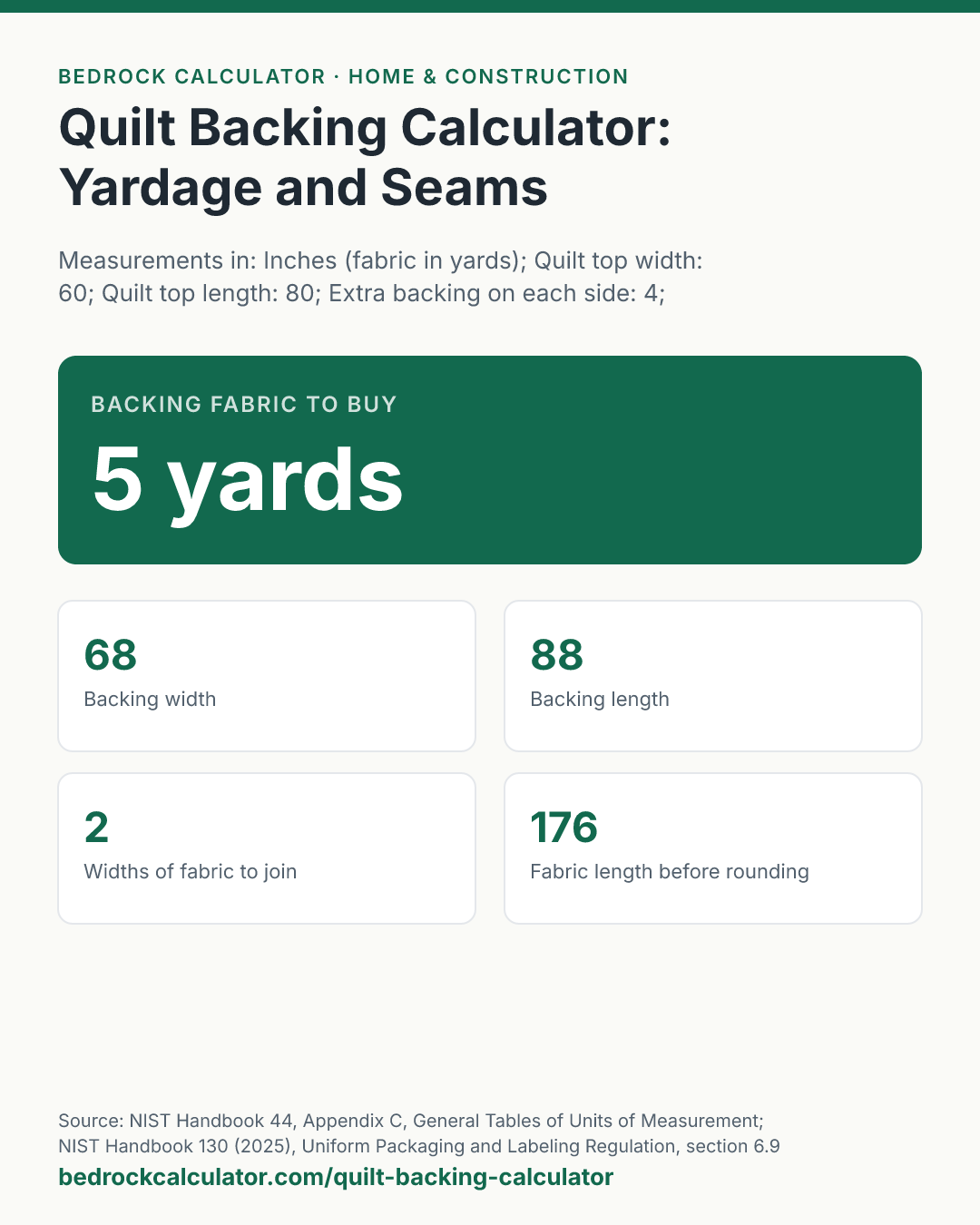
Quick Answer: A 60 by 80 inch quilt top with 4 inches of extra backing on each side needs a 68 by 88 inch backing. From 42 inch wide fabric that is two lengths joined side by side, 5 yards in all.
What does this calculator do?
This quilt backing calculator works out how much fabric to buy for the back of a quilt, and how to piece it. Quilt backs are almost always bigger than a single width of quilting cotton, so the backing is sewn from two, three or more widths of fabric.
Those widths can run the length of the quilt, with the seams running top to bottom, or across it, with the seams running side to side. One way usually wastes less than the other, and the calculator picks the one that needs less fabric.
Enter the size of the quilt top, how much bigger the backing should be on each side, and the usable width of your fabric. The calculator gives the backing size, the number of fabric widths to join, which way the seams run, and the fabric to buy, rounded up to the next eighth of a yard. It works in centimetres and metres too.
It also answers the other common question: whether extra-wide backing fabric saves money. Enter its width instead and compare.
Using the Quilt Backing Calculator
- Choose inches or centimetres.
- Enter the width and length of the finished quilt top.
- Enter the extra backing you want on each side. If someone else will quilt it on a longarm, ask how much they need.
- Enter the usable fabric width: the width after the selvages are cut off.
- Read the fabric to buy at the top, and the backing size, number of widths and seam direction below.
The presets show a 90 by 108 inch queen quilt on 42 inch fabric, the same quilt on 108 inch wide-back fabric, and a 36 by 48 inch baby quilt.
How is this calculated?
- Size the backing. Add the extra on both sides to the width and to the length.
W_b = W_q + 2 × extra; L_b = L_q + 2 × extra
- Try lengthwise panels. Divide the backing width by the fabric width and round up: that many panels, each as long as the backing, sewn side by side.
fabric_lengthwise = ⌈W_b/(fabric width)⌉ × L_b
- Try crosswise panels. Divide the backing length by the fabric width and round up: that many panels, each as long as the backing is wide.
fabric_crosswise = ⌈L_b/(fabric width)⌉ × W_b
- Keep the smaller. The layout that uses less fabric wins. If both are equal, lengthwise panels are used. If only one panel is needed, there are no seams.
- Convert and round up. The fabric length is converted to yards (or metres) and rounded up to the next 1/8 yard (or 10 centimetres).
Worked Example
The default is a 60 by 80 inch quilt top, 4 inches extra on each side, 42 inch fabric:
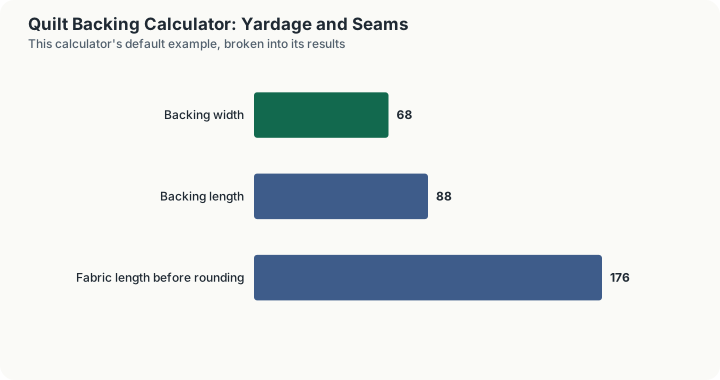
- Backing: 60 + 8 = 68 inches wide and 80 + 8 = 88 inches long.
- Lengthwise: 68 ÷ 42 rounds up to 2 panels of 88 inches, which is 176 inches of fabric.
- Crosswise: 88 ÷ 42 rounds up to 3 panels of 68 inches, which is 204 inches.
- Lengthwise wins: 176 inches, just under 5 yards, rounded up to 5 yards, with one seam running the length of the quilt.
A 90 by 108 inch queen needs a 98 by 116 inch backing. Lengthwise takes 3 panels of 116 inches; crosswise takes 3 panels of 98 inches, which is shorter, so the seams run across the quilt and you buy 8.25 yards of 42 inch fabric.
On 108 inch wide-back fabric the same queen backing is a single piece, 3.25 yards, with no seams at all.
A 36 by 48 inch baby quilt needs a 44 by 56 inch backing, just over one width of 42 inch fabric, so it takes two widths joined crosswise: 2.5 yards.
How Much Backing Fabric Do I Need for a Quilt?
Add the extra allowance to the quilt top on all four sides, then work out how many widths of fabric cover it and how long each must be. The table below lists the yardage for common quilt sizes on 42 inch and 108 inch fabric, which is usually all you need to decide which to buy.
Is Wide Backing Fabric Worth It?
Often, for large quilts. A queen backing on 42 inch fabric takes 8.25 yards and two long seams; on 108 inch fabric it takes 3.25 yards and none. Wide-back fabric costs more per yard, so compare the total: multiply each yardage by its price per yard.
For small quilts the saving disappears, and for very large ones even wide fabric needs a seam.
What does this calculator not account for?
- Seam allowances. Joining panels uses up some width at each seam. If your fabric is only just wide enough, enter a usable width a little narrower than the bolt to allow for them.
- Shrinkage. Prewashing can shrink cotton. Buy a little extra if you will wash first.
- Directional prints. A one-way print may need its panels to run a particular way, even if the other way uses less fabric.
- Binding, batting and the top itself. Only the backing is worked out.
- Matching a print across seams. Matching a large print needs extra length for each panel.
What mistakes do people make with this?
- Using the full bolt width. The selvages are not usable. Quilting cotton often measures 42 to 44 inches wide on the bolt, but less once the selvages are trimmed.
- Forgetting the extra on both sides. Four inches on each side adds eight inches to each dimension, not four.
- Assuming seams must run lengthwise. Crosswise seams can save a yard or more on wide quilts.
- Buying the exact length. Fabric is cut by hand; buying the rounded-up yardage leaves room for a crooked cut.
Frequently Asked Questions
How much backing do I need for a queen size quilt?
How much bigger should a quilt back be than the top?
Should backing seams run vertically or horizontally?
How many yards is 176 inches?
Can I use centimetres?
Sources
- NIST Handbook 44, Appendix C, General Tables of Units of Measurement: 36 inches to the yard and the inch of 2.54 centimetres. nist.gov/pml/owm/nist-handbook-44-current-edition
- NIST Handbook 130 (2025), Uniform Packaging and Labeling Regulation, section 6.9: bi-dimensional goods such as fabric declared by length and width. doi.org/10.6028/NIST.HB.130-2025