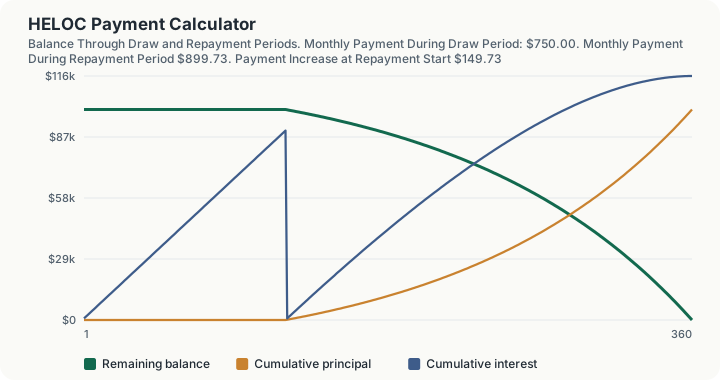
Quick Answer: A $100,000 HELOC draw at 9% costs $750.00 a month during a 10-year interest-only draw period, then jumps to $899.73 a month once the balance amortizes over a 20-year repayment period, for $205,934.23 in total lifetime interest.
Overview
A Home Equity Line of Credit, or HELOC, is a revolving credit line secured against the equity in your home. Unlike a home equity loan, which hands you a lump sum upfront with a fixed repayment schedule, a HELOC works more like a credit card: you're approved for a maximum credit limit, you draw against it as needed, and you can pay down and redraw during the draw period, all secured by your home.
Every HELOC has two distinct phases. During the draw period, typically 5 to 10 years, most HELOCs require interest-only payments on whatever balance you've actually drawn. Your payment is low, but none of it reduces the principal balance; you're only covering the cost of borrowing, not paying the loan down. Once the draw period ends, the HELOC enters the repayment period, typically 10 to 20 years, during which you can no longer draw new funds and the outstanding balance fully amortizes, meaning your payment includes both principal and interest, structured like a standard mortgage payment for the remainder of the term.
This calculator models the simplest, most common scenario: you draw the full amount at the start, make interest-only payments throughout the draw period, then the balance amortizes to zero over the repayment period. Real usage is often messier, with balances that rise and fall as you draw and repay, but this baseline case captures the two structural phases and the payment jump that catches many borrowers off guard when it happens.
How This Is Calculated
- Draw-period monthly payment. The drawn balance multiplied by the monthly interest rate (annual rate divided by 12). Because the loan is interest-only during this phase, the payment stays flat every month and the balance doesn't decrease.
- Total draw-period interest. The monthly interest-only payment multiplied by the number of months in the draw period.
- Repayment-period monthly payment. Once the draw period ends, the outstanding balance amortizes as a standard fixed-payment loan over the repayment term, using the same amortization math as any other fully amortizing mortgage.
- Total repayment-period interest. The cumulative interest paid across the repayment period as the balance is paid down to zero.
- Total lifetime interest. Draw-period interest plus repayment-period interest combined, showing the full cost of borrowing across both phases.
Worked Example
A $100,000 HELOC draw at 9% APR, with a 10-year draw period followed by a 20-year repayment period:
- Monthly rate: 9% ÷ 12 = 0.75%
- Draw-period monthly payment (interest-only): $100,000 × 0.75% = $750.00
- Total draw-period interest (120 months): $750.00 × 120 = $90,000.00
- Repayment-period monthly payment (240 months, fully amortizing): $899.73
- Total repayment-period interest: $115,934.23
- Total lifetime interest: $90,000.00 + $115,934.23 = $205,934.23
- Payment increase at the start of repayment: $899.73 − $750.00 = $149.73 per month
If the rate rises 2 percentage points to 11% (a realistic scenario, since most HELOCs carry a variable rate tied to the Prime Rate), the draw-period payment jumps to $916.67 a month, and the repayment-period payment rises as well. This is the single most important thing to understand about a HELOC: because the rate typically floats, both your draw-period and repayment-period payments can move with the broader interest rate environment, not just with the fixed schedule shown here.
What This Does Not Account For
- Variable rate changes over time. HELOC rates are typically tied to the Prime Rate and adjust periodically; this calculator uses a fixed snapshot rate rather than modeling a rate path.
- Partial draws and repeat borrowing. Most real-world HELOC usage involves drawing and repaying multiple times during the draw period rather than pulling the full amount on day one and holding it flat.
- Draw-period principal payments. Some borrowers voluntarily pay down principal during the draw period even though it isn't required; doing so would reduce both the draw-period balance and the eventual repayment-period payment, which this baseline model doesn't reflect.
- Annual fees and inactivity fees. Some HELOCs charge an annual maintenance fee or a fee if the line goes unused for an extended period.
- Closing costs and appraisal fees. Origination costs to open the line aren't included in this monthly payment calculation.
Common Pitfalls
- Being surprised by the repayment-period payment jump. Because draw-period payments are interest-only and don't reduce the balance, the shift to a fully amortizing payment at the start of the repayment period can be a meaningfully larger monthly obligation, exactly when the draw period's flexibility disappears.
- Assuming the rate is fixed for the life of the line. Most HELOCs are variable-rate products; a rate increase during the draw period raises your interest-only payment immediately, and a rate increase during repayment changes the amortizing payment at the next reset.
- Treating the credit line like it doesn't need to be repaid. Because a HELOC feels like available credit rather than a lump-sum loan, some borrowers underestimate that every dollar drawn accrues interest and must eventually be paid back in full, principal included.
- Ignoring the draw-period end date when planning cash flow. Borrowers who don't plan for the repayment-period payment increase can face real budget strain the month that switch happens.
Frequently Asked Questions
What's the difference between the draw period and the repayment period?
Why does my payment increase so much when the repayment period starts?
Is a HELOC rate fixed or variable?
Can I pay down principal during the draw period even though it's not required?
What happens if I don't repay the balance by the end of the repayment period?
Sources
- Consumer Financial Protection Bureau (CFPB): "What You Should Know About Home Equity Lines of Credit," Regulation Z (Truth in Lending Act) HELOC disclosure requirements. ecfr.gov/current/title-12/chapter-X/part-1026
- Federal Reserve Board: HELOC structure, draw period, and repayment period consumer guidance. federalreserve.gov
Also consulted: Office of the Comptroller of the Currency (OCC): home equity lending underwriting and consumer protection standards.