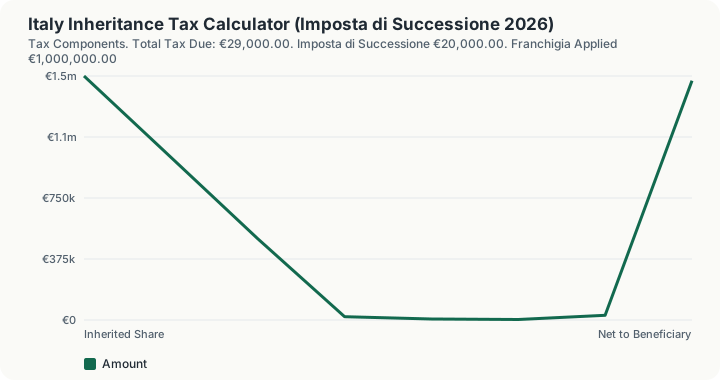
Quick Answer: A €1,500,000 share passing to a child or spouse, including €300,000 of real property at cadastral value, is taxed €29,000.00. The €1,000,000 franchigia leaves €500,000 taxable at 4%, giving €20,000 of imposta di successione, and the property attracts a further €6,000 of imposta ipotecaria at 2% and €3,000 of imposta catastale at 1%. The beneficiary keeps €1,471,000.00, an effective rate of 1.93% on the share.
What does this calculator do?
Italian inheritance tax is charged per beneficiary, on that beneficiary's own share, not on the estate as a whole. The franchigia (tax-free allowance) belongs to the beneficiary too, which is why dividing an estate among more heirs genuinely reduces the total tax rather than merely redistributing it.
Article 7 TUS sets four classes:
- 4% with a €1,000,000 franchigia for a spouse and direct-line relatives
- 6% with a €100,000 franchigia for siblings
- 6% with no franchigia for other relatives to the fourth degree and affini
- 8% with no franchigia for everyone else
By international standards Italy is unusually generous to children and spouses and unusually harsh to everyone else. A €1,500,000 share costs a child €20,000 of succession tax and someone unrelated €120,000, six times as much on the same money.
There is a separate, kinship-blind allowance: a beneficiary recognised as having a severe disability under L. 104/1992 art. 3 c.3 gets a €1,500,000 franchigia regardless of relationship. Franchigie do not stack, so a child with that recognition gets €1.5 million, not €2.5 million.
Where the share contains land or buildings, two further taxes apply on the cadastral value: imposta ipotecaria at 2% and imposta catastale at 1%. Each is independently floored at €200, which is the detail a naive percentage implementation gets wrong, and on a modest property those two together can exceed the inheritance tax itself.
How is this calculated?
Total = r⋅(S − F)⁺ + max(0.02C, 200) + max(0.01C, 200)
where $S$ is the share, $F$ the franchigia, $r$ the class rate and $C$ the cadastral value of real property. Under the prima casa benefit the last two terms become €200 each.
Step 1: Identify the class from the relationship. This sets both the rate and the franchigia together.
Step 2: Determine the franchigia actually applied. Where the beneficiary has the recognised severe disability, take the higher of the kinship allowance and €1,500,000. They are never added.
Step 3: Compute the taxable amount. The inherited share less the franchigia, floored at zero.
Step 4: Charge the class rate. 4%, 6% or 8% on the taxable amount. This is the imposta di successione.
Step 5: Compute the imposta ipotecaria. 2% of the cadastral value of real property in the share, or a flat €200 under the prima casa benefit.
Step 6: Apply the €200 floor to the ipotecaria. Where the percentage produces less than €200, the charge is €200. The Agenzia's Guida directs exactly this: "Se l'importo ottenuto è inferiore all'imposta fissa (pari a 200 euro) occorre indicare 200 euro".
Step 7: Compute the imposta catastale. 1% of the same cadastral value, or a flat €200 under prima casa.
Step 8: Apply the €200 floor to the catastale, independently. The two floors are applied to each tax separately, not to their sum.
Step 9: Total the three taxes.
Step 10: Report the net and the effective rate. The share less the total tax, and the total tax as a percentage of the share.
Worked Example
A child inherits a €1,500,000 share, of which €300,000 is the cadastral value of real property. No prima casa benefit, no disability recognition.
Step 1: Class and rate. Spouse or direct-line relative, so 4% with a €1,000,000 franchigia
Step 2: Franchigia applied. No disability recognition, so the kinship allowance stands at €1,000,000.00
Step 3: Taxable amount. €1,500,000 - €1,000,000 = €500,000.00
Step 4: Imposta di successione. €500,000 x 4% = €20,000.00
Step 5: Imposta ipotecaria before the floor. €300,000 x 2% = €6,000.00
Step 6: After the €200 floor. max(€6,000.00, €200) = €6,000.00
Step 7: Imposta catastale before the floor. €300,000 x 1% = €3,000.00
Step 8: After its own €200 floor. max(€3,000.00, €200) = €3,000.00
Step 9: Total property taxes. €6,000.00 + €3,000.00 = €9,000.00
Step 10: Total tax due. €20,000.00 + €9,000.00 = €29,000.00
Step 11: Net to the beneficiary. €1,500,000.00 - €29,000.00 = €1,471,000.00
Step 12: Effective rate on the share. €29,000.00 / €1,500,000 = 1.93%, far below the 4% headline rate because the franchigia removes two thirds of the share
The relationship comparison is stark. The same €1,500,000 share attracts €20,000 of succession tax passing to a child and €120,000 passing to someone unrelated, because the stranger has no allowance at all and pays 8% from the first euro. A sibling would face a €100,000 franchigia and 6%, so €84,000.
What does this calculator not account for?
- Autoliquidazione is disclosed but not modelled, because it is procedural rather than arithmetic. From 1 January 2025 the taxpayer self-assesses in quadro EF, with payment due within 90 days of the filing deadline, F24 code 1539, and instalments available above €1,000 with a 20% minimum down payment. Successions opened before 2025 are still assessed by the Agenzia. None of that changes the amount.
- D.Lgs. 139/2024 changed no rate and no franchigia. It relocated the existing D.L. 262/2006 figures into art. 7 TUS unchanged. Any commentary suggesting the 2024 decree altered the amounts is wrong.
- Only one beneficiary's share is computed. Italian inheritance tax is per beneficiary, so a multi-heir estate needs one run per heir. The calculator does not divide an estate for you.
- Cadastral value is taken as given. The rendita catastale and the multipliers that convert it into a taxable value are not computed here. Enter the cadastral value, not the market value.
- The "Tax If Inherited by a Child" and "Tax If Inherited by a Non-Relative" comparison figures exclude the property taxes. They are computed on the share alone with no cadastral value, so they isolate the effect of the relationship on the succession tax. They are not the total bill those beneficiaries would face on the same property.
- The prima casa conditions are not tested. The benefit is available where the dwelling is in a cadastral category other than A/1, A/8 or A/9 and at least one beneficiary meets the prima casa requirements, and it then extends to the whole property. The calculator applies it when you tick the box; it does not verify the conditions.
- Debts and deductible liabilities of the estate are not modelled. Enter the net share.
- Lifetime gifts (donazioni) and their interaction with the franchigia are not modelled.
- Regional and municipal charges, and non-resident or cross-border rules, are out of scope.
What mistakes do people make with this?
- Using market value for the ipo-catastali. They are charged on the cadastral value, which is typically well below market. Using market value overstates them substantially.
- Applying one €200 floor instead of two. The Agenzia's instruction applies the fixed minimum to each tax independently. A property with a small cadastral value therefore attracts €400 in total, not €200.
- Forgetting the floor entirely. A percentage-only implementation charges €40 and €20 on a €2,000 cadastral value. The correct answer is €200 and €200. On low-value properties the floors dominate.
- Treating the franchigia as an estate-level allowance. It belongs to each beneficiary. Splitting an estate across more heirs genuinely lowers the total tax, which is a real planning point rather than an accounting one.
- Stacking the disability franchigia on the kinship one. They do not stack. A child with the L. 104 recognition gets €1,500,000, not €2,500,000.
- Assuming relatives to the fourth degree get an allowance. They pay 6% with no franchigia. Only spouses, direct-line relatives and siblings have one.
- Believing the 2024 reform changed the rates. It did not. It changed how the tax is assessed and paid.
Frequently Asked Questions
What are the Italian inheritance tax rates and allowances?
Is the allowance per estate or per heir?
What are the imposta ipotecaria and catastale?
What is the disability franchigia?
Did the 2024 reform change the tax?
How does the prima casa benefit work here?
Sources
- Agenzia delle Entrate, circolare on D.Lgs. 139/2024, agenziaentrate.gov.it/portale/documents/20143/8410821/Circolare_decreto_delegato_Successioni_Donazioni.pdf, read 2026-08-31: quotes the new art. 7 TUS (D.Lgs. 346/1990) verbatim with the 4%/6%/6%/8% rates and the €1,000,000 and €100,000 franchigie, and confirms the decree "inserisce nel Testo Unico le aliquote e le franchigie ... di cui all'articolo 2, comma 48, del d.l. n. 262 del 2006" without changing them.
- Agenzia delle Entrate, "Dichiarazione di successione: come pagare le imposte", agenziaentrate.gov.it/portale/schede/dichiarazioni/dichiarazione-di-successione/imposte-dichsucc-cittadini, read 2026-08-31, the autoliquidazione procedure from 1 January 2025.
- Agenzia delle Entrate, "Istruzioni successioni Fascicolo I": imposta ipotecaria at the rate under art. 1 of the tariff to D.Lgs. 347/1990, "attualmente del 2 per cento", and catastale under art. 10, "attualmente dell'1 per cento". agenziaentrate.gov.it/portale/documents/20143/244895/Succ_FASCICOLO_I_Nov_23.pdf/ebc28cca-a79f-5a00-5a9a-7e4b70611a6b
Full citation block is in engine/primitives/italy-tax.ts section 9.
Also consulted: Agenzia delle Entrate, "Guida al calcolo dell'imposta di successione", the €200 fixed minimum, applied per tax: "Se l'importo ottenuto è inferiore all'imposta fissa (pari a 200 euro) occorre indicare 200 euro"; L. 104/1992 art. 3 c.3 (and the D.Lgs. 62/2024 wording): the €1,500,000 franchigia for a beneficiary with a recognised severe disability, regardless of kinship.