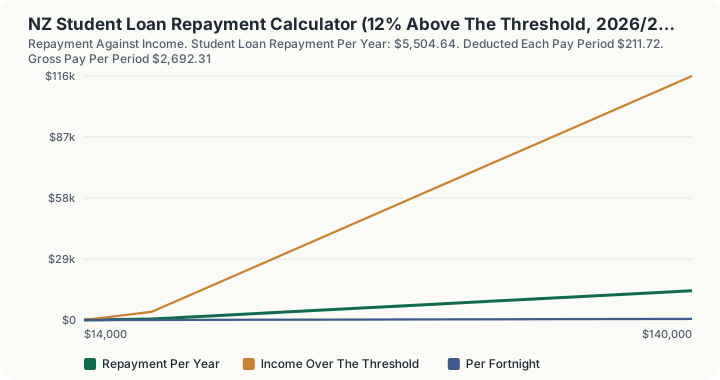
Quick Answer: On a $70,000 salary the student loan repayment is $5,504.64 a year, which is 12% of the $45,872 earned above the $24,128 annual threshold. Paid fortnightly that is $211.72 a pay. The effective rate on gross income is 7.86%, not 12%, because the first $24,128 is free. On a secondary job there is no threshold at all: 12% comes off the very first dollar.
What does this calculator do?
New Zealand repays student loans through PAYE, at a flat 12% of income above a repayment threshold. There is no interest rate to model for a borrower living in New Zealand, no term to choose and no minimum payment to negotiate. The deduction is a function of income and nothing else.
Three details do most of the damage when people work it out by hand.
Repayments are calculated per pay period, not annually. Inland Revenue publishes a threshold for each pay frequency: $464 weekly, $928 fortnightly, $1,856 four-weekly and $2,010.66 monthly. Your employer applies the one that matches your pay cycle, pay by pay. The annual threshold of $24,128 is exactly 52 weekly thresholds.
Those pay-period figures are not simple divisions of the annual figure. A twelfth of $24,128 is $2,010.6667, but Inland Revenue publishes $2,010.66, rounded down. The published divisor is what payroll uses.
A secondary job gets no threshold. The threshold has already been used against your main job, so on an SB SL, S SL, SH SL, ST SL or SA SL tax code the deduction is 12% of the whole gross, from the first dollar.
How is this calculated?
- Find the income above the annual threshold. Nothing is deducted at or below it, and the excess cannot go negative.
Excess = max(0, Income − 24,128)
- Apply the flat 12% rate to that excess. The rate does not tier, taper or rise with income.
Repayment_annual = Excess × 12%
- Work out the per-pay-period deduction against that period's own published threshold. The calculator divides your salary into the number of periods in a year, then applies the threshold Inland Revenue publishes for that frequency rather than a fraction of the annual figure.
Deduction = max(0, Gross_period − Threshold_period) × 12%
- Drop the threshold to zero for a secondary job. With no threshold, the same formula deducts 12% of the entire gross, and the annual figure is then built from the pay periods rather than from the annual excess.
Deduction_secondary = Gross_period × 12%
- Divide the loan balance by the annual repayment to show how many years of repayments it represents. This is a plain division. It applies no interest, no inflation and no salary growth.
Years = Balance/Repayment_annual
Worked Example
An employee earns $70,000, paid fortnightly, with a $30,000 loan balance.
Step 1 - The income above the threshold. $70,000 - $24,128 = $45,872.00
Step 2 - The annual repayment. $45,872.00 x 12% = $5,504.64
Step 3 - The effective rate. $5,504.64 / $70,000 = 7.86%, well under the 12% headline
Step 4 - Gross pay per fortnight. $70,000 / 26 = $2,692.31
Step 5 - The fortnightly excess. $2,692.31 - $928.00 = $1,764.31
Step 6 - The fortnightly deduction. $1,764.31 x 12% = $211.72
Step 7 - Years of repayments in the balance. $30,000 / $5,504.64 = 5.4 years, before any interest
Now test the threshold itself, which is inclusive.
Step 8 - Income of exactly $24,128. $24,128 - $24,128 = $0, so the repayment is $0.00
Step 9 - One dollar more. $1 x 12% = $0.12. Inland Revenue's own weekly table shows this: the student loan column is $0.00 at $464.00 of weekly gross and $0.12 at $465.00.
Now the secondary job rule, which is where hand calculations usually go wrong.
Step 10 - $15,000 from a main job. $15,000 is under $24,128, so the repayment is $0.00
Step 11 - The same $15,000 from a secondary job. No threshold applies. Per fortnight: $15,000 / 26 = $576.92, and $576.92 x 12% = $69.23
Step 12 - Annualised. $69.23 x 26 = $1,799.98, on income that would have attracted nothing at all on a main tax code
Finally the pay frequency, which changes the per-pay figure but not the year.
Step 13 - The same $70,000 paid weekly. $70,000 / 52 = $1,346.15, less the $464.00 weekly threshold = $882.15, at 12% = $105.86 a week
The Threshold, The Flat Rate And The Secondary Job Trap
The 12% is flat above the threshold, so every extra $1,000 of salary costs exactly $120. That is true at $30,000 and equally true at $300,000. Unlike a tax bracket, the rate never steps up, and unlike an income-tested benefit, it never phases out. The repayment simply grows in a straight line forever.
The effective rate rises towards 12% but never reaches it. At $30,000 the repayment is $704.64, which is 2.35% of gross. At $70,000 it is 7.86%. At $150,000 it is $15,104.64, or 10.07%. The untaxed first $24,128 keeps the average below the marginal rate at every income.
The threshold is a genuine inclusive boundary and not a cliff. At $24,128 nothing is deducted, at $24,129 twelve cents is, and the deduction grows one cent at a time from there. Nobody is worse off for crossing it.
The secondary job rule is the largest single trap here. A person earning $15,000 in each of two jobs pays nothing on the first and $1,799.98 on the second, on total income of $30,000 that would have attracted only $704.64 had it come from one job. Inland Revenue's answer to that is a special deduction rate, which the borrower has to apply for.
Pay frequency changes the timing, not the total, unless your pay is uneven. $105.86 a week and $211.72 a fortnight annualise to $5,504.72 and $5,504.72, within cents of the $5,504.64 annual figure. The small gap is rounding at each pay, and it is why the annual figure and twelve or twenty-six deductions rarely tie out to the exact cent.
Because the deduction is per pay period, an uneven year is treated unevenly. A fortnight where you earn nothing gets no deduction and does not bank the unused threshold, while a fortnight with a large bonus is deducted on the whole excess.
What does this calculator not account for?
- Interest. Loans are interest free for borrowers living in New Zealand. Borrowers overseas are charged interest, and this calculator does not model it or the different overseas repayment obligations, which are fixed amounts based on loan balance rather than a percentage of income.
- The loan balance running out. The calculator keeps applying 12% regardless of whether the balance has been cleared, and the years figure is a plain division.
- Income other than salary and wages. Self-employed and other income has its own end-of-year repayment obligation and interim payment rules.
- Special deduction rates and repayment deduction exemptions, both of which can be applied for and both of which change the deduction from the figure shown here.
- PAYE, the ACC earners' levy and KiwiSaver deductions, which come off the same pay and are calculated separately.
- End-of-year square-ups, where the pay-period deductions are reconciled against the annual obligation.
- Voluntary extra repayments, and the bonus arrangements that have historically applied to them.
- Any change to the threshold after the April 2026 tables. The $24,128 figure is verified against Inland Revenue's deduction tables for the year beginning 1 April 2026.
What mistakes do people make with this?
- Applying 12% to the whole salary. On $70,000 that gives $8,400 instead of $5,504.64.
- Dividing the annual threshold to get the pay-period one. A twelfth of $24,128 is $2,010.6667; Inland Revenue publishes $2,010.66.
- Expecting a threshold on a second job. There is none, and 12% comes off the first dollar.
- Assuming two part-time jobs are treated like one full-time one. They are not, and the difference on $30,000 split evenly is over $1,000 a year.
- Treating the repayment as a tax rate. It repays a debt you owe. It is not revenue.
- Assuming the deduction stops when the loan is repaid. It stops when your employer is told to stop, which is why final-balance timing matters.
Frequently Asked Questions
How much do I repay?
Is the threshold applied to each pay?
What happens on a second job?
Am I charged interest?
What if I earn under the threshold?
Can I have the deduction reduced?
Sources
- Inland Revenue, "Repaying my student loan when I earn salary or wages", ird.govt.nz. The 12% rate and the published pay-period thresholds of $464 weekly, $928 fortnightly, $1,856 four-weekly and $2,010.66 monthly, with an annual threshold of $24,128. Read 31 August 2026. ird.govt.nz/student-loans/living-in-new-zealand-with-a-student-loan/repaying-my-student-loan-when-i-earn-salary-or-wages
Also consulted: Inland Revenue, "IR340: Weekly and fortnightly PAYE deduction tables", April 2026 edition, tax tables for pay periods between 1 April 2026 and 31 March 2027. The weekly table's student loan column reads $0.00 at $464.00 of weekly gross and $0.12 at $465.00, fixing the weekly threshold at $464 and the rate at 12% of the excess. Page 4: "For employees using secondary tax codes, the student loan repayment deduction is 12% of their gross pay ... The repayment threshold does not apply to secondary income." Read 31 August 2026; Inland Revenue, "Student loan repayment deduction exemption" and "Repaying my student loan when I am self-employed or earn other income", for the exemptions and the non-salary obligations noted above as out of scope.