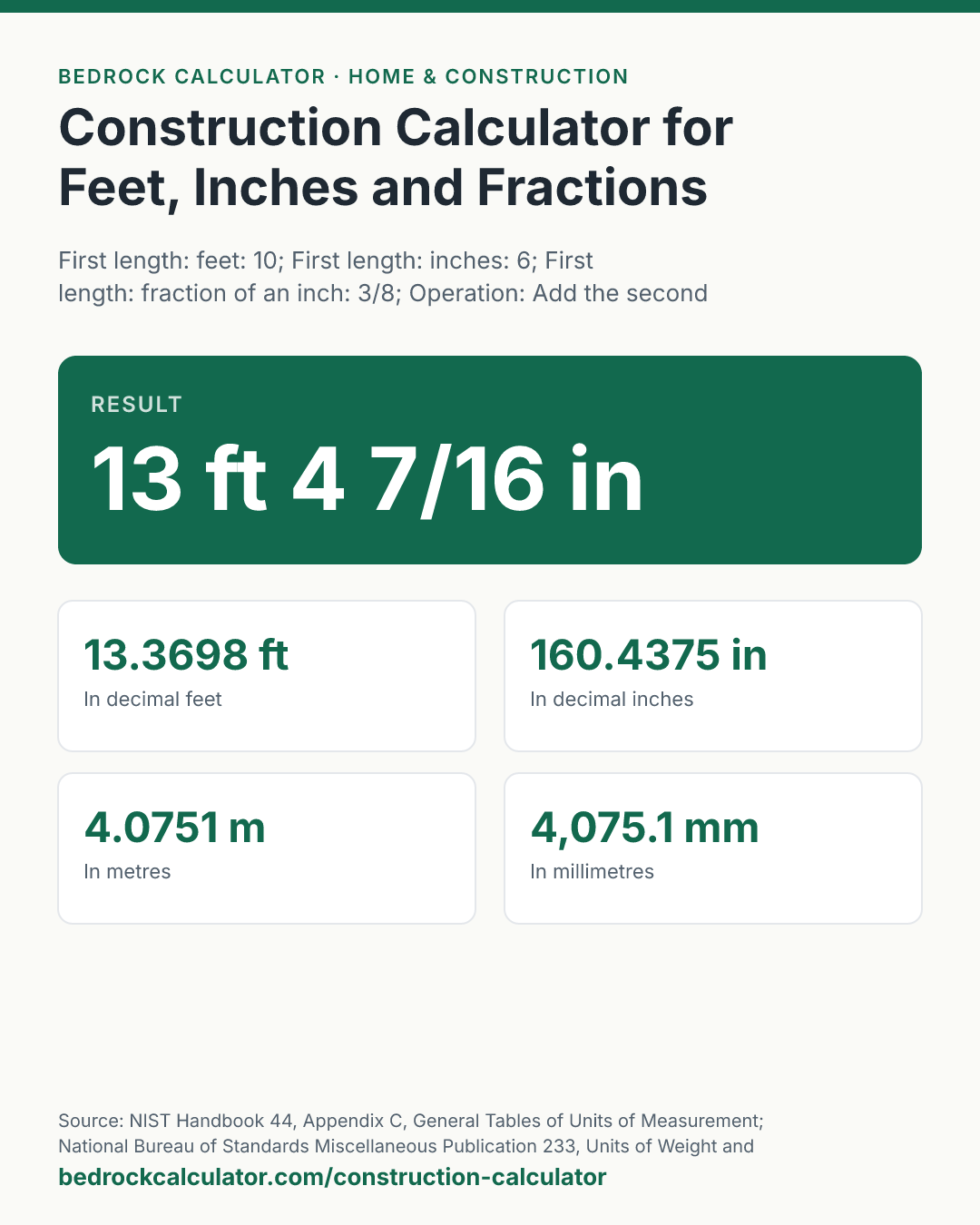
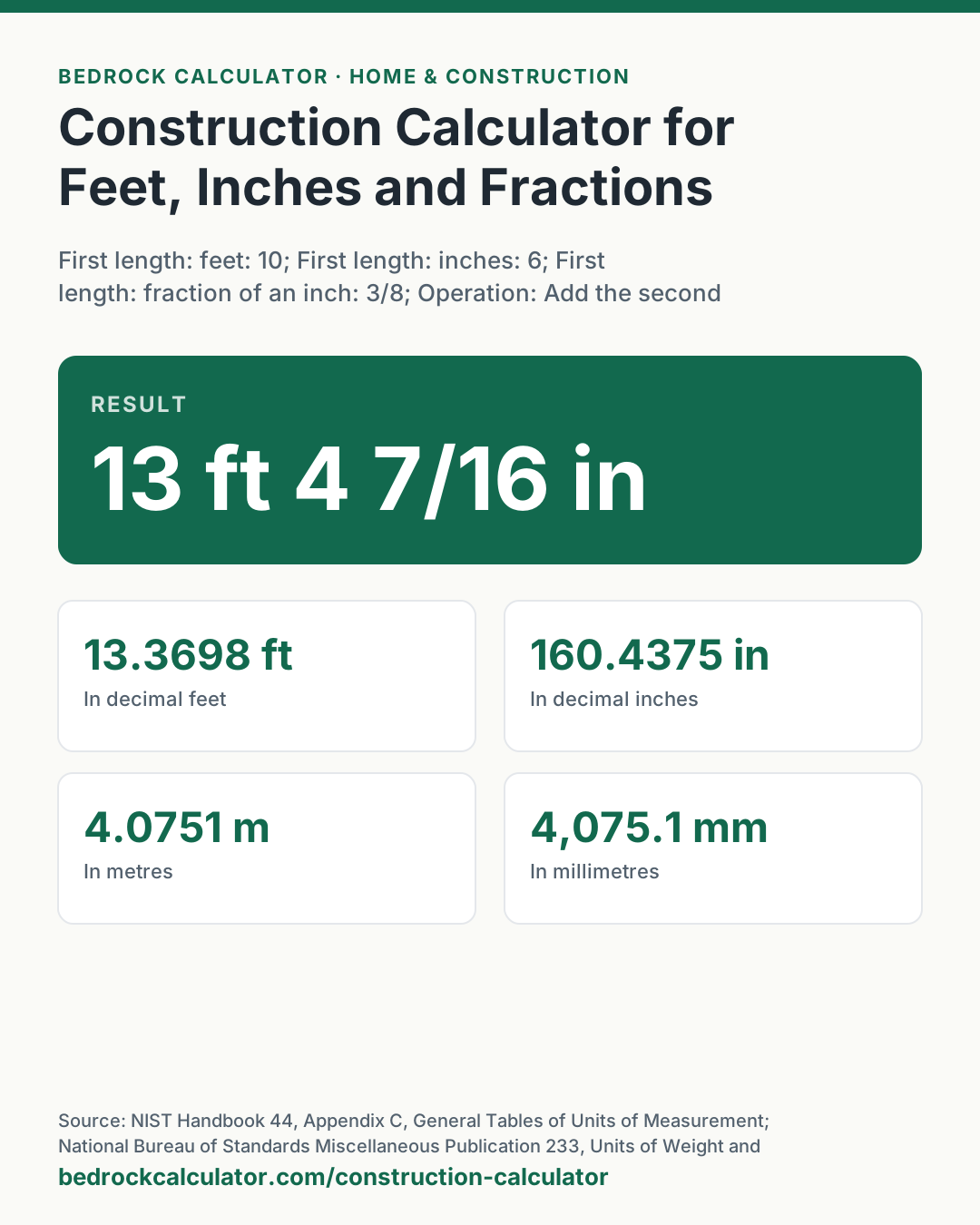
Quick Answer: 10 ft 6 3/8 in plus 2 ft 10 1/16 in is 13 ft 4 7/16 in, which is 160.4375 inches or 13.3698 feet. Add the inches and fractions first, carry whole feet out of the inches, and round to the nearest sixteenth.
What does this calculator do?
This construction calculator does the arithmetic a tape measure forces on you: adding, subtracting, multiplying and dividing lengths written in feet, inches and fractions of an inch. It is the job dedicated construction calculators were invented for, and the one ordinary calculators handle badly, because 12 inches make a foot and fractions come in sixteenths rather than tenths.
Enter one or two lengths as feet, inches and a fraction from 1/16 to 15/16. Choose an operation: add the second length, subtract it, multiply the first by a count, or split the first into equal parts. The answer comes back the way you would mark it on a board, rounded to the nearest 1/8, 1/16 or 1/32 inch, along with decimal feet, decimal inches, metres and millimetres.
The rest of the home calculators on this site turn lengths into areas, volumes and material counts. This one is for the cuts in between.
Using the Construction Calculator
- Enter the first length: whole feet, inches, and the fraction of an inch from the menu.
- Pick the operation.
- For adding or subtracting, enter the second length the same way. For multiplying or dividing, enter the count instead.
- Choose how finely to round. Sixteenths match most tape measures; eighths are fine for framing; thirty-seconds suit finish work.
- Read the answer at the top. The decimal and metric versions are below it, before any rounding to a fraction.
The presets cut 2 ft 7 3/4 in from an 8 foot board, total four shelves of 2 ft 10 1/16 in, and split a 13 ft 7 in wall into five equal bays.
How is this calculated?
- Turn each length into inches. Feet are converted at 12 inches to the foot, then the inches and the fraction are added. 10 ft 6 3/8 in becomes 120 + 6 + 0.375 = 126.375 inches.
- Do the operation in inches. Add or subtract the second length, multiply by the count, or divide by it. The arithmetic is exact decimal arithmetic, so dividing a length into equal parts does not drift.
- Round to the chosen fraction. The inches are multiplied by 16 (or 8, or 32), rounded half up to a whole number of those steps, and turned back into whole feet, whole inches and a remaining fraction.
steps = round(inches × 16); feet = ⌊steps/192⌋
- Carry and reduce. A fraction that rounds up to 16/16 becomes a whole inch, and 12 inches become a foot, so you never see 1 ft 12 in or 15/16 rounding to 16/16. The fraction is reduced: 8/16 is shown as 1/2.
- Convert for the other outputs. Decimal feet divide the unrounded inches by 12; metres and millimetres use the exact inch of 25.4 millimetres. These are shown before any fraction rounding.
- Handle a negative result. If the second length is longer than the first when subtracting, the answer is shown with a minus sign so you can see by how much.
Worked Example
The default adds 10 ft 6 3/8 in and 2 ft 10 1/16 in:
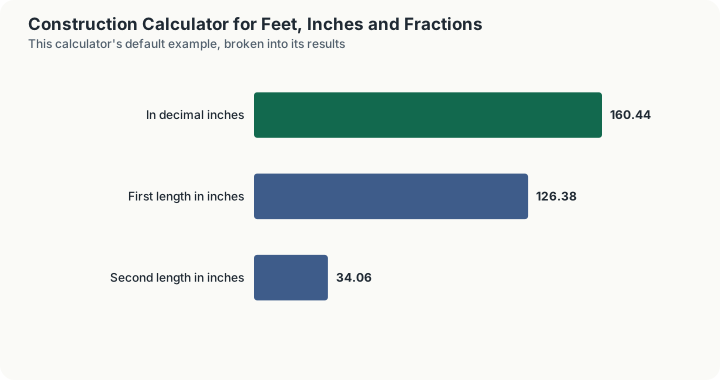
- First length: 120 + 6 + 0.375 = 126.375 in.
- Second length: 24 + 10 + 0.0625 = 34.0625 in.
- Sum: 160.4375 in.
- 160.4375 × 16 = 2,567 sixteenths exactly. That is 13 feet (2,496 sixteenths) with 71 left, which is 4 inches and 7/16.
- Answer: 13 ft 4 7/16 in, or 13.3698 ft and 4.0751 m.
Cutting 2 ft 7 3/4 in from an 8 foot board leaves 96 − 31.75 = 64.25 inches, which is 5 ft 4 1/4 in.
Four shelves of 2 ft 10 1/16 in need 34.0625 × 4 = 136.25 inches of board, which is 11 ft 4 1/4 in.
A 13 ft 7 in wall split into five equal bays: 163 ÷ 5 = 32.6 inches each. To the nearest sixteenth that is 32 10/16, shown as 2 ft 8 5/8 in.
How Do You Add Feet and Inches?
Add the fractions, then the inches, then the feet, carrying as you go. Sixteenths over 16 become an inch; inches over 12 become a foot. Or convert both lengths to inches, add, and convert back by dividing by 12: the whole number is feet and the remainder is inches.
The calculator does the second method because it never loses a carry.
How Do You Convert a Decimal to a Fraction of an Inch?
Multiply the decimal part by 16 and round to the nearest whole number; that is the number of sixteenths. In the wall preset each bay is 32.6 inches: 0.6 × 16 is 9.6 sixteenths, which rounds to 10/16, or 5/8.
The table below lists every sixteenth with its decimal and millimetre equivalents, which is the same lookup a carpenter's chart gives.
What does this calculator not account for?
- Saw kerf. When you cut a board into pieces, each cut removes the width of the blade. Dividing a length into equal parts here gives the centre-to-centre spacing, not the length of each piece after cutting.
- Areas and volumes. Multiplying a length by a count gives a length. For square feet or cubic yards, use the square footage or gravel calculators.
- Mixed units in one box. The inches box takes inches only. Enter 18 inches as 1 foot 6 inches or as 0 feet 18 inches; both work.
- Precision beyond 1/32. Rounding stops at thirty-seconds. The decimal inches line shows the exact figure.
What mistakes do people make with this?
- Treating 5 ft 6 in as 5.6 feet. Six inches is half a foot, so 5 ft 6 in is 5.5 feet. The decimal feet line shows the correct figure.
- Forgetting to carry. In the default example the inches add to 6 3/8 + 10 1/16 = 16 7/16 in, which carries to 1 ft 4 7/16 in. Leave the 16 inches uncarried and the total reads 12 ft 16 7/16 in.
- Rounding before adding. Round once, at the end. Rounding each piece to the nearest eighth and then adding can drift by more than an eighth.
- Dividing without allowing for the blade. See kerf above.
Frequently Asked Questions
What is a construction calculator?
How many inches are in a foot?
How do I subtract feet and inches?
How do I divide a length into equal parts?
Why does the answer differ slightly from my own sum?
Can I get the answer in metric?
Sources
- NIST Handbook 44, Appendix C, General Tables of Units of Measurement: 12 inches to the foot and 3 feet to the yard. nist.gov/pml/owm/nist-handbook-44-current-edition
- National Bureau of Standards Miscellaneous Publication 233, Units of Weight and Measure: the 1959 international inch of exactly 25.4 millimetres. nvlpubs.nist.gov/nistpubs/Legacy/MP/nbsmiscellaneouspub233.pdf
- NIST Special Publication 811, Guide for the Use of the International System of Units, Appendix B: conversion of feet and inches to metres. nist.gov/pml/special-publication-811