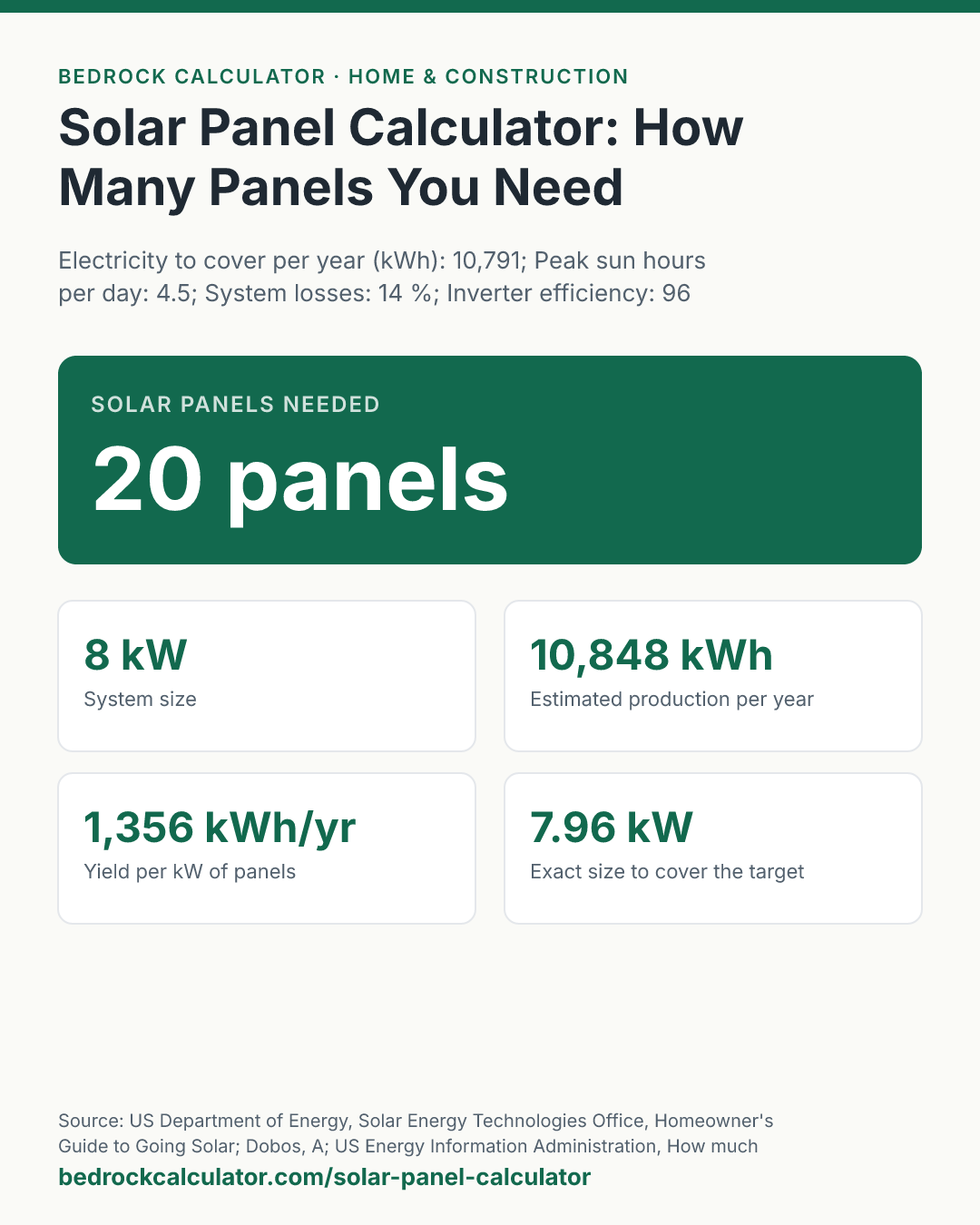
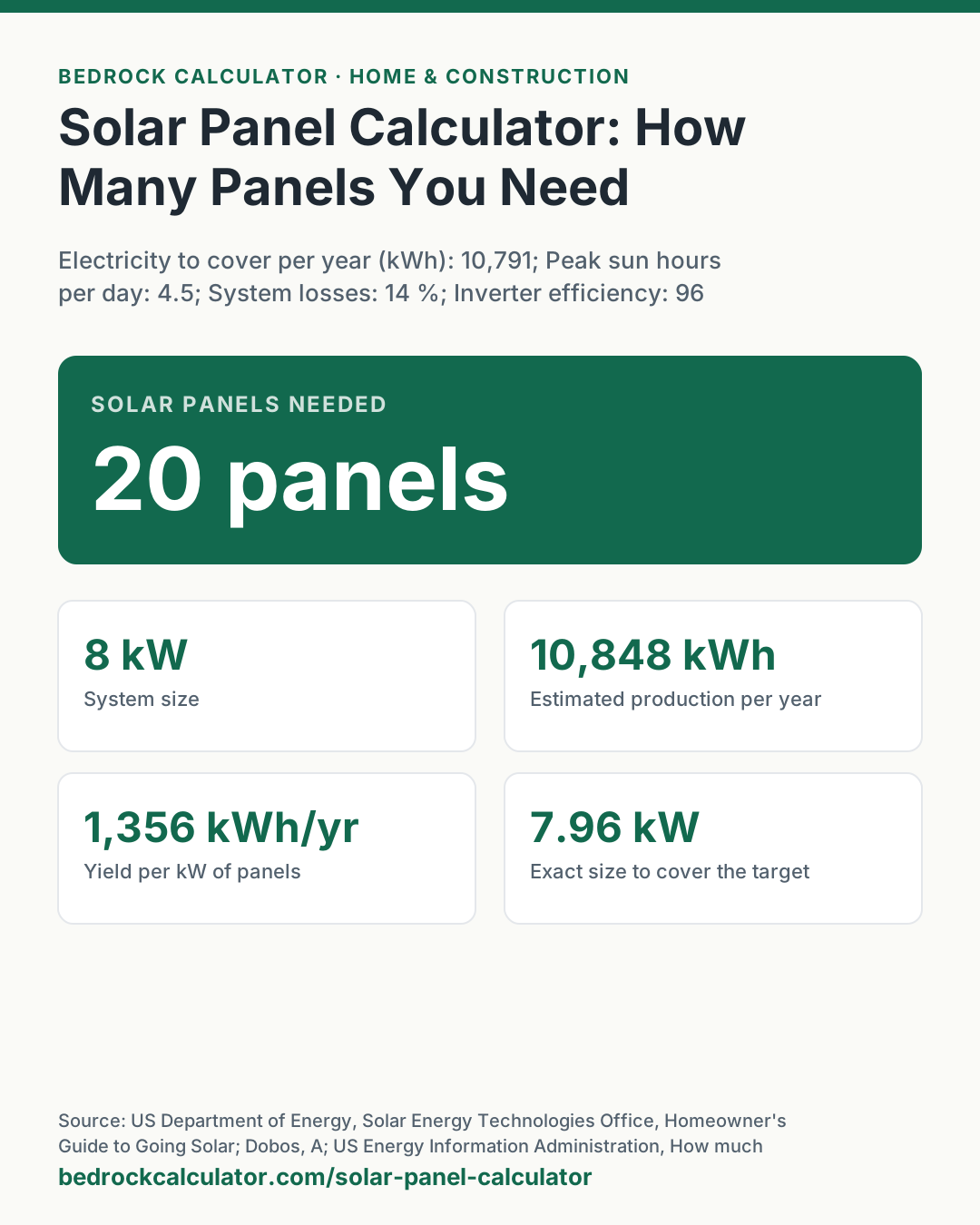
Quick Answer: To cover 10,791 kWh a year at 4.5 peak sun hours with 400 watt panels, you need 20 panels, an 8 kW system that should produce about 10,848 kWh a year after typical losses.
What does this calculator do?
This solar panel calculator estimates how many panels it takes to cover a year of electricity use. Give it the kilowatt hours you want to produce, the peak sun hours where the panels will sit, and the rating of the panel you are considering, and it works out the system size and the panel count, rounded up to whole panels.
The method is the energy chain used by PVWatts, the free tool the National Renewable Energy Laboratory built for exactly this question, run backwards. One kilowatt of panels in full sun for one hour makes one kilowatt hour of DC electricity. Losses from dirt, shading, wiring and downtime take some of it away, and the inverter takes a little more converting it to AC. The calculator uses PVWatts' own defaults for those two losses, 14% and 96%, so its yield per kilowatt matches a simple PVWatts estimate at the same sunlight.
What it cannot know is your sunlight. Peak sun hours depend on where you live, which way the roof faces and how steep it is. PVWatts will give you that figure for your address in a minute, and the calculator is only as good as the number you put in.
Using the Solar Panel Calculator
- Add up a year of electricity use from your bills, in kWh. The default, 10,791 kWh, is the US Energy Information Administration's figure for an average home in 2022.
- Enter the peak sun hours for your roof. In PVWatts, enter your address and roof angle; the annual "solar radiation" result in kWh per square metre per day is the number to use.
- Leave the losses and inverter efficiency at the PVWatts defaults unless you know better. Raise the losses for a partly shaded roof.
- Enter the panel's rated wattage from its datasheet, and optionally its area to see how much roof the array covers.
- Read the number of panels at the top, with the system size and estimated production below.
The presets compare a sunnier site at 5.5 sun hours, a cloudier one at 3.5, and a smaller 6,000 kWh target with 430 watt panels.
How is this calculated?
- Find the yield of one kilowatt of panels. Panel ratings are measured at 1 kW of sunlight per square metre, so a day with 4.5 kWh per square metre of sunlight gives each kilowatt of panels 4.5 kWh of DC energy. Over a year that is 365 times as much. System losses and the inverter then take their share.
yield per kW = sun hours × 365 × (1 − losses) × inverter efficiency
- Find the system size. Divide the yearly target by the yield per kilowatt. That is the exact DC size that would produce the target.
kW needed = (kWh per year)/(yield per kW)
- Round up to whole panels. Divide the kilowatts by the panel rating in kilowatts and round up.
panels = ⌈(kW needed × 1000)/(panel watts)⌉
- Work out what those panels produce. Panels times their rating is the actual system size. That size times the yield per kilowatt is the estimated yearly production, which is a little above the target because of the rounding.
- Add up the panel area if given. Panels times the area of one panel, in square feet and square metres.
Worked Example
The default is 10,791 kWh a year, 4.5 peak sun hours, 14% losses, a 96% inverter and 400 watt panels:
- Yield per kW: 4.5 × 365 × 0.86 × 0.96 = 1,356 kWh a year (1,356.048 before rounding).
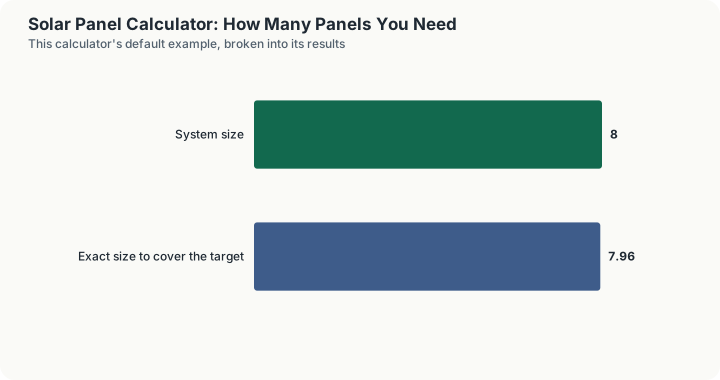
- Size needed: 10,791 ÷ 1,356.048 = 7.96 kW.
- Panels: 7.96 kW divided by 0.4 kW per panel, rounded up, is 20 panels.
- Actual system: 20 × 400 W = 8 kW, producing about 10,848 kWh a year.
At a sunnier site with 5.5 sun hours the same use takes 17 panels (6.8 kW). At a cloudier site with 3.5 sun hours it takes 26 panels (10.4 kW). The sunlight figure moves the answer more than anything else on the form.
A smaller target of 6,000 kWh with 430 watt panels of 21.5 square feet each needs 11 panels, a 4.73 kW system covering 236.5 square feet before any gaps between panels.
How Many Solar Panels Do I Need for My House?
Divide your yearly use by what one kilowatt of panels produces where you live, then divide by the panel size. For a home using the 2022 US average of 10,791 kWh, the answer runs from 17 to 26 panels of 400 watts as sun hours go from 5.5 down to 3.5.
The table below shows the range from 3 to 6.5 sun hours for three panel sizes. The Department of Energy notes that NREL's analyses use an average residential system of 7.15 kW, within a range of 3 to 11 kW, which is where most of the table falls.
What Are Peak Sun Hours?
The total sunlight a surface receives in a day, expressed as the number of hours of full-strength sun (1 kW per square metre) that would deliver the same energy. A day of 4.5 peak sun hours might be ten hours of daylight that starts weak, peaks at midday and fades.
The figure depends on latitude, climate, and the tilt and direction of the panels. The Department of Energy says panels typically do best on south-facing roofs sloped between 15 and 40 degrees.
What does this calculator not account for?
- Heat. Panels lose output as they get hot. PVWatts models cell temperature hour by hour; this calculator does not, so in a hot climate its production estimate runs high.
- Seasons and hours. A single average sun-hours figure stands in for a year of changing weather. Production in winter and summer can differ widely.
- Inverter sizing and clipping. The inverter is treated as a flat efficiency. A small inverter that clips output at midday is not modelled.
- Roof layout. Panel area is the panels alone. Setbacks from edges and ridges, vents and spacing need more roof.
- Cost, incentives and net metering. None are included. Savings depend on your rates and your utility's rules.
- Panel ageing. Output falls slowly over the years. Raise the losses if you want to size for later years.
What mistakes do people make with this?
- Using daylight hours instead of peak sun hours. Twelve hours of daylight is not twelve sun hours. Use the solar radiation figure from PVWatts.
- Using a monthly bill instead of a year. One winter or summer bill times twelve over- or under-states use. Add up a full year.
- Sizing for a roof that faces north. A north-facing roof in the northern hemisphere gets far less sun. Get the sun hours for the actual roof direction.
- Ignoring shade. A tree that shades the roof at midday can cost more than the 3% shading built into the default losses.
- Treating the result as a quote. Installers run detailed hourly models and site surveys. This is a starting estimate.
Frequently Asked Questions
How much electricity does one solar panel produce?
What size solar system do I need?
Where do I find peak sun hours for my location?
Why are system losses set to 14%?
Does the calculator include batteries?
Can I use it for a partial offset?
Sources
- US Department of Energy, Solar Energy Technologies Office, Homeowner's Guide to Going Solar: PVWatts, NREL's average residential system size, and roof orientation and slope. energy.gov/eere/solar/homeowners-guide-going-solar
- Dobos, A. P., PVWatts Version 5 Manual, NREL/TP-6A20-62641 (2014): default system losses of 14% and inverter efficiency of 96%. pvwatts.nlr.gov/downloads/pvwattsv5.pdf
- US Energy Information Administration, How much electricity does an American home use?: 10,791 kWh per residential customer in 2022. eia.gov/tools/faqs/faq.php