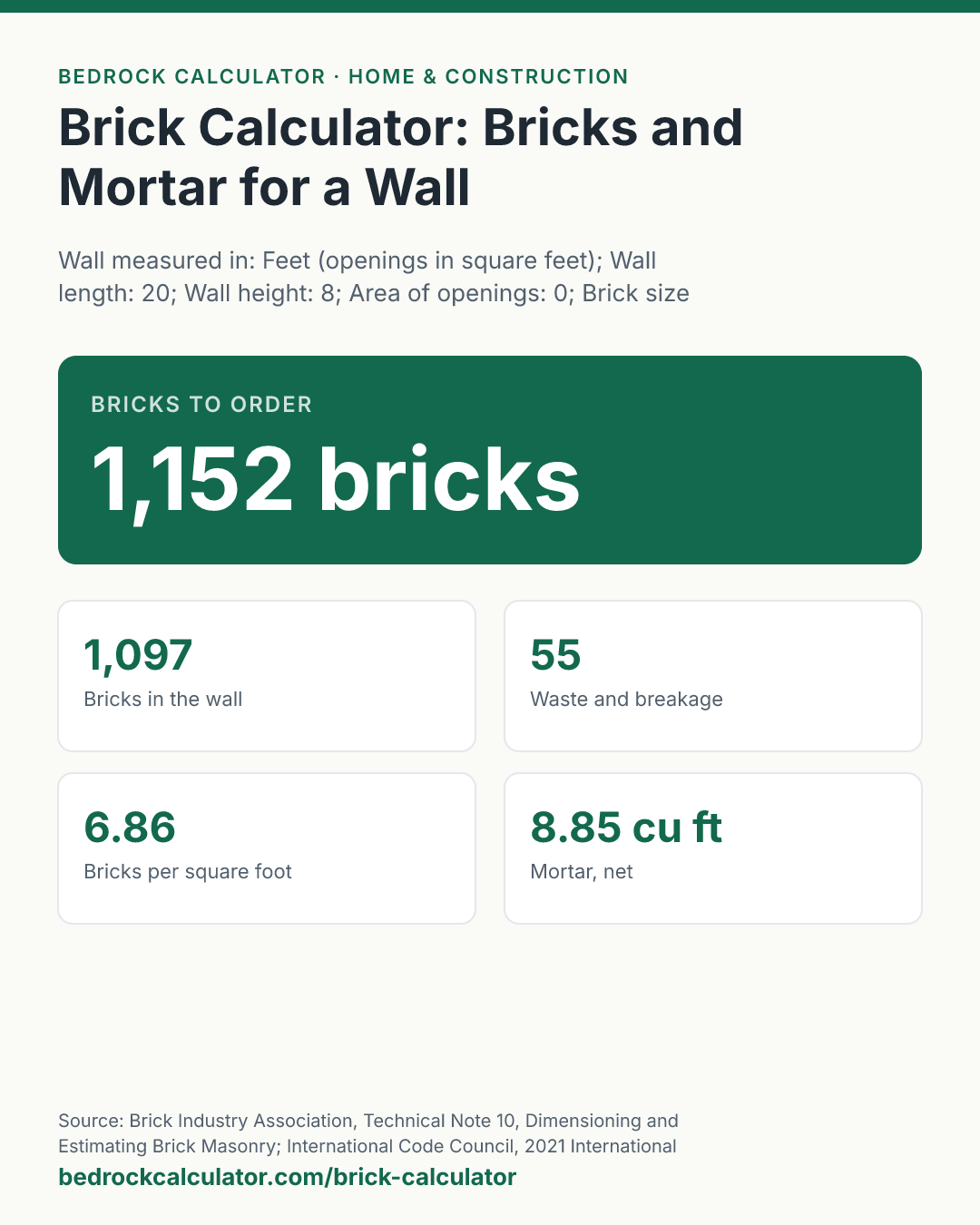
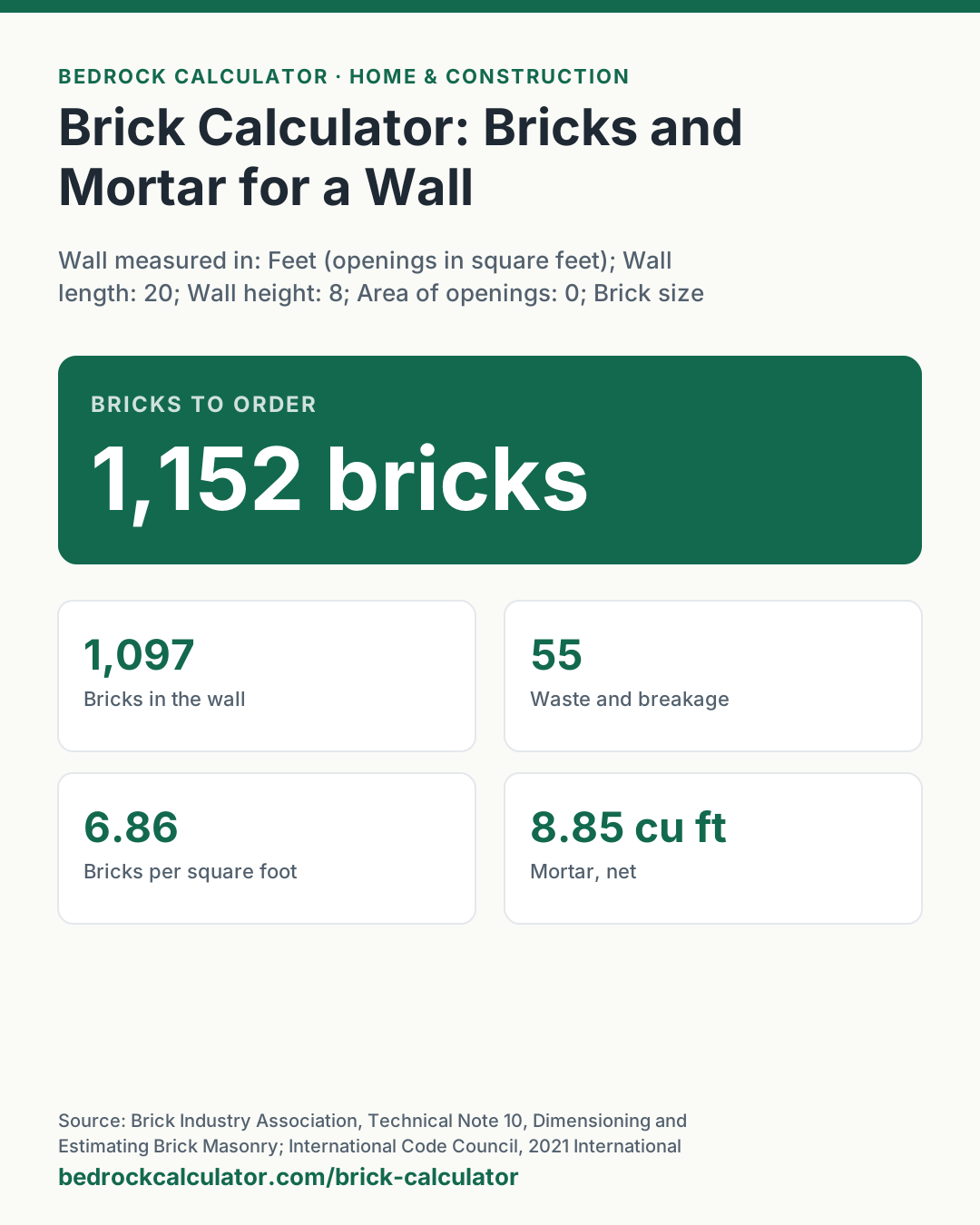
Quick Answer: A wall 20 feet long and 8 feet high in modular brick with 3/8 inch joints takes 1,097 bricks, 6.86 per square foot. With a 5% allowance for waste and breakage, order 1,152 bricks.
What does this calculator do?
This brick calculator counts the bricks for a single-thickness wall by the wall-area method, the estimating method the Brick Industry Association describes as the most widely used. Measure the wall, take off the doors and windows, and divide by the face area each brick occupies once a mortar joint is added to its length and its height.
The count depends on two things: the size of the brick and the thickness of the joint.
Pick one of ten standard brick sizes from the BIA tables, or enter your own. The calculator gives the bricks in the wall, a waste allowance as a separate line, the total to order, the bricks per square foot, and the net volume of mortar in the joints.
The defaults follow published guidance rather than guesswork: a 3/8 inch joint, which the International Residential Code sets for head and bed joints unless the drawings say otherwise, and a 5% allowance, which BIA gives as the general minimum to add to a net brick count.
Using the Brick Calculator
- Choose feet or metres and enter the wall's length and height.
- Enter the area of any doors or windows in square feet (or square metres).
- Pick the brick size. If yours is not listed, choose Custom and enter its length, height and depth in inches.
- Check the joint thickness. Leave it at 3/8 inch unless your plans say otherwise.
- Set the waste allowance and read the number of bricks to order.
The presets show the same wall less a 3 by 7 foot door, the same wall in Norman brick, and a 6 by 2 metre garden wall.
How is this calculated?
- Find the net wall area. Length times height, less the openings, converted to square feet if you measured in metres. The area cannot go below zero.
- Find the area one brick takes up. Each brick in the wall occupies its own face plus one head joint and one bed joint, so its share of the wall is (length + joint) × (height + joint). For a modular brick with 3/8 inch joints that is 8 × 2.625 = 21 square inches.
bricks per sq in = 1/((L + j)(H + j)); bricks per sq ft = 144/((L + j)(H + j))
- Count the bricks in the wall. Net area in square inches times bricks per square inch.
- Add the waste allowance as its own line, then round up. The net count times your percentage is the allowance; the total, rounded up to a whole brick, is what to order.
- Work out the mortar. In each brick's share of the wall, everything that is not brick face is joint. That fraction of the area, times the brick's depth, is the mortar volume. It is reported net, before any mortar waste.
mortar per sq in = (1 − (L × H)/((L + j)(H + j))) × depth
Worked Example
The default is a 20 by 8 foot wall of modular brick (3 5/8 × 2 1/4 × 7 5/8 inches) with 3/8 inch joints:
- Net area: 20 × 8 = 160 sq ft, or 23,040 square inches.
- One brick's share: (7.625 + 0.375) × (2.25 + 0.375) = 21 square inches, which is 6.86 bricks per square foot.
- Bricks in the wall: 23,040 ÷ 21 = 1,097.
- Waste at 5%: 55, for 1,152 bricks to order.
- Mortar: 8.85 cubic feet net (0.328 cubic yards).
Take off a 3 by 7 foot door and the net area is 139 square feet, which needs 1,001 bricks with waste. The same wall in Norman brick, which is 11 5/8 inches long, takes 4.57 per square foot and 768 bricks. A garden wall 6 metres long and 2 metres high is 129.17 square feet and needs 931 modular bricks.
How Many Bricks Are in a Square Foot?
It depends on the brick and the joint. With 3/8 inch joints, modular brick works out to 6.86 per square foot, Norman to 4.57, utility to 3 and queen to 5.76; the table below lists all ten sizes with mortar per 100 square feet.
BIA's own Table 4 gives 675 modular bricks per 100 square feet rather than the 686 here. The difference is coursing: BIA counts modular brick on its nominal 2 2/3 inch course height, three courses to 8 inches, which assumes a bed joint slightly thicker than 3/8. The calculator uses the specified size plus the joint you enter, so if your bed joints are thicker, enter the thicker joint and the count drops toward BIA's figure.
How Much Mortar Do I Need for Brick?
The mortar line is the volume of the joints themselves, worked out from the brick size and joint thickness. For modular brick with 3/8 inch joints it comes to 5.53 cubic feet per 100 square feet of wall, which matches the 5.5 in BIA's Table 4.
BIA recommends adding 15 to 25 percent to net mortar quantities for waste, so take that on top. How much cement, lime and sand that takes depends on the mortar type, which ASTM C270 sets out.
What does this calculator not account for?
- Double walls and collar joints. The count is for one wythe. A two-wythe wall needs twice the bricks plus the mortar or grout between them.
- Header courses and patterns. Running and stack bond use one brick per share of face. Flemish bond, English bond and other patterns with headers use more; BIA gives correction factors for them.
- Corners, sills and soldier courses. Cut bricks at corners and openings, and bricks laid on end over openings, change the count slightly. The waste allowance covers some of this.
- Mortar waste and ingredients. Mortar is the net volume, before the 15 to 25 percent BIA suggests for waste, and is not broken down into bags.
- Structure. Footings, ties, flashing and reinforcement belong to the code and the design, not to a quantity estimate.
What mistakes do people make with this?
- Using the nominal size with a joint added. A modular brick is nominally 8 inches long because the 7 5/8 inch brick plus a 3/8 inch joint makes 8. Adding a joint to the nominal size counts the joint twice.
- Forgetting openings, or forgetting the brick around them. Subtract doors and windows, but keep enough allowance for the cuts at their edges.
- Ordering the exact count. Some bricks arrive broken and others are cut. BIA's minimum is 5%.
- Mixing feet and metres. Openings use the same unit as the wall: square feet with feet, square metres with metres.
Frequently Asked Questions
How many bricks do I need for a 10 by 10 foot wall?
What is the most common brick size?
How thick should a mortar joint be?
Does the calculator work in metres?
How many bricks are in a pallet?
Sources
- Brick Industry Association, Technical Note 10, Dimensioning and Estimating Brick Masonry: Tables 1 and 2 (brick sizes), Table 4 (quantity estimates) and the waste allowances for brick and mortar. gobrick.com/media/file/10-dimensioning-and-estimating-brick-masonry.pdf
- International Code Council, 2021 International Residential Code, section R606.3.1: 3/8 inch head and bed joints. codes.iccsafe.org/content/IRC2021P2/chapter-6-wall-construction
- NIST Handbook 44, Appendix C, General Tables of Units of Measurement: square and cubic inches, feet and yards. nist.gov/pml/owm/nist-handbook-44-current-edition