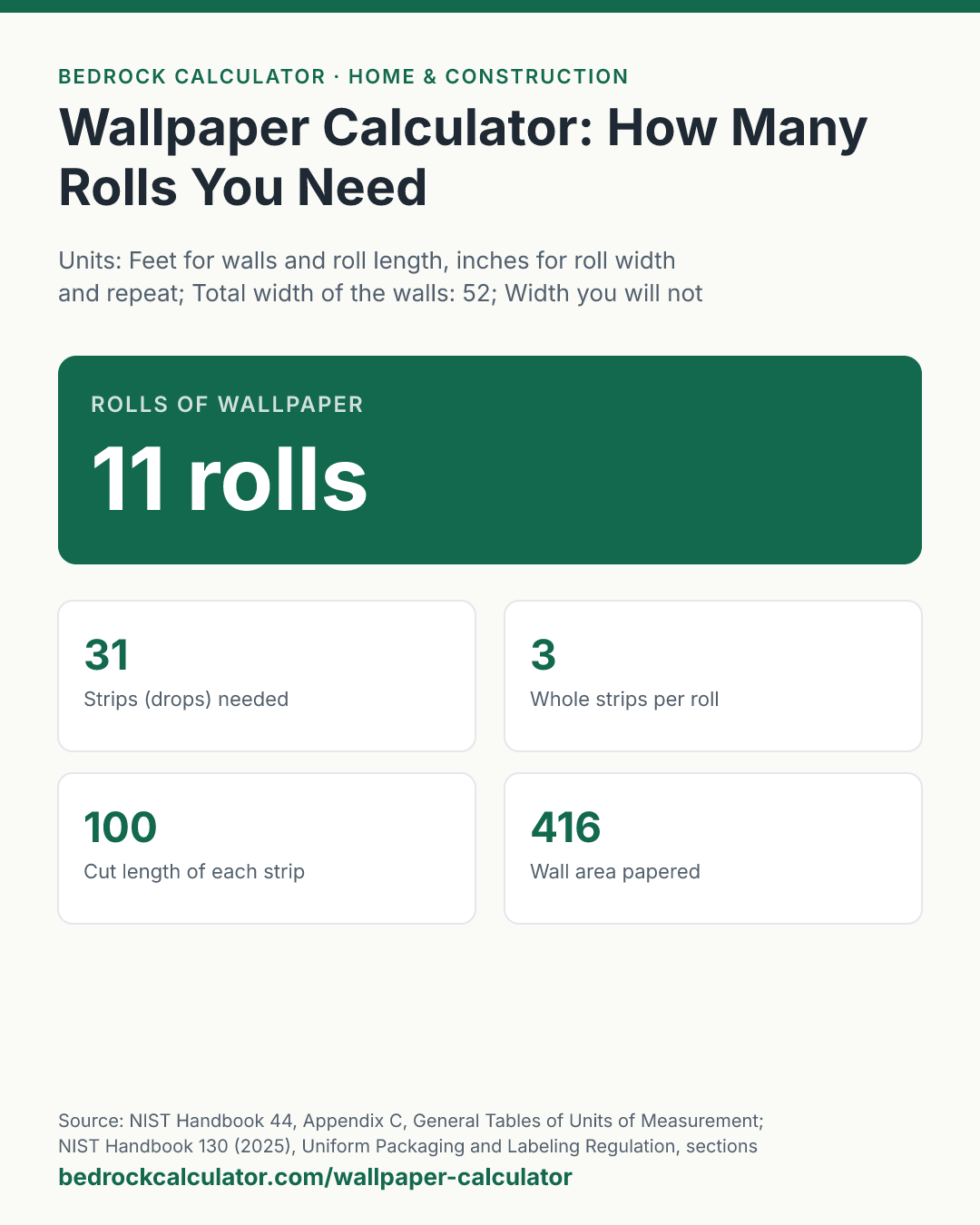
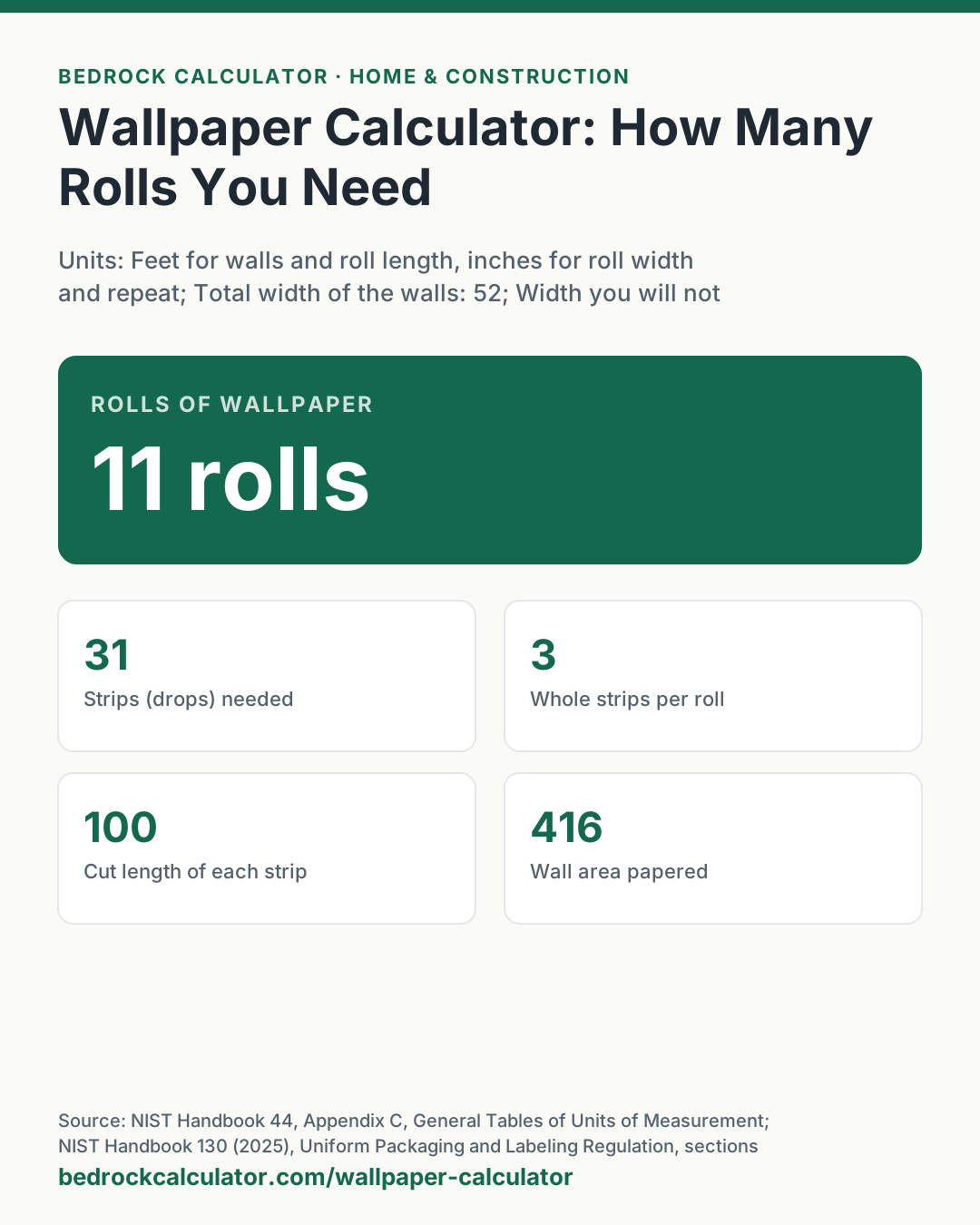
Quick Answer: A room with 52 feet of wall, 8 feet high, papered with 20.5 inch by 33 foot rolls, needs 31 strips at 3 strips per roll, which is 11 rolls. A long pattern repeat can push that much higher, so enter the repeat from the label.
What does this calculator do?
This wallpaper calculator counts rolls the way a paperhanger does, by strips rather than by square feet. Wallpaper goes on in vertical strips, called drops, each cut a little longer than the wall is high. What matters is how many whole strips you can get out of one roll, and how many strips it takes to get around the room.
Leftover paper at the end of a roll that is too short for another strip is waste, and an area-based estimate cannot see it.
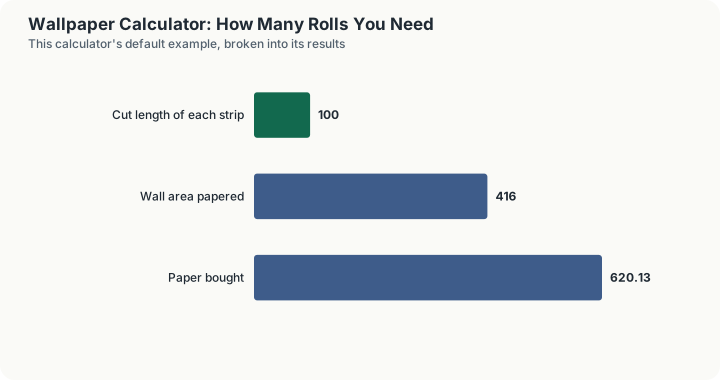
Enter the total width of the walls, the wall height, and the roll width, length and pattern repeat from the label. The calculator works out how long each strip must be cut, how many strips each roll gives, how many strips the walls need, and the number of rolls. It also shows the wall area against the area of paper you are buying, so you can see how much ends up as offcut.
You can work in feet and inches or in metres and centimetres, which suits both US rolls and the narrower European rolls.
Using the Wallpaper Calculator
- Choose US or metric units.
- Enter the total width of the walls you will paper. For a whole room that is the perimeter, twice the length plus twice the width.
- Enter the width of any doors or floor-to-ceiling openings you will skip. Leave windows in.
- Enter the wall height.
- Copy the roll width, roll length and pattern repeat from the label. Use 0 for the repeat if the paper is plain or a random match.
- Set the trim allowance, the extra you cut on each strip to trim at the top and bottom.
The presets show the same room with 9 foot walls and a 27 inch repeat, a single feature wall, and a metric room papered with 53 centimetre rolls.
How is this calculated?
- Convert everything to inches. Feet, metres and centimetres are converted exactly (1 inch is 2.54 cm).
- Find the cut length of each strip. The wall height plus the trim allowance. If the paper has a pattern repeat, that length is rounded up to a whole number of repeats so each strip starts at the same point in the pattern.
drop = ⌈(H + trim)/repeat⌉ × repeat
- Count strips per roll. The roll length divided by the drop, rounded down, because a part strip is no use.
- Count strips needed. The width to paper (total width less skipped openings) divided by the roll width, rounded up.
strips = ⌈(wall width)/(roll width)⌉
- Count rolls. Strips needed divided by strips per roll, rounded up.
- Compare areas. The wall area is the width papered times the height. The paper bought is the number of rolls times one roll's area. If a single strip would be longer than the roll, the calculator says so instead of giving a count.
Worked Example
The default is 52 feet of wall, 8 feet high, with 20.5 inch by 33 foot rolls, no repeat and a 4 inch trim:
- Drop: 96 + 4 = 100 inches.
- Strips per roll: 33 feet is 396 inches, and 396 ÷ 100 rounds down to 3.
- Strips needed: 52 feet is 624 inches, and 624 ÷ 20.5 rounds up to 31.
- Rolls: 31 ÷ 3 rounds up to 11 rolls.
- Wall area 416 sq ft; paper bought 620.13 sq ft.
Raise the walls to 9 feet and use a paper with a 27 inch repeat, and the drop becomes 108 + 4 = 112 inches, rounded up to five repeats, 135 inches. Now each roll gives only 2 strips, and the room needs 16 rolls instead of 11.
A single 14 foot feature wall at 8 feet needs 9 strips and 3 rolls.
A metric room with 16 metres of wall, 2.5 metres high, using 53 centimetre by 10.05 metre rolls and a 10 centimetre trim cuts 260 centimetre drops, gets 3 strips from each roll, needs 31 strips and so 11 rolls.
How Does Pattern Repeat Change the Number of Rolls?
Every strip has to start at the same point in the pattern so the design lines up across the seams. That means each strip is cut to a whole number of repeats, and the longer the repeat, the more paper is cut off and thrown away at each strip.
Whether that costs you a roll depends on how the drop fits into the roll length. In the table below, 9 foot walls with no repeat give 3 strips per roll, while a 27 inch repeat gives only 2, which raises the roll count by about half at every room size.
What does this calculator not account for?
- Half-drop matches. Some patterns repeat diagonally, so alternate strips start half a repeat lower. That can waste more than a straight match. Allowing an extra repeat in the trim is one way to cover it.
- Windows and small openings. These are usually papered over and cut out, so the calculator does not subtract them. Only full-height openings come off the width.
- Sloped ceilings, stairwells and chimney breasts. Every strip is the full wall height here. Shorter strips above doors and below windows can sometimes come from offcuts, which the count does not plan.
- Batch numbers. Rolls printed in different runs can differ in colour. Buy all you need, plus a spare, from one batch.
- Price. Rolls are counted, not priced, because single and double rolls are priced differently by different sellers.
What mistakes do people make with this?
- Estimating by area. Dividing wall area by roll area ignores the offcut at the end of each roll and almost always comes up short.
- Ignoring the repeat. A long repeat can add several rolls. Read it off the label.
- Single versus double rolls. In the US, wallpaper is often priced per single roll but sold in double rolls. Check the length on the label against the length you enter.
- Mixing units. In US mode the roll width and repeat are in inches but the roll length is in feet.
- Forgetting the trim. Strips cut exactly to the wall height leave no room to trim a crooked ceiling line.
Frequently Asked Questions
How many rolls of wallpaper do I need for a 12 by 12 room?
How do I measure a room for wallpaper?
What is a drop in wallpapering?
How much extra wallpaper should I buy?
Does the calculator work for metric rolls?
Sources
- NIST Handbook 44, Appendix C, General Tables of Units of Measurement: the inch, foot and yard. nist.gov/pml/owm/nist-handbook-44-current-edition
- NIST Handbook 130 (2025), Uniform Packaging and Labeling Regulation, sections 6.9 and 11.31: wallpaper and wallcovering borders labelled with their length and width. doi.org/10.6028/NIST.HB.130-2025
- National Bureau of Standards Miscellaneous Publication 233, Units of Weight and Measure: the inch of exactly 2.54 centimetres. nvlpubs.nist.gov/nistpubs/Legacy/MP/nbsmiscellaneouspub233.pdf