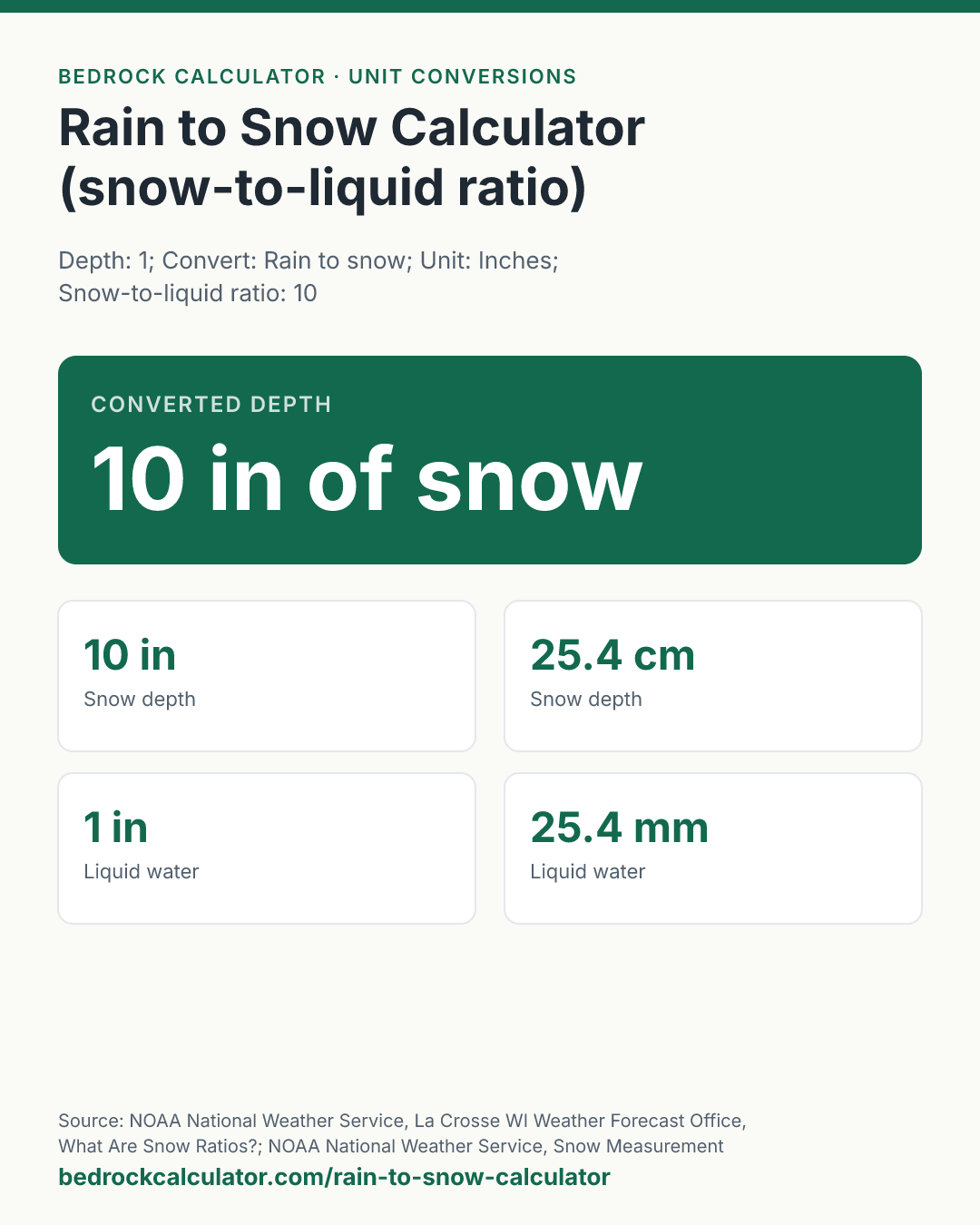

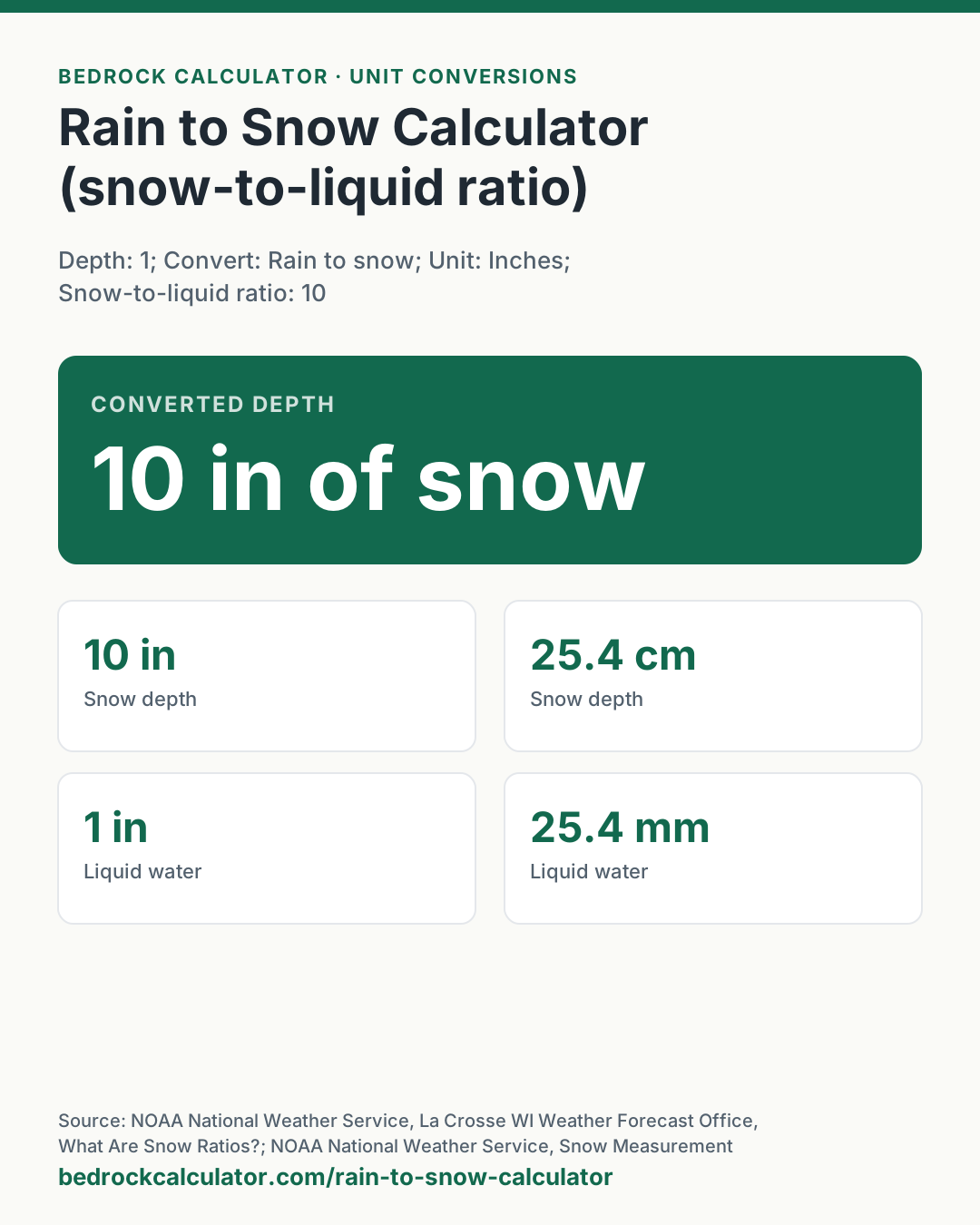
Quick Answer: At the traditional 10:1 ratio, 1 inch of rain equals 10 in of snow, and an inch of snow melts to 0.1 in of water. At the 12:1 ratio the National Weather Service in La Crosse cites for the Upper Midwest, the same inch of rain is 12 in of snow.
What does this calculator do?
This rain to snow calculator turns a depth of rain, or more precisely of liquid water, into the depth of snow it would make, and turns a snow depth back into its liquid equivalent. You choose the snow-to-liquid ratio. It starts at 10, the old rule of thumb that ten inches of snow hold one inch of water.
That ratio is a starting point, not a constant. The National Weather Service office in La Crosse, Wisconsin, describes 10:1 as an old rule of thumb that is "far from the norm", notes that a 12:1 ratio may be more representative on average for the Upper Midwest, and says the ratio can change dramatically even within one storm. Warm, wet snow packs more water into each inch, so its ratio is lower. Cold, dry, fluffy snow holds less water per inch, so its ratio is higher. Wind breaks flakes apart and lowers the ratio too.
So the calculator does one honest thing: it multiplies or divides by the ratio you give it. If a forecast states a ratio, use that. If you have measured your own, use that. If you have nothing else, 10 is the traditional default.
Using the Rain to Snow Calculator
- Type the depth.
- Choose Rain to snow or Snow to rain (liquid equivalent).
- Choose the unit: inches, centimetres or millimetres. The headline answer comes back in the same unit.
- Set the snow-to-liquid ratio, or leave it at 10.
- Read the headline, then the cards for snow depth in inches and centimetres, liquid water in inches and millimetres, and the ratio used.
The presets load an inch of snow at 10:1, an inch of rain at 12:1 and 10 mm of rain at 10:1. Below the calculator, one table shows an inch of rain at ratios from 4:1 to 30:1, and another converts rain depths from 0.05 to 3 inches at 10:1. Both download as CSV.
How is this calculated?
- Read the ratio. The ratio is units of snow per unit of liquid water. A ratio of zero or less has no meaning, so the calculator uses 10 instead and the ratio card says so.
- Scale the depth. Rain to snow multiplies the liquid depth by the ratio. Snow to rain divides the snow depth by it. Both depths are in the unit you chose.
snow depth = liquid depth × ratio; liquid depth = (snow depth)/ratio
- Convert the units. The snow and liquid depths are converted to inches, centimetres and millimetres through the exact inch of 2.54 cm.
- Round for display only. Inches and centimetres are shown to two decimal places, millimetres to one, rounded half up.
Worked Example
The default, 1 inch of rain at 10:1:
- Snow: 1 × 10 = 10 in of snow, which is 25.4 cm.
- Liquid: 1 in, or 25.4 mm.
One inch of snow to water at 10:1: 1 ÷ 10 = 0.1 in of water, or 2.5 mm.
One inch of rain at 12:1: 1 × 12 = 12 in of snow, or 30.48 cm.
10 mm of rain at 10:1: 100 mm of snow, which is 10 cm or 3.94 in.
One Inch of Rain at Different Ratios
| Snow-to-liquid ratio | Snow (in) | Snow (cm) |
|---|---|---|
| 4 | 4 | 10.16 |
| 5 | 5 | 12.7 |
| 8 | 8 | 20.32 |
| 10 | 10 | 25.4 |
| 12 | 12 | 30.48 |
| 15 | 15 | 38.1 |
| 20 | 20 | 50.8 |
| 30 | 30 | 76.2 |
The same inch of water can lie as a few inches of slush or as well over a foot of powder, which is one reason a snowfall total is harder to pin down than the water in it. Every row comes from the calculator's reference table.
How Much Snow Is an Inch of Rain?
At the 10:1 rule of thumb, an inch of rain would have been 10 inches of snow. That is the figure most people quote, and it is the calculator's default. The honest answer is "it depends on the snow": at 12:1 it is a foot, and in very wet or very dry snow it can be far from either.
When forecasters talk about a storm's "liquid equivalent", they mean this liquid depth, and the snow total depends on the ratio they expect.
How Much Rain Is an Inch of Snow?
Turned around, an inch of snow at 10:1 melts to a tenth of an inch of water, about 2.5 mm. At 12:1 it is a little less. This is the figure that matters for water supply, flooding from snowmelt and roof loads, because the weight on a roof comes from the water in the snow, not its depth.
Measuring Your Own Ratio
The National Weather Service's Snow Measurement Guidelines describe how volunteer observers do it. Measure new snowfall on a flat board to the nearest tenth of an inch. Collect snow in a rain gauge or take a core of the new snow with the gauge's outer cylinder, melt it, and measure the water to the nearest hundredth of an inch. Divide the snow depth by the water depth and you have the ratio for that snowfall, which you can type into the calculator.
What does this calculator not account for?
- How the ratio varies. The calculator uses one ratio for the whole depth. Real storms change ratio as temperatures and winds change.
- Settling and melting. Snow compacts under its own weight and melts at the ground, so snow on the ground days later is shallower than the fresh snowfall this calculator estimates.
- Mixed precipitation. Sleet and freezing rain do not follow a snow ratio.
- Gauge catch. Rain gauges catch less snow in wind, which affects any ratio measured with them.
What mistakes do people make with this?
- Treating 10:1 as a law. It is a rule of thumb. Use a forecast ratio when one is given.
- Mixing units. Enter the depth in the unit you selected. Millimetres of rain and inches of snow need the unit menu set correctly, or use the cards, which show both.
- Comparing settled snow with liquid totals. Measure fresh snowfall, not the depth of an old snowpack.
- Using the ratio for roof loads by depth. Use the liquid equivalent; it carries the weight.
Frequently Asked Questions
How many inches of snow is 1 inch of rain?
How much rain is 1 inch of snow?
How much snow is 10 mm of rain?
How much snow is half an inch of rain?
Why does the same storm give different snow totals?
Sources
- NOAA National Weather Service, La Crosse WI Weather Forecast Office, What Are Snow Ratios?: the 10:1 rule of thumb, the 12:1 Upper Midwest average and the factors that change the ratio. weather.gov/arx/why_snowratios
- NOAA National Weather Service, Snow Measurement Guidelines for National Weather Service Surface Observing Programs (2014): measuring snowfall and its water content. weather.gov/media/coop/Snow_Measurement_Guidelines-2014.pdf
- NIST Handbook 44, Appendix C, General Tables of Units of Measurement: the inch as exactly 2.54 centimetres. nist.gov/pml/owm/nist-handbook-44-current-edition