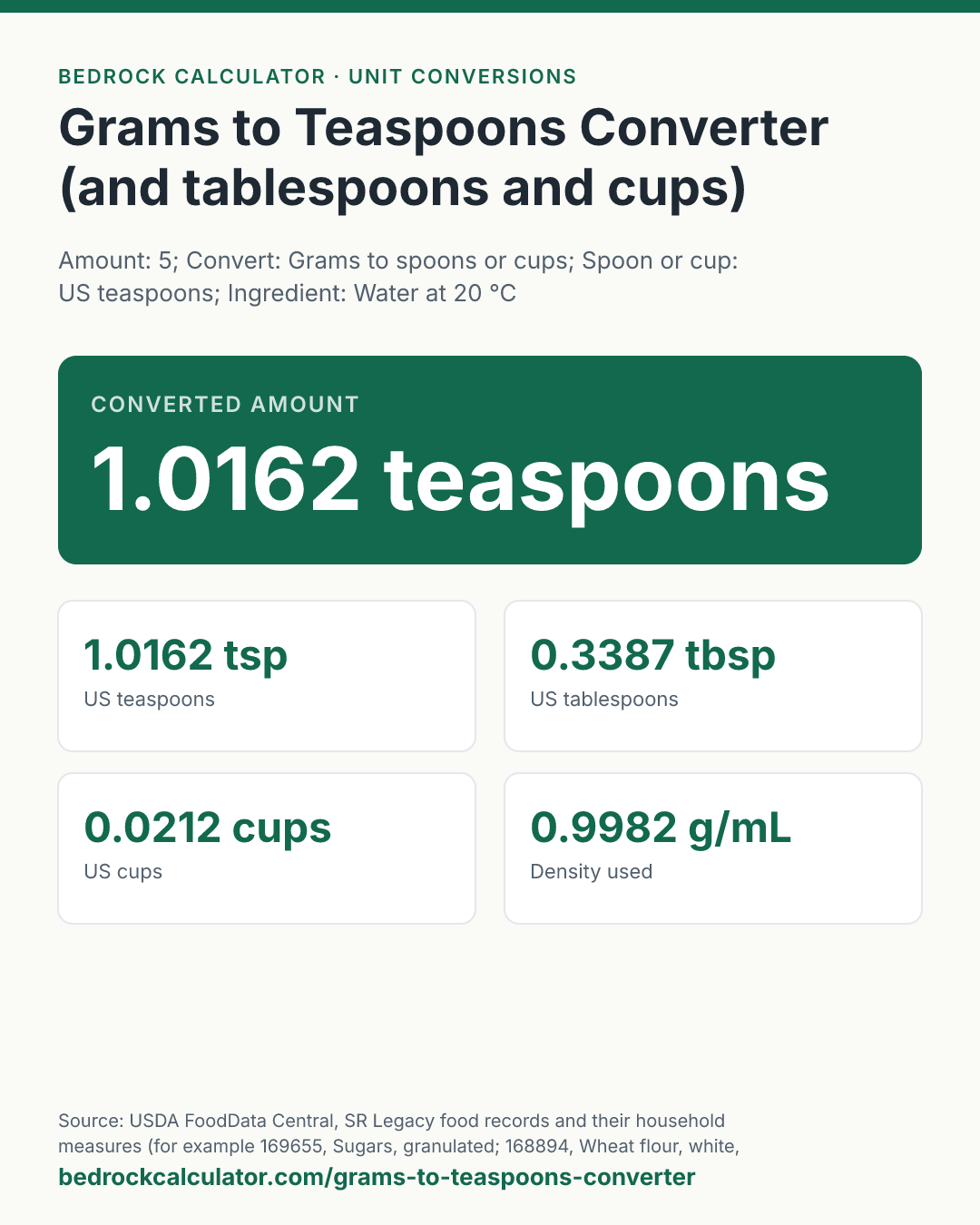
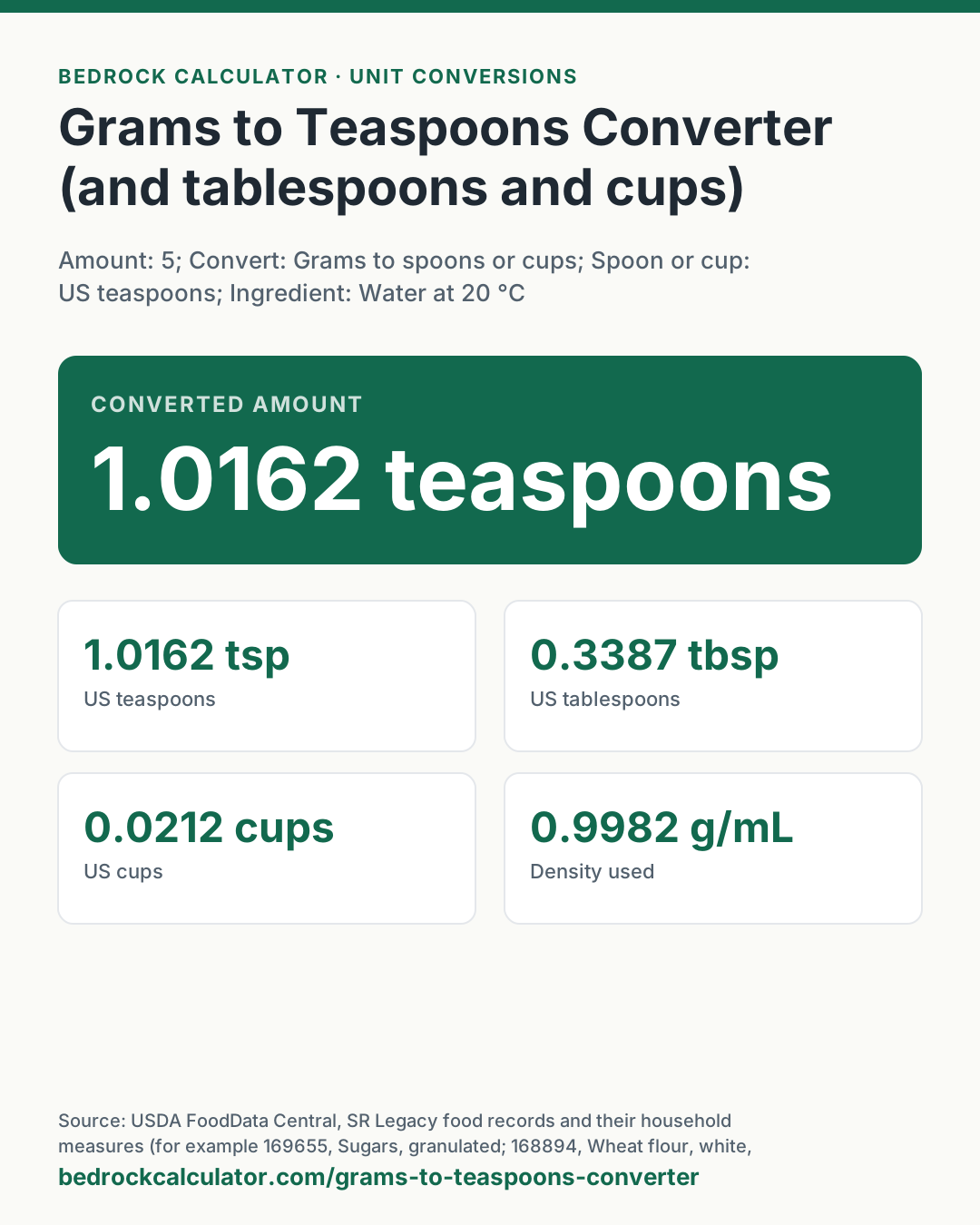
Quick Answer: 5 grams of water is 1.0162 teaspoons. For other ingredients the answer changes with density: 5 g of granulated sugar is 1.2 teaspoons, and a teaspoon of table salt weighs 6.08 g.
What does this calculator do?
This grams to teaspoons converter turns a weight in grams into US teaspoons, tablespoons or cups, and turns a spoon or cup measure back into grams. Because grams measure weight and spoons measure volume, the converter needs to know what you are measuring. It starts with water and offers fifteen common ingredients whose weights are published by USDA FoodData Central.
For anything else, you can type a density yourself.
The density is the whole story here. A level teaspoon holds the same volume of everything, about 4.93 mL, but a teaspoon of salt weighs more than twice as much as a teaspoon of flour. A converter that gives one answer for "5 grams to teaspoons" without asking what the 5 grams are has assumed a density, usually water's, without saying so. This one shows the density it uses and where that figure comes from on every result.
Where the figures come from:
- Water uses the density of pure, air-free water at 20 °C from the CIPM formula (Tanaka and others, Metrologia, 2001), 0.9982 g/mL.
- Each ingredient uses the gram weight of one household measure on its USDA FoodData Central record, such as "1 cup = 125 g" for all-purpose flour. The converter turns that measure into a density, so converting one cup returns exactly the USDA figure.
- Other uses the density you type in grams per millilitre. Nothing is guessed.
Using the Grams to Teaspoons Converter
- Type the amount: grams, or a number of spoons or cups.
- Choose Grams to spoons or cups, or the reverse.
- Choose the measure for the headline: US teaspoons, tablespoons or cups.
- Choose the ingredient. If yours is not listed, choose Other and type its density in grams per millilitre.
- Read the headline, then the cards: grams, teaspoons, tablespoons, cups and millilitres, plus the density used and its source.
The presets load 5 g of sugar to teaspoons, 125 g of flour to cups and a teaspoon of salt to grams. Below the converter, one table gives the grams in a cup, a tablespoon and a teaspoon of every listed ingredient, and another converts grams of water to spoons and cups. Both download as CSV.
How is this calculated?
- Pick the density. Water uses the CIPM formula at 20 °C. A listed ingredient uses its USDA FoodData Central measure divided by the size of that measure: for granulated sugar, 200 g per US cup of 236.5882365 mL. Other uses your figure, converted from grams per millilitre to kilograms per cubic metre. A density of zero or less is replaced by 1 g/mL, and the source card says so.
ρ = (grams in the USDA measure)/(volume of that measure)
- Convert between weight and volume. Grams to a volume divides the mass by the density; a volume to grams multiplies the volume by the density. Volumes are held as exact fractions of the US gallon: a teaspoon is 1/768 of a gallon, a tablespoon 1/256, a cup 1/16.
volume = mass/ρ; mass = volume × ρ
- Express the volume in each unit. The same volume is written as teaspoons, tablespoons, cups and millilitres for the cards.
- Round for display only. The arithmetic runs at 34 significant digits. Grams and millilitres are shown to two decimal places, spoons and cups to four, and density to four.
Worked Example
The default, 5 grams of water to teaspoons:
- Density: water at 20 °C, 0.9982 g/mL.
- Volume: 5 g ÷ 0.9982 g/mL is 5.01 mL.
- Teaspoons: 1.0162. Tablespoons: 0.3387.
5 grams of granulated sugar: USDA lists 1 cup as 200 g, a density of 0.8454 g/mL. Five grams fill 5.91 mL, which is 1.2 teaspoons.
125 grams of all-purpose flour to cups: USDA lists 1 cup as 125 g, so the answer is 1 cup, or 16 tablespoons.
One teaspoon of table salt: USDA lists 1 cup as 292 g, a density of 1.2342 g/mL, so a teaspoon weighs 6.08 g.
Grams per Spoon and Cup for Common Ingredients
| Ingredient | Per cup (g) | Per tablespoon (g) | Per teaspoon (g) |
|---|---|---|---|
| Water at 20 °C | 236.16 | 14.76 | 4.92 |
| All-purpose flour | 125 | 7.81 | 2.6 |
| Granulated sugar | 200 | 12.5 | 4.17 |
| Brown sugar, packed | 220 | 13.75 | 4.58 |
| Butter | 227 | 14.19 | 4.73 |
| Table salt | 292 | 18.25 | 6.08 |
| Honey | 339 | 21.19 | 7.06 |
| Unsweetened cocoa powder | 86 | 5.38 | 1.79 |
The full reference table below the converter adds powdered sugar, milk, two oils, rice, oats, cornstarch and baking soda, with the USDA measure behind each row.
How Many Teaspoons Is 5 Grams?
It depends on the ingredient. Five grams of water is 1.0162 teaspoons. Five grams of granulated sugar is 1.2 teaspoons, because sugar packs less mass into a spoon than water. Five grams of salt would be less than a teaspoon, and five grams of flour nearly two.
If a recipe gives grams and you only have spoons, choose the ingredient first.
How Many Grams Are in a Tablespoon?
Again, it depends on what is in the tablespoon. A US tablespoon of water weighs 14.76 g, of butter 14.19 g, of sugar 12.5 g, of flour 7.81 g and of salt 18.25 g. The ingredient table has the rest.
What does this calculator not account for?
- Packing and sifting. USDA weighed a particular way of filling the cup. Flour spooned into a cup and levelled weighs less than flour scooped and pressed; brown sugar is listed packed and powdered sugar unsifted. Your cup may differ noticeably.
- USDA's own spoon figures. Some records also list a teaspoon or tablespoon weight, measured or rounded separately. The converter derives every spoon from the cup measure so that all three agree; USDA's separate figure for a teaspoon of salt or sugar can differ from it in the first decimal place.
- Brands and varieties. Coarse kosher salt, bread flour or a different cocoa will not match the listed record.
- Heaped measures. Every figure assumes a level spoon or cup.
- Baking soda by the cup. Its USDA record gives only a teaspoon weight, so cup and tablespoon figures for it are that density scaled up.
What mistakes do people make with this?
- Assuming a gram is a millilitre. That holds roughly for water and not for most dry ingredients.
- Using the water answer for everything. Many charts quietly do this. Pick the ingredient.
- Mixing teaspoons and tablespoons. A tablespoon is three teaspoons; tsp and tbsp are easy to misread.
- Weighing milligrams with a spoon. A dose in milligrams needs a scale or the measuring tool that came with the product, not a kitchen spoon.
Frequently Asked Questions
How many grams is a teaspoon of sugar?
How many grams is a teaspoon of salt?
How many grams is a tablespoon of butter?
How many grams is a cup of flour?
How many cups is 225 g of sugar?
How many tablespoons is 50 g of butter?
What if my ingredient is not listed?
Why does a teaspoon of water show 4.92 g and not 5 g?
Sources
- USDA FoodData Central, SR Legacy food records and their household measures (for example 169655, Sugars, granulated; 168894, Wheat flour, white, all-purpose). fdc.nal.usda.gov/food-details/169655/nutrients
- USDA FoodData Central, SR Legacy 168894, Wheat flour, white, all-purpose, enriched, bleached: 1 cup = 125 g. fdc.nal.usda.gov/food-details/168894/nutrients
- USDA FoodData Central, SR Legacy 173468, Salt, table: 1 cup = 292 g. fdc.nal.usda.gov/food-details/173468/nutrients
- Metrologia 38 (2001) 301-309, Tanaka et al., Recommended table for the density of water between 0 °C and 40 °C (CIPM formula). doi.org/10.1088/0026-1394/38/4/3
- NIST Handbook 44, Appendix C, General Tables of Units of Measurement: the US gallon, cup, tablespoon and teaspoon. nist.gov/pml/owm/nist-handbook-44-current-edition