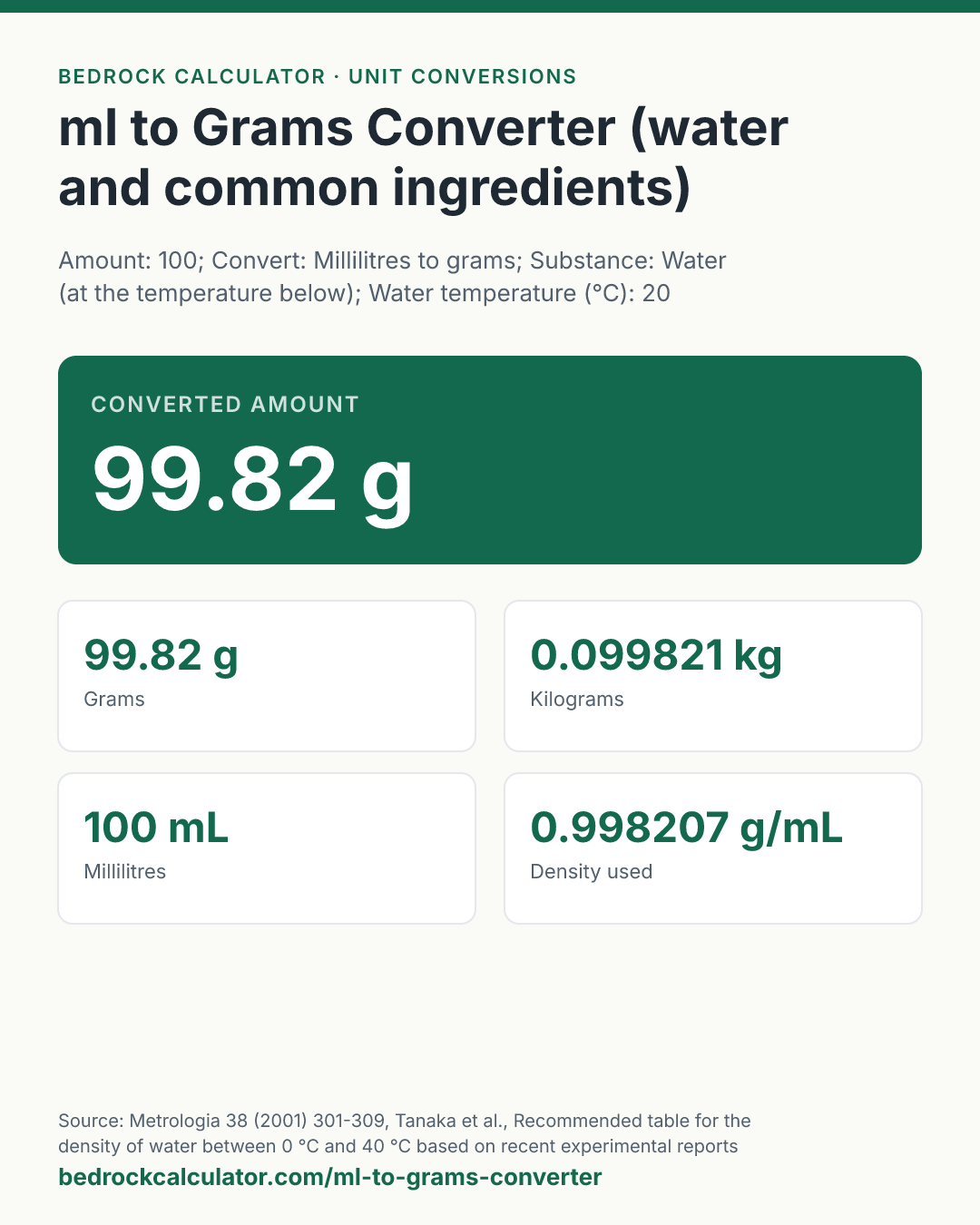
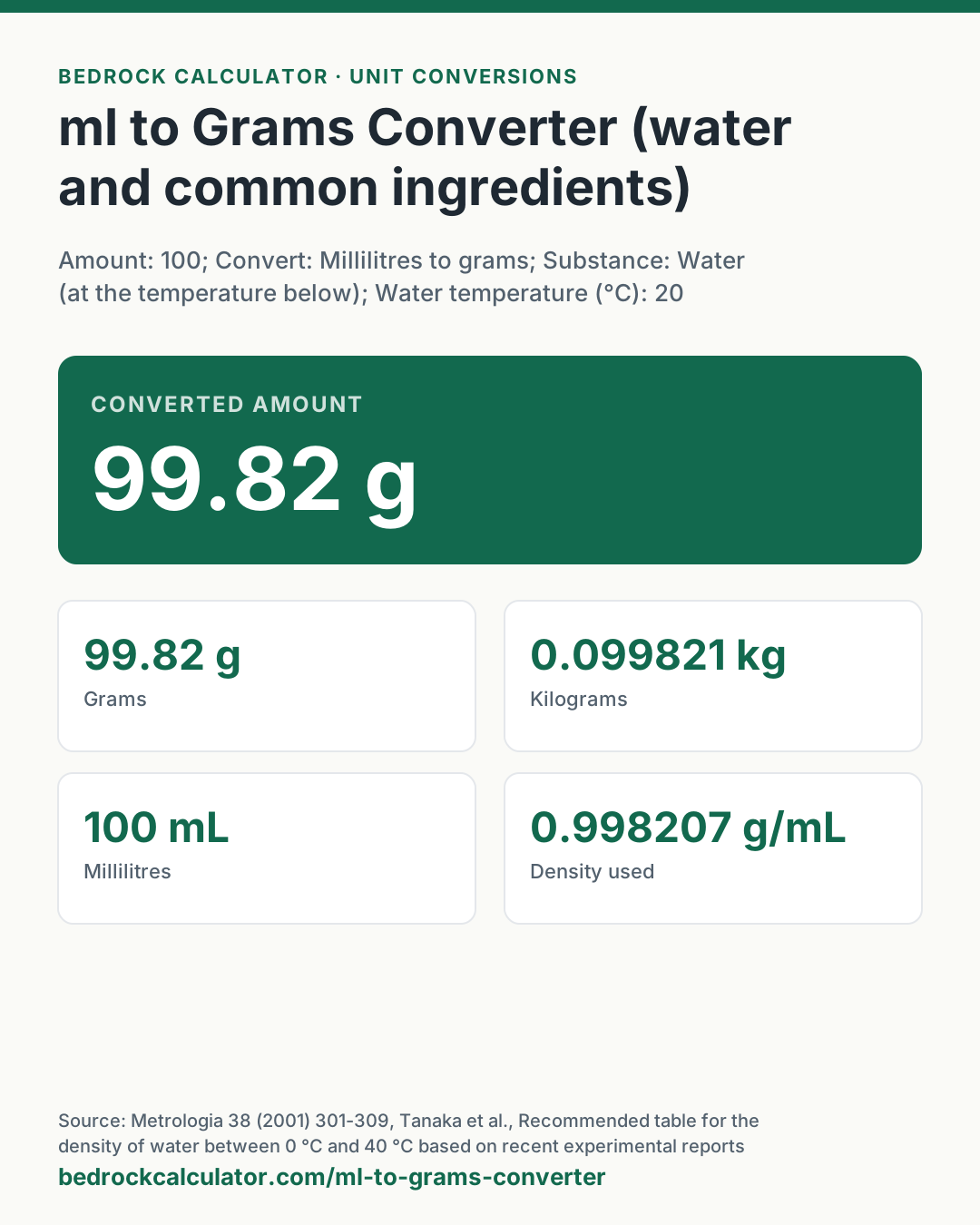
Quick Answer: 100 mL of pure water at 20 °C weighs 99.82 g, not quite 100 g, because water at room temperature is slightly less dense than 1 g/mL. At 4 °C a litre of water weighs 999.97 g, and 240 mL of whole milk weighs 247.52 g.
What does this calculator do?
This ml to grams converter turns a volume in millilitres into a weight in grams, and a weight back into a volume. It also gives the same figures in litres and kilograms, and asks what you are measuring, because density links the two.
The choices are water at a temperature you choose, one of fifteen ingredients with weights published by USDA FoodData Central, or a substance whose density you type in.
The familiar shortcut, one millilitre of water weighs one gram, is nearly right. It is not exact. Pure water reaches its greatest density just below 4 °C, and even there a litre weighs slightly less than a kilogram. At a room temperature of 20 °C, the density is 0.998207 g/mL, so 100 mL weighs 99.82 g. For cooking that gap is irrelevant. For lab work, calibrating a pipette by weighing water, or checking a scale, it matters, and so does the temperature.
For everything other than water the gap is much larger. A millilitre of honey weighs well over a gram, and a millilitre of flour well under half a gram. The converter shows the density it used and its source on every result, so you can see exactly what the answer rests on.
Using the ml to Grams Converter
- Type the amount in millilitres or grams.
- Choose Millilitres to grams or Grams to millilitres.
- Choose the substance. For water, set the temperature from 0 to 40 °C; it starts at 20 °C. For something not listed, choose Other and type its density in grams per millilitre.
- Read the headline, then the cards: grams, millilitres, kilograms, litres, the density used and where it comes from.
The presets load 240 mL of whole milk, 15 g of olive oil and a litre of water at 4 °C. Two tables below the converter give the grams in 100 mL and in a litre of every listed substance, and the density of water from 0 to 40 °C. Both download as CSV.
How is this calculated?
- Pick the density. For water, the converter evaluates the CIPM formula of Tanaka and others (Metrologia, 2001) at your temperature. That formula is the international reference for pure, air-free water at standard atmospheric pressure and covers 0 to 40 °C; a temperature outside that range is held at the nearest end, and the source card says so. For a listed ingredient, the density is its USDA FoodData Central measure divided by the volume of that measure, such as 244 g per US cup of 236.5882365 mL for whole milk. For Other, it is your figure in grams per millilitre. A typed density of zero or less is replaced by 1 g/mL, and the source card says so.
ρ_water(t) = a₅[1 − ((t + a₁)²(t + a₂))/(a₃(t + a₄))]
Here t is the temperature in °C and the five constants are those published with the formula: a1 = -3.983035, a2 = 301.797, a3 = 522528.9, a4 = 69.34881 and a5 = 999.97495 kg per cubic metre.
- Convert. Millilitres to grams multiplies the volume by the density; grams to millilitres divides the mass by it.
grams = mL × ρ; mL = grams/ρ
- Give litres and kilograms. The same mass and volume are written in kilograms and litres for the cards.
- Round for display only. The arithmetic runs at 34 significant digits. Grams and millilitres are shown to two decimal places, kilograms and litres to six, and density to six.
Worked Example
The default, 100 mL of water at 20 °C:
- Density: the CIPM formula at 20 °C gives 0.998207 g/mL.
- Grams: 100 × 0.998207 = 99.82 g, or 0.099821 kg.
240 mL of whole milk: USDA lists 1 cup of whole milk as 244 g, a density of 1.031328 g/mL. So 240 mL weighs 247.52 g.
15 g of olive oil: USDA lists 1 cup as 216 g, a density of 0.912979 g/mL, so 15 g fills 16.43 mL, a little more than a tablespoon.
One litre of water at 4 °C: 999.97 g. Water is at its densest near this temperature, and even so a litre falls just short of a kilogram.
Grams in 100 mL and 1 Litre
| Substance | Grams in 100 mL | Grams in 1 L |
|---|---|---|
| Water at 20 °C | 99.82 | 998.21 |
| Whole milk | 103.13 | 1,031.33 |
| Olive oil | 91.3 | 912.98 |
| Honey | 143.29 | 1,432.87 |
| Granulated sugar | 84.54 | 845.35 |
| All-purpose flour | 52.83 | 528.34 |
| Table salt | 123.42 | 1,234.21 |
The full table below the converter covers all fifteen ingredients with the USDA measure behind each.
How Many Grams Is 1 ml?
For water at room temperature, about 0.998 g; at 4 °C, almost exactly 1 g. For other liquids it is their density in grams per millilitre: milk is a little over 1, oils a little over 0.9, honey over 1.4. For dry ingredients a millilitre holds even less, because there is air between the grains.
A litre is 1,000 mL, so the same number tells you the kilograms in a litre.
Water Density and Temperature
| Temperature (°C) | Density (g/mL) | Grams in 1 L |
|---|---|---|
| 0 | 0.999843 | 999.84 |
| 4 | 0.999975 | 999.97 |
| 20 | 0.998207 | 998.21 |
| 25 | 0.997047 | 997.05 |
| 37 | 0.993329 | 993.33 |
| 40 | 0.992215 | 992.22 |
Water is densest near 4 °C and lighter both colder and warmer. The 20 °C and 25 °C rows are the usual laboratory reference temperatures.
What does this calculator not account for?
- Dissolved air and salts. The CIPM formula is for pure, air-free water. Tap water, seawater and air-saturated water differ slightly.
- Pressure. The formula assumes standard atmospheric pressure.
- Packing of dry ingredients. A USDA cup of flour is one way of filling a cup. Sifted, spooned or packed flour gives a different density.
- Temperature of other liquids. Milk and oils also change density with temperature. Their USDA figures are single measurements and are used as they are.
- Ice. Below 0 °C water is ice, which the formula does not cover.
What mistakes do people make with this?
- Assuming 1 mL is 1 g for everything. It is close only for water and water-like liquids.
- Forgetting the temperature in a lab. Calibrating a pipette by weighing water at 25 °C and assuming 1 g/mL ignores the difference between 0.997047 g/mL and 1 g/mL, which shows up as a false volume error.
- Using the wrong milk or oil. Skim milk, cream and nut oils are not the same as the listed records.
- Mixing up mL and mg. A milligram is a thousandth of a gram, a weight. A millilitre is a volume.
Frequently Asked Questions
How many grams is 15 ml?
How many grams is 240 ml?
How many ml is 1,000 grams of water?
How many kilograms is a litre of water?
How do I convert grams to ml for something not listed?
Is a millilitre the same as a cubic centimetre?
Sources
- Metrologia 38 (2001) 301-309, Tanaka et al., Recommended table for the density of water between 0 °C and 40 °C based on recent experimental reports (CIPM formula). doi.org/10.1088/0026-1394/38/4/3
- USDA FoodData Central, SR Legacy 171265, Milk, whole, 3.25% milkfat, with added vitamin D: 1 cup = 244 g. fdc.nal.usda.gov/food-details/171265/nutrients
- USDA FoodData Central, SR Legacy 171413, Oil, olive, salad or cooking: 1 cup = 216 g. fdc.nal.usda.gov/food-details/171413/nutrients
- USDA FoodData Central, SR Legacy 169640, Honey: 1 cup = 339 g. fdc.nal.usda.gov/food-details/169640/nutrients
- NIST Handbook 44, Appendix C, General Tables of Units of Measurement: the US cup used in the USDA measures. nist.gov/pml/owm/nist-handbook-44-current-edition
- NIST Special Publication 811, Guide for the Use of the International System of Units (2008): the litre and the millilitre. nist.gov/pml/special-publication-811