Quick Answer: Your Required Minimum Distribution equals your prior year-end account balance divided by the IRS life expectancy factor for your age from the Uniform Lifetime Table.
Overview
Once you reach the applicable age, the IRS requires you to withdraw a minimum amount each year from Traditional IRAs, 401(k)s, and most other tax-deferred retirement accounts, whether or not you actually need the money. This is the Required Minimum Distribution, or RMD, and it exists because those accounts deferred income tax on the way in; the government eventually needs to collect it. The RMD age was raised from 72 to 73 by the SECURE 2.0 Act of 2022 for individuals turning 72 after December 31, 2022, with a further scheduled increase to age 75 for those turning 74 after 2032. This calculator's input range starts at age 73, reflecting the current applicable starting age for most account owners under the post-SECURE 2.0 rules.
The RMD amount isn't an arbitrary percentage. It comes from actuarial life expectancy. The IRS Uniform Lifetime Table, codified in Treasury Regulation §1.401(a)(9)-9 and reproduced in IRS Publication 590-B, assigns a "distribution period" (a divisor, effectively an estimate of remaining years of life expectancy plus a margin) to every age from 73 upward. As you age, that divisor shrinks, and a shrinking divisor mechanically increases the percentage of your balance you must withdraw each year, since the same account balance is being divided by a smaller number. At age 73 the divisor is 26.5, meaning you must withdraw roughly 1/26.5, or about 3.77%, of your balance; by age 90 the divisor has fallen to 12.2, meaning the required withdrawal percentage has more than doubled to roughly 8.2%.
Failing to withdraw at least the full RMD by the deadline (generally December 31 of the distribution year, with a one-time grace period for your very first RMD) triggers an excise tax penalty. That penalty was substantially reduced by SECURE 2.0, from 50% of the shortfall down to 25%, with a further reduction to 10% if the shortfall is corrected within a two-year correction window, but it remains a meaningful, avoidable cost for anyone who simply forgets to take the distribution.
How This Is Calculated
Step 1: Look up your distribution factor. The IRS Uniform Lifetime Table assigns a divisor to your age (the account owner's age as of December 31 of the distribution year):
| Age | Factor | Age | Factor | Age | Factor |
|---|---|---|---|---|---|
| 73 | 26.5 | 80 | 20.2 | 90 | 12.2 |
| 74 | 25.5 | 82 | 18.5 | 95 | 8.9 |
| 75 | 24.6 | 85 | 16.0 | 100 | 6.4 |
| 76 | 23.7 | 87 | 14.4 | 105 | 4.6 |
| 78 | 22.0 | 88 | 13.7 | 110 | 3.5 |
Step 2: Divide your prior year-end balance by the factor.
Step 3: Convert to a monthly equivalent, if desired.
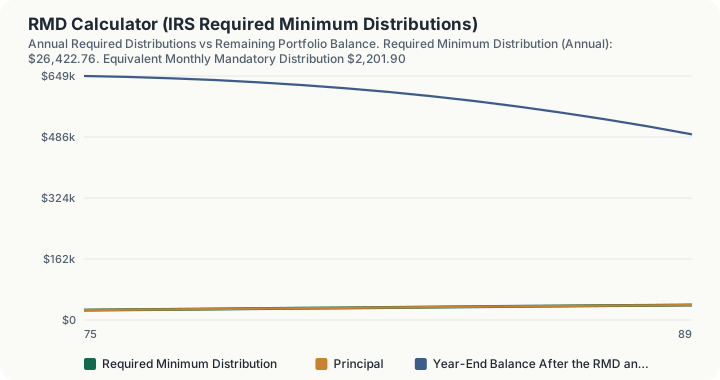
Step 4: Project forward. The calculator also runs a 15-year projection, applying each subsequent year's own age-based factor to the remaining balance and modeling continued portfolio growth after each year's distribution is subtracted, to illustrate how the required distribution amount and remaining balance evolve over time.
Worked Example
Using this calculator's baseline inputs: a $650,000 prior year-end account balance and an account owner age of 75.
- Look up the distribution factor for age 75: 24.6, per the IRS Uniform Lifetime Table
- Annual RMD: $650,000 ÷ 24.6 = $26,422.76
- Monthly equivalent: $26,422.76 ÷ 12 = $2,201.90
That $26,422.76 represents roughly 4.07% of the account balance, already noticeably above the 3.77% required at age 73. The required percentage climbs even before accounting for any investment growth in the account. Swap in a 90-year-old with the same $650,000 balance and the age-90 factor of 12.2 produces an RMD of $650,000 ÷ 12.2 = $53,278.69, more than double the age-75 amount on an identical balance, purely as a function of the shrinking life expectancy divisor.
Carrying the Distribution Forward
- Age 75: RMD $26,422.76. After the distribution and 4% growth on the remainder, the year-end balance is $648,520.33 -- almost exactly where it started.
- Age 76: the divisor shortens, so the RMD rises to $27,363.73 on the smaller balance. Year-end balance $646,002.86.
- Age 80: RMD $31,282.54, year-end balance $624,649.66.
- Age 89: RMD $39,859.19, year-end balance $493,297.29.
Across those fourteen years the required distribution climbs 50.9% while the account falls only 24.1%. That is the divisor doing the work: the IRS table shortens faster than 4% growth can refill the account, so the required percentage of the balance rises every single year even when the balance itself is holding up. The tax planning consequence is that the largest RMDs, and therefore the largest forced income, arrive in the years when the account is least able to absorb them.
What This Does Not Account For
- Multiple retirement accounts and the aggregation rule. If you own several Traditional IRAs, the IRS allows you to calculate each account's RMD separately but withdraw the combined total from any one or a combination of them; this calculator computes the RMD for a single account balance only.
- Roth 401(k) and Roth IRA distinctions. Roth IRAs are not subject to RMDs during the original owner's lifetime, and since SECURE 2.0, in-plan Roth 401(k) balances are also exempt from RMDs starting in 2024. This calculator models a Traditional, RMD-subject account.
- The still-working exception. Employees still working past the RMD age who do not own more than 5% of the company may be able to delay RMDs from their current employer's 401(k) until actual retirement; this exception is not modeled here.
- Inherited account RMD rules. Beneficiaries of inherited IRAs and 401(k)s are subject to different, often more restrictive distribution rules (including the 10-year rule for most non-spouse beneficiaries under the SECURE Act), which differ substantially from the original-owner Uniform Lifetime Table used here.
- Qualified Charitable Distributions (QCDs). Donating up to the annual QCD limit directly from an IRA to a qualified charity can satisfy some or all of your RMD without it counting as taxable income, an option this calculator does not model.
Common Pitfalls
- Using the current year's balance instead of the prior year-end balance. RMDs are always calculated using the account balance as of December 31 of the prior year, not the balance on the day you calculate or withdraw.
- Missing the deadline for your very first RMD. You have until April 1 of the year after you reach the RMD age to take your first distribution, but doing so means you will owe two RMDs in that same calendar year, which can push you into a higher tax bracket; most people are better off taking the first RMD by the standard December 31 deadline instead.
- Forgetting that RMDs are ordinary taxable income. The distributed amount is added to your taxable income for the year; it is not a tax-free return of principal, even though it was your own money originally.
- Using the wrong IRS life expectancy table. The Uniform Lifetime Table used here applies to most account owners; a different, more favorable Joint Life and Last Survivor Table applies only if your sole beneficiary is a spouse more than 10 years younger than you.
- Not withdrawing enough across multiple accounts. Aggregating IRA balances to calculate a combined RMD is allowed for IRAs, but 401(k) RMDs generally must be taken separately from each individual 401(k) plan; mixing up these aggregation rules is a common, penalty-triggering mistake.
Frequently Asked Questions
At what age do RMDs start?
What happens if I don't take my full RMD?
How is the distribution factor determined?
Do Roth IRAs require RMDs?
Can I reinvest my RMD if I don't need the cash?
What is a Qualified Charitable Distribution and how does it affect my RMD?
Sources
- IRS Publication 590-B, Distributions from Individual Retirement Arrangements (IRAs), irs.gov/publications/p590b
- IRS Publication 575, Pension and Annuity Income, irs.gov/publications/p575
Also consulted: Treasury Regulation §1.401(a)(9)-9, Uniform Lifetime Table; SECURE 2.0 Act of 2022, Pub. L. No. 117-328, RMD age and penalty provisions.