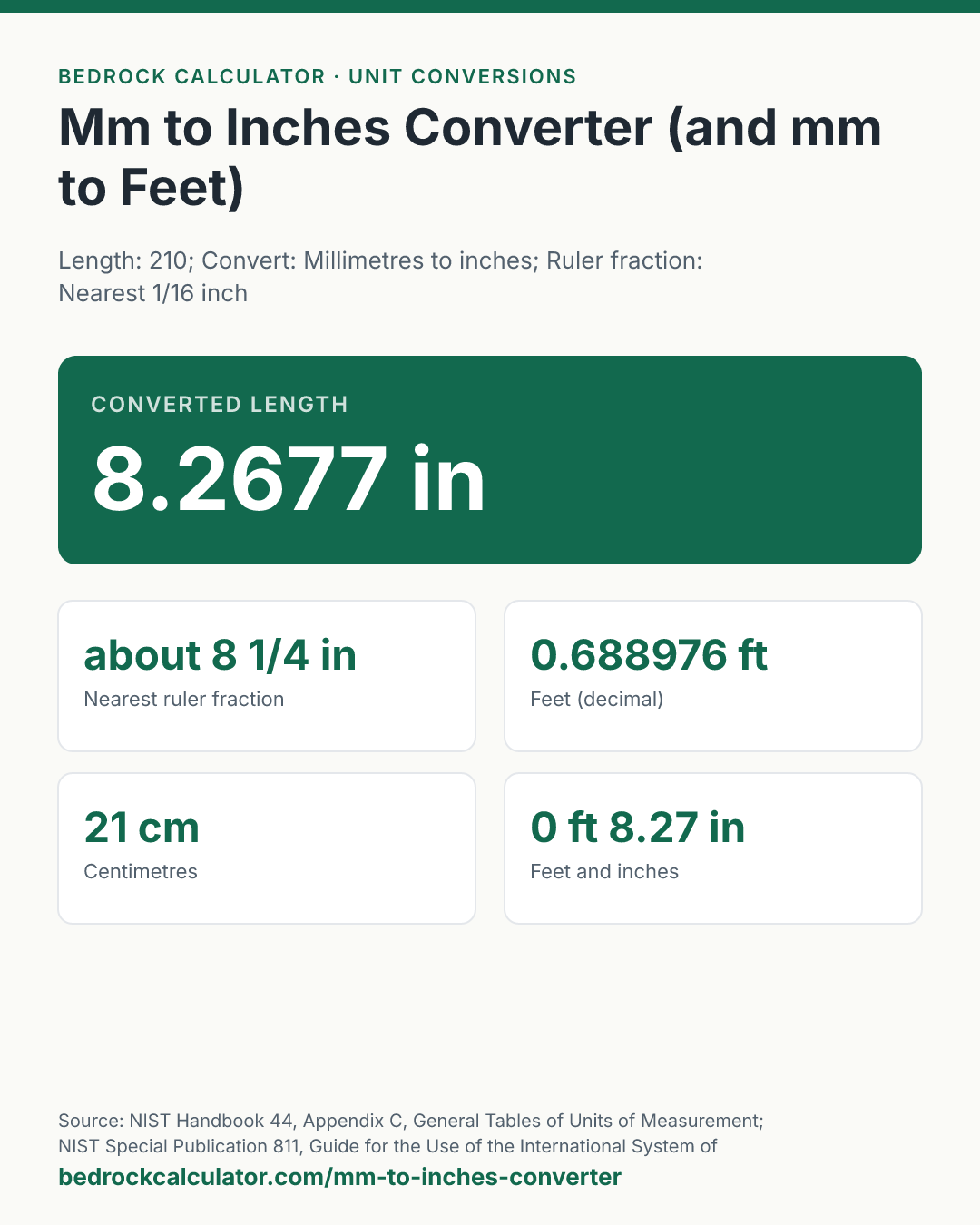
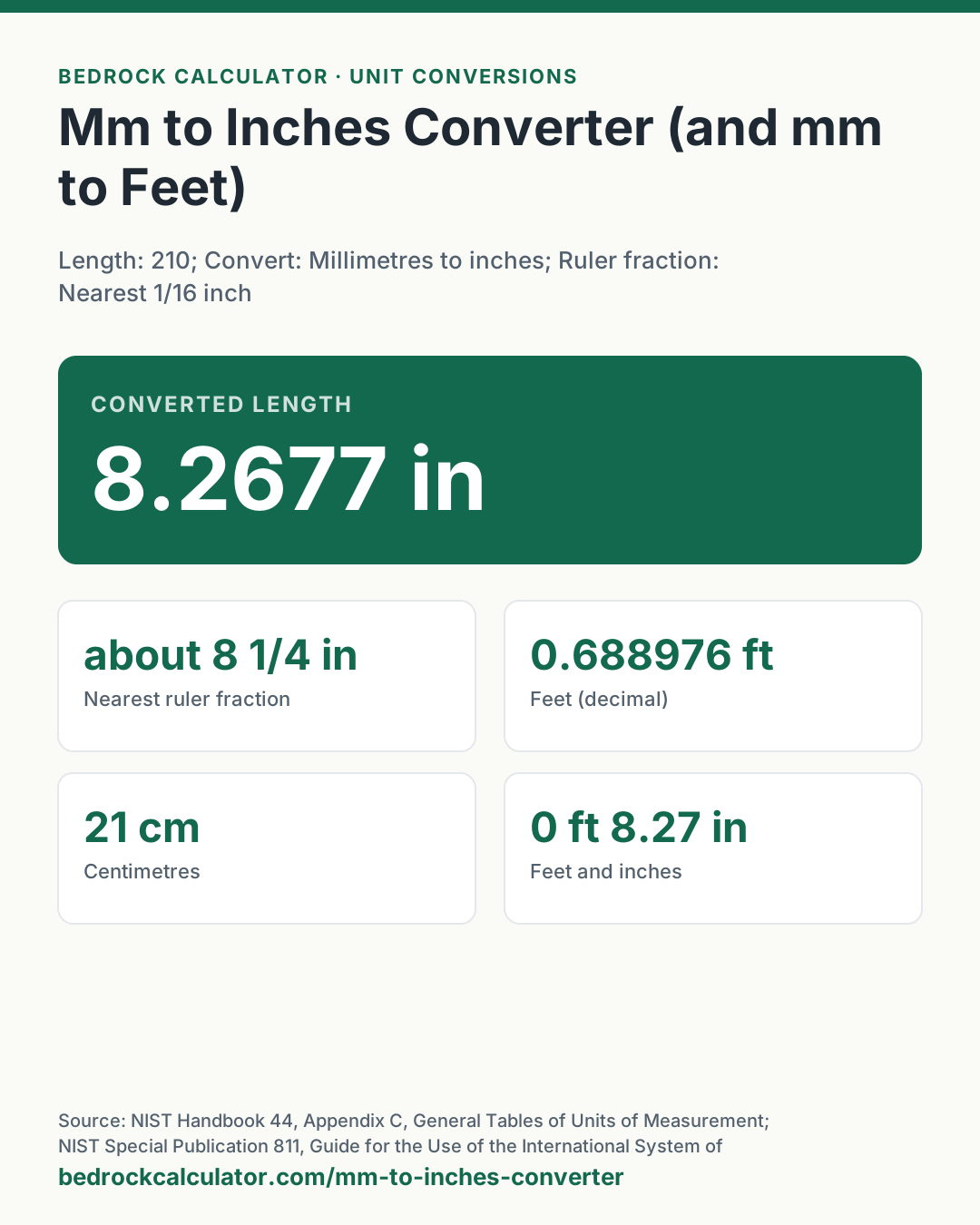
Quick Answer: 210 mm is 8.2677 in, about 8 1/4 inches on a tape measure. 1.5 mm is 0.0591 in, a quarter inch is 6.35 mm, and 2,400 mm is 7.874016 ft.
What does this calculator do?
This mm to inches converter turns millimetres into inches or feet, and inches or feet back into millimetres. Alongside the decimal answer it gives the nearest fraction of an inch, the way a tape measure or a drill index reads, so 210 mm comes out as 8.2677 inches and about 8 1/4 inches.
Both conversions are exact. Since 1959 the inch has been defined as exactly 25.4 millimetres, and the foot as 12 inches, exactly 304.8 mm. The decimal inches are rounded only for display. The ruler fraction is a separate, deliberately rounded reading: it snaps the inch figure to the nearest sixteenth (or eighth, thirty-second or sixty-fourth, if you choose), and it says "about" whenever that snapping changed the value.
Millimetres are the standard for hardware, sheet thickness, paper sizes, bike parts and engineering drawings, while US tools and lumber are marked in inches and feet. The default, 210 mm, is the short side of an A4 sheet of paper.
Using the Mm to Inches Converter
- Type the length.
- Choose the direction: millimetres to inches, inches to millimetres, millimetres to feet, or feet to millimetres.
- Choose how fine the ruler fraction should be. Sixteenths match most tape measures.
- Read the result at the top. The cards show decimal inches, the nearest ruler fraction, decimal feet, feet and inches, millimetres and centimetres.
The preset buttons load 1.5 mm, a quarter inch, a 2,400 mm board and 8 feet. Below the converter are two tables: millimetres to inches, and common inch fractions to millimetres.
How is this calculated?
- Choose the starting unit. The direction tells the converter whether your number is in millimetres, inches or feet. A negative length is read as zero.
- Convert through the metre. The millimetre is stored as 0.001 m, the inch as exactly 0.0254 m and the foot as exactly 0.3048 m. The converter multiplies your number by the size of the unit you started in and divides by the size of the unit you want.
inches = mm/25.4; feet = mm/304.8; mm = inches × 25.4
- Find the nearest ruler fraction. The inch figure is multiplied by the chosen denominator (16 by default), rounded half up to a whole number, and written as whole inches plus a reduced fraction. 132 sixteenths is 8 4/16, written 8 1/4. If the rounded fraction reaches a whole inch, it carries. The reading says "about" when rounding changed the value, and nothing when the fraction is exact. A length shorter than half of the smallest mark is reported as such rather than as zero.
- Split into feet and inches. The length in feet is cut at the decimal point; the leftover is turned into inches and rounded half up to two decimal places, with a carry into the next foot at 12.
- Round for display only. Decimal inches are shown to four places, feet to six, millimetres and centimetres to four, rounded half up with trailing zeros dropped.
Worked Example
The default, 210 mm to inches:
- Inches: 210 ÷ 25.4 = 8.26771..., shown as 8.2677 in.
- Ruler fraction: 8.26771 × 16 = 132.28, which rounds to 132 sixteenths, so about 8 1/4 in.
- Feet: 0.688976 ft, or 0 ft 8.27 in. Centimetres: 21 cm.
1.5 mm to inches: 1.5 ÷ 25.4 = 0.0591 in, which is about 1/16 in.
A quarter inch to millimetres: 0.25 × 25.4 = 6.35 mm exactly. The fraction is exact, so it reads 1/4 in with no "about".
2,400 mm to feet: 2,400 ÷ 304.8 = 7.874016 ft, which is 7 ft 10.49 in, or about 94 1/2 inches.
8 feet to millimetres: 8 × 304.8 = 2,438.4 mm.
Millimetres to Inches: Common Sizes
| mm | Inches | Nearest 1/16 inch |
|---|---|---|
| 1 | 0.0394 | about 1/16 |
| 3 | 0.1181 | about 1/8 |
| 5 | 0.1969 | about 3/16 |
| 6 | 0.2362 | about 1/4 |
| 8 | 0.315 | about 5/16 |
| 10 | 0.3937 | about 3/8 |
| 12 | 0.4724 | about 1/2 |
| 16 | 0.6299 | about 5/8 |
| 19 | 0.748 | about 3/4 |
| 22 | 0.8661 | about 7/8 |
| 25.4 | 1 | 1 |
| 50 | 1.9685 | about 1 15/16 |
| 100 | 3.937 | about 3 15/16 |
| 297 | 11.6929 | about 11 11/16 |
| 1,000 | 39.3701 | about 39 3/8 |
297 mm is the long side of A4 paper; 210 mm is the short side.
Inch Fractions to Millimetres
| Inches | Millimetres |
|---|---|
| 1/16 | 1.5875 |
| 1/8 | 3.175 |
| 3/16 | 4.7625 |
| 1/4 | 6.35 |
| 5/16 | 7.9375 |
| 3/8 | 9.525 |
| 1/2 | 12.7 |
| 5/8 | 15.875 |
| 3/4 | 19.05 |
| 7/8 | 22.225 |
| 1 | 25.4 |
Every value in this table is exact.
How Do You Convert mm to Feet?
Divide the millimetres by 304.8, the exact number of millimetres in a foot. 2,400 mm is 7.874016 ft. For a length in feet and inches, the converter also splits the result: 2,400 mm is 7 ft 10.49 in. Going the other way, multiply feet by 304.8: 8 ft is 2,438.4 mm.
What does this calculator not account for?
- Nominal sizes. A "2 by 4" board, a 1/2 inch pipe and many bolt and wrench sizes are names, not measurements. A 1/2 inch pipe is not 12.7 mm across.
- Metric and imperial tool fit. Metric and inch sockets and drills that look close are different sizes. A 13 mm socket is not a 1/2 inch socket. Use the decimal figure, not the rounded fraction, when the fit matters.
- Weight. An ounce is a weight and a millimetre a length, so there is no number of millimetres in an ounce.
- Tolerances. The conversion is exact; manufactured parts are not.
What mistakes do people make with this?
- Trusting the fraction for a tight fit. The fraction is rounded to the nearest mark. 6 mm reads about 1/4 inch, but a quarter inch is 6.35 mm.
- Dividing by 25 instead of 25.4. The shortcut is a few percent out, which is visible on anything longer than a hand span.
- Mixing up mm and cm. 210 mm is 21 cm. Paper, screen and furniture sizes are often given in either.
- Reading decimal feet as feet and inches. 7.874016 ft is not 7 ft 8.7 in. The feet and inches card gives 7 ft 10.49 in.
Frequently Asked Questions
How many inches is 210 mm?
What is 1.5 mm in inches?
How many mm are in an inch?
How many mm are in a foot?
What is 10 mm in inches?
How many mm is 5/16 of an inch?
How many millimetres are in one ounce?
Sources
- NIST Handbook 44, Appendix C, General Tables of Units of Measurement: the inch and the foot. nist.gov/pml/owm/nist-handbook-44-current-edition
- NIST Special Publication 811, Guide for the Use of the International System of Units (2008), Appendix B: conversion factors to SI. nist.gov/pml/special-publication-811
- National Bureau of Standards Miscellaneous Publication 233, Units of Weight and Measure (revised to the 1959 refinement of the yard and the pound announced in the Federal Register, 24 FR 5348). nvlpubs.nist.gov/nistpubs/Legacy/MP/nbsmiscellaneouspub233.pdf