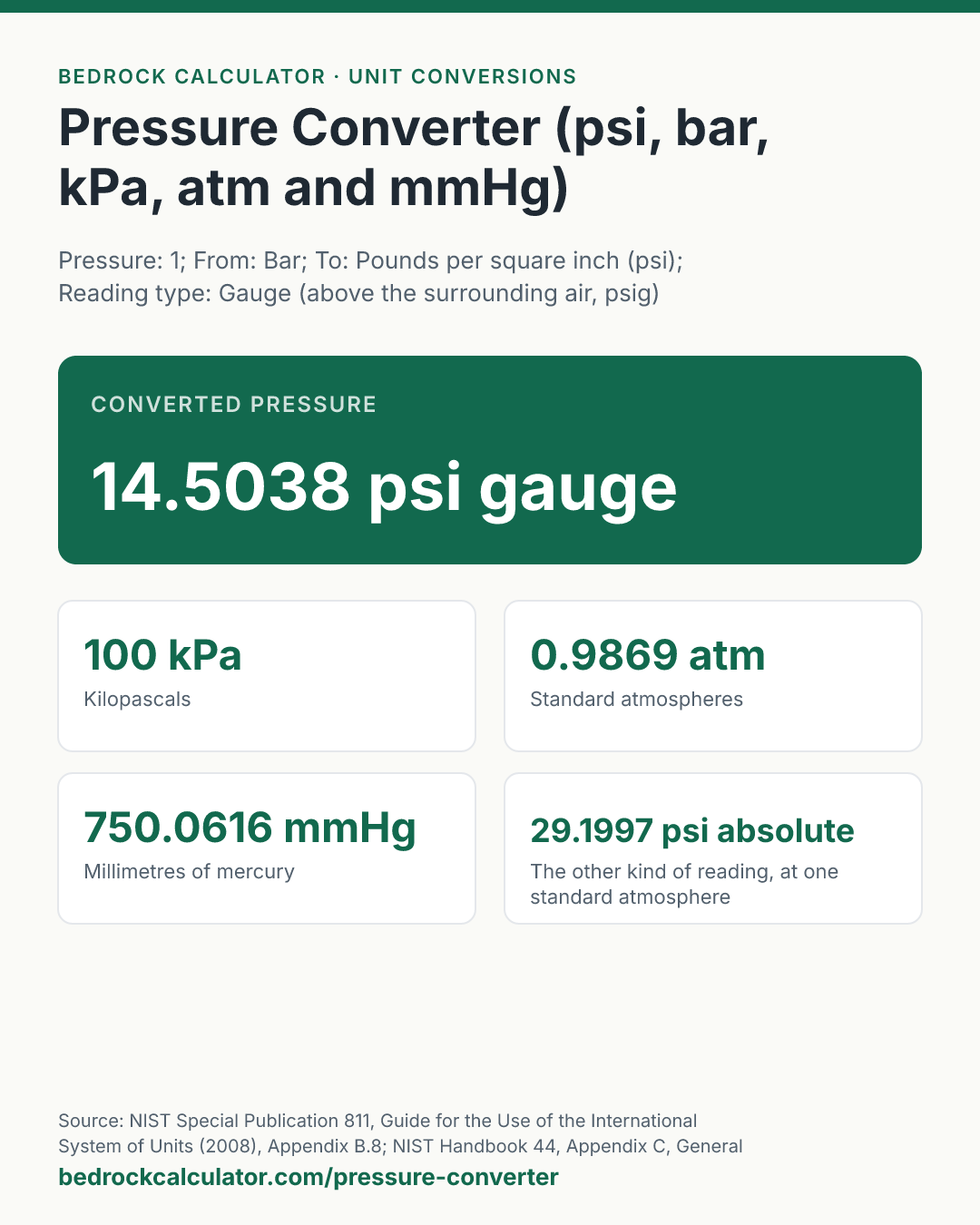

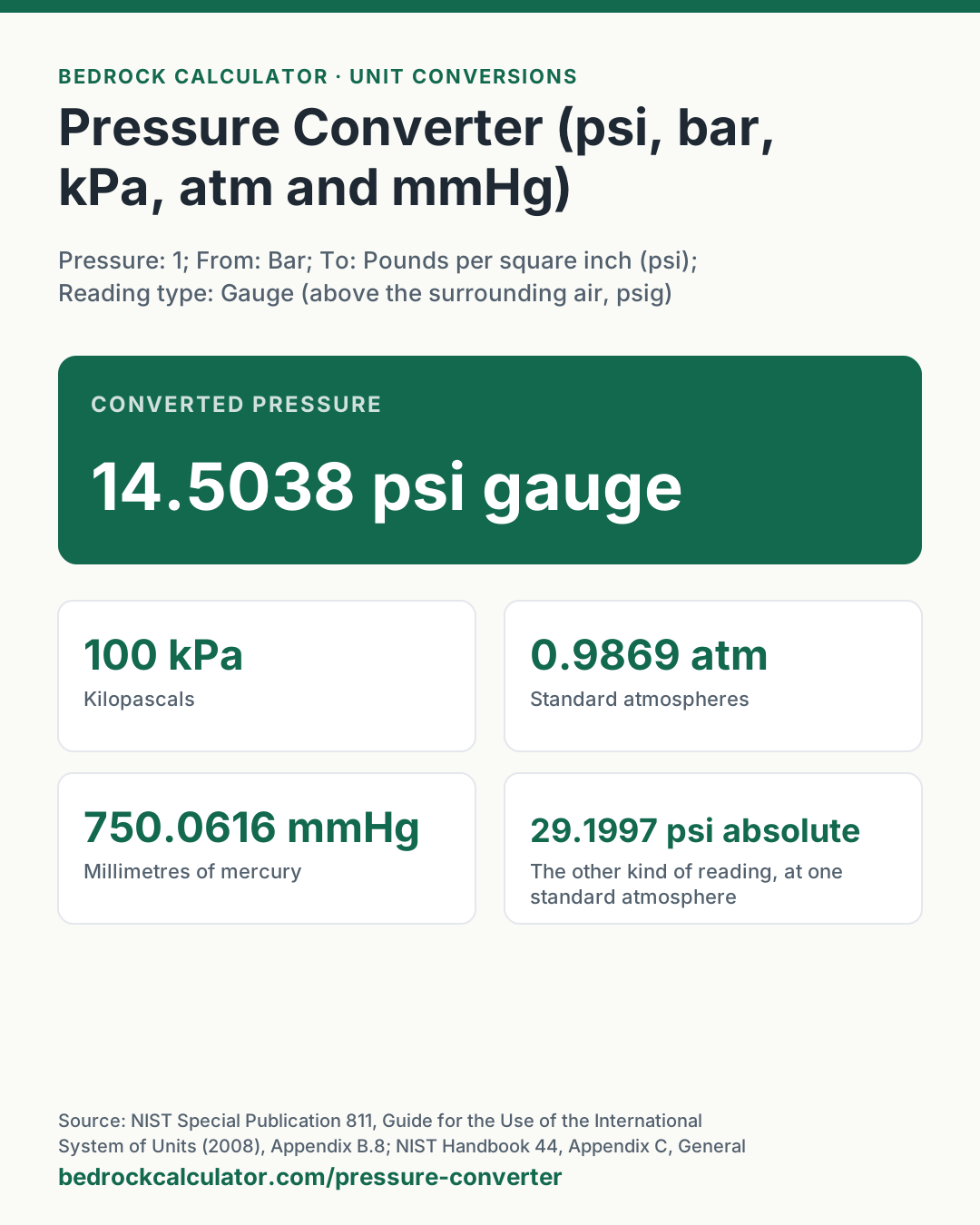
Quick Answer: 1 bar is 14.5038 psi, so 10 bar is 145.0377 psi and a 32 psi tyre is 2.2063 bar. A gauge reading of 1 bar is 29.1997 psi absolute at one standard atmosphere.
What does this calculator do?
This pressure converter changes a pressure between psi, bar, millibar, pascals, hectopascals, kilopascals, megapascals, standard atmospheres, millimetres of mercury, torr and inches of mercury. Choose the unit you have and the unit you want; the main units are listed under the answer.
It also deals with the question that trips people up more than the units do: whether a reading is gauge or absolute. A tyre gauge reads zero on a flat tyre even though the air inside is at atmospheric pressure. It measures how far the pressure is above the surrounding air, which is gauge pressure, often written psig. A barometer or a vacuum gauge measures from a perfect vacuum, which is absolute pressure, psia. Converting units never changes the kind of reading, so 5 bar gauge is 72.5189 psi gauge. The converter keeps the kind, and also shows the reading of the other kind by adding or subtracting one standard atmosphere.
Every unit factor is exact. The bar is 100,000 pascals, the standard atmosphere is 101,325 pascals, and psi is one pound-force on one square inch, built from the exact pound, inch and standard gravity.
Using the Pressure Converter
- Type the pressure. A gauge reading can be negative, down to minus one atmosphere, which is a perfect vacuum.
- Choose its unit in From and the unit you want in To.
- Choose Gauge if the number came from a tyre gauge, compressor, hose or pump dial, or Absolute if it is a weather, altitude, vacuum or scientific figure.
- Read the result at the top. The cards show psi, bar, kilopascals, atmospheres, mmHg and inHg, plus the same reading converted to the other kind.
The preset buttons load a 32 psi tyre, a 10 bar pump rating, one atmosphere in mmHg, and the standard sea-level pressure of 1013.25 hPa in inches of mercury.
How is this calculated?
- Check the floor. An absolute pressure cannot be below zero, and a gauge reading cannot be below minus one standard atmosphere. A lower number is raised to that floor.
- Convert through the pascal. Each unit is stored as its exact size in pascals. The bar is 100,000 Pa, the millibar and the hectopascal are 100 Pa, the standard atmosphere is 101,325 Pa, and the torr is 101,325/760 Pa. psi is the pound-force (0.45359237 kg × 9.80665 m/s²) divided by a square inch (0.0254 m squared), 6,894.757... Pa. The conventional millimetre of mercury is 13,595.1 kg/m³ × 0.001 m × 9.80665 m/s² = 133.322387415 Pa, and the inch of mercury uses the same basis over an inch. The converter multiplies your number by the size of the unit you started in and divides by the size of the unit you want.
psi = (bar × 100000)/6894.757...; kPa = bar × 100
- Show the other kind of reading. The converted reading has one standard atmosphere, expressed in the target unit, added to it if it was gauge, or subtracted if it was absolute.
p_absolute = p_gauge + 101325 Pa
- Round for display only. Every unit is shown to four decimal places, rounded half up with trailing zeros dropped.
Worked Example
The default, 1 bar gauge to psi:
- Pascals: 1 × 100,000 = 100,000 Pa, which is 100 kPa.
- psi: 100,000 ÷ 6,894.757... = 14.5038 psi, still a gauge reading.
- Absolute: 14.5038 + 14.6959 (one atmosphere in psi) = 29.1997 psi absolute.
A 32 psi tyre: 32 psi gauge is 2.2063 bar gauge, or 220.6322 kPa. As an absolute pressure it is 3.2196 bar.
10 bar to psi: 145.0377 psi. The same figure is 1 MPa, since a megapascal is 10 bar.
5 bar to psig: a 5 bar gauge reading is 72.5189 psi gauge, which is 87.2148 psi absolute.
One atmosphere in mmHg: 759.9999 mmHg. The conventional millimetre of mercury is defined from a mercury density, while the torr is defined as exactly 1/760 of an atmosphere, so they differ in the seventh significant figure. One atmosphere is exactly 760 torr.
1013.25 hPa is 29.9213 inHg, the standard pressure US weather reports round to 29.92.
Bar to psi: Common Values
| bar | psi | kPa |
|---|---|---|
| 0.5 | 7.25 | 50 |
| 1 | 14.5 | 100 |
| 2 | 29.01 | 200 |
| 2.2 | 31.91 | 220 |
| 2.5 | 36.26 | 250 |
| 3 | 43.51 | 300 |
| 4 | 58.02 | 400 |
| 5 | 72.52 | 500 |
| 8 | 116.03 | 800 |
| 10 | 145.04 | 1,000 |
| 200 | 2,900.75 | 20,000 |
psi to bar: Tyres and Tools
| psi | bar | kPa |
|---|---|---|
| 28 | 1.9305 | 193.05 |
| 30 | 2.0684 | 206.84 |
| 32 | 2.2063 | 220.63 |
| 35 | 2.4132 | 241.32 |
| 40 | 2.7579 | 275.79 |
| 60 | 4.1369 | 413.69 |
| 90 | 6.2053 | 620.53 |
| 100 | 6.8948 | 689.48 |
| 3,000 | 206.8427 | 20,684.27 |
What Is the Difference Between psig and psia?
psig is gauge pressure: the pressure above the air around the gauge. psia is absolute pressure: the pressure above a perfect vacuum. At sea level on a standard day they differ by one atmosphere, 14.6959 psi.
NIST's style guide asks that the gauge or absolute label go on the quantity rather than the unit, so you will see "a gauge pressure of 5 bar" in technical writing, while trade literature writes 5 barg or 72.5189 psig. The number converts the same way either way; only the zero point differs.
The converter assumes the gauge was zeroed against one standard atmosphere. The real air pressure falls as you climb, so in a mountain town the true absolute pressure for the same gauge reading is lower than the figure shown.
How Many psi Is 1 Bar?
1 bar is 14.5038 psi to four decimal places. To convert bar to psi, multiply by 14.5038 (the same rule answers convertir bar a psi). In the other direction, 1 psi is 0.0689 bar.
What does this calculator not account for?
- Local air pressure. The gauge to absolute conversion uses the standard atmosphere, 101,325 Pa. Weather and altitude change the real figure.
- Temperature. A tyre's pressure rises as it warms up. The converter changes units; it does not correct a hot reading to a cold one.
- Inches or feet of water. Water column units are not included.
- mmHg at a stated temperature. NIST lists inch of mercury values at 32 °F and 60 °F as well. This converter uses the conventional values only.
What mistakes do people make with this?
- Adding an atmosphere twice. If a figure is already absolute, do not add 14.7 again. Pick the reading type that matches the source.
- Using 14.5 for big numbers. 14.5 is close for one bar but the gap grows: 200 bar is 2,900.75 psi, not 2,900.
- Mixing up MPa and mPa. A megapascal is a million pascals; a millipascal is a thousandth of one.
- Treating torr and mmHg as identical everywhere. They match to better than one part in a million, which is fine for blood pressure and vacuum work, but they are defined differently.
Frequently Asked Questions
How many psi is 2 bar?
How many psi is 10 bar?
What is 5 bar in psig?
How many kPa is one atmosphere?
How many mmHg are in an atmosphere?
How many psi is 1 MPa?
Is psi gauge or absolute?
Sources
- NIST Special Publication 811, Guide for the Use of the International System of Units (2008), Appendix B.8: bar, millibar, standard atmosphere, torr, conventional millimetre and inch of mercury, and pound-force per square inch. Section 7.4 on attaching information such as "gauge" to the quantity rather than the unit. nist.gov/pml/special-publication-811
- NIST Handbook 44, Appendix C, General Tables of Units of Measurement: the avoirdupois pound and the inch. nist.gov/pml/owm/nist-handbook-44-current-edition
- NOAA, JetStream: Air Pressure (standard sea-level pressure of 1013.25 mb and 29.92 inHg, and pressure falling with altitude). noaa.gov/jetstream/atmosphere/air-pressure