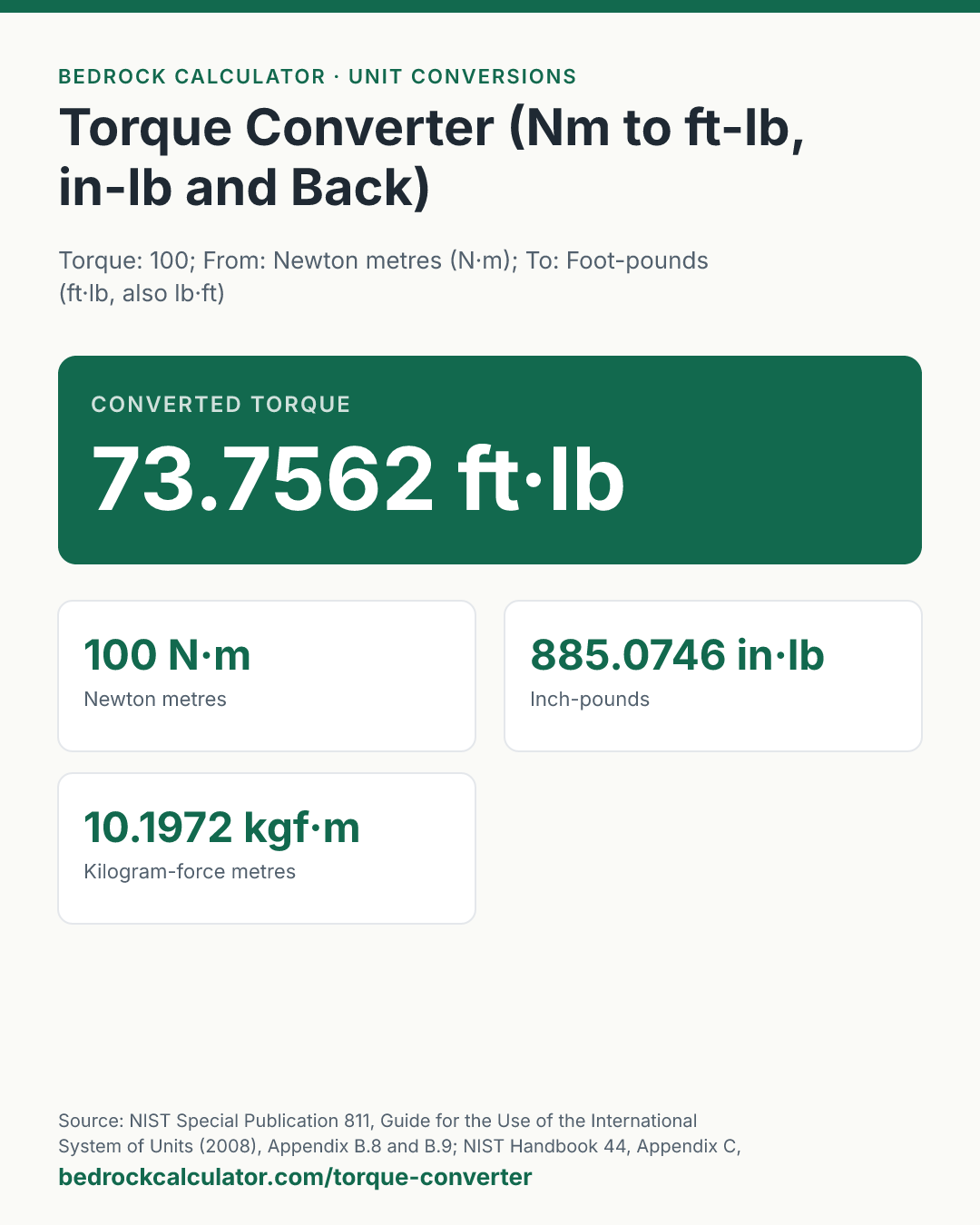
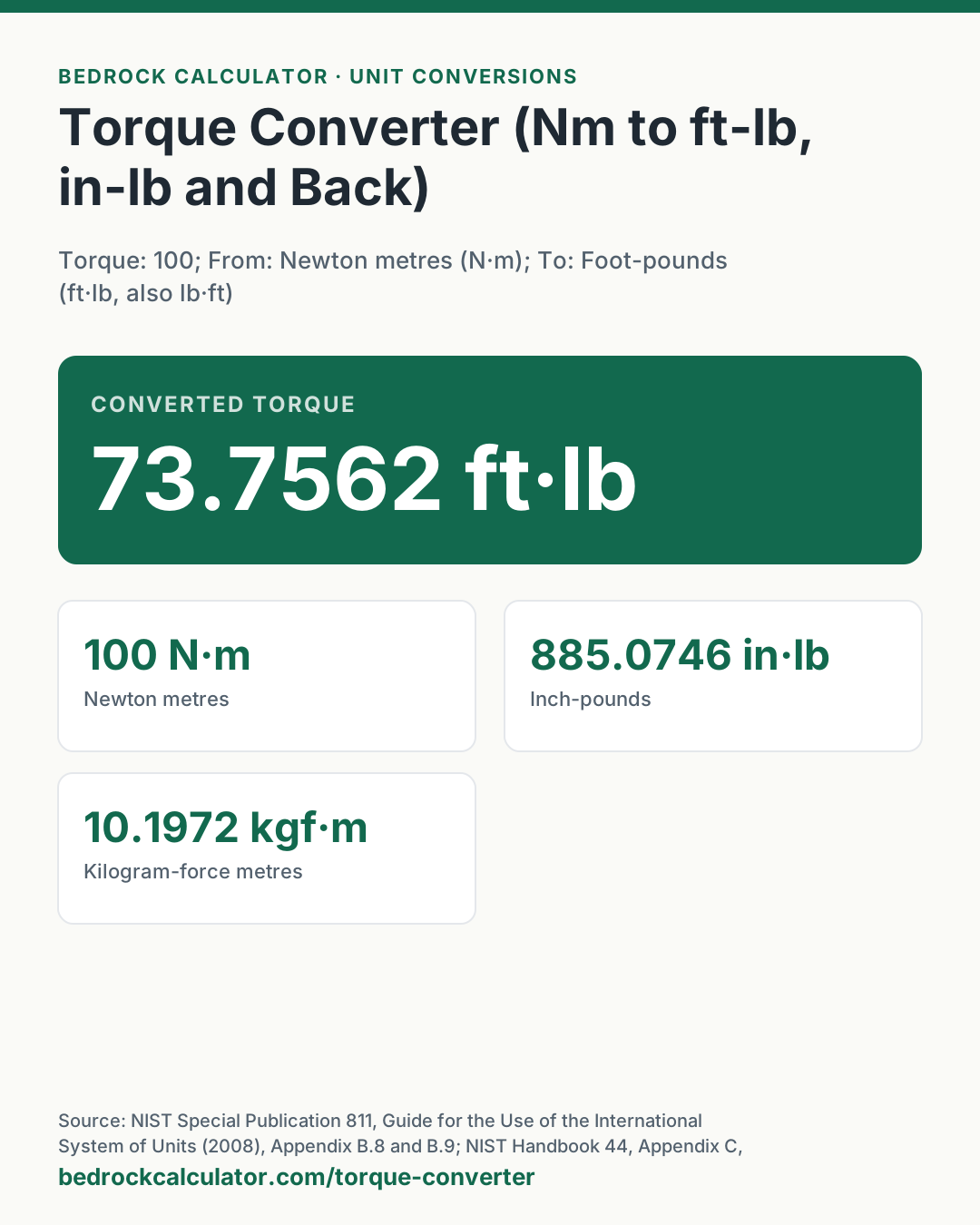
Quick Answer: 100 N·m is 73.7562 ft·lb. Going the other way, 40 ft-lb is 54.2327 N·m, 120 N·m is 88.5075 ft-lb, and 5 N·m is 44.2537 in-lb.
What does this calculator do?
This torque converter changes a tightening torque between newton metres, foot-pounds, inch-pounds and kilogram-force metres, in any direction. It is built for the common job of reading a service manual in one unit and setting a torque wrench marked in another.
Torque is a force times the length of the lever it acts on. A newton metre is one newton pushing on a one metre lever; a foot-pound is one pound-force on a one foot lever. The pound-force is the force that gravity puts on a one pound mass under standard gravity, 9.80665 m/s², and the pound is exactly 0.45359237 kg. Put those together with the foot of exactly 0.3048 m and a foot-pound is exactly 1.3558179483314004 N·m. The converter uses that exact figure, not a rounded 1.356 or 0.7376.
All four units are shown under the answer, so the same setting can be read on any wrench scale.
Using the Torque Converter
- Type the torque from your manual or spec sheet.
- Choose its unit in From and your wrench's unit in To. Foot-pounds are also written lb-ft or lbf·ft; they are the same unit.
- Read the converted torque at the top. The cards list newton metres, foot-pounds, inch-pounds and kilogram-force metres.
The preset buttons load 40 ft-lb to N·m, 25 N·m to ft-lb, 120 N·m (a typical car wheel nut figure) and 5 N·m to in-lb. Below the converter are three tables: newton metres to foot-pounds and inch-pounds, foot-pounds to newton metres, and inch-pounds to newton metres.
How is this calculated?
- Choose the units. A negative torque is read as zero; the converter does not model the direction of turn.
- Convert through the newton metre. Each unit is stored as its exact size in newton metres. The foot-pound is 0.3048 m × 0.45359237 kg × 9.80665 m/s² = 1.3558179483314004 N·m. The inch-pound is one twelfth of that, 0.1129848290276167 N·m. The kilogram-force metre is 9.80665 N·m. The converter multiplies your number by the size of the unit you started in and divides by the size of the unit you want.
ft⋅lb = N⋅m/1.3558179483314004; N⋅m = in⋅lb × 0.1129848290276167
in⋅lb = ft⋅lb × 12
- Round for display only. Results are shown to four decimal places, rounded half up with trailing zeros dropped. The tables show two decimal places, which is finer than any torque wrench can be set.
Worked Example
The default, 100 N·m to foot-pounds:
- Foot-pounds: 100 ÷ 1.3558179... = 73.75621..., shown as 73.7562 ft·lb.
- Inch-pounds: 885.0746 in·lb. Kilogram-force metres: 10.1972 kgf·m.
40 ft-lb to N·m: 40 × 1.3558179... = 54.2327 N·m. In inch-pounds that is exactly 40 × 12 = 480 in·lb.
25 N·m to ft-lb: 18.4391 ft·lb.
120 N·m to ft-lb: 88.5075 ft·lb. A wheel nut spec of 120 N·m is set at about 88.5 on a foot-pound wrench.
5 N·m to in-lb: 44.2537 in·lb. Small fasteners such as bicycle stem bolts are usually given in N·m and set with an inch-pound wrench.
Newton Metres to Foot-Pounds: Common Settings
| N·m | ft·lb | in·lb |
|---|---|---|
| 5 | 3.69 | 44.25 |
| 10 | 7.38 | 88.51 |
| 20 | 14.75 | 177.01 |
| 25 | 18.44 | 221.27 |
| 40 | 29.5 | 354.03 |
| 50 | 36.88 | 442.54 |
| 80 | 59.01 | 708.06 |
| 100 | 73.76 | 885.07 |
| 120 | 88.51 | 1,062.09 |
| 140 | 103.26 | 1,239.1 |
| 200 | 147.51 | 1,770.15 |
Foot-Pounds to Newton Metres
| ft·lb | N·m |
|---|---|
| 10 | 13.56 |
| 20 | 27.12 |
| 25 | 33.9 |
| 30 | 40.67 |
| 40 | 54.23 |
| 50 | 67.79 |
| 65 | 88.13 |
| 80 | 108.47 |
| 100 | 135.58 |
| 150 | 203.37 |
How Do You Convert Nm to ft-lb?
Divide newton metres by 1.3558179483314004, or multiply by its inverse, about 0.7376. To go from foot-pounds to newton metres, multiply by 1.3558. For inch-pounds, multiply foot-pounds by 12, or divide newton metres by 0.1129848. The converter does the exact division, so a figure converted one way and back returns what you typed, to the four decimal places shown.
Inch-Pounds to Newton Metres
Inch-pound wrenches are used for small fasteners where a foot-pound scale is too coarse.
| in·lb | N·m | ft·lb |
|---|---|---|
| 25 | 2.82 | 2.08 |
| 50 | 5.65 | 4.17 |
| 100 | 11.3 | 8.33 |
| 120 | 13.56 | 10 |
| 150 | 16.95 | 12.5 |
| 200 | 22.6 | 16.67 |
What does this calculator not account for?
- Force units on their own. Newtons, pounds-force and kilograms-force measure force, not torque. To turn a force into a torque you need the lever length, which this page does not ask for.
- Wrench accuracy and extensions. A click wrench is typically accurate to a few percent of its reading, and an extension or crow's foot adapter that changes the lever length changes the torque delivered.
- Lubrication and thread condition. Specs assume a stated thread condition. Oiled threads reach a higher clamping force at the same torque.
- Torque-angle specs. Some bolts are tightened to a torque and then turned a further angle. Only the torque part converts here.
What mistakes do people make with this?
- Mixing up ft-lb and in-lb. An inch-pound is twelve times smaller. Setting 40 on an inch-pound wrench for a 40 ft-lb spec leaves the bolt far too loose; the reverse can snap it.
- Treating lb-ft and ft-lb as different. Engineers often write lb-ft for torque to separate it from foot-pounds of energy. For a wrench, the number is the same.
- Using 1.36 or 0.74 for big numbers. Fine for a bolt, but the rounding adds up on large engine figures. The converter uses the exact factor.
- Reading kgf·m as kg. Older Japanese and European manuals give torque in kgf·m or kg·m. One kgf·m is exactly 9.80665 N·m.
Frequently Asked Questions
How many foot-pounds is 100 Nm?
How many Nm is 40 ft-lb?
What is 25 Nm in ft-lb?
How many inch-pounds are in a foot-pound?
How do I convert inch-pounds to newton metres?
Is a newton the same as a newton metre?
What is 140 Nm in ft-lb?
Sources
- NIST Special Publication 811, Guide for the Use of the International System of Units (2008), Appendix B.8 and B.9: pound-force foot, pound-force inch, kilogram-force meter, and the standard acceleration of gravity. nist.gov/pml/special-publication-811
- NIST Handbook 44, Appendix C, General Tables of Units of Measurement: the avoirdupois pound and the foot. nist.gov/pml/owm/nist-handbook-44-current-edition
- National Bureau of Standards Miscellaneous Publication 233, Units of Weight and Measure (revised to the 1959 refinement of the yard and the pound announced in the Federal Register, 24 FR 5348). nvlpubs.nist.gov/nistpubs/Legacy/MP/nbsmiscellaneouspub233.pdf