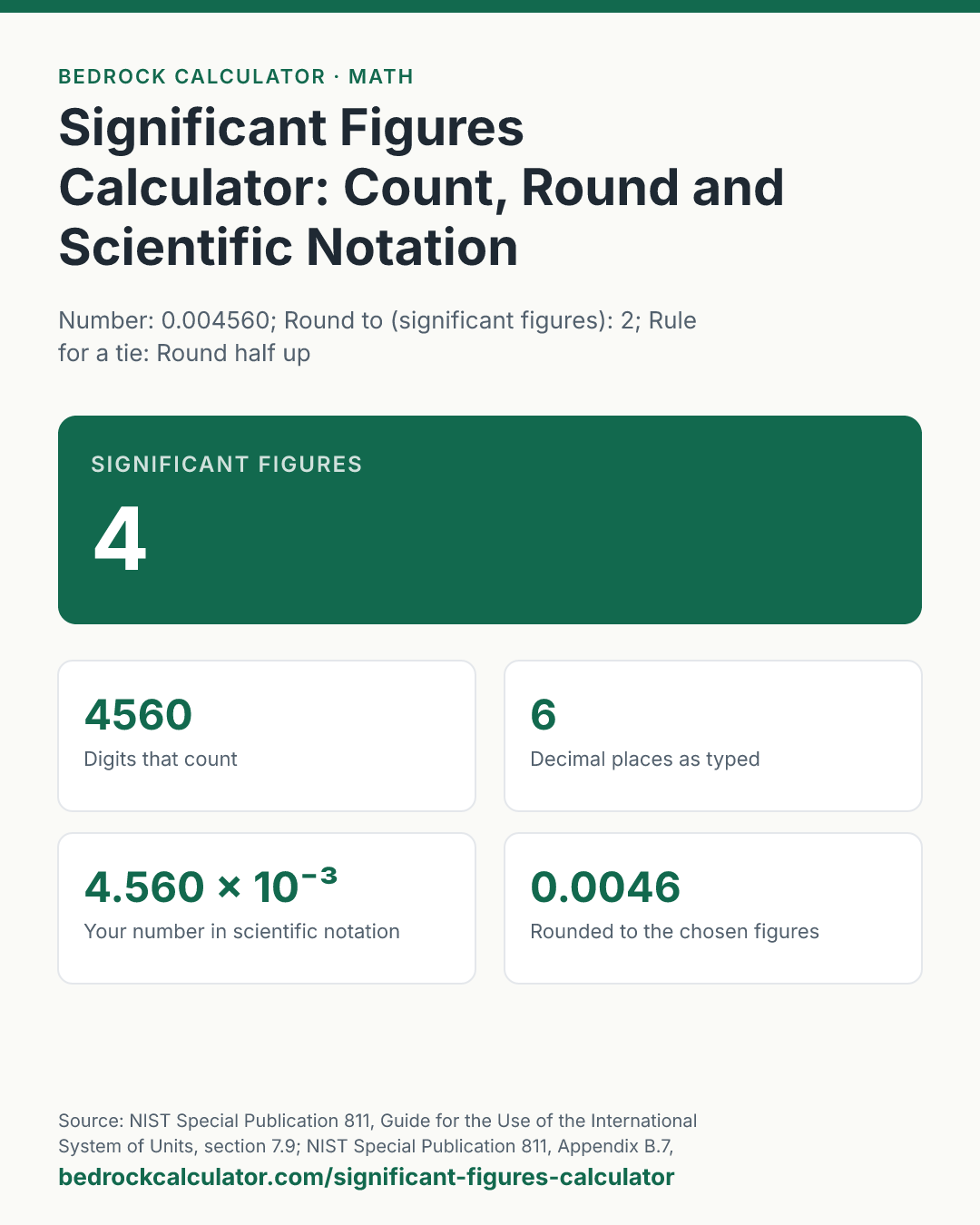

Quick Answer: 0.004560 has 4 significant figures: the leading zeros are placeholders, and the final zero counts because it comes after the decimal point. Rounded to 2 significant figures it is 0.0046, or 4.6 × 10⁻³ in scientific notation.
What does this calculator do?
This significant figures calculator does two jobs. It counts the significant figures in a number exactly as you typed it, applying the standard rules to leading, trapped and trailing zeros, and it rounds the number to however many significant figures you ask for, writing the result in plain form, scientific notation and E notation.
Significant figures (also called significant digits, or sig figs) are the digits that carry information about a measurement's precision. NIST's Guide to the SI puts it simply: a digit is significant if it is needed to express the value. Writing 1.200 km says the length is known to the metre; writing 1200 m leaves a reader unsure whether it is known to the metre or only to the nearest hundred metres. That ambiguity is real, and the calculator reports it rather than hiding it.
Because significant figures depend on how a number is written, the input is a text box, not a number box. 1.50 and 1.5 are the same value but not the same measurement, and the calculator treats them differently.
Using the Significant Figures Calculator
- Type the number exactly as written, including any trailing zeros and decimal point. Scientific notation works as 6.02e23 or 6.02 x 10^23. Thousands commas are allowed here and ignored.
- Choose how many significant figures to round to.
- Choose the rule for ties: round half up, or round half to even as NIST SP 811 recommends. The rule only changes the answer when the digits being dropped are exactly a 5 followed by zeros.
- Read the count at the top, then the rounded number in three notations, and the note, which flags any ambiguity.
How is this calculated?
- Read the digits as typed. The sign is set aside, spaces and commas are removed, and a "x 10^" is read as an exponent. For scientific notation, only the mantissa (the part before the exponent) is counted.
- Drop leading zeros. Zeros before the first nonzero digit only place the decimal point, so they never count. 0.0045 has two significant figures.
- Count the rest. Every digit from the first nonzero digit on is counted, which covers the rules for nonzero digits and for zeros trapped between them (105 has three).
- Decide the trailing zeros. If the number has a decimal point, trailing zeros count: 4.50 has three and 1200. has four. If it is a whole number with no decimal point, the trailing zeros are ambiguous, so the calculator reports a range: 1200 has 2 to 4. Zero itself has no first nonzero digit, so it has no count.
- Round to the chosen figures. The value is rounded to the requested number of significant figures. Under round half up, a dropped part of exactly one half moves away from zero; under round half to even (NIST SP 811 B.7.1, rule 3), it moves to the even neighbour.
x = m × 10^e; 1 ≤ |m| < 10
- Write it three ways. Scientific notation writes the mantissa m with exactly the requested number of digits, keeping trailing zeros, and the power of ten e. E notation is the same with "e" for "× 10". The plain form keeps the trailing zeros that are significant; when the last significant digit falls in the units place and is a zero, a decimal point is added (120.), and when it falls left of the units place, the note warns that the plain form cannot show the precision.
Worked Example
The default is 0.004560, rounded to 2 significant figures.
- Leading zeros: 0.00 are placeholders. The digits that count are 4560.
- The trailing zero comes after a decimal point, so it counts. Total: 4 significant figures.
- In scientific notation with its own four figures: 4.560 × 10⁻³.
- Rounded to two figures: the third figure is 6, more than half, so 4.5 becomes 4.6. The result is 0.0046, or 4.6 × 10⁻³, or 4.6e-3.
A large number, using the 123456 to 2 figures preset: rounded, it is 1.2 × 10⁵. Written plainly that is 120,000, which looks like it might have six significant figures. The note says so, and the scientific form is the one to report.
How Many Significant Figures Are in 1200?
Two, three or four: written that way, it is ambiguous. The 1200 preset reports 2 to 4 (ambiguous). To make it clear, write 1200. (four, with a decimal point), 1.20 × 10³ (three), or 1.2 × 10³ (two). The reference table shows each of these forms counted.
How Do You Round to Significant Figures?
Find the first nonzero digit, count along to the number of figures you want, and look at the next digit. Below 5, drop everything after; above 5, add one to the last kept digit; exactly 5 with nothing after it, apply the tie rule. Then put back zeros as placeholders so the number keeps its size.
The NIST SP 811 example uses the number 6.9749505 rounded to seven figures with the even rule. The digits dropped are exactly 5, and the preceding 0 is even, so it stays: 6.974950. The Avogadro constant preset rounds 6.02214076 × 10²³ to three figures, 6.02 × 10²³.
Pi Rounded to Significant Figures
The second reference table rounds pi to between 1 and 10 significant figures. Pi to 3 figures is 3.14, to 5 is 3.1416, and to 8 is 3.1415927.
What does this calculator not account for?
- Arithmetic with significant figures. The rules for how many figures to keep after adding or multiplying measured values are not applied. This calculator counts and rounds one number at a time.
- Exact numbers. Counted quantities and defined constants (12 eggs, 2.54 cm per inch) have unlimited significant figures. The calculator cannot tell from the digits that a number is exact.
- Uncertainty statements. A result like 4.56 ± 0.03 carries its precision in the uncertainty, which is the clearer modern practice. The calculator does not read uncertainties.
- Zero. A value of zero has no first nonzero digit, so no count is given.
- Thirty figures. Rounding is offered up to 30 significant figures.
What mistakes do people make with this?
- Dropping trailing zeros when copying a measurement. 2.50 g and 2.5 g are different claims about the balance. Keep the zeros the instrument gave you.
- Counting leading zeros. 0.0045 has two significant figures, not four or five.
- Writing a rounded large number plainly. 120,000 does not show that only two figures are meant. Use scientific notation.
- Rounding twice. Round the original value once to the final number of figures, not in stages.
- Confusing decimal places with significant figures. 0.0046 has four decimal places but only two significant figures.
Frequently Asked Questions
Are zeros significant?
How many significant figures does 100.0 have?
What is scientific notation?
Why do significant figures matter?
What is the difference between round half up and round half to even?
Sources
- NIST Special Publication 811, Guide for the Use of the International System of Units, section 7.9: a digit is significant if it is required to express the value; the 1200 m ambiguity. nist.gov/pml/special-publication-811/nist-guide-si-chapter-7-rules-and-style-conventions-expressing-values
- NIST Special Publication 811, Appendix B.7, Rounding Numbers: the rules and the 6.9749505 examples. nist.gov/pml/special-publication-811/nist-guide-si-appendix-b-conversion-factors
- NIST CODATA 2022 recommended value of the Avogadro constant, exact by definition: 6.02214076 × 10²³ per mole. physics.nist.gov/cgi-bin/cuu/Value