How much corporate tax does a small business pay in each Canadian province?
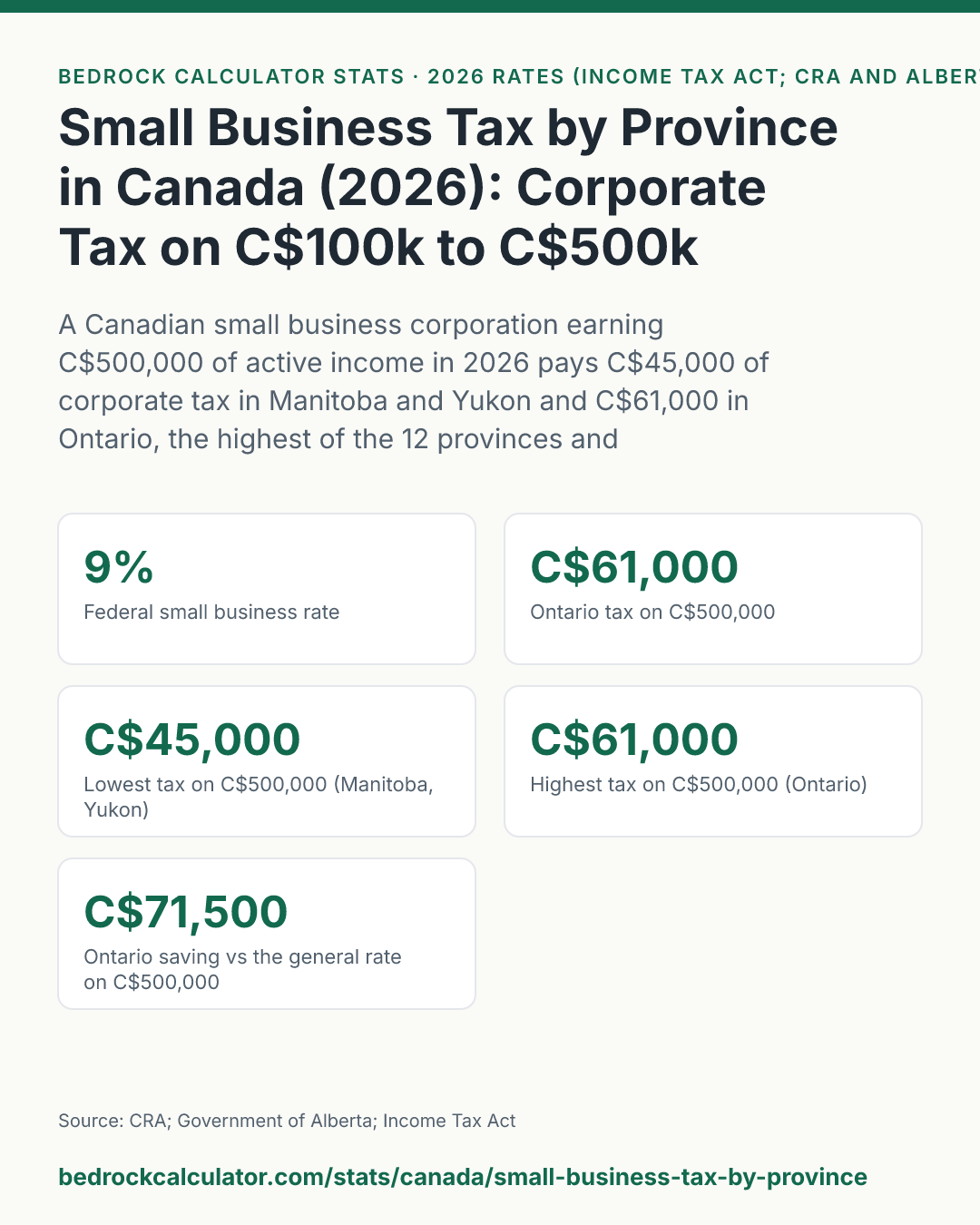
A Canadian-controlled private corporation pays a much lower rate on its first C$500,000 of active business income than a large company does. That's the small business deduction. In 2026 the federal rate on that income is 9%, and each province adds its own lower rate on top.
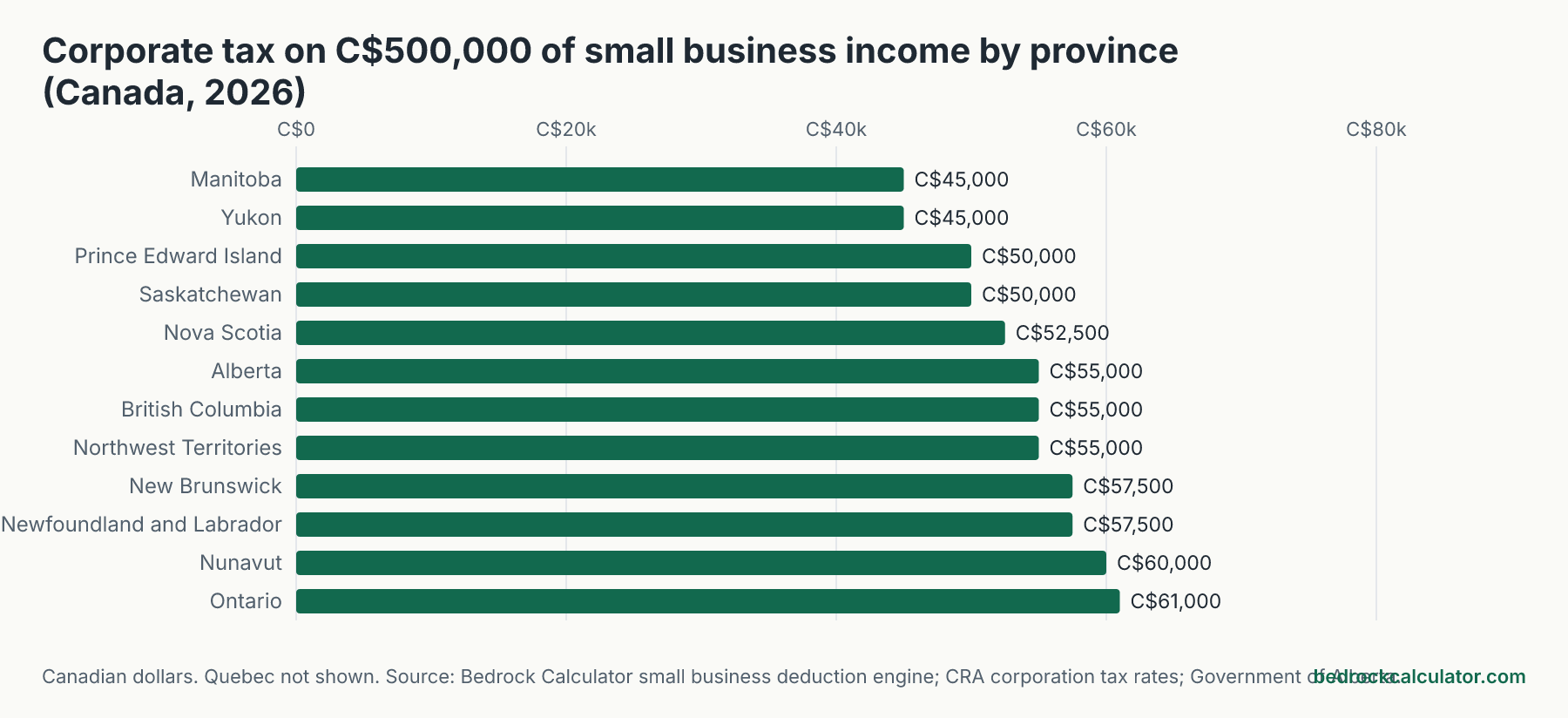
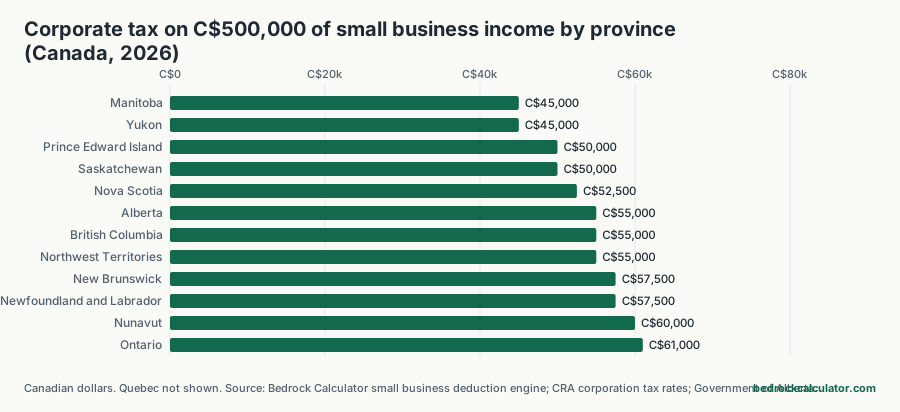
So where the business is based matters. On C$500,000 of active income, corporate tax is C$45,000 in Manitoba and Yukon, C$55,000 in Alberta and C$55,000 in British Columbia, and C$61,000 in Ontario, the highest of the 12 provinces and territories we could check. The gap between top and bottom is C$16,000 a year.
How we worked out these numbers
We ran the small business deduction calculator on this site for each province and territory at five levels of active business income, from C$100,000 to C$500,000.
The federal side comes straight from the Income Tax Act, and the calculator works it out rather than assuming it. It starts from the 38% basic rate, takes off the 10-point provincial abatement and then the 19-point small business deduction, which leaves 9%. On income above the business limit it takes off the 13-point general rate reduction instead, which leaves 15%.
The provincial side is an input to the calculator, because every province sets its own rate. We filled it from a table we built for this page from CRA's published corporation tax rates and, for Alberta, the Government of Alberta's own tax overview. CRA's page doesn't list Quebec, and we couldn't verify Quebec's reduced rate from Revenu Québec, which also depends on how many hours the company pays its staff. So Quebec shows as n/a.
Every run assumes the corporation has the full C$500,000 business limit to itself, with no passive investment income and no large taxable capital.
Corporate tax in every province and territory
Click any column heading to sort. Because every income here is within the business limit, the tax is just the combined small business rate times the income.
Corporate tax on active business income by province, 2026 (Canadian dollars)
Download CSVCanadian-controlled private corporation, full C$500,000 business limit, no passive income or taxable capital grind. Federal small business rate plus the provincial or territorial lower rate. Quebec n/a: its rate was not verified and its reduced rate depends on a paid-hours test the calculator does not model.
| Manitoba | 9.0% | C$9,000 | C$18,000 | C$27,000 | C$36,000 | C$45,000 | C$90,000 |
| Yukon | 9.0% | C$9,000 | C$18,000 | C$27,000 | C$36,000 | C$45,000 | C$90,000 |
| Prince Edward Island | 10.0% | C$10,000 | C$20,000 | C$30,000 | C$40,000 | C$50,000 | C$100,000 |
| Saskatchewan | 10.0% | C$10,000 | C$20,000 | C$30,000 | C$40,000 | C$50,000 | C$85,000 |
| Nova Scotia | 10.5% | C$10,500 | C$21,000 | C$31,500 | C$42,000 | C$52,500 | C$92,500 |
| Alberta | 11.0% | C$11,000 | C$22,000 | C$33,000 | C$44,000 | C$55,000 | C$60,000 |
| British Columbia | 11.0% | C$11,000 | C$22,000 | C$33,000 | C$44,000 | C$55,000 | C$80,000 |
| Northwest Territories | 11.0% | C$11,000 | C$22,000 | C$33,000 | C$44,000 | C$55,000 | C$77,500 |
| New Brunswick | 11.5% | C$11,500 | C$23,000 | C$34,500 | C$46,000 | C$57,500 | C$87,500 |
| Newfoundland and Labrador | 11.5% | C$11,500 | C$23,000 | C$34,500 | C$46,000 | C$57,500 | C$92,500 |
| Nunavut | 12.0% | C$12,000 | C$24,000 | C$36,000 | C$48,000 | C$60,000 | C$75,000 |
| Ontario | 12.2% | C$12,200 | C$24,400 | C$36,600 | C$48,800 | C$61,000 | C$71,500 |
| Quebec | n/a | n/a | n/a | n/a | n/a | n/a | n/a |
Manitoba and Yukon charge no provincial tax on small business income at all, so a corporation there pays only the federal 9%. Ontario has the highest provincial small business rate of those we could verify, so its combined rate is 12.2%. In Ontario that's C$12,200 on C$100,000, C$36,600 on C$300,000 and C$61,000 on C$500,000.
Who gets the small business rate
The deduction isn't automatic for every company. The calculator assumes the income qualifies, which means:
- The company is a Canadian-controlled private corporation, so not public and not controlled by non-residents.
- The income comes from an active business carried on in Canada. Rent, interest and dividends from investments don't count.
- The business isn't a personal services business, the kind where an incorporated employee works for what is really one employer. That income is taxed at a higher rate with no deduction.
If those hold, a corporation in Ontario earning C$500,000 keeps C$439,000 after corporate tax to reinvest, pay down debt or pay out to its owners later.
What the small business deduction is worth
The last column shows how much more a corporation would pay if the same income were taxed at the general rate. In Ontario the combined general rate is 26.5% against 12.2% for small business income, so the deduction saves C$71,500 on C$500,000. In Alberta, which has the lowest general rate, it still saves C$60,000.
Keep in mind that this is mostly a deferral rather than a permanent saving. Money left in the corporation is taxed lightly, but when it's paid out to you as a dividend, personal tax applies. Canada's dividend tax credit is designed so that the corporate and personal tax together come out close to what you'd have paid earning the money directly. The dividend tax credit calculator shows the personal side.
How passive income eats the business limit
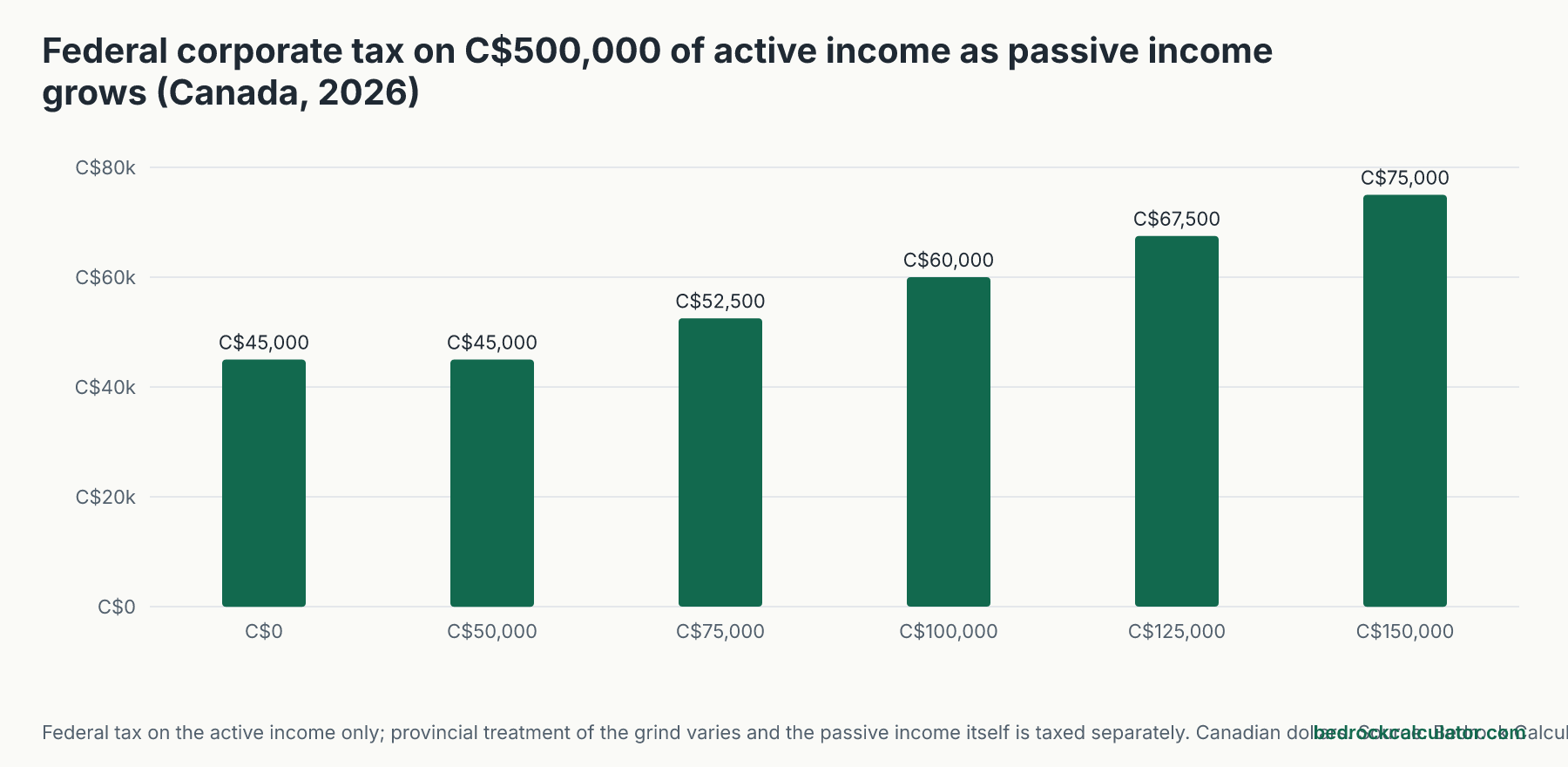
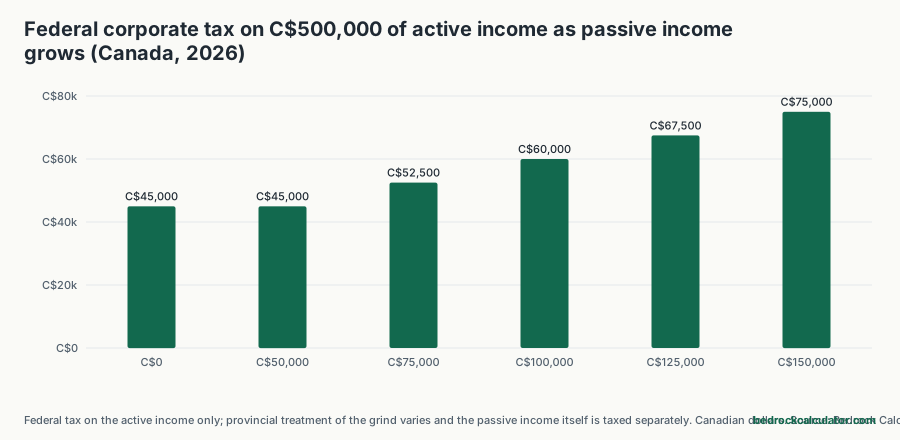
Corporations that build up investments inside the company can lose the small business deduction. For every dollar of passive investment income above C$50,000 in a year, the federal business limit shrinks by five dollars. By C$150,000 of passive income, it's gone.
With C$500,000 of active income, the federal tax on that income is C$45,000 with no passive income. At C$100,000 of passive income the limit drops to C$250,000 and the federal tax rises by C$15,000, to C$60,000. At C$150,000 it's C$75,000, the full general rate. We've shown the federal tax only here, because provinces don't all follow the federal grind and the calculator applies it to both.
What these figures leave out
The calculator covers active business income and the main federal rules. It doesn't model:
- Quebec, for the reasons above.
- Provincial business limits that differ from the federal one. Nova Scotia, Prince Edward Island and Saskatchewan have higher provincial limits. That doesn't change anything at or below C$500,000, which is all this page covers.
- Investment income inside the corporation, which is taxed under a separate regime with refundable taxes.
- Associated corporations, which share one business limit between them.
- How taxable capital is measured, which is complex and is tested across the whole associated group.
- Provincial versions of the passive income grind, which vary.
- Personal tax when you take the money out, as salary or dividends.
Run your own numbers
Put your own active income, business limit, passive income and provincial rates into the small business deduction calculator. If you're deciding how to pay yourself, compare the corporate side with your personal tax using the Canada income tax calculator and the dividend tax credit calculator.