Which leaves more in Canada, a TFSA or an RRSP?
The TFSA vs RRSP question in Canada has a cleaner answer than most people expect. It depends on just two numbers: your marginal tax rate when you put the money in, and the rate on the money when you take it out in retirement. If today's rate is higher, the RRSP leaves you more. If it's lower, the TFSA does.
If they're the same, it's a tie to the dollar.
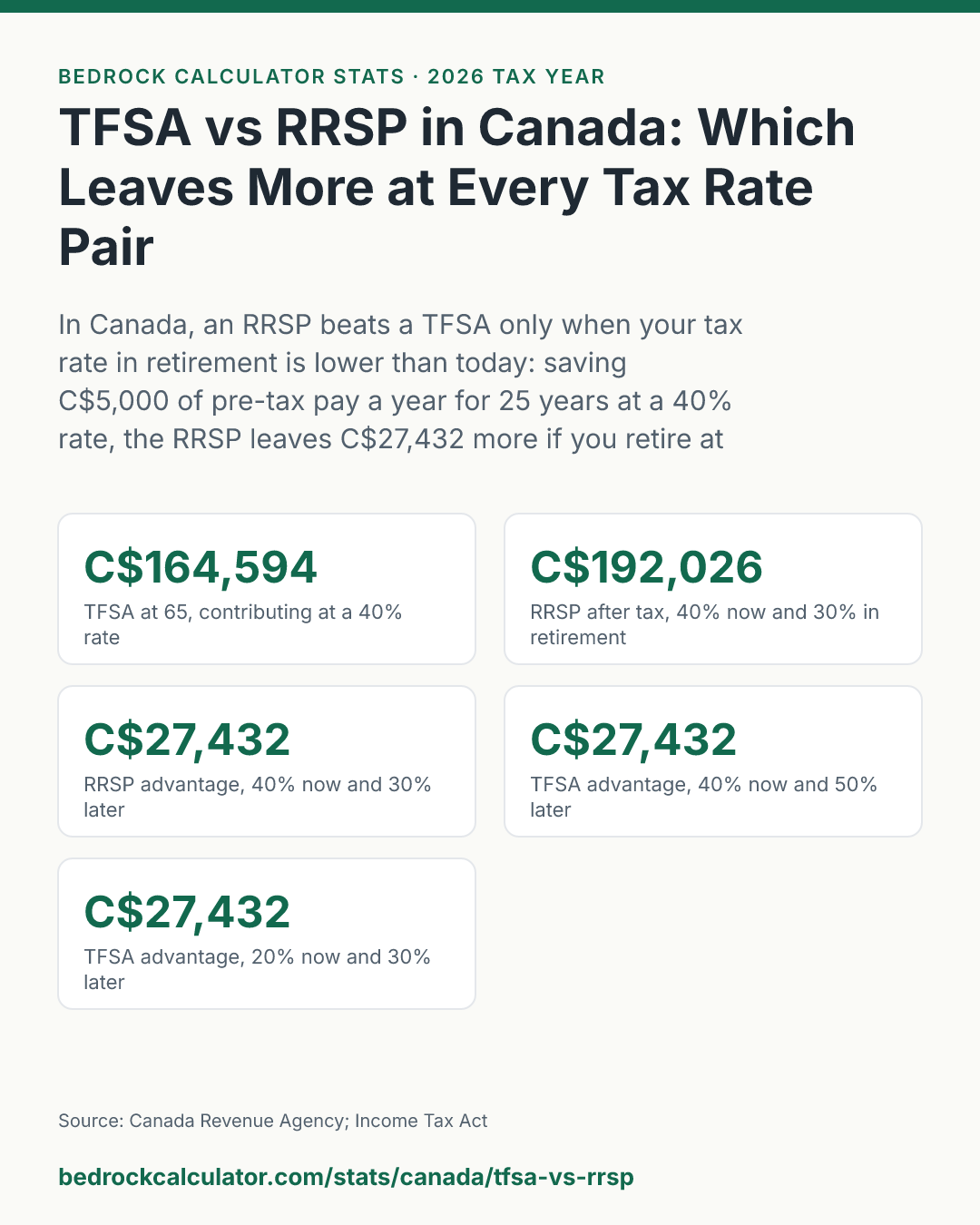
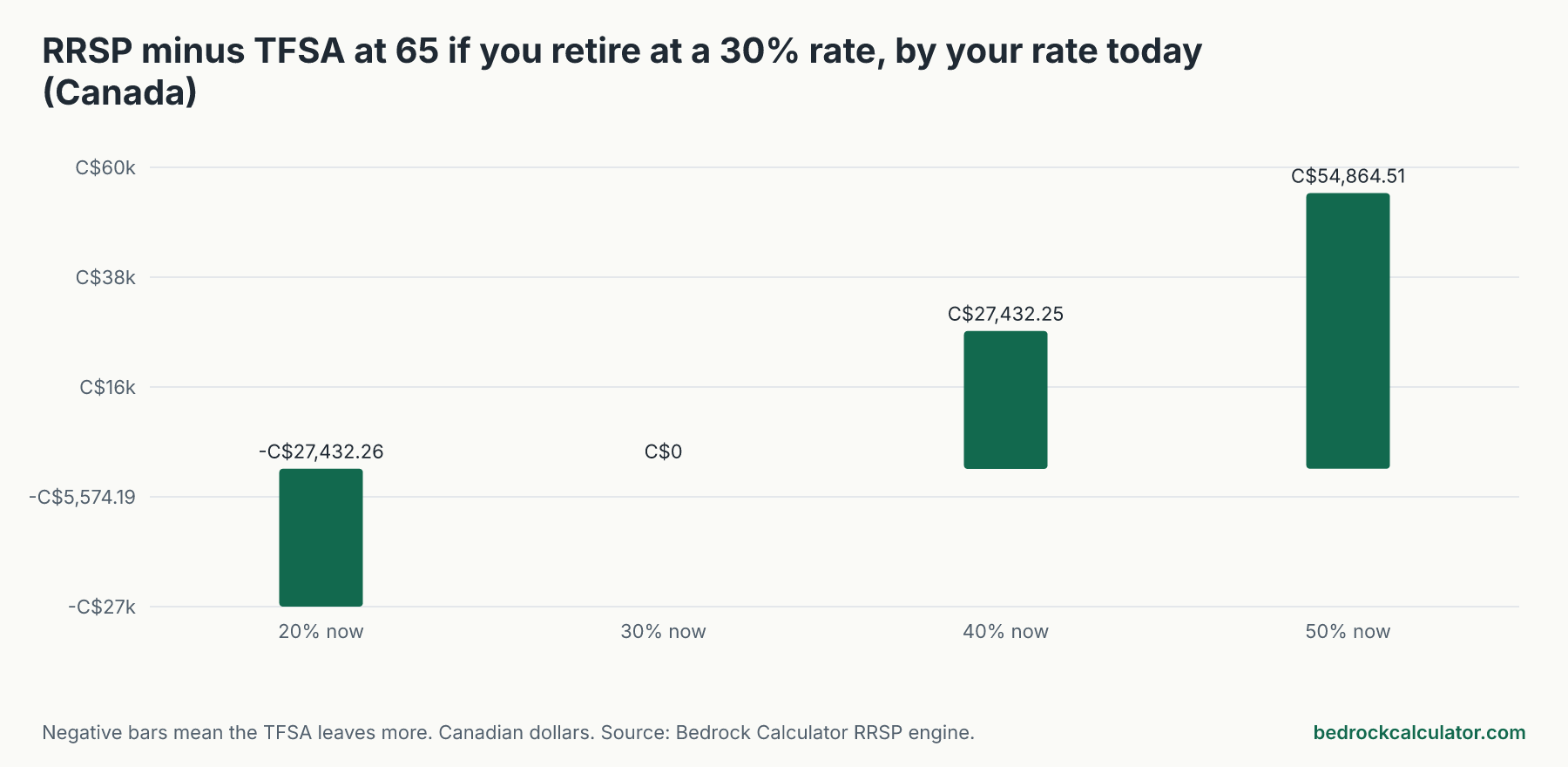
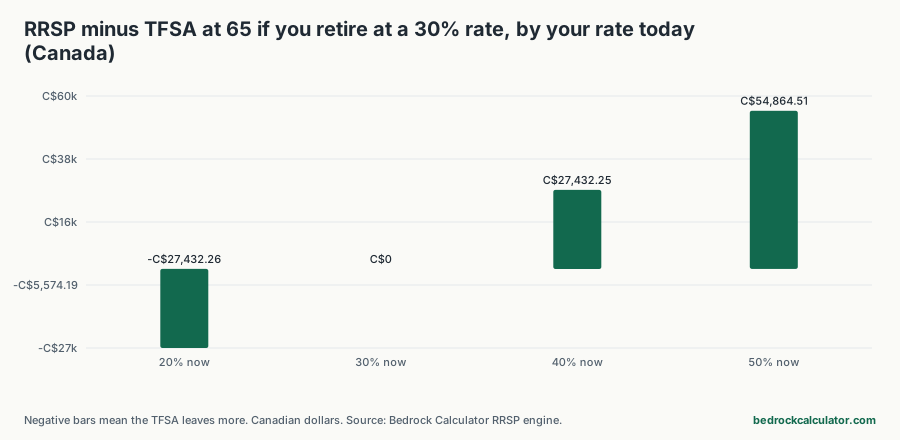
Take someone saving C$5,000 of pre-tax pay a year for 25 years at a 40% marginal rate. If their retirement withdrawals are taxed at 30%, the RRSP comes out C$27,432 ahead. If they're taxed at 50%, the TFSA wins by C$27,432.
How we set up the comparison
To compare the two fairly, both accounts have to cost you the same. So we start with C$5,000 of salary each year and follow it down two paths:
- RRSP: the full C$5,000 goes in. You get a tax refund at your marginal rate, so at 40% your real cost is C$3,000 a year. The account grows untouched, and every dollar is taxed when it comes out.
- TFSA: you pay tax on the C$5,000 first, so at 40% you have C$3,000 left to put in. It grows, and nothing is taxed on the way out.
Both paths take the same bite out of your take-home pay. We ran the RRSP side through the RRSP calculator on this site from age 40 to 65 with a 6% annual return, which builds C$274,323 from C$125,000 of contributions. The TFSA side uses the same return and the same yearly compounding from the site's time-value-of-money engine. Then we taxed the RRSP balance at four possible retirement rates.
The rates are combined federal and provincial marginal rates, and we've used round numbers from 20% to 50% rather than any one province's brackets. That's deliberate: this site's engine doesn't hold a bracket table for each province, so we compare rates directly. To find your own, look up your province's combined marginal rate for your income, or run the take-home pay calculator to see roughly where you sit.
Every rate pair, side by side
Each row is your rate when you contribute. The TFSA column doesn't change with your retirement rate because TFSA withdrawals aren't taxed. The four RRSP columns show what's left after tax at each retirement rate.
After-tax value at 65: TFSA vs RRSP in Canada (C$5,000 a year of pre-tax income, 25 years at 6%)
Download CSVEach row is your combined federal and provincial marginal rate when you contribute. RRSP columns are the after-tax value if every withdrawal is taxed at that retirement rate. Canadian dollars.
| 20% | C$219,458 | C$219,458 | C$192,026 | C$164,594 | C$137,161 |
| 30% | C$192,026 | C$219,458 | C$192,026 | C$164,594 | C$137,161 |
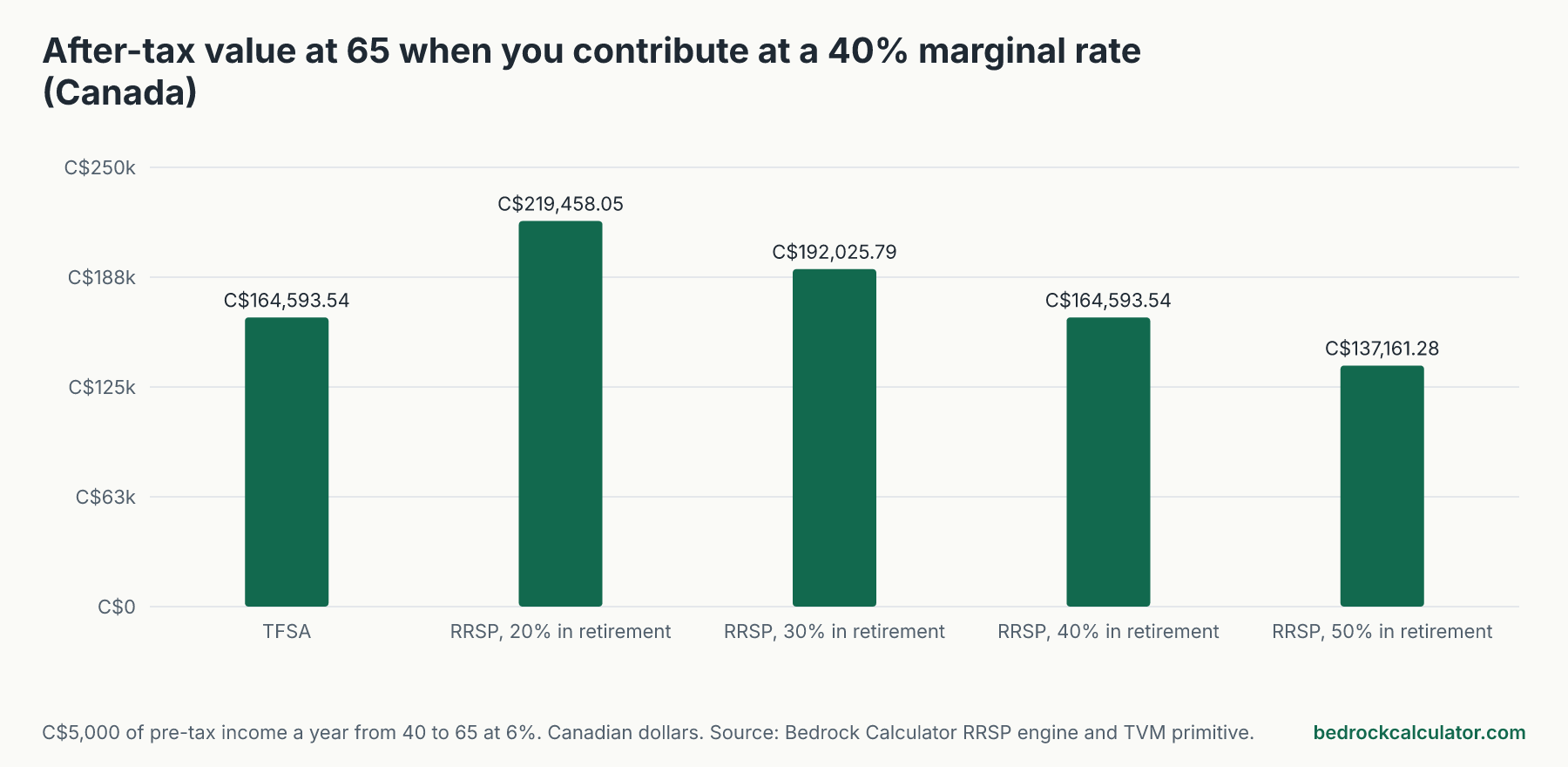
| 40% | C$164,594 | C$219,458 | C$192,026 | C$164,594 | C$137,161 |
| 50% | C$137,161 | C$219,458 | C$192,026 | C$164,594 | C$137,161 |
Read along the diagonal and you'll see the TFSA and RRSP match exactly whenever the two rates are equal. Contributing at 40% and withdrawing at 40% gives C$164,594 either way. Away from the diagonal, every ten points of difference in tax rate moves the result by C$27,432 in this scenario.
Why equal rates come out the same
This surprises people, so it's worth a minute. At a 40% rate, the RRSP gets C$5,000 a year invested and the TFSA gets C$3,000. Both grow at the same rate, so the RRSP pot is always bigger in the same proportion. When you then pay 40% tax on the RRSP withdrawal, you give back exactly the share the TFSA never had. What's left is the same.
So the RRSP's famous refund isn't a gift. It's a loan from the government that you repay at whatever rate applies in retirement. The RRSP only wins if you repay it at a lower rate than you borrowed it.
When the RRSP clearly wins
Higher earners who expect a more modest income in retirement are the classic RRSP case. At a 50% rate today and 30% in retirement, the RRSP is worth C$192,026 after tax at 65 against C$137,161 in the TFSA, a gap of C$54,865. If retirement withdrawals end up taxed at only 20%, the gap reaches C$82,297.
The same logic works at middle incomes. Someone at 30% today who retires at 20% gets C$219,458 from the RRSP against C$192,026 from the TFSA.
When the TFSA clearly wins
The TFSA is the better home whenever your retirement rate could end up higher than today's. That's more common than it sounds. A young worker at a 20% rate who builds a good pension, or anyone who expects large RRIF withdrawals stacked on CPP and OAS, can easily face a higher rate later. At 20% now and 30% later, the TFSA leaves C$27,432 more. At 20% now and 50% later, it's C$82,297 more.
There's a second reason low earners lean toward the TFSA. RRSP and RRIF withdrawals count as income, and income-tested benefits like the Guaranteed Income Supplement shrink as income rises. TFSA withdrawals don't count at all.
What this comparison leaves out
We kept the model simple so the rate effect is easy to see. A few things will move your own answer:
- One flat retirement rate. Real withdrawals are taxed through the brackets, so a large RRIF can push part of the money into a higher band than the rest.
- The OAS clawback. Above the recovery threshold, OAS is clawed back at 15 cents per dollar on top of income tax, which raises the effective rate on RRSP withdrawals. Our OAS clawback figures for 2026 show where that starts.
- Benefits and credits. We don't model the Guaranteed Income Supplement, the age amount or the pension income credit, all of which depend on income in retirement.
- Spending the refund. The comparison assumes the RRSP saver's lower take-home cost is the same as the TFSA saver's. If you'd spend the refund rather than save it, the RRSP loses part of its edge.
- Contribution room. At C$5,000 a year both accounts fit inside the 2026 limits. See this year's TFSA, RRSP and FHSA limits for the ceilings.
- Returns. Both accounts get the same 6% here. Different investments in each would change the result for reasons that have nothing to do with tax.
A practical rule of thumb
If you're in a high bracket now and expect to live on less in retirement, start with the RRSP. If you're early in your career, earning less than you expect to later, or worried about clawbacks on government benefits, start with the TFSA. If you honestly can't tell, splitting between the two hedges the guess.
To put your own numbers in, use the RRSP calculator with your marginal rate and the TFSA calculator with your available room.