How much does the child care expense deduction save in each province?
Canadian parents can deduct what they pay for child care so they can work, and the deduction usually goes on the lower earner's return. What it's worth depends on that parent's income and province.
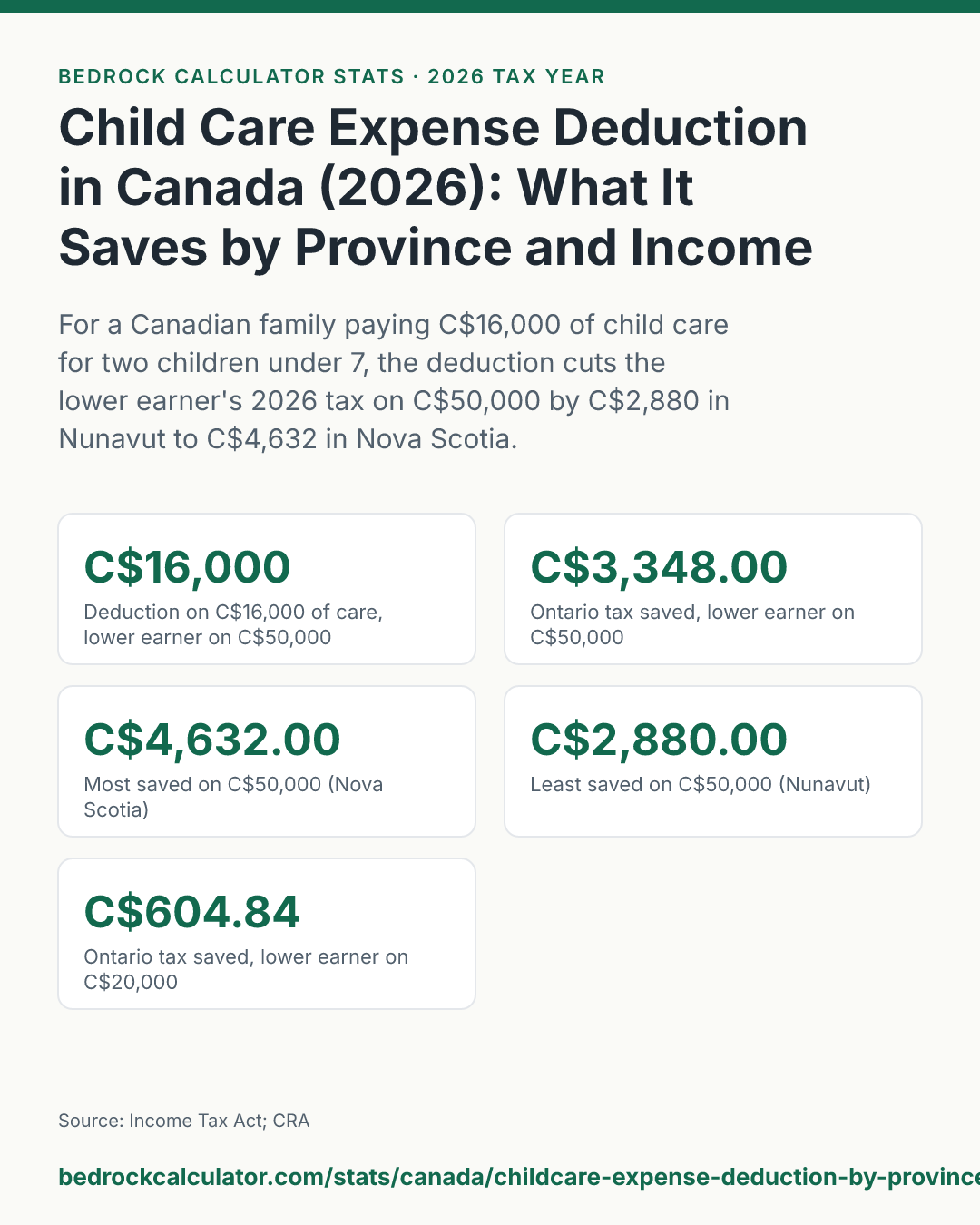
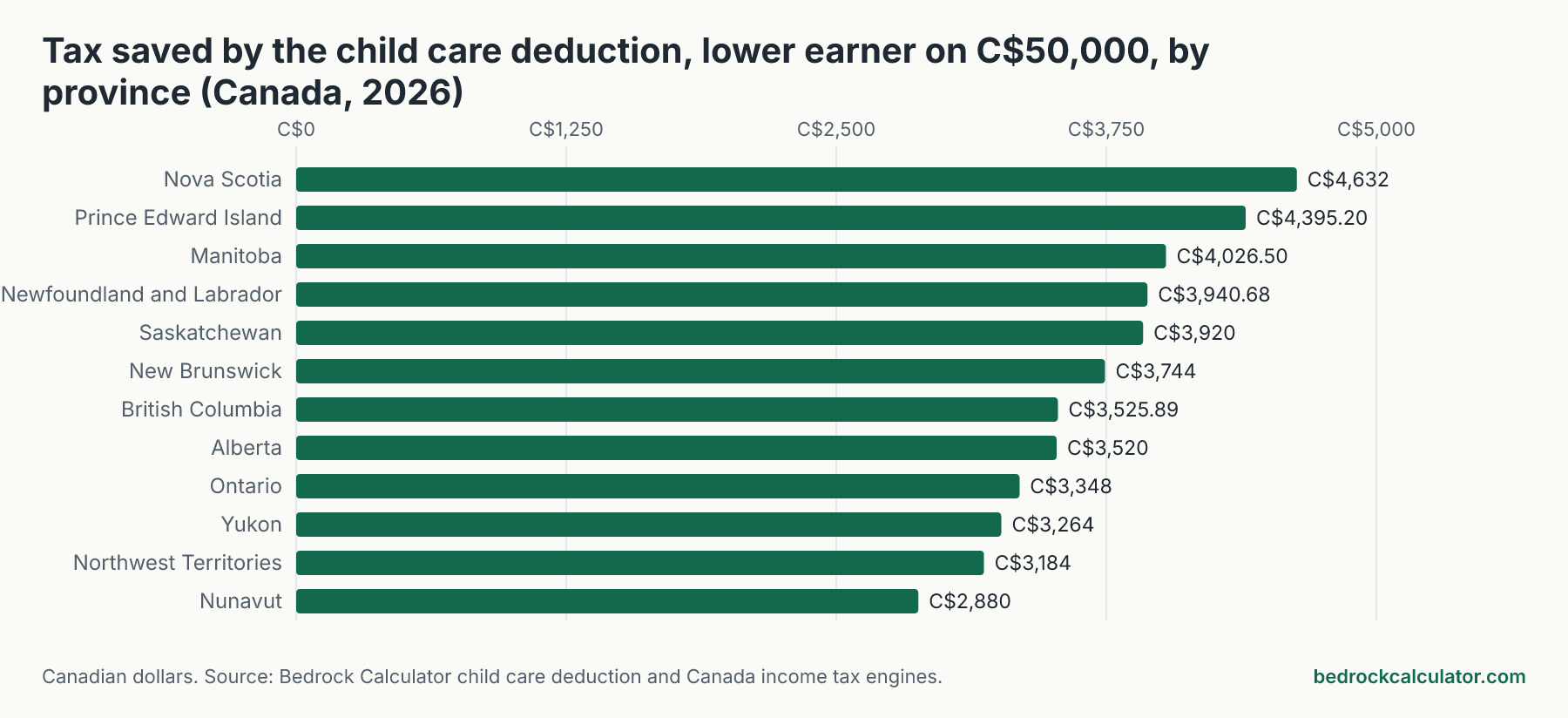
Take a family paying C$16,000 a year for two children under 7. If the lower earner makes C$50,000, the deduction cuts their 2026 income tax by C$3,348.00 in Ontario. Across the country at that income the saving runs from C$2,880.00 in Nunavut to C$4,632.00 in Nova Scotia, a gap of C$1,752.00.
How we worked out these numbers
There are two steps, and each uses a calculator on this site.
First, the child care deduction calculator works out how much can be deducted. Under section 63 of the Income Tax Act, the deduction is the smallest of three amounts:
- what you actually paid for child care
- a yearly amount per child: C$8,000 for each child under 7 at the end of the year, C$5,000 for other eligible children and C$11,000 for a child eligible for the disability tax credit
- two thirds of the lower earner's earned income
Second, we put that deduction into the Canada income tax calculator. We worked out the lower earner's 2026 federal and provincial tax on their full income, then again on their income less the deduction, for every province and territory except Quebec. The difference is the saving.
The child care calculator can estimate the saving itself, but only by multiplying the deduction by a marginal rate you type in. A large deduction can cross a bracket edge or fall partly below the basic personal amount, so the before-and-after method is more accurate. It's what we used throughout.
Our family has 2 children under 7, pays C$16,000 a year for care, and the parent claiming has no other deductions.
The saving in every province and territory
Click any column heading to sort. All figures are the 2026 tax saved, in Canadian dollars.
Tax saved by the child care expense deduction in 2026, by province and the lower earner's income (Canadian dollars)
Download CSVTwo children under 7, C$16,000 of child care paid. Deduction claimed by the lower earner. Saving is the drop in 2026 federal plus provincial or territorial income tax.
| Nova Scotia | C$3,303.12 | C$4,632 | C$5,895.75 |
| Prince Edward Island | C$3,321.72 | C$4,395.20 | C$5,722.53 |
| Manitoba | C$3,432.48 | C$4,026.50 | C$5,320 |
| Newfoundland and Labrador | C$3,288.72 | C$3,940.68 | C$5,600 |
| Saskatchewan | C$2,906.71 | C$3,920 | C$5,280 |
| New Brunswick | C$3,400.72 | C$3,744 | C$5,520 |
| British Columbia | C$2,304.33 | C$3,525.89 | C$4,512 |
| Alberta | C$2,475.20 | C$3,520 | C$4,836 |
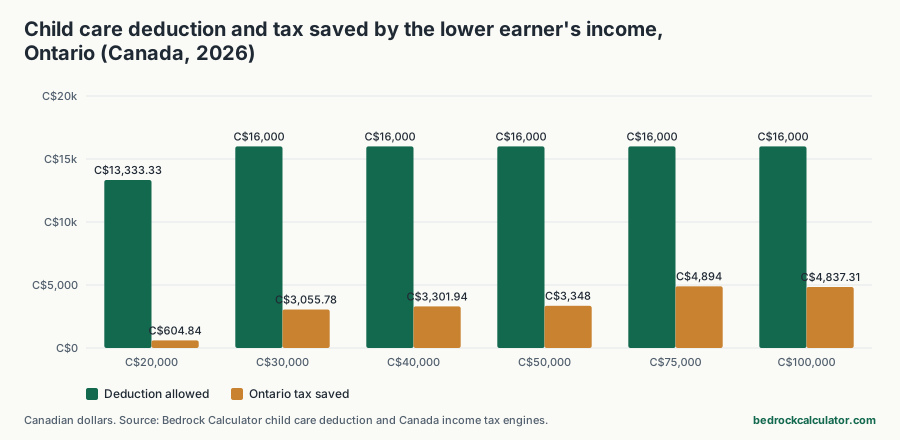
| Ontario | C$3,055.78 | C$3,348 | C$4,894 |
| Yukon | C$2,763.79 | C$3,264 | C$4,720 |
| Northwest Territories | C$2,593.04 | C$3,184 | C$4,656 |
| Nunavut | C$2,310.36 | C$2,880 | C$4,400 |
| Quebec | n/a | n/a | n/a |
n/a: Quebec gives a refundable provincial child care credit instead of a provincial deduction, which the calculators do not model.
The ranking moves around with income, because each province's brackets and basic personal amount fall in different places. At C$30,000 the biggest saving is in Manitoba, at C$3,432.48, and the smallest in British Columbia, at C$2,304.33. At C$50,000 Nova Scotia leads and Nunavut is last.
Why a low-earning parent gets less
Two things hold the deduction back when the lower earner's income is modest.
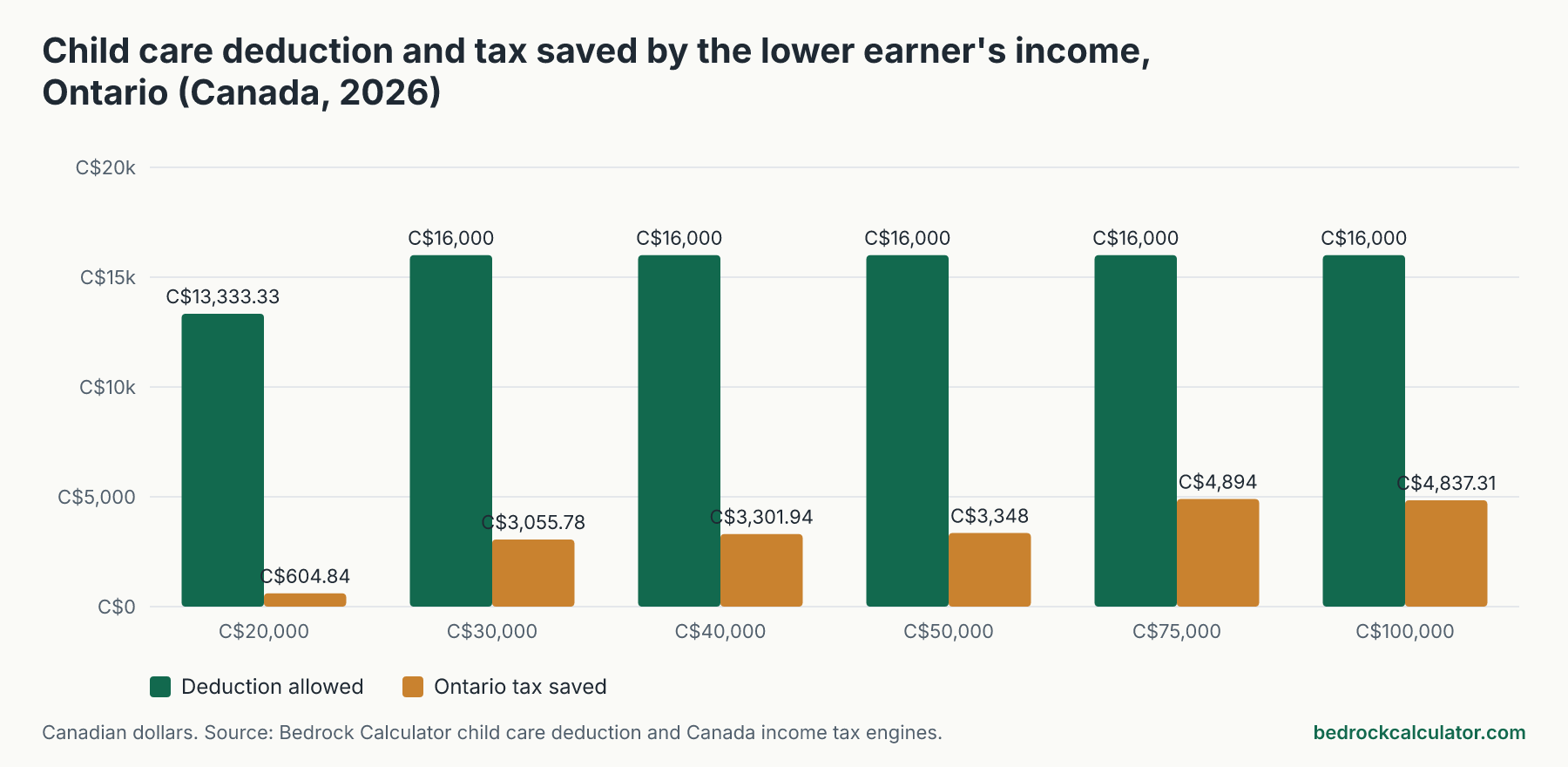
The first is the two-thirds limit. On C$20,000 of earned income, the most that can be deducted is C$13,333.33, even though the family paid C$16,000. From C$30,000 up, two thirds of income is more than the family paid, so the whole C$16,000 is deductible.
The second is that a deduction only saves tax you would have paid. A parent on C$20,000 pays little income tax to begin with, because the basic personal amount covers much of it. So in Ontario the deduction saves only C$604.84 at that income, against C$3,055.78 at C$30,000 and C$3,348.00 at C$50,000. By C$100,000 the saving is C$4,837.31, or 30.2% of the deduction, compared with 20.9% at C$50,000.
That's why the rule matters about who claims. The law generally gives the deduction to the lower-income parent, which keeps its value down. A couple can't choose to put it on the higher earner's return unless one of the exceptions applies, such as the lower earner being in school, in hospital or separated.
What it means for the real cost of child care
Even after the deduction, child care is expensive. For an Ontario family with a lower earner on C$50,000, the C$3,348.00 saving brings C$16,000 of care down to about C$12,652 after tax.
Many provinces have also brought in reduced-fee child care in recent years, so lots of families now pay far less than C$16,000. The deduction follows what you actually pay. If the same Ontario family pays C$5,000 a year instead, the deduction is C$5,000 and the saving for a parent on C$50,000 is C$1,102.50.
What these figures leave out
The two calculators apply the main rules, not every detail. They don't model:
- The exceptions to the lower-earner rule, when the higher earner may claim for weeks the lower earner was in school, in hospital, in prison or separated.
- The full definition of earned income. We treat the lower earner's income as both earned income and taxable income. Investment income and most benefits don't count as earned income.
- Overnight camps and boarding schools, which have their own weekly limits. We assumed none.
- Credits other than the basic personal amount, such as the Canada employment amount and CPP and EI credits, and low-income reductions outside Ontario and British Columbia. These mean tax at lower incomes is somewhat overstated, so the saving may be too.
- Quebec. Quebec gives a refundable provincial credit for child care instead of a provincial deduction. The calculators don't model that credit, and applying the deduction to Quebec's provincial tax would overstate the saving, so Quebec shows as n/a. Quebec parents still get the federal deduction.
- Benefits based on net income, such as the Canada Child Benefit. Because the deduction lowers net income, it can raise those benefits too.
Run your own numbers
Enter your own children, costs and income in the child care deduction calculator to see the deduction and which limit applies. Then run the Canada income tax calculator on the lower earner's income with and without it. To see how it changes the Canada Child Benefit, use the Canada Child Benefit and RESP calculator, and for the effect on each paycheque, the take-home pay calculator.