Which US states charge an estate or inheritance tax in 2026?
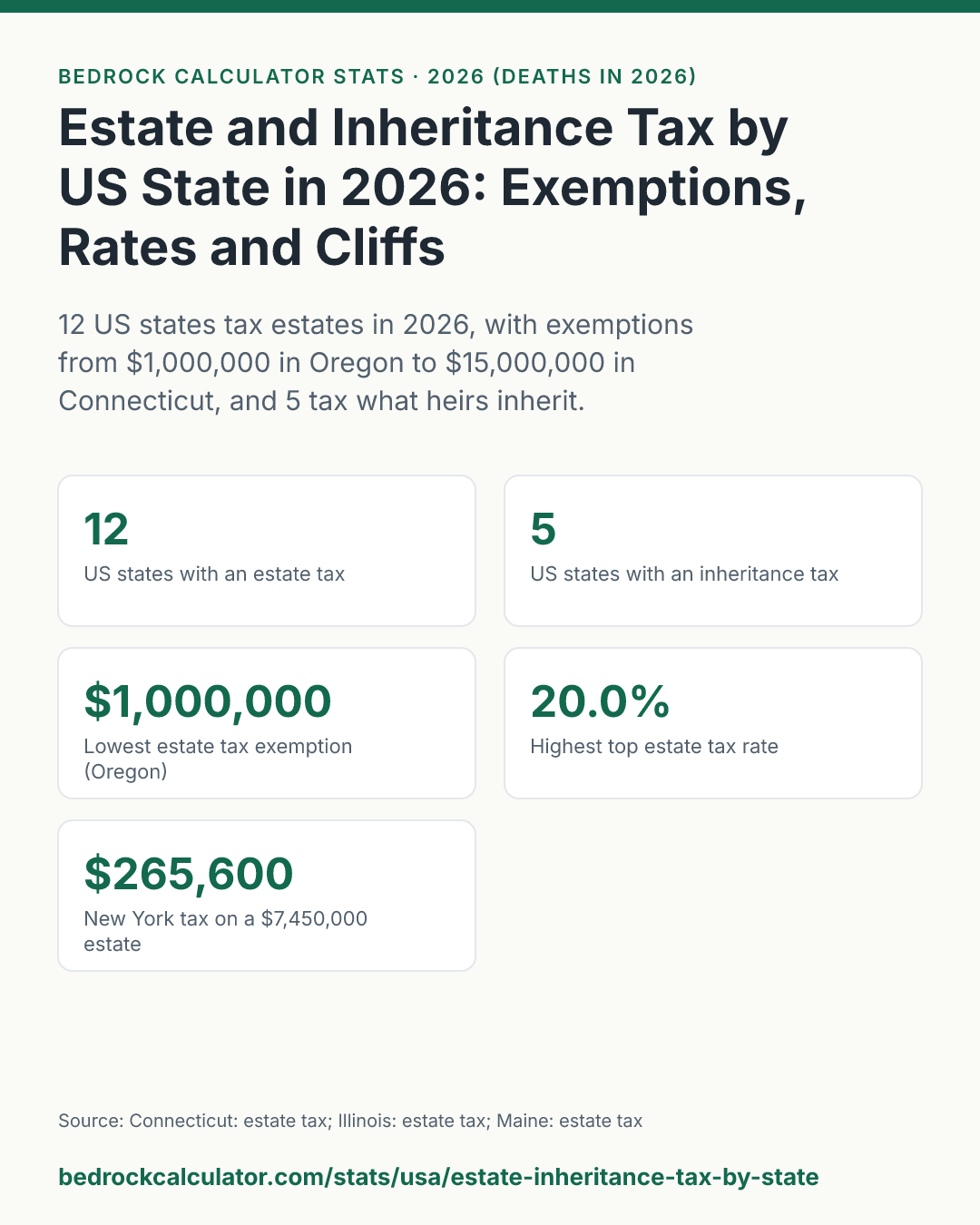
Most Americans will never owe a state death tax. But in 2026, 12 US states tax estates, and 5 tax the money heirs receive. Maryland does both. The other 34 states charge neither.
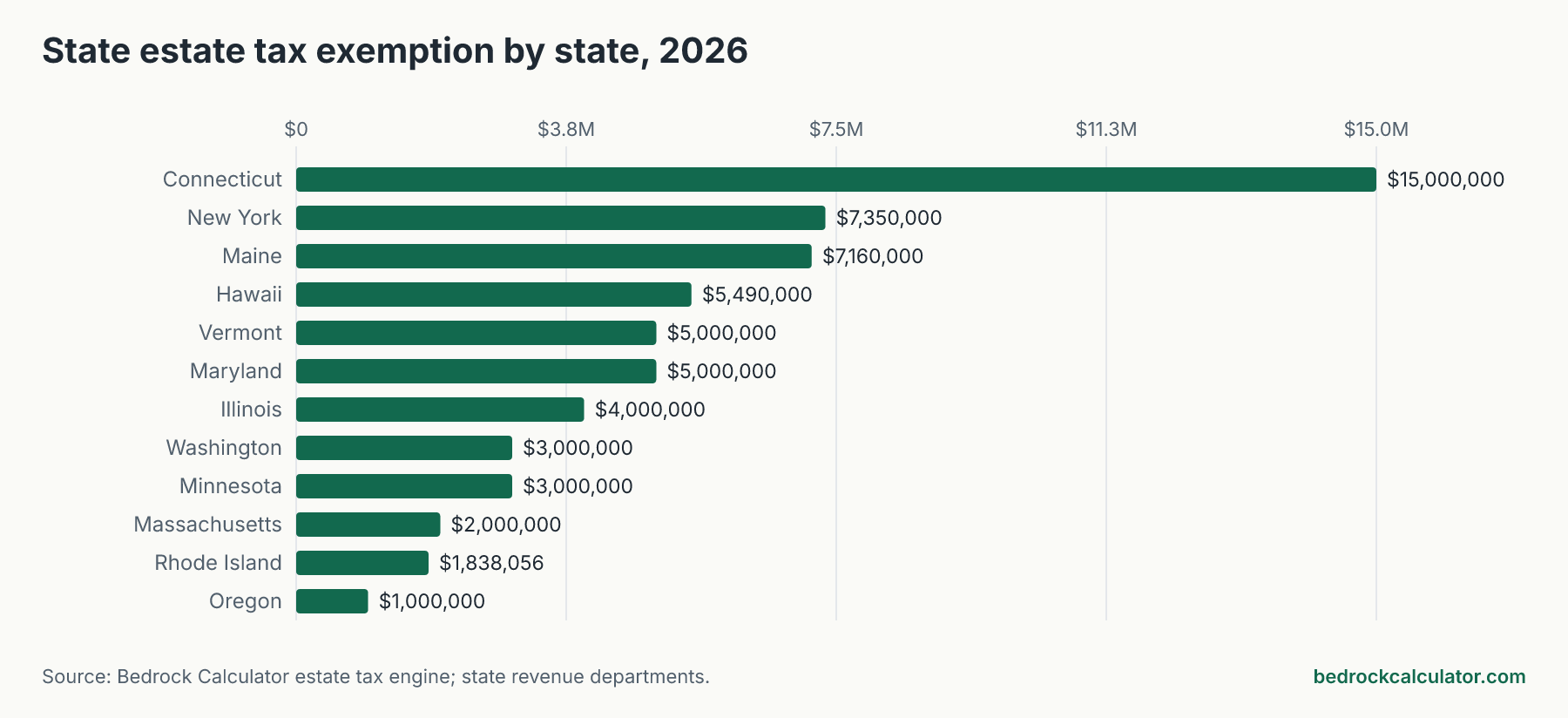
State estate taxes start far lower than the federal one. Exemptions run from $1,000,000 in Oregon up to $15,000,000 in Connecticut, and top rates reach 20.0% in Hawaii and Washington. New York is the one with a true cliff: go a little over its $7,350,000 exemption and the tax can run into the hundreds of thousands.
Estate tax vs inheritance tax: what's the difference?
An estate tax is charged on the whole estate before anything is handed out. The executor files the return and pays it from the estate. The size of the estate decides whether any tax is due.
An inheritance tax is charged on what each person receives, and the rate depends on how closely they were related to the person who died. Spouses are exempt everywhere, children are usually exempt or taxed lightly, and friends and distant relatives pay the most.
Both are set by the state where the person who died lived, plus the state where any real estate sits. Where the heir lives doesn't matter.
How we worked out these numbers
The exemptions and the tax on each test estate come from the estate tax calculator, run for every state with an estate tax. Top rates and the inheritance tax classes come from the same 2026 engine tables the calculators use, and the tax on a $100,000 inheritance comes from the inheritance tax calculator.
Some things to keep in mind:
- Federal estate tax isn't included. Only state tax is computed. The federal exemption is far higher than any state's, but very large estates can owe both.
- No deductions. Our test estates have no marital, charitable or debt deductions. A surviving spouse can usually inherit everything free of state estate tax, so real bills are often lower.
- Washington changed mid-year. The figures use the schedule for deaths on or after July 1, 2026. Deaths earlier in the year used a slightly higher exemption and higher top rates.
- The District of Columbia has its own estate tax, but it isn't in our engine's table, so we don't compute it. Its verified rule: DC has an estate tax; for decedents dying in 2026 the exclusion (zero bracket) amount is $4,988,400.
- Gifts, trusts and property in other states can all change the taxable estate.
State estate tax exemptions and rates in 2026
The table shows each state's exemption, its top rate, and the tax on an estate $500,000 above the exemption, so you can see how quickly the tax builds once you cross the line. Click any heading to sort.
State estate tax exemptions and rates, 2026
Download CSVExemption for deaths in 2026 (Washington: on or after July 1, 2026). Tax computed on an estate $500,000 above the exemption, no deductions. Federal estate tax not included.
| Oregon | $1,000,000 | 16.0% | $50,000 | 3.33% | No | n/a |
| Rhode Island | $1,838,056 | 16.0% | $37,904 | 1.62% | No | n/a |
| Massachusetts | $2,000,000 | 16.0% | $39,200 | 1.57% | No | n/a |
| Minnesota | $3,000,000 | 16.0% | $65,000 | 1.86% | No | n/a |
| Washington | $3,000,000 | 20.0% | $50,000 | 1.43% | No | n/a |
| Illinois | $4,000,000 | 16.0% | $142,857 | 3.17% | No | n/a |
| Maryland | $5,000,000 | 16.0% | $80,000 | 1.45% | No | Also inheritance tax |
| Vermont | $5,000,000 | 16.0% | $80,000 | 1.45% | No | n/a |
| Hawaii | $5,490,000 | 20.0% | $50,000 | 0.83% | No | n/a |
| Maine | $7,160,000 | 12.0% | $40,000 | 0.52% | No | n/a |
| New York | $7,350,000 | 16.0% | $752,800 | 9.59% | Yes | n/a |
| Connecticut | $15,000,000 | 12.0% | $60,000 | 0.39% | No | n/a |
n/a means the column does not apply to that row.
Oregon has the lowest exemption by far: $1,000,000. An Oregon estate $500,000 over that owes $50,000. Massachusetts, at $39,200 on the same excess, has a low threshold too, but since 2023 it uses a credit that removes the old cliff, so the tax starts small.
At the other end, Connecticut exempts $15,000,000 and taxes the excess at a flat rate, $60,000 on $500,000 over.
The New York estate tax cliff
New York works differently from every other state. Its exemption is $7,350,000, but it shrinks quickly once an estate passes that amount and is gone completely at $7,717,500. From there the entire estate is taxed, not just the part above the exemption.
An estate right at the exemption owes $0. One of $7,450,000 owes $265,600. At $7,717,500 the bill is $734,780, and $500,000 over the exemption it's $752,800, an effective rate of 9.6% on the whole estate. That's why New York estate planners pay close attention to estates near the line, often using charitable gifts or trusts to stay under it.
Inheritance tax rates by heir
Here are the five inheritance tax states with each class of heir, the exemption that class gets, and its rates.
State inheritance tax rates by heir class, 2026
Download CSVExemption per heir in that class. Where a class has brackets, the lowest and highest bracket rates are shown.
| Kentucky | Class A - Exempt (spouse, parent, child incl. stepchild/adopted, grandchild via qualifying child, brother, sister, niece, nephew - incl. half-blood) | $0 | 0.0% | 0.0% |
| Kentucky | Class B (daughter/son-in-law, aunt, uncle, great-grandchild via qualifying child) | $1,000 | 4.0% | 16.0% |
| Kentucky | Class C - All Other Beneficiaries (cousins, friends, unrelated individuals, non-exempt organizations) | $500 | 6.0% | 16.0% |
| Maryland | Exempt Relationship (spouse, child, stepchild, grandchild, great-grandchild, parent, grandparent, sibling, child's spouse, domestic partner, charity) | $0 | 0.0% | 0.0% |
| Maryland | Collateral Heir or Unrelated Beneficiary (e.g. niece, nephew, cousin, friend) | $1,000 | 10.0% | 10.0% |
| Nebraska | Surviving Spouse | $0 | 0.0% | 0.0% |
| Nebraska | Immediate Relatives / Class 1 (parents, grandparents, siblings, children, other lineal descendants) | $100,000 | 1.0% | 1.0% |
| Nebraska | Remote Relatives / Class 2 (aunts, uncles, nieces, nephews, their descendants) | $40,000 | 11.0% | 11.0% |
| Nebraska | All Other Transferees / Class 3 (unrelated individuals, most organizations) | $25,000 | 15.0% | 15.0% |
| New Jersey | Class A - Exempt (spouse, civil union/domestic partner, parent, grandparent, child incl. adopted/mutually acknowledged, grandchild, great-grandchild, stepchild) | $0 | 0.0% | 0.0% |
| New Jersey | Class C (siblings; son/daughter-in-law or civil union partner of a child) | $25,000 | 11.0% | 16.0% |
| New Jersey | Class D - All Other Beneficiaries (cousins, friends, unrelated individuals) | $0 | 15.0% | 16.0% |
| New Jersey | Class E - Exempt (qualified charities, religious/educational/medical institutions, government) | $0 | 0.0% | 0.0% |
| Pennsylvania | Surviving Spouse | $0 | 0.0% | 0.0% |
| Pennsylvania | Transfer Between a Parent and a Child Age 21 or Younger (either direction) | $0 | 0.0% | 0.0% |
| Pennsylvania | Lineal Descendants/Ascendants (children over 21, grandchildren, parents, grandparents) | $0 | 4.5% | 4.5% |
| Pennsylvania | Siblings (incl. half-siblings) | $0 | 12.0% | 12.0% |
| Pennsylvania | Other Transferees (nieces, nephews, friends, unrelated) | $0 | 15.0% | 15.0% |
| Pennsylvania | Charities, Exempt Institutions & Government | $0 | 0.0% | 0.0% |
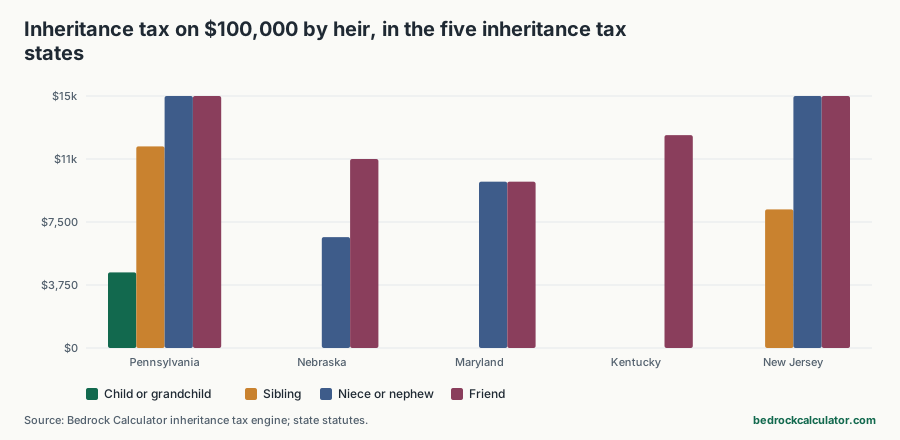
How much a $100,000 inheritance costs each heir
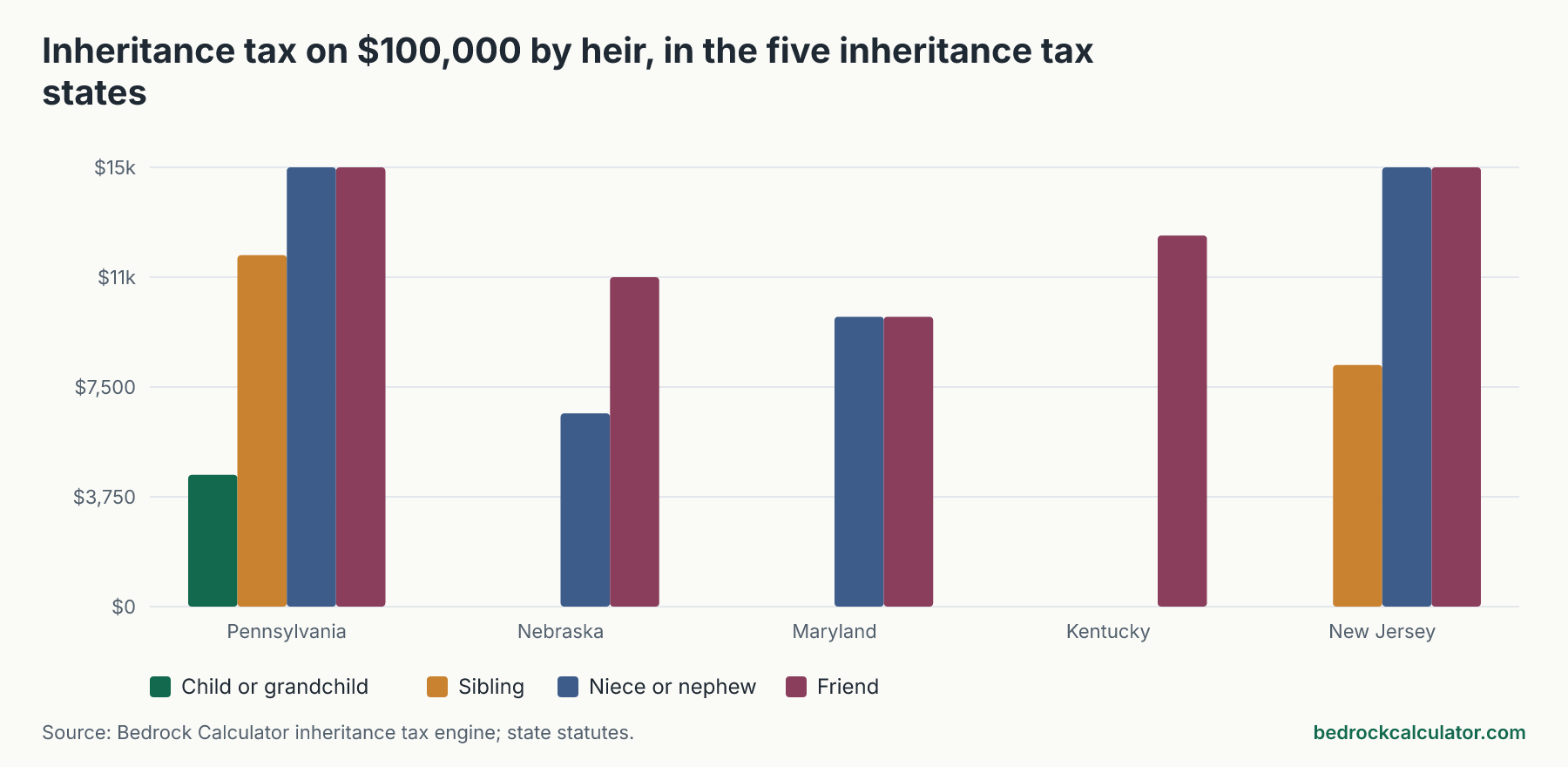
The relationship matters more than the amount. On a $100,000 inheritance:
- Pennsylvania taxes almost everyone except a spouse. An adult child pays $4,500, and a niece, nephew or friend pays $15,000.
- New Jersey exempts children and grandchildren, but a niece or nephew pays $15,000.
- Kentucky exempts close family, including nieces and nephews since 2026, so they pay $0.
- Maryland exempts close family and charges a niece or nephew $9,900.
- Nebraska gives each class its own exemption, so a niece or nephew pays $6,600 and a child pays $0.
A friend pays the most in Pennsylvania: $15,000 on the same amount.
Planning around state death taxes
If you live in one of these states, or own real estate in one, it's worth checking where your estate stands. Run your numbers in the estate tax calculator, or the state pages such as the New York estate tax calculator and the Massachusetts estate tax calculator. Heirs can check what they'd owe with the inheritance tax calculator. For larger estates, an estate attorney can explain trusts, gifting and the marital deduction.