How much more do you keep by moving to a state with no income tax?
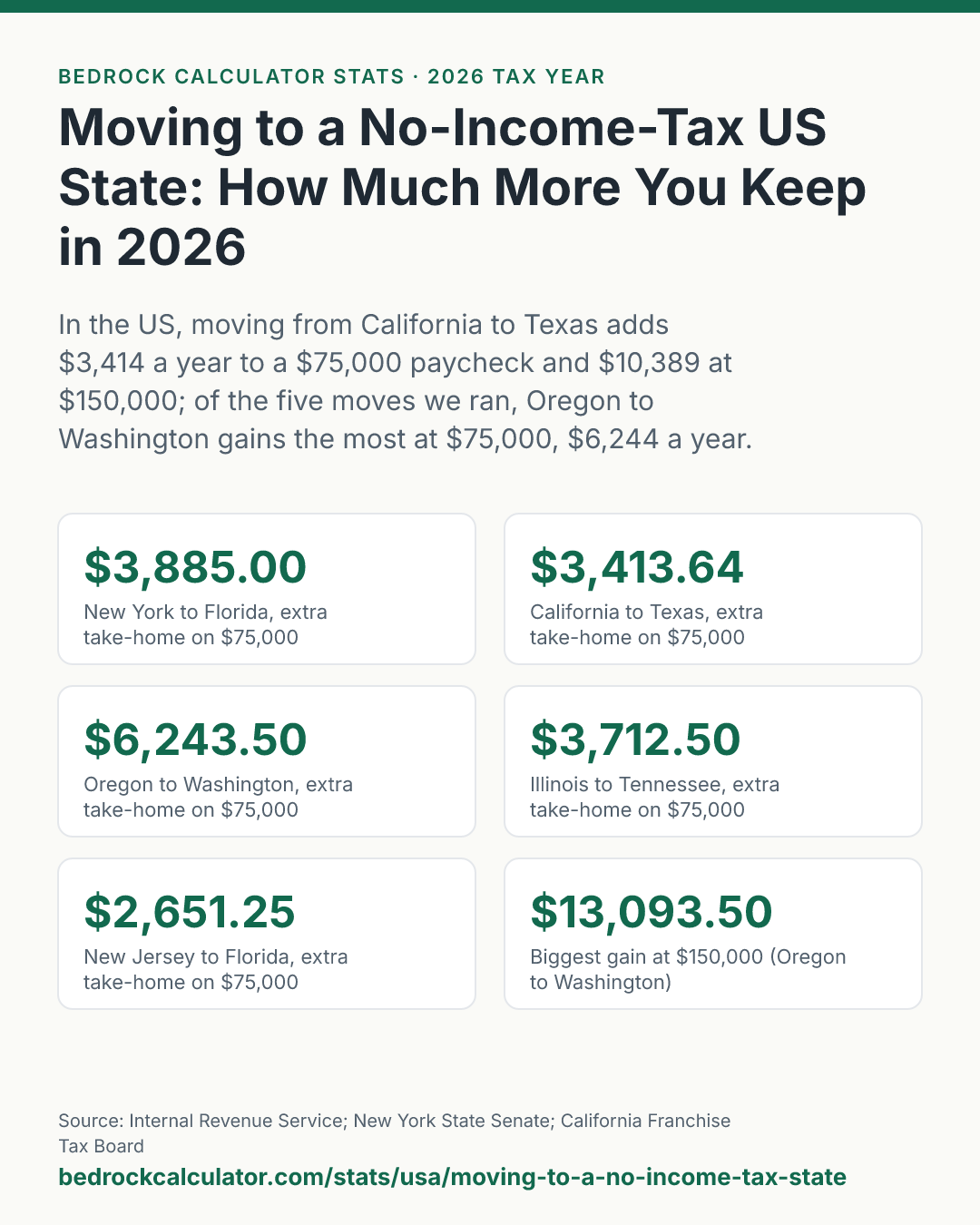
Moving from a US state with an income tax to one without adds the whole state income tax back to your paycheck. On a $75,000 salary that's $3,885.00 a year going from New York to Florida, $3,413.64 from California to Texas, $3,712.50 from Illinois to Tennessee and $2,651.25 from New Jersey to Florida.
Oregon to Washington is the biggest jump of the five, at $6,243.50 a year, or about $240.13 every two weeks.
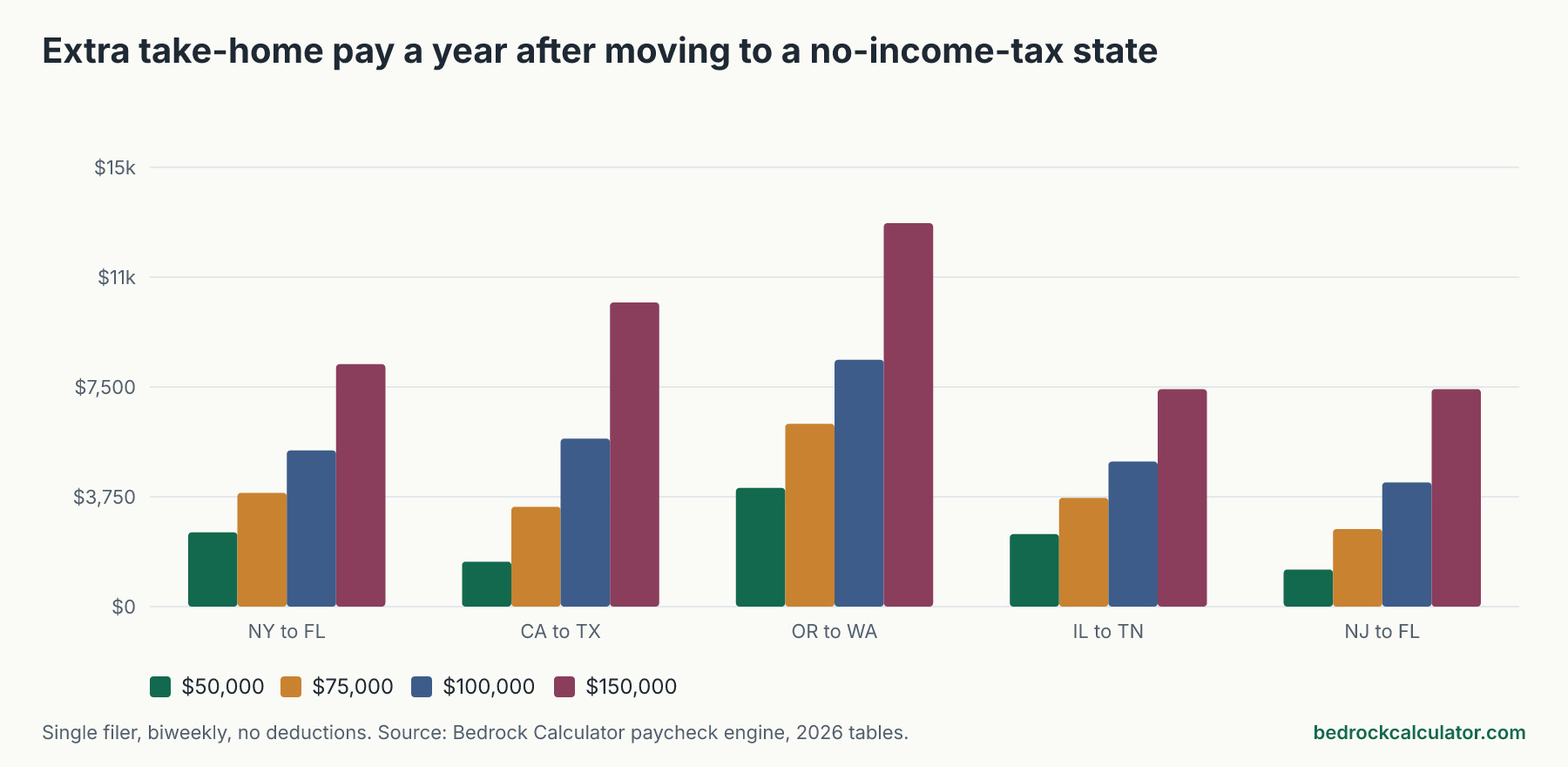
The gain grows with your salary. At $150,000, California to Texas is worth $10,388.64 a year and Oregon to Washington $13,093.50.
How we worked out these numbers
We ran the paycheck calculator on this site for both states in each pair, at $50,000, $75,000, $100,000 and $150,000, and subtracted one take-home figure from the other. Every run uses the same setup:
- Single filer, paid every two weeks
- Salary only, no 401(k), HSA or other deductions
- 2026 federal brackets, 2026 Social Security wage base, and each state's own income tax schedule
Federal income tax, Social Security and Medicare don't change when you move between states, so the difference you see is exactly the state income tax in the state you leave. That makes these numbers simple to check: open the New York paycheck calculator and the Florida paycheck calculator side by side with the same salary.
Here is what the figures leave out:
- City income tax. New York City, Yonkers and Portland-area transit and local taxes are not here. If you live in New York City now, your saving from a move to Florida is larger than the New York figure in the table.
- State deductions and credits. The calculator applies each state's brackets to wages without a state standard deduction or credit. That slightly overstates the tax you'd leave behind, most of all at the lower salaries.
- Payroll premiums that aren't income tax. Washington takes paid family leave and long-term care premiums out of paychecks. California, New York and New Jersey have their own disability and family leave deductions. None of those are in these numbers.
- One earner, single filer. A married couple filing jointly gets wider brackets in many states, which changes the gap.
Extra take-home pay for each move, at four salaries
Extra take-home pay a year after moving, 2026
Download CSVSingle filer, salary paid biweekly, no deductions. The difference in annual take-home pay between the two states.
| Oregon to Washington | $4,056.00 | $6,243.50 | $8,431.00 | $13,093.50 |
| New York to Florida | $2,535.00 | $3,885.00 | $5,331.75 | $8,281.75 |
| Illinois to Tennessee | $2,475.00 | $3,712.50 | $4,950.00 | $7,425.00 |
| California to Texas | $1,534.89 | $3,413.64 | $5,738.64 | $10,388.64 |
| New Jersey to Florida | $1,270.00 | $2,651.25 | $4,243.75 | $7,428.75 |
A few things stand out.
Oregon to Washington is the largest gain at every salary. Oregon's rate climbs quickly into the high single digits, so even a $50,000 earner leaves $4,056.00 a year on the table compared with Washington.
New York to Florida is worth $2,535.00 at $50,000 and $5,331.75 at $100,000. That's state tax alone. Add New York City's own income tax and the gap gets a lot wider for city residents.
California to Texas starts smaller, $1,534.89 at $50,000, because California's lowest brackets are light. It then grows faster than every pair except Oregon to Washington, because California's rates keep climbing, reaching $10,388.64 at $150,000.
Illinois to Tennessee grows in a straight line, because Illinois uses one flat rate: $2,475.00 at $50,000, $4,950.00 at $100,000 and $7,425.00 at $150,000.
New Jersey to Florida is the smallest gain of the five at $2,651.25 on $75,000, because New Jersey's low brackets are gentle. At $150,000 it climbs to $7,428.75.
Does the move still pay once sales and property tax are counted?
Income tax isn't the only tax that changes. We added the same household to the sales tax calculator and the property tax calculator: $25,000 of taxable purchases a year and a $400,000 home in both states. Those two inputs are our choices, held the same in every state so only the tax rates move.
The same moves once sales and property tax are counted ($75,000 salary)
Download CSVSales tax on $25,000 of taxable purchases at the state plus average local rate; property tax on a $400,000 home at the state average effective rate. A positive change is more tax in the new state.
| Illinois to Tennessee | $3,712.50 | $157.50 | -$5,880.00 | $9,435.00 |
| New Jersey to Florida | $2,651.25 | $88.75 | -$4,560.00 | $7,122.50 |
| New York to Florida | $3,885.00 | -$390.00 | -$2,800.00 | $7,075.00 |
| Oregon to Washington | $6,243.50 | $2,392.50 | $40.00 | $3,811.00 |
| California to Texas | $3,413.64 | -$207.50 | $2,400.00 | $1,221.14 |
All five moves still come out ahead for this household, but by very different amounts.
- Illinois to Tennessee saves the most once everything is counted, $9,435.00 a year. Tennessee's sales tax costs $157.50 more, but Illinois has the highest average property tax rate in this data, and the property tax bill on a $400,000 home falls by $5,880.00.
- New York to Florida and New Jersey to Florida both gain from Florida's lower property taxes, saving $7,075.00 and $7,122.50 a year in total.
- Oregon to Washington gives a lot back at the register. Oregon has no general sales tax, so our household pays $2,392.50 more in sales tax in Washington, and the total saving shrinks to $3,811.00.
- California to Texas ends up with the smallest saving. Texas property tax on the same home is $2,400.00 a year higher, which eats most of the income tax saving and leaves $1,221.14. Buy a bigger house in Texas than you had in California and the saving can disappear.
These figures use statewide average rates. Your own county's property tax and your city's sales tax can be quite a bit higher or lower.
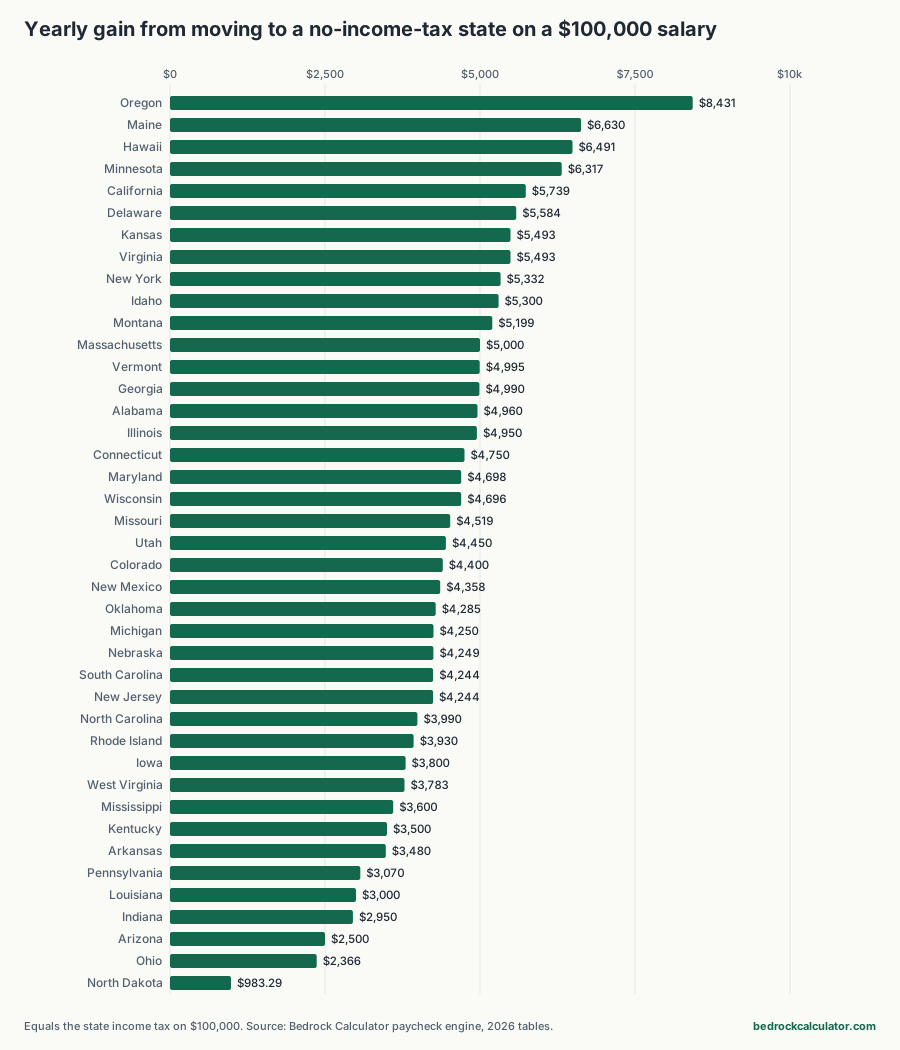
Moving from any US state: the gain on $100,000
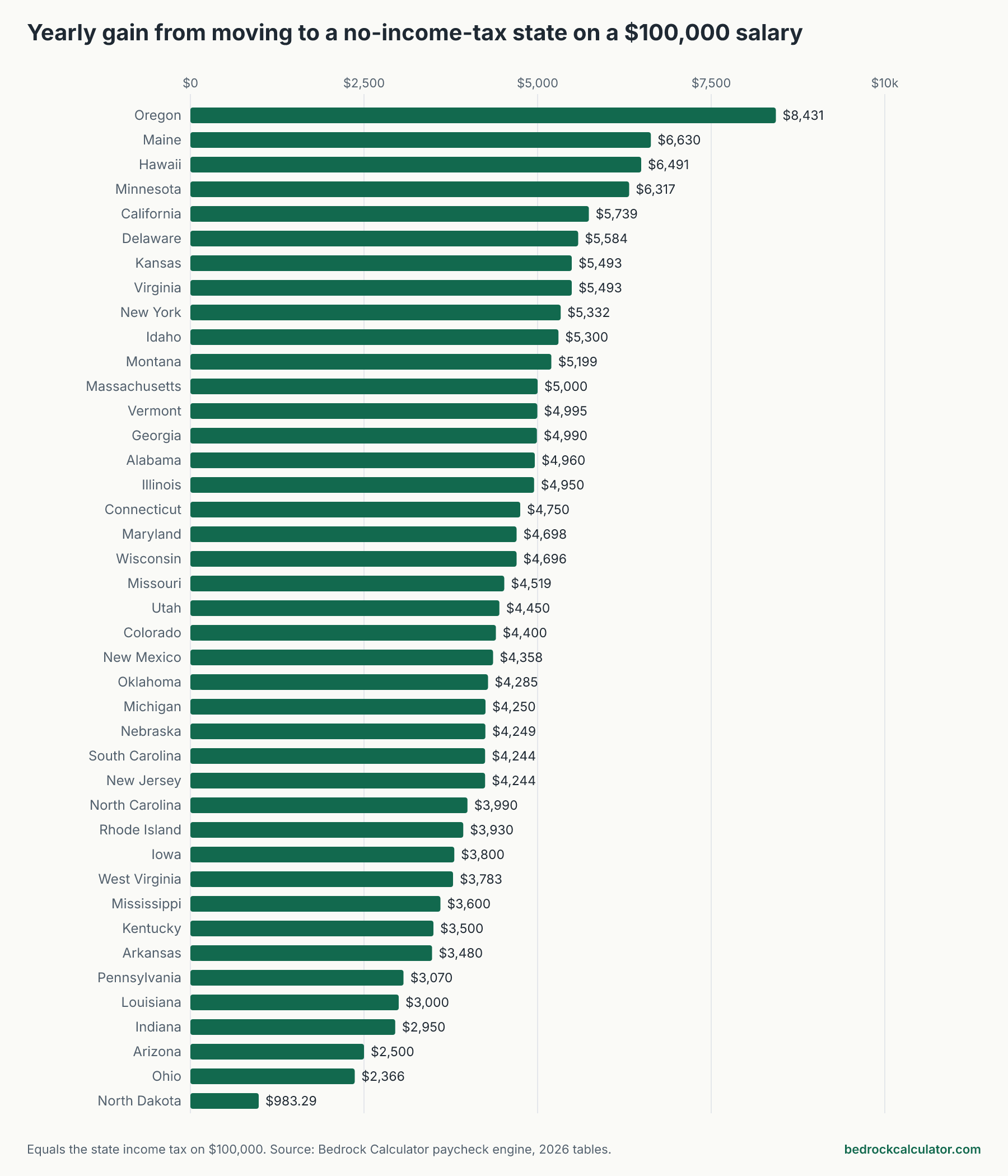
The five pairs above are the classic moves, but the arithmetic works the same from anywhere. Because federal tax and FICA are identical across states, the extra take-home pay from moving to a no-income-tax state is exactly what your current state charges.
On a $100,000 salary, leaving Oregon adds $8,431.00 a year. At the other end, leaving North Dakota adds only $983.29, because its rates are low.
What you keep by moving to a no-income-tax state on $100,000, from every state
Download CSVEqual to the state income tax the paycheck calculator charges on a $100,000 salary, single filer, no deductions.
| Oregon | $8,431.00 |
| Maine | $6,630.30 |
| Hawaii | $6,491.20 |
| Minnesota | $6,317.01 |
| California | $5,738.64 |
| Delaware | $5,583.50 |
| Kansas | $5,492.60 |
| Virginia | $5,492.50 |
| New York | $5,331.75 |
| Idaho | $5,300.00 |
| Montana | $5,198.75 |
| Massachusetts | $5,000.00 |
| Vermont | $4,994.50 |
| Georgia | $4,990.00 |
| Alabama | $4,960.00 |
| Illinois | $4,950.00 |
| Connecticut | $4,750.00 |
| Maryland | $4,697.50 |
| Wisconsin | $4,696.46 |
| Missouri | $4,519.37 |
| Utah | $4,450.00 |
| Colorado | $4,400.00 |
| New Mexico | $4,358.00 |
| Oklahoma | $4,285.25 |
| Michigan | $4,250.00 |
| Nebraska | $4,249.13 |
| South Carolina | $4,244.00 |
| New Jersey | $4,243.75 |
| North Carolina | $3,990.00 |
| Rhode Island | $3,929.50 |
| Iowa | $3,800.00 |
| West Virginia | $3,782.50 |
| Mississippi | $3,600.00 |
| Kentucky | $3,500.00 |
| Arkansas | $3,480.00 |
| Pennsylvania | $3,070.00 |
| Louisiana | $3,000.00 |
| Indiana | $2,950.00 |
| Arizona | $2,500.00 |
| Ohio | $2,365.63 |
| North Dakota | $983.29 |
Before you pack the truck
Tax is one line in a big budget. Housing, insurance, wages for your field and the cost of the move itself usually matter more than the state income tax. Remote workers should also check that their employer will actually let them change their work state, because withholding follows where you work.
To run your own numbers, start with the paycheck calculator for both states at your real salary and deductions. The California paycheck calculator and Texas paycheck calculator explain the rules specific to each state, and our look at what no-income-tax states charge instead compares sales and property tax across all of them.