Which US states have a flat income tax in 2026, and who pays less?
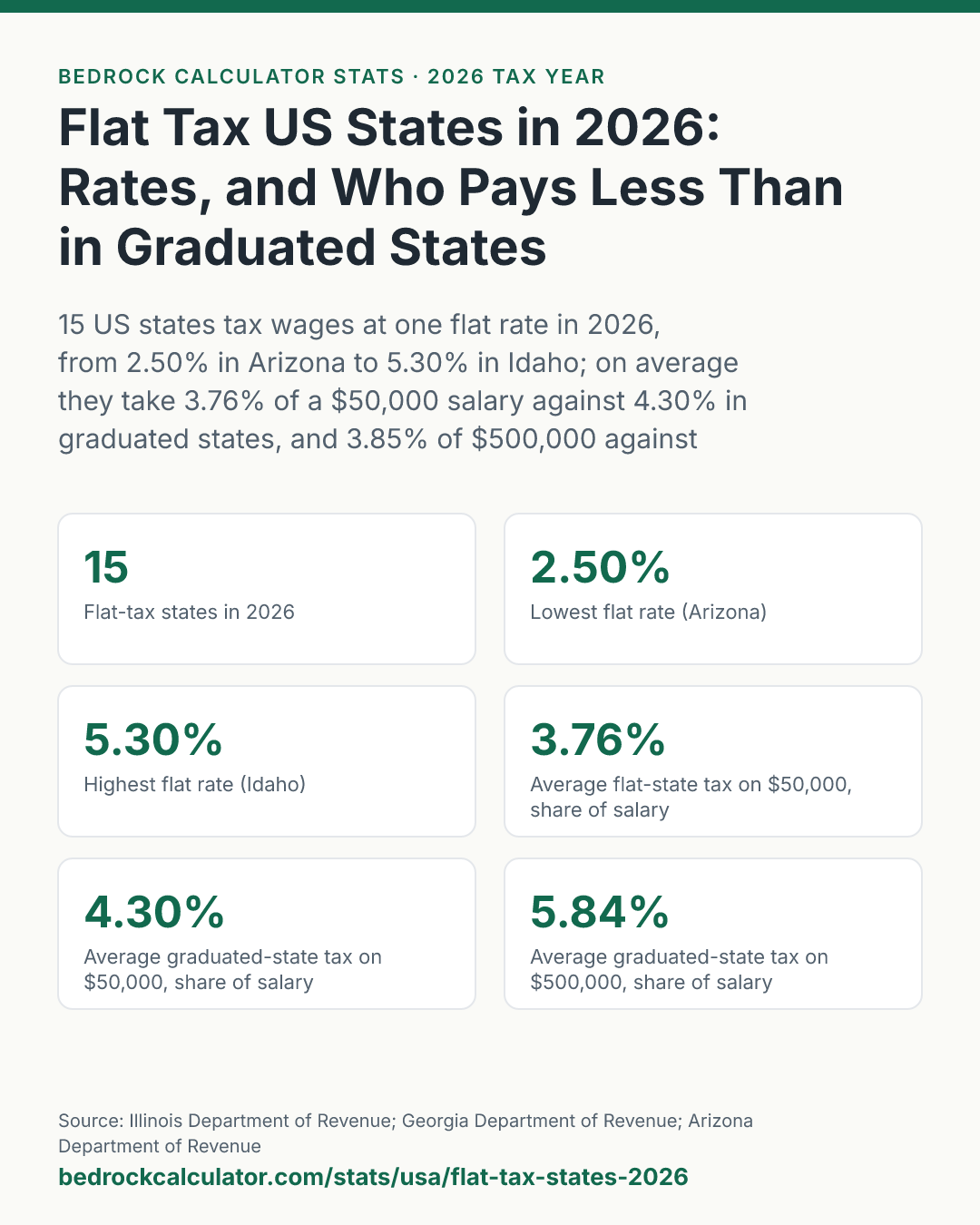
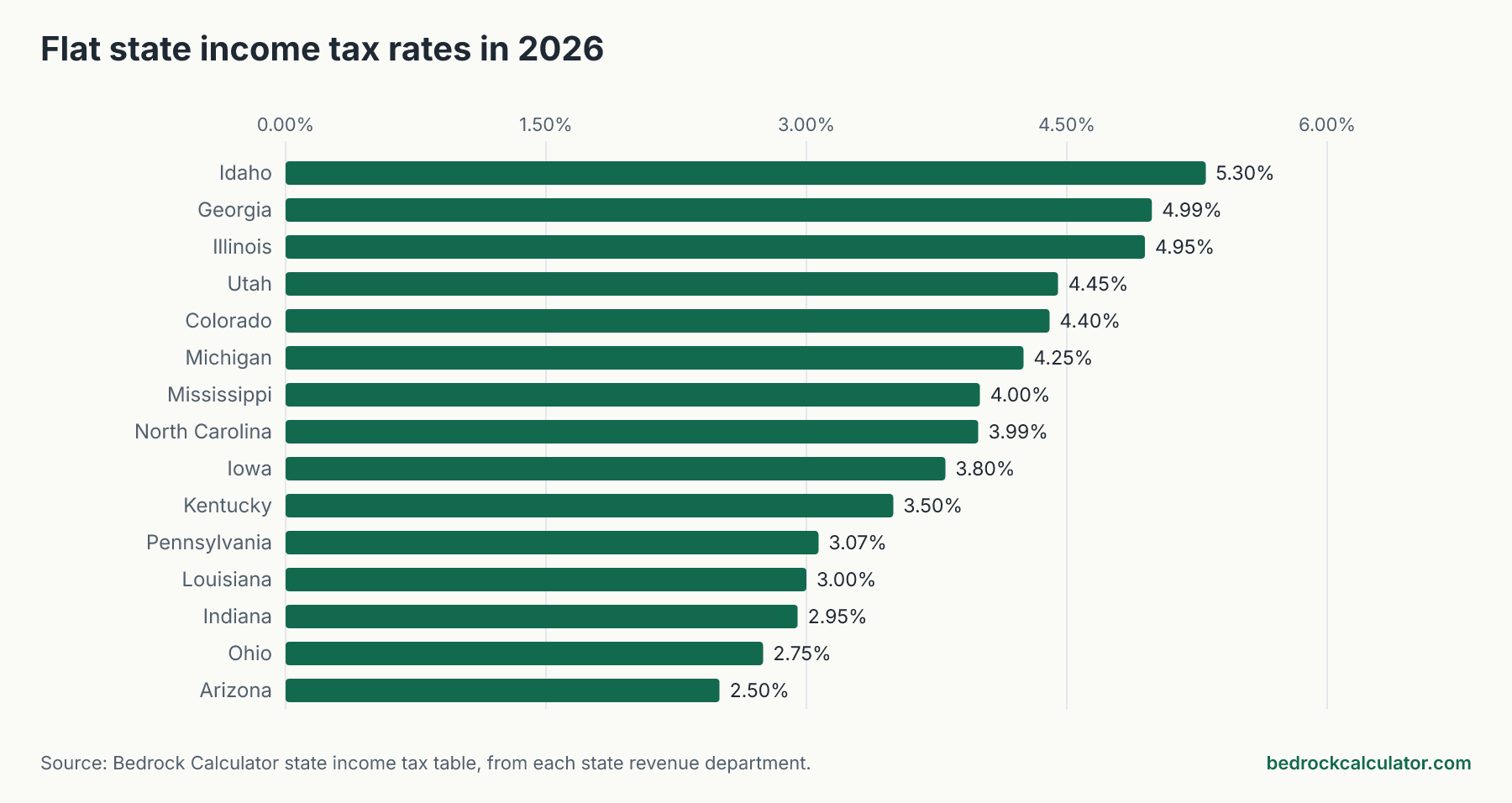
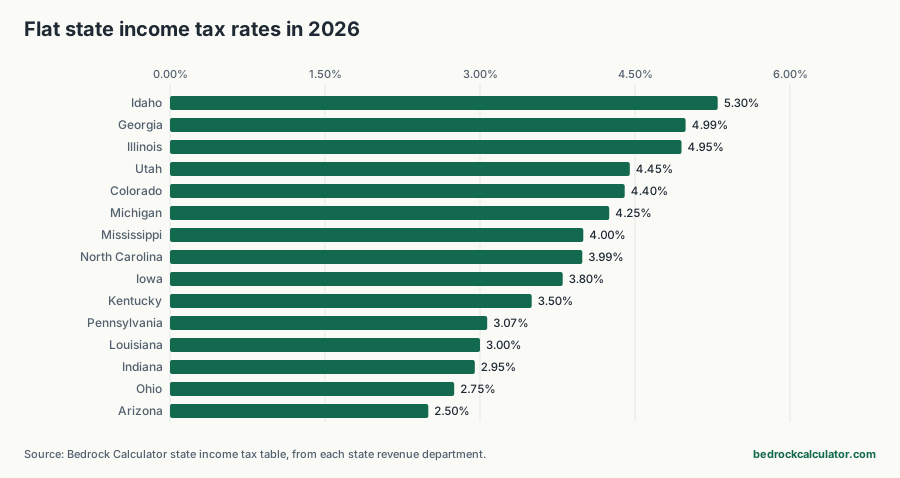
15 US states tax wages at one flat rate in 2026: Arizona, Colorado, Georgia, Idaho, Illinois, Indiana, Iowa, Kentucky, Louisiana, Michigan, Mississippi, North Carolina, Ohio, Pennsylvania, Utah. Rates run from 2.50% in Arizona to 5.30% in Idaho.
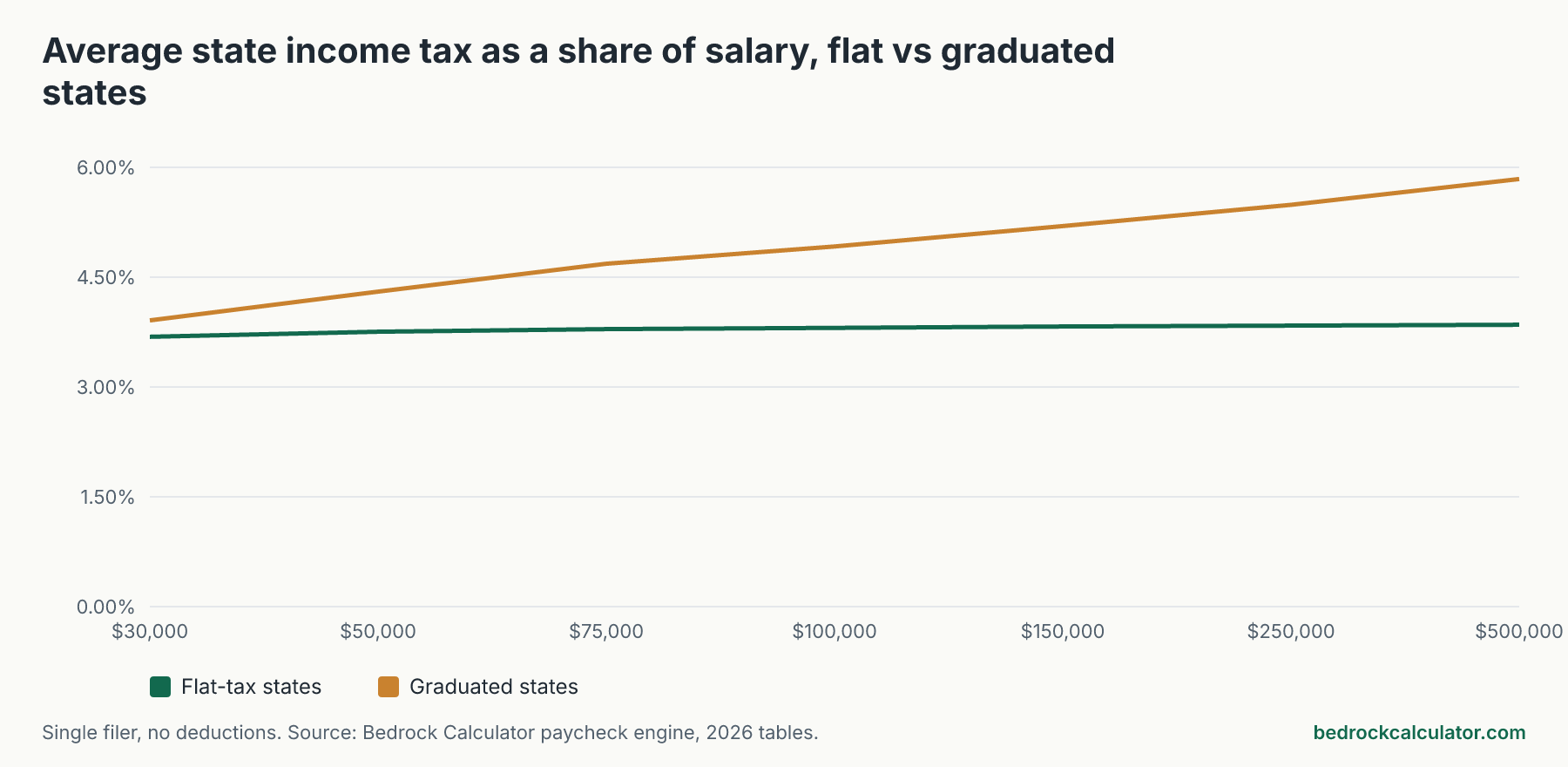
On average, flat-tax states take a smaller share of pay than states with graduated brackets at every salary we tested. The gap is small at the bottom, 3.69% against 3.91% on $30,000, and wide at the top, 3.85% against 5.84% on $500,000.
What counts as a flat tax state
A flat tax charges the same rate on every dollar of taxable income. We count a US state as flat when its 2026 schedule has a single rate above any zero-rate band. That puts Mississippi and Ohio on the list, because both tax nothing on the first slice of income and then charge one rate on the rest. Ohio also adds a fixed dollar amount at its threshold, a leftover from an old credit, so its bill jumps once you cross that line.
Several of these rates are new. Georgia, Kentucky, Mississippi and North Carolina all charge a lower rate in 2026 than they did in 2025, Louisiana replaced its brackets with a flat rate in 2025, and Iowa moved to a flat rate in 2025 as well. Some are scheduled to keep cutting. For the full 2026 bracket schedule of every state, flat or not, see 2026 state income tax brackets.
How we worked out these numbers
We ran the paycheck calculator for every state at seven salaries, from $30,000 to $500,000, and recorded the state income tax it charged. Every run is the same: single filer, salary only, paid every two weeks, no 401(k) or other deductions. Then we split the 41 states that tax wages into two groups, flat and graduated, and averaged each group's tax as a share of salary. Each state counts once, whatever its population.
What these numbers leave out matters a lot for this comparison:
- No state standard deductions, exemptions or credits. The paycheck calculator applies each state's rates to wages directly. In reality most states let you subtract something first, and several graduated states have generous deductions or credits for lower incomes. That means the real tax at $30,000 or $50,000 is lower than shown in many states, flat and graduated alike, and the low-income comparison is the least reliable part of this page.
- Single-filer schedules only. Married couples get wider brackets in many graduated states, which doesn't happen in a flat-tax state.
- No local income taxes. Several flat-tax states have city or county income taxes on top, including Pennsylvania, Ohio, Michigan, Kentucky and Indiana. None are counted here.
Who wins and who loses at each salary
Here's the average share of salary each group takes, with a count of how many flat-tax states charge less than most of the 26 graduated states at that salary.
Average state income tax as a share of salary, flat vs graduated states
Download CSVEach state counted once. States with no tax on wages are excluded from both groups.
| $30,000 | 3.69% | 3.91% | 8 |
| $50,000 | 3.76% | 4.30% | 9 |
| $75,000 | 3.79% | 4.68% | 12 |
| $100,000 | 3.81% | 4.92% | 12 |
| $150,000 | 3.83% | 5.20% | 13 |
| $250,000 | 3.84% | 5.49% | 14 |
| $500,000 | 3.85% | 5.84% | 15 |
At $50,000, the averages are close: 3.76% for flat-tax states and 4.30% for graduated ones. 9 of the 15 flat-tax states charge less than most graduated states. The rest charge more, because graduated states put their lowest rates on the first slices of income, and a flat rate taxes those dollars at full rate. Illinois, at 4.95%, takes $2,475.00 on $50,000. California, with some of the highest top rates in the country, takes only $1,534.89 on the same salary, because its lowest brackets are light.
At $100,000, the gap opens: 3.81% against 4.92%.
At $500,000, all 15 flat-tax states charge less than most graduated states. Flat-tax states take 3.85% of salary on average and graduated states 5.84%. California charges $44,766.14 on $500,000 against $24,750.00 in Illinois, a difference of $20,016.14.
So the honest summary is this: a flat tax is a clear win for high earners. For middle earners it depends on which states you compare. For lower earners it can cost more than a graduated state with gentle bottom brackets, once real deductions are counted.
Flat tax rates and what they cost
The table below shows each flat-tax state's rate, what it charges at three salaries, and how many graduated states charge more on the same pay.
State income tax in the flat-tax states, 2026 (single filer)
Download CSVSalary paid biweekly, no deductions. The last two columns count how many of the graduated-bracket states charge more on the same salary.
| Arizona | 2.50% | $1,250.00 | $2,500.00 | $6,250.00 | 25 | 25 |
| Ohio | 2.75% | $990.63 | $2,365.63 | $6,490.63 | 25 | 25 |
| Indiana | 2.95% | $1,475.00 | $2,950.00 | $7,375.00 | 24 | 25 |
| Louisiana | 3.00% | $1,500.00 | $3,000.00 | $7,500.00 | 24 | 25 |
| Pennsylvania | 3.07% | $1,535.00 | $3,070.00 | $7,675.00 | 21 | 25 |
| Kentucky | 3.50% | $1,750.00 | $3,500.00 | $8,750.00 | 19 | 25 |
| Iowa | 3.80% | $1,900.00 | $3,800.00 | $9,500.00 | 18 | 24 |
| North Carolina | 3.99% | $1,995.00 | $3,990.00 | $9,975.00 | 16 | 24 |
| Mississippi | 4.00% | $1,600.00 | $3,600.00 | $9,600.00 | 21 | 24 |
| Michigan | 4.25% | $2,125.00 | $4,250.00 | $10,625.00 | 13 | 24 |
| Colorado | 4.40% | $2,200.00 | $4,400.00 | $11,000.00 | 12 | 23 |
| Utah | 4.45% | $2,225.00 | $4,450.00 | $11,125.00 | 12 | 21 |
| Illinois | 4.95% | $2,475.00 | $4,950.00 | $12,375.00 | 8 | 17 |
| Georgia | 4.99% | $2,495.00 | $4,990.00 | $12,475.00 | 8 | 16 |
| Idaho | 5.30% | $2,650.00 | $5,300.00 | $13,250.00 | 5 | 13 |
Arizona has the lowest flat rate at 2.50%, which costs $2,500.00 on $100,000. Idaho has the highest at 5.30%, or $5,300.00 on the same salary. Georgia, at 4.99%, sits near the top of the flat-rate range: on $50,000, 8 graduated states charge more, but on $500,000 that number rises to 20.
A low flat rate doesn't automatically mean the lowest tax. North Dakota is graduated, not flat, yet it charges just $983.29 on $100,000, less than any flat-tax state, because its first bracket is a zero rate on a wide band and its rates are low.
A few caveats on specific states
- Colorado's rate is the statutory one. Colorado lowers it temporarily in years with a state revenue surplus, so the rate charged on 2026 returns may end up lower.
- Utah cut its rate for 2026, and the cut is what we use. The Tax Commission's rate page hadn't caught up when we last checked.
- Indiana's rate follows its legislated step-down for 2026, but we couldn't confirm it on Indiana's own site.
- Idaho has a zero-rate band on the first few thousand dollars of taxable income that our table doesn't store, so its tax is slightly overstated at low incomes.
Every US state at every salary
For completeness, here is the state income tax the paycheck calculator charges in all 50 states at each salary.
State income tax at every salary, all 50 states
Download CSVSingle filer, biweekly, no deductions.
| Oregon | Graduated | $2,306.00 | $4,056.00 | $6,243.50 | $8,431.00 | $13,093.50 | $22,993.50 | $47,743.50 |
| Maine | Graduated | $1,764.70 | $3,114.70 | $4,842.80 | $6,630.30 | $10,205.30 | $17,355.30 | $35,230.30 |
| Hawaii | Graduated | $1,267.20 | $2,691.20 | $4,591.20 | $6,491.20 | $10,366.20 | $18,125.00 | $36,250.00 |
| Minnesota | Graduated | $1,605.00 | $2,917.01 | $4,617.01 | $6,317.01 | $10,142.99 | $18,929.99 | $43,554.99 |
| California | Graduated | $563.93 | $1,534.89 | $3,413.64 | $5,738.64 | $10,388.64 | $19,688.64 | $44,766.14 |
| Delaware | Graduated | $1,278.50 | $2,388.50 | $3,933.50 | $5,583.50 | $8,883.50 | $15,483.50 | $31,983.50 |
| Kansas | Graduated | $1,586.60 | $2,702.60 | $4,097.60 | $5,492.60 | $8,282.60 | $13,862.60 | $27,812.60 |
| Virginia | Graduated | $1,467.50 | $2,617.50 | $4,055.00 | $5,492.50 | $8,367.50 | $14,117.50 | $28,492.50 |
| New York | Graduated | $1,455.00 | $2,535.00 | $3,885.00 | $5,331.75 | $8,281.75 | $14,510.45 | $31,635.45 |
| Idaho | Flat | $1,590.00 | $2,650.00 | $3,975.00 | $5,300.00 | $7,950.00 | $13,250.00 | $26,500.00 |
| Montana | Graduated | $1,410.00 | $2,373.75 | $3,786.25 | $5,198.75 | $8,023.75 | $13,673.75 | $27,798.75 |
| Massachusetts | Graduated | $1,500.00 | $2,500.00 | $3,750.00 | $5,000.00 | $7,500.00 | $12,500.00 | $25,000.00 |
| Vermont | Graduated | $1,005.00 | $1,694.50 | $3,344.50 | $4,994.50 | $8,597.50 | $16,200.95 | $38,075.95 |
| Georgia | Flat | $1,497.00 | $2,495.00 | $3,742.50 | $4,990.00 | $7,485.00 | $12,475.00 | $24,950.00 |
| Alabama | Graduated | $1,460.00 | $2,460.00 | $3,710.00 | $4,960.00 | $7,460.00 | $12,460.00 | $24,960.00 |
| Illinois | Flat | $1,485.00 | $2,475.00 | $3,712.50 | $4,950.00 | $7,425.00 | $12,375.00 | $24,750.00 |
| Connecticut | Graduated | $1,100.00 | $2,000.00 | $3,375.00 | $4,750.00 | $7,750.00 | $14,000.00 | $31,250.00 |
| Maryland | Graduated | $1,372.50 | $2,322.50 | $3,510.00 | $4,697.50 | $7,260.00 | $12,760.00 | $27,135.00 |
| Wisconsin | Graduated | $1,184.01 | $2,064.01 | $3,371.46 | $4,696.46 | $7,346.46 | $12,646.46 | $29,827.54 |
| Missouri | Graduated | $1,229.37 | $2,169.37 | $3,344.37 | $4,519.37 | $6,869.37 | $11,569.37 | $23,319.37 |
| Utah | Flat | $1,335.00 | $2,225.00 | $3,337.50 | $4,450.00 | $6,675.00 | $11,125.00 | $22,250.00 |
| Colorado | Flat | $1,320.00 | $2,200.00 | $3,300.00 | $4,400.00 | $6,600.00 | $11,000.00 | $22,000.00 |
| New Mexico | Graduated | $1,015.00 | $1,941.00 | $3,133.00 | $4,358.00 | $6,808.00 | $12,108.00 | $26,858.00 |
| Oklahoma | Graduated | $1,135.25 | $2,035.25 | $3,160.25 | $4,285.25 | $6,535.25 | $11,035.25 | $22,285.25 |
| Michigan | Flat | $1,275.00 | $2,125.00 | $3,187.50 | $4,250.00 | $6,375.00 | $10,625.00 | $21,250.00 |
| Nebraska | Graduated | $1,064.13 | $1,974.13 | $3,111.63 | $4,249.13 | $6,524.13 | $11,074.13 | $22,449.13 |
| South Carolina | Graduated | $597.00 | $1,639.00 | $2,941.50 | $4,244.00 | $6,849.00 | $12,059.00 | $25,084.00 |
| New Jersey | Graduated | $455.00 | $1,270.00 | $2,651.25 | $4,243.75 | $7,428.75 | $13,798.75 | $29,723.75 |
| North Carolina | Flat | $1,197.00 | $1,995.00 | $2,992.50 | $3,990.00 | $5,985.00 | $9,975.00 | $19,950.00 |
| Rhode Island | Graduated | $1,125.00 | $1,875.00 | $2,812.50 | $3,929.50 | $6,304.50 | $11,842.52 | $26,817.52 |
| Iowa | Flat | $1,140.00 | $1,900.00 | $2,850.00 | $3,800.00 | $5,700.00 | $9,500.00 | $19,000.00 |
| West Virginia | Graduated | $790.50 | $1,528.50 | $2,637.50 | $3,782.50 | $6,072.50 | $10,652.50 | $22,102.50 |
| Mississippi | Flat | $800.00 | $1,600.00 | $2,600.00 | $3,600.00 | $5,600.00 | $9,600.00 | $19,600.00 |
| Kentucky | Flat | $1,050.00 | $1,750.00 | $2,625.00 | $3,500.00 | $5,250.00 | $8,750.00 | $17,500.00 |
| Arkansas | Graduated | $750.00 | $1,530.00 | $2,505.00 | $3,480.00 | $5,430.00 | $9,330.00 | $19,080.00 |
| Pennsylvania | Flat | $921.00 | $1,535.00 | $2,302.50 | $3,070.00 | $4,605.00 | $7,675.00 | $15,350.00 |
| Louisiana | Flat | $900.00 | $1,500.00 | $2,250.00 | $3,000.00 | $4,500.00 | $7,500.00 | $15,000.00 |
| Indiana | Flat | $885.00 | $1,475.00 | $2,212.50 | $2,950.00 | $4,425.00 | $7,375.00 | $14,750.00 |
| Arizona | Flat | $750.00 | $1,250.00 | $1,875.00 | $2,500.00 | $3,750.00 | $6,250.00 | $12,500.00 |
| Ohio | Flat | $440.63 | $990.63 | $1,678.13 | $2,365.63 | $3,740.63 | $6,490.63 | $13,365.63 |
| North Dakota | Graduated | $0.00 | $8.29 | $495.79 | $983.29 | $1,958.29 | $3,908.29 | $10,156.09 |
| Alaska | No tax on wages | $0.00 | $0.00 | $0.00 | $0.00 | $0.00 | $0.00 | $0.00 |
| Florida | No tax on wages | $0.00 | $0.00 | $0.00 | $0.00 | $0.00 | $0.00 | $0.00 |
| Nevada | No tax on wages | $0.00 | $0.00 | $0.00 | $0.00 | $0.00 | $0.00 | $0.00 |
| New Hampshire | No tax on wages | $0.00 | $0.00 | $0.00 | $0.00 | $0.00 | $0.00 | $0.00 |
| South Dakota | No tax on wages | $0.00 | $0.00 | $0.00 | $0.00 | $0.00 | $0.00 | $0.00 |
| Tennessee | No tax on wages | $0.00 | $0.00 | $0.00 | $0.00 | $0.00 | $0.00 | $0.00 |
| Texas | No tax on wages | $0.00 | $0.00 | $0.00 | $0.00 | $0.00 | $0.00 | $0.00 |
| Washington | No tax on wages | $0.00 | $0.00 | $0.00 | $0.00 | $0.00 | $0.00 | $15,540.00 |
| Wyoming | No tax on wages | $0.00 | $0.00 | $0.00 | $0.00 | $0.00 | $0.00 | $0.00 |
Getting your own number
State income tax is only part of what a state costs you, but if you're comparing two states, start with your actual salary and deductions. The Illinois paycheck calculator, Georgia paycheck calculator and North Carolina paycheck calculator show the flat-tax side, and the California paycheck calculator shows a steep graduated schedule for contrast.