What are the 2026 state income tax rates in each US state?
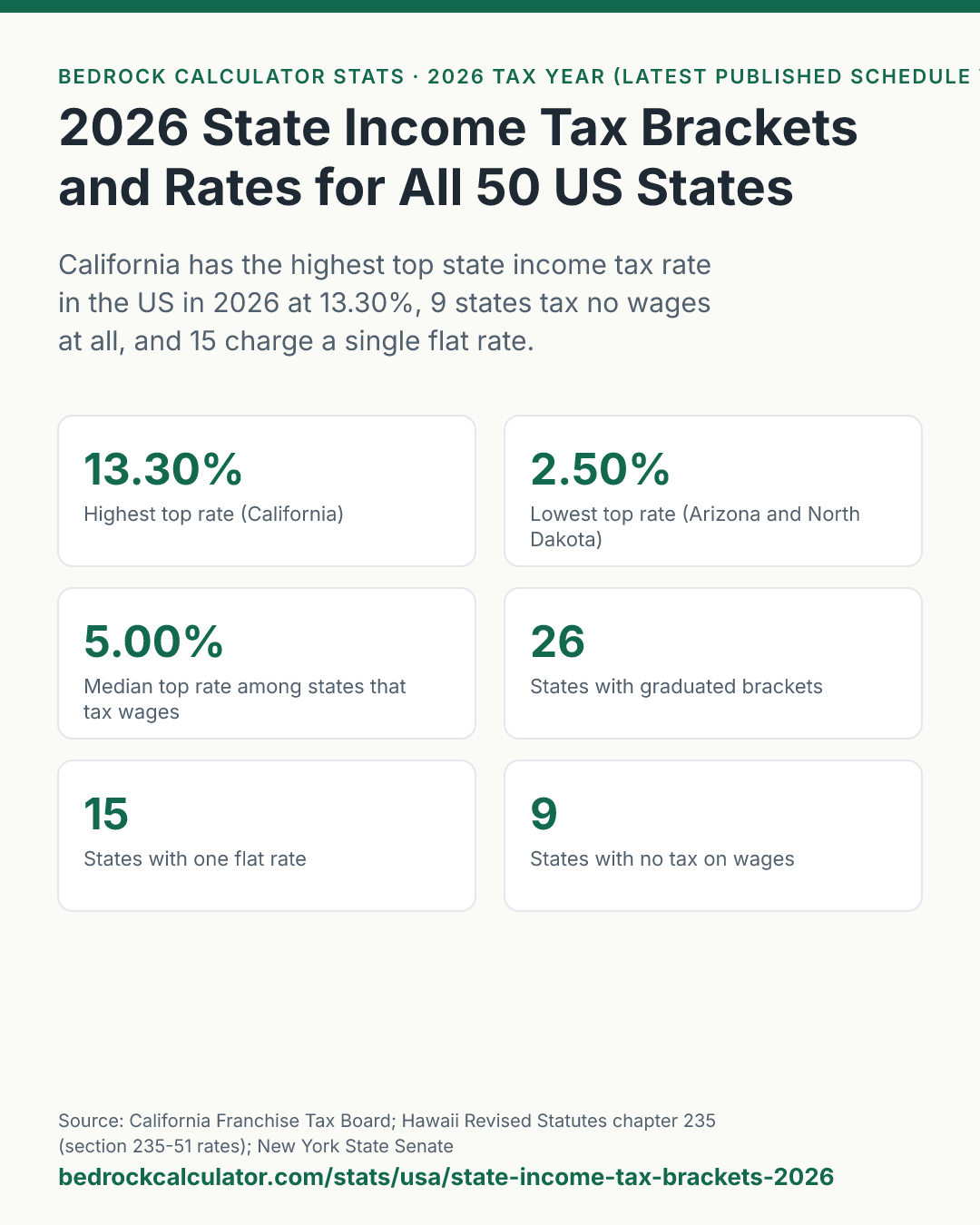
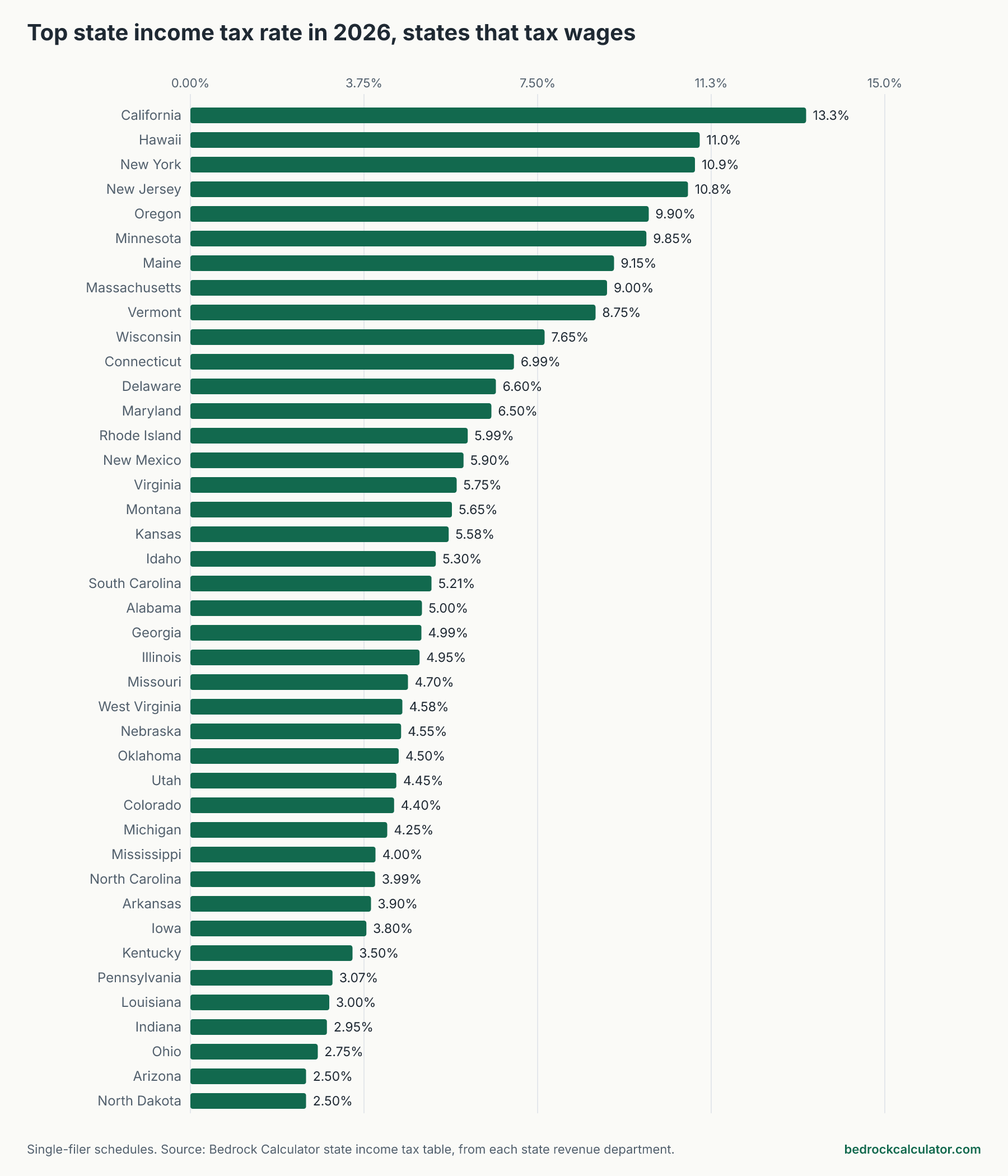
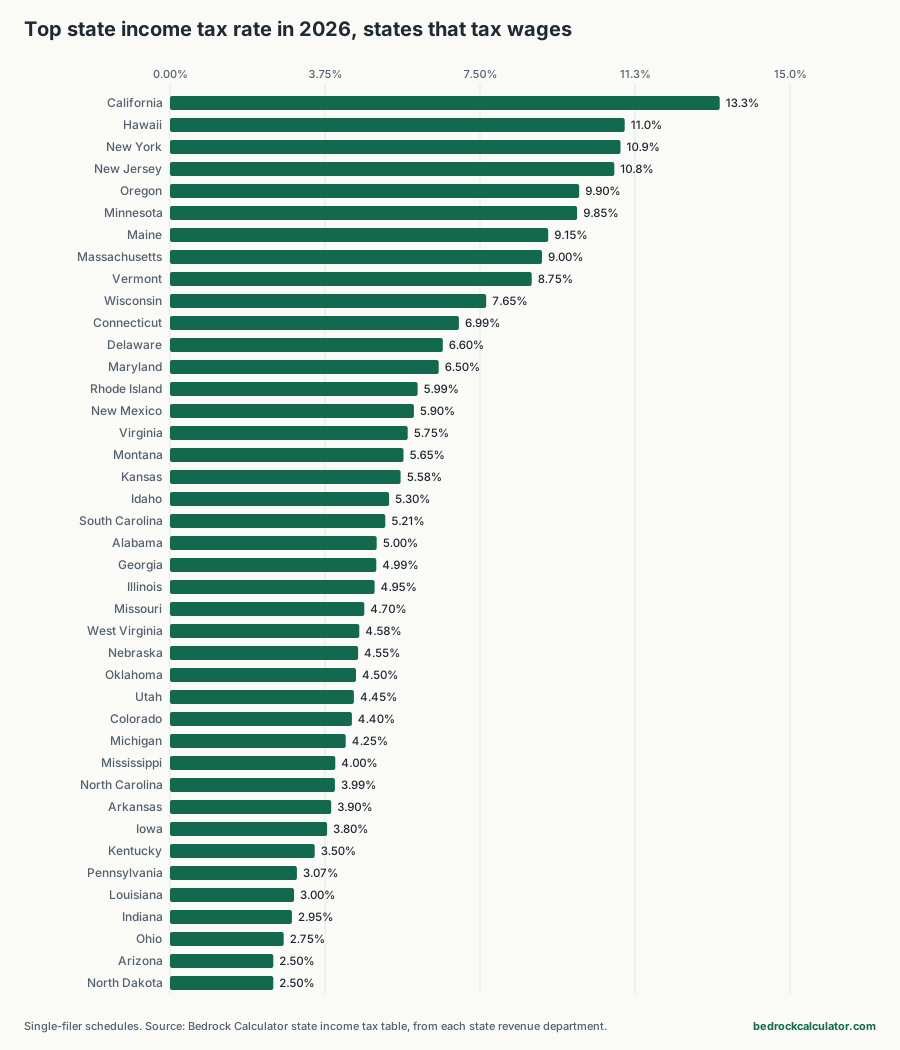
California has the highest top state income tax rate in the US in 2026, 13.30% on taxable income over $1,000,000. Hawaii (11.00%), New York (10.90%) and New Jersey (10.75%) follow. At the low end, Arizona and North Dakota top out at 2.50%.
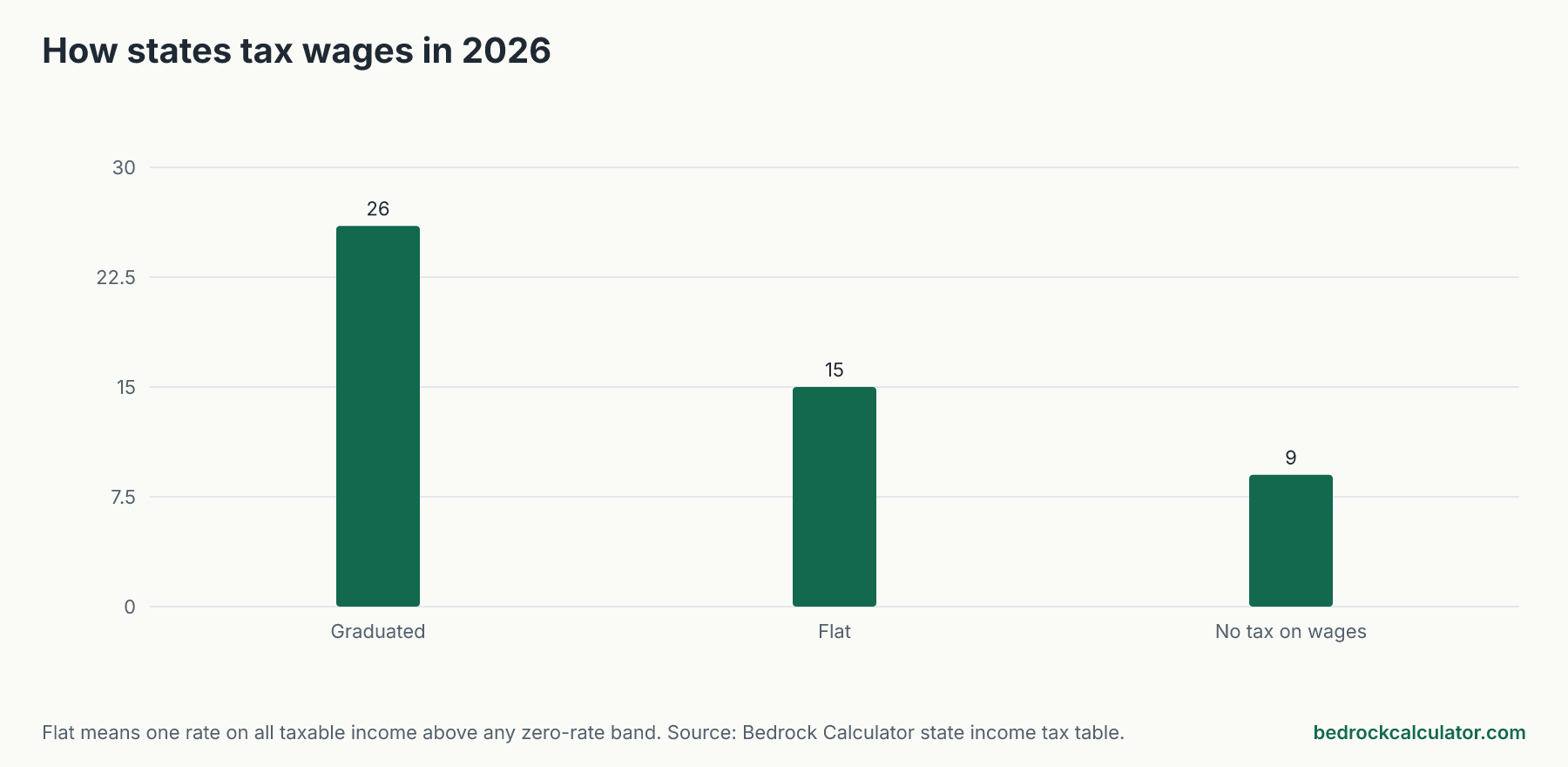
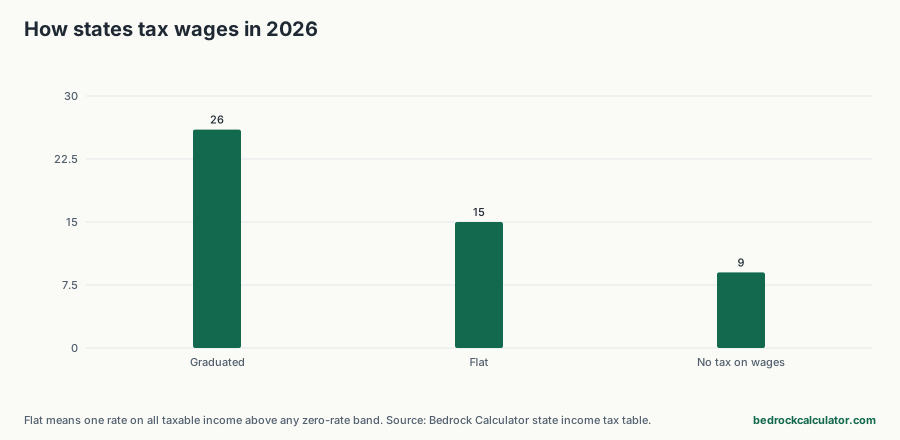
Of the 50 US states, 26 use graduated brackets, 15 charge one flat rate, and 9 don't tax wages at all. Among the 41 states that do tax wages, the median top rate is 5.00%.
Where these brackets come from
Every rate and threshold on this page is read from the state income tax table that our paycheck calculator uses to work out state withholding. Each state's schedule in that table was checked against the state's own revenue department, statute or legislature, and the source for each is listed at the bottom of the page.
Three things to keep in mind when you read the tables:
- These are single-filer schedules. Many states give married couples filing jointly wider brackets. More on that below.
- Brackets apply to taxable income, not to your salary. Your state may let you subtract a standard deduction or personal exemption first, and many states also offer credits. None of that is shown here.
- A few states haven't published 2026 yet. For Arkansas, California, Connecticut, Idaho, Vermont, the newest published schedule is for 2025, and that's what we show and use. We don't project a 2026 schedule a state hasn't released.
2026 US state income tax rates at a glance
This table gives one row per state: its lowest and top rates, where the top rate starts, and how many rate brackets it has. Click a heading to sort.
2026 state income tax rates at a glance (single filer)
Download CSVLowest and top rates exclude any zero-rate band. "Top rate starts at" is the taxable income where the top rate begins. Schedule year is the tax year of the published schedule the engine uses.
| California | Graduated | 1.00% | 13.30% | $1,000,000 | 10 | 2025 |
| Hawaii | Graduated | 1.40% | 11.00% | $325,000 | 12 | 2026 |
| New York | Graduated | 3.90% | 10.90% | $25,000,000 | 9 | 2026 |
| New Jersey | Graduated | 1.40% | 10.75% | $1,000,000 | 7 | 2026 |
| Oregon | Graduated | 4.75% | 9.90% | $125,000 | 4 | 2026 |
| Minnesota | Graduated | 5.35% | 9.85% | $203,150 | 4 | 2026 |
| Maine | Graduated | 5.80% | 9.15% | $1,000,000 | 4 | 2026 |
| Massachusetts | Graduated | 5.00% | 9.00% | $1,107,750 | 2 | 2026 |
| Vermont | Graduated | 3.35% | 8.75% | $249,700 | 4 | 2025 |
| Wisconsin | Graduated | 3.50% | 7.65% | $332,720 | 4 | 2026 |
| Connecticut | Graduated | 2.00% | 6.99% | $500,000 | 7 | 2025 |
| Delaware | Graduated | 2.20% | 6.60% | $60,000 | 6 | 2026 |
| Maryland | Graduated | 2.00% | 6.50% | $1,000,000 | 10 | 2026 |
| Rhode Island | Graduated | 3.75% | 5.99% | $186,450 | 3 | 2026 |
| New Mexico | Graduated | 1.50% | 5.90% | $210,000 | 6 | 2026 |
| Virginia | Graduated | 2.00% | 5.75% | $17,000 | 4 | 2026 |
| Montana | Graduated | 4.70% | 5.65% | $47,500 | 2 | 2026 |
| Kansas | Graduated | 5.20% | 5.58% | $23,000 | 2 | 2026 |
| Idaho | Flat | 5.30% | 5.30% | $0 | 1 | 2025 |
| South Carolina | Graduated | 1.99% | 5.21% | $30,000 | 2 | 2026 |
| Alabama | Graduated | 2.00% | 5.00% | $3,000 | 3 | 2026 |
| Georgia | Flat | 4.99% | 4.99% | $0 | 1 | 2026 |
| Illinois | Flat | 4.95% | 4.95% | $0 | 1 | 2026 |
| Missouri | Graduated | 2.00% | 4.70% | $9,436 | 7 | 2026 |
| West Virginia | Graduated | 2.11% | 4.58% | $60,000 | 5 | 2026 |
| Nebraska | Graduated | 2.46% | 4.55% | $24,760 | 3 | 2026 |
| Oklahoma | Graduated | 2.50% | 4.50% | $7,200 | 3 | 2026 |
| Utah | Flat | 4.45% | 4.45% | $0 | 1 | 2026 |
| Colorado | Flat | 4.40% | 4.40% | $0 | 1 | 2026 |
| Michigan | Flat | 4.25% | 4.25% | $0 | 1 | 2026 |
| Mississippi | Flat | 4.00% | 4.00% | $10,000 | 1 | 2026 |
| North Carolina | Flat | 3.99% | 3.99% | $0 | 1 | 2026 |
| Arkansas | Graduated | 2.00% | 3.90% | $26,400 | 4 | 2025 |
| Iowa | Flat | 3.80% | 3.80% | $0 | 1 | 2026 |
| Kentucky | Flat | 3.50% | 3.50% | $0 | 1 | 2026 |
| Pennsylvania | Flat | 3.07% | 3.07% | $0 | 1 | 2026 |
| Louisiana | Flat | 3.00% | 3.00% | $0 | 1 | 2026 |
| Indiana | Flat | 2.95% | 2.95% | $0 | 1 | 2026 |
| Ohio | Flat | 2.75% | 2.75% | $26,050 | 1 | 2026 |
| Arizona | Flat | 2.50% | 2.50% | $0 | 1 | 2026 |
| North Dakota | Graduated | 1.95% | 2.50% | $250,400 | 2 | 2026 |
| Alaska | No tax on wages | n/a | n/a | n/a | n/a | n/a |
| Florida | No tax on wages | n/a | n/a | n/a | n/a | n/a |
| Nevada | No tax on wages | n/a | n/a | n/a | n/a | n/a |
| New Hampshire | No tax on wages | n/a | n/a | n/a | n/a | n/a |
| South Dakota | No tax on wages | n/a | n/a | n/a | n/a | n/a |
| Tennessee | No tax on wages | n/a | n/a | n/a | n/a | n/a |
| Texas | No tax on wages | n/a | n/a | n/a | n/a | n/a |
| Washington | No tax on wages | n/a | n/a | n/a | n/a | n/a |
| Wyoming | No tax on wages | n/a | n/a | n/a | n/a | n/a |
n/a means the state has no tax on wage income.
How states tax wages: flat, graduated or not at all
Graduated states tax each slice of income at a rising rate. Hawaii has the most brackets, 12 of them. California has 10, starting at 1.00%. A graduated rate only applies to the income inside its bracket, so moving into a higher bracket never makes your whole income taxable at the higher rate. Our guide to marginal vs effective tax rates walks through why.
Flat-tax states charge one rate on all taxable income. There are 15 in 2026 by our count: Arizona, Colorado, Georgia, Idaho, Illinois, Indiana, Iowa, Kentucky, Louisiana, Michigan, Mississippi, North Carolina, Ohio, Pennsylvania, Utah. We count a state as flat when it has a single rate above any zero-rate band, which is why Mississippi and Ohio are in the list. Ohio taxes nothing up to $26,050, then charges a fixed $332 plus 2.75% of income above that line. Flat rates run from 2.50% in Arizona to 5.30% in Idaho. We compare what flat and graduated states charge at different incomes in flat tax states in 2026.
States with no tax on wages are Alaska, Florida, Nevada, New Hampshire, South Dakota, Tennessee, Texas, Washington, Wyoming. Washington is on the list because it taxes only long-term capital gains, at 7.0% rising to 9.9% on the largest gains, and not paychecks. See what the no-income-tax states charge instead for the sales and property taxes they rely on.
The millionaire brackets
6 states start their top rate at $1,000,000 of taxable income or more: California, Maine, Maryland, Massachusetts, New Jersey, New York. Two of them work a bit differently from a normal bracket:
- California's top 13.30% is its 12.30% bracket plus a separate 1.00% tax on income over $1,000,000 that funds behavioral health services. We show it as one band because that's how it's charged.
- Massachusetts has one 5.00% rate for nearly everyone, then a 4.00% surtax on taxable income over $1,107,750, for a combined 9.00% on income above that line. The threshold is adjusted for inflation every year.
Every 2026 US state income tax bracket
Here is the full schedule for each state that taxes wages, one row per bracket. Sort by state to read a schedule from the bottom up. "No upper limit" marks the top bracket.
Every 2026 state income tax bracket (single filer)
Download CSVRate applies to taxable income from the lower bound up to the upper bound. Sort by state to read one schedule in order.
| Alabama | 2.00% | $0 | $500 | 2026 |
| Alabama | 4.00% | $500 | $3,000 | 2026 |
| Alabama | 5.00% | $3,000 | No upper limit | 2026 |
| Arizona | 2.50% | $0 | No upper limit | 2026 |
| Arkansas | 0.00% | $0 | $5,600 | 2025 |
| Arkansas | 2.00% | $5,600 | $11,200 | 2025 |
| Arkansas | 3.00% | $11,200 | $16,000 | 2025 |
| Arkansas | 3.40% | $16,000 | $26,400 | 2025 |
| Arkansas | 3.90% | $26,400 | No upper limit | 2025 |
| California | 1.00% | $0 | $11,079 | 2025 |
| California | 2.00% | $11,079 | $26,264 | 2025 |
| California | 4.00% | $26,264 | $41,452 | 2025 |
| California | 6.00% | $41,452 | $57,542 | 2025 |
| California | 8.00% | $57,542 | $72,724 | 2025 |
| California | 9.30% | $72,724 | $371,479 | 2025 |
| California | 10.30% | $371,479 | $445,771 | 2025 |
| California | 11.30% | $445,771 | $742,953 | 2025 |
| California | 12.30% | $742,953 | $1,000,000 | 2025 |
| California | 13.30% | $1,000,000 | No upper limit | 2025 |
| Colorado | 4.40% | $0 | No upper limit | 2026 |
| Connecticut | 2.00% | $0 | $10,000 | 2025 |
| Connecticut | 4.50% | $10,000 | $50,000 | 2025 |
| Connecticut | 5.50% | $50,000 | $100,000 | 2025 |
| Connecticut | 6.00% | $100,000 | $200,000 | 2025 |
| Connecticut | 6.50% | $200,000 | $250,000 | 2025 |
| Connecticut | 6.90% | $250,000 | $500,000 | 2025 |
| Connecticut | 6.99% | $500,000 | No upper limit | 2025 |
| Delaware | 0.00% | $0 | $2,000 | 2026 |
| Delaware | 2.20% | $2,000 | $5,000 | 2026 |
| Delaware | 3.90% | $5,000 | $10,000 | 2026 |
| Delaware | 4.80% | $10,000 | $20,000 | 2026 |
| Delaware | 5.20% | $20,000 | $25,000 | 2026 |
| Delaware | 5.55% | $25,000 | $60,000 | 2026 |
| Delaware | 6.60% | $60,000 | No upper limit | 2026 |
| Georgia | 4.99% | $0 | No upper limit | 2026 |
| Hawaii | 1.40% | $0 | $9,600 | 2026 |
| Hawaii | 3.20% | $9,600 | $14,400 | 2026 |
| Hawaii | 5.50% | $14,400 | $19,200 | 2026 |
| Hawaii | 6.40% | $19,200 | $24,000 | 2026 |
| Hawaii | 6.80% | $24,000 | $36,000 | 2026 |
| Hawaii | 7.20% | $36,000 | $48,000 | 2026 |
| Hawaii | 7.60% | $48,000 | $125,000 | 2026 |
| Hawaii | 7.90% | $125,000 | $175,000 | 2026 |
| Hawaii | 8.25% | $175,000 | $225,000 | 2026 |
| Hawaii | 9.00% | $225,000 | $275,000 | 2026 |
| Hawaii | 10.00% | $275,000 | $325,000 | 2026 |
| Hawaii | 11.00% | $325,000 | No upper limit | 2026 |
| Idaho | 5.30% | $0 | No upper limit | 2025 |
| Illinois | 4.95% | $0 | No upper limit | 2026 |
| Indiana | 2.95% | $0 | No upper limit | 2026 |
| Iowa | 3.80% | $0 | No upper limit | 2026 |
| Kansas | 5.20% | $0 | $23,000 | 2026 |
| Kansas | 5.58% | $23,000 | No upper limit | 2026 |
| Kentucky | 3.50% | $0 | No upper limit | 2026 |
| Louisiana | 3.00% | $0 | No upper limit | 2026 |
| Maine | 5.80% | $0 | $27,400 | 2026 |
| Maine | 6.75% | $27,400 | $64,850 | 2026 |
| Maine | 7.15% | $64,850 | $1,000,000 | 2026 |
| Maine | 9.15% | $1,000,000 | No upper limit | 2026 |
| Maryland | 2.00% | $0 | $1,000 | 2026 |
| Maryland | 3.00% | $1,000 | $2,000 | 2026 |
| Maryland | 4.00% | $2,000 | $3,000 | 2026 |
| Maryland | 4.75% | $3,000 | $100,000 | 2026 |
| Maryland | 5.00% | $100,000 | $125,000 | 2026 |
| Maryland | 5.25% | $125,000 | $150,000 | 2026 |
| Maryland | 5.50% | $150,000 | $250,000 | 2026 |
| Maryland | 5.75% | $250,000 | $500,000 | 2026 |
| Maryland | 6.25% | $500,000 | $1,000,000 | 2026 |
| Maryland | 6.50% | $1,000,000 | No upper limit | 2026 |
| Massachusetts | 5.00% | $0 | $1,107,750 | 2026 |
| Massachusetts | 9.00% | $1,107,750 | No upper limit | 2026 |
| Michigan | 4.25% | $0 | No upper limit | 2026 |
| Minnesota | 5.35% | $0 | $33,310 | 2026 |
| Minnesota | 6.80% | $33,310 | $109,430 | 2026 |
| Minnesota | 7.85% | $109,430 | $203,150 | 2026 |
| Minnesota | 9.85% | $203,150 | No upper limit | 2026 |
| Mississippi | 0.00% | $0 | $10,000 | 2026 |
| Mississippi | 4.00% | $10,000 | No upper limit | 2026 |
| Missouri | 0.00% | $0 | $1,348 | 2026 |
| Missouri | 2.00% | $1,348 | $2,696 | 2026 |
| Missouri | 2.50% | $2,696 | $4,044 | 2026 |
| Missouri | 3.00% | $4,044 | $5,392 | 2026 |
| Missouri | 3.50% | $5,392 | $6,740 | 2026 |
| Missouri | 4.00% | $6,740 | $8,088 | 2026 |
| Missouri | 4.50% | $8,088 | $9,436 | 2026 |
| Missouri | 4.70% | $9,436 | No upper limit | 2026 |
| Montana | 4.70% | $0 | $47,500 | 2026 |
| Montana | 5.65% | $47,500 | No upper limit | 2026 |
| Nebraska | 2.46% | $0 | $4,130 | 2026 |
| Nebraska | 3.51% | $4,130 | $24,760 | 2026 |
| Nebraska | 4.55% | $24,760 | No upper limit | 2026 |
| New Jersey | 1.40% | $0 | $20,000 | 2026 |
| New Jersey | 1.75% | $20,000 | $35,000 | 2026 |
| New Jersey | 3.50% | $35,000 | $40,000 | 2026 |
| New Jersey | 5.53% | $40,000 | $75,000 | 2026 |
| New Jersey | 6.37% | $75,000 | $500,000 | 2026 |
| New Jersey | 8.97% | $500,000 | $1,000,000 | 2026 |
| New Jersey | 10.75% | $1,000,000 | No upper limit | 2026 |
| New Mexico | 1.50% | $0 | $5,500 | 2026 |
| New Mexico | 3.20% | $5,500 | $16,500 | 2026 |
| New Mexico | 4.30% | $16,500 | $33,500 | 2026 |
| New Mexico | 4.70% | $33,500 | $66,500 | 2026 |
| New Mexico | 4.90% | $66,500 | $210,000 | 2026 |
| New Mexico | 5.90% | $210,000 | No upper limit | 2026 |
| New York | 3.90% | $0 | $8,500 | 2026 |
| New York | 4.40% | $8,500 | $11,700 | 2026 |
| New York | 5.15% | $11,700 | $13,900 | 2026 |
| New York | 5.40% | $13,900 | $80,650 | 2026 |
| New York | 5.90% | $80,650 | $215,400 | 2026 |
| New York | 6.85% | $215,400 | $1,077,550 | 2026 |
| New York | 9.65% | $1,077,550 | $5,000,000 | 2026 |
| New York | 10.30% | $5,000,000 | $25,000,000 | 2026 |
| New York | 10.90% | $25,000,000 | No upper limit | 2026 |
| North Carolina | 3.99% | $0 | No upper limit | 2026 |
| North Dakota | 0.00% | $0 | $49,575 | 2026 |
| North Dakota | 1.95% | $49,575 | $250,400 | 2026 |
| North Dakota | 2.50% | $250,400 | No upper limit | 2026 |
| Ohio | 0.00% | $0 | $26,050 | 2026 |
| Ohio | 2.75% | $26,050 | No upper limit | 2026 |
| Oklahoma | 0.00% | $0 | $3,750 | 2026 |
| Oklahoma | 2.50% | $3,750 | $4,900 | 2026 |
| Oklahoma | 3.50% | $4,900 | $7,200 | 2026 |
| Oklahoma | 4.50% | $7,200 | No upper limit | 2026 |
| Oregon | 4.75% | $0 | $4,550 | 2026 |
| Oregon | 6.75% | $4,550 | $11,400 | 2026 |
| Oregon | 8.75% | $11,400 | $125,000 | 2026 |
| Oregon | 9.90% | $125,000 | No upper limit | 2026 |
| Pennsylvania | 3.07% | $0 | No upper limit | 2026 |
| Rhode Island | 3.75% | $0 | $82,050 | 2026 |
| Rhode Island | 4.75% | $82,050 | $186,450 | 2026 |
| Rhode Island | 5.99% | $186,450 | No upper limit | 2026 |
| South Carolina | 1.99% | $0 | $30,000 | 2026 |
| South Carolina | 5.21% | $30,000 | No upper limit | 2026 |
| Utah | 4.45% | $0 | No upper limit | 2026 |
| Vermont | 3.35% | $0 | $49,400 | 2025 |
| Vermont | 6.60% | $49,400 | $119,700 | 2025 |
| Vermont | 7.60% | $119,700 | $249,700 | 2025 |
| Vermont | 8.75% | $249,700 | No upper limit | 2025 |
| Virginia | 2.00% | $0 | $3,000 | 2026 |
| Virginia | 3.00% | $3,000 | $5,000 | 2026 |
| Virginia | 5.00% | $5,000 | $17,000 | 2026 |
| Virginia | 5.75% | $17,000 | No upper limit | 2026 |
| West Virginia | 2.11% | $0 | $10,000 | 2026 |
| West Virginia | 2.81% | $10,000 | $25,000 | 2026 |
| West Virginia | 3.16% | $25,000 | $40,000 | 2026 |
| West Virginia | 4.22% | $40,000 | $60,000 | 2026 |
| West Virginia | 4.58% | $60,000 | No upper limit | 2026 |
| Wisconsin | 3.50% | $0 | $15,110 | 2026 |
| Wisconsin | 4.40% | $15,110 | $51,950 | 2026 |
| Wisconsin | 5.30% | $51,950 | $332,720 | 2026 |
| Wisconsin | 7.65% | $332,720 | No upper limit | 2026 |
7 states start with a zero-rate band, so the first slice of taxable income is untaxed. That band is separate from any standard deduction the state allows.
Notes on specific states
A few schedules come with caveats you should know about before relying on them:
- Indiana: the 2026 flat rate shown follows the state's legislated step-down, but we couldn't confirm it on Indiana's own site when we last checked. Treat it as expected rather than confirmed.
- Utah: the legislature cut the rate for 2026, and that's the rate shown. The Tax Commission's rate page hadn't been updated to match when we checked.
- Colorado: the rate shown is the statutory one. Colorado cuts it temporarily in years with a state revenue surplus, so the rate actually charged on 2026 returns may end up lower.
- Idaho: Idaho's schedule has a zero-rate band on the first few thousand dollars of taxable income. Our table stores Idaho as a single rate from the first dollar, which slightly overstates tax on very small incomes.
- Kansas: the statutory rates are shown. Kansas law has a revenue trigger that can lower them, and we couldn't confirm from a Kansas source whether it fired for 2026.
- Ohio: the fixed amount at the $26,050 line is taken from the statute. Ohio's own tax sites couldn't be reached to read it again when we last checked.
What about married couples?
These are single-filer brackets. 18 of the graduated states use a separate schedule for married couples filing jointly, usually the same rates over wider income bands. The rest use one schedule for everyone. If you file jointly, check your state's joint schedule before estimating your bill.
How to use these brackets
A bracket table tells you the rate on each slice of income. It doesn't tell you what you'll owe, because deductions, exemptions, credits and local taxes all come in between. To see what a given salary actually costs in state tax, the paycheck calculator applies these same schedules to your wages, and state pages like the New York paycheck calculator or Ohio paycheck calculator explain each state's quirks. For the federal side, see the federal income tax calculator.