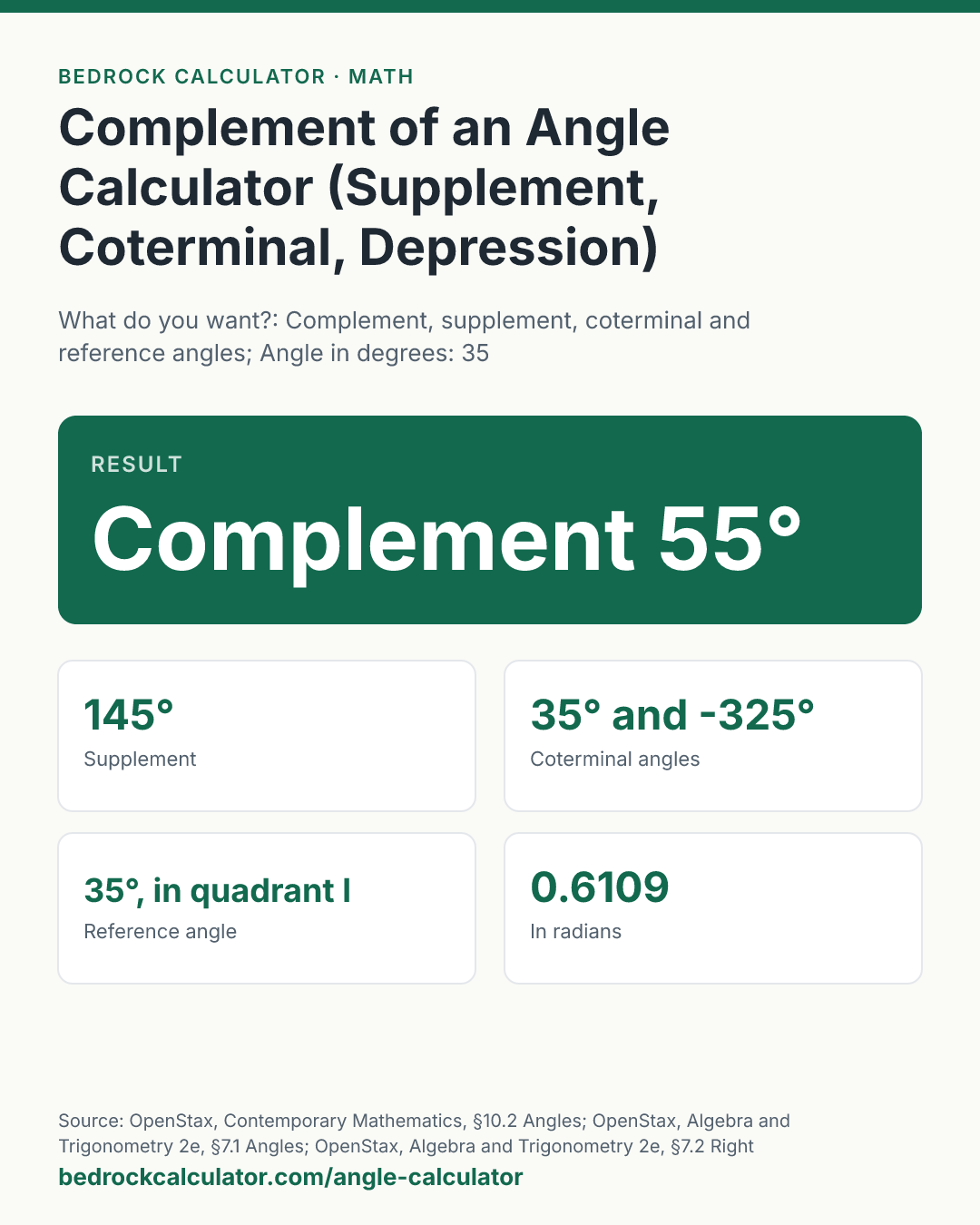

Quick Answer: The complement of an angle is what you add to it to make 90 degrees, so the complement of 35° is 55°, because 90 − 35 = 55. Its supplement, the amount that makes 180°, is 145°.
What does this calculator do?
This calculator finds the complement of an angle, and the other angles that go with it: the supplement, the coterminal angles, the reference angle and the quadrant the angle points into. It also gives the angle in radians, its sine, cosine and tangent, and the same three values for twice the angle, which is what the double-angle identities produce.
A second mode works out an angle of depression, the angle you look down through to see something below you, from the height difference and the level distance.
Two angles are complementary when they add up to 90 degrees, a right angle, and supplementary when they add up to 180 degrees, a straight line. So only an angle between 0 and 90 has a complement, and only one between 0 and 180 has a supplement. The calculator says "none" outside those ranges rather than giving a negative angle.
Angles are entered in degrees and may be negative or larger than a full turn. Results are rounded to four decimal places for display; the trigonometry runs at 34-digit precision.
Using the Complement of an Angle Calculator
- Leave the mode on complement, supplement, coterminal and reference angles.
- Type the angle in degrees. Negative angles and angles over 360 are fine.
- Read the headline for the complement, or the supplement if there is no complement. The cards list everything else.
For the angle of depression, switch the mode, then enter how far below you the object is and how far away it is horizontally. The presets load an angle of 120 degrees, an angle of −45 degrees, an angle of 765 degrees and a lighthouse keeper 30 m above the sea looking at a boat 50 m out. Below the calculator, one table lists the related angles for 21 common angles and another lists angles of depression from a height of 10.
How is this calculated?
- Complement and supplement. For an angle t strictly between 0° and 90°, the complement is 90° − t; for t strictly between 0° and 180°, the supplement is 180° − t.
complement = 90^∘ − t; supplement = 180^∘ − t
- Coterminal angles. Angles that differ by whole turns point the same way. The calculator reduces the angle to the range 0° up to 360° by subtracting 360° times the floor of t ÷ 360, and also shows the one a full turn below.
t₀ = t − 360^∘⌊t/360^∘⌋
- Reference angle and quadrant. From the reduced angle, the reference angle is the angle back to the nearer side of the x-axis: t₀ itself in quadrant I, 180° − t₀ in quadrant II, t₀ − 180° in quadrant III and 360° − t₀ in quadrant IV. Angles of exactly 0°, 90°, 180° or 270° lie on an axis.
- Radians and trigonometry. Radians are degrees times pi over 180. The sine, cosine and tangent are then taken of that angle, and the double-angle values come from the identities. A tangent whose cosine is zero is reported as undefined.
sin 2θ = 2 sin θ cos θ; cos 2θ = cos ²θ − sin ²θ; tan 2θ = sin 2θ/cos 2θ
- Angle of depression. The height difference and the horizontal distance are the two legs of a right triangle; the angle below the horizontal is the arctangent of their ratio, and the line of sight is the hypotenuse. Its complement is the same direction measured from straight down.
θ = arctan height/distance; line of sight = √(height² + distance²)
- Round for display to four decimal places, half up.
Worked Example
The default angle is 35°.
- Complement: 90 − 35 = 55°. Supplement: 180 − 35 = 145°.
- Coterminal angles: 35° and −325°. It sits in quadrant I, so its reference angle is 35° itself.
- Radians: 35 × pi ÷ 180 = 0.6109.
- Sine 0.5736, cosine 0.8192, tangent 0.7002. For 70°, twice the angle: sine 0.9397, cosine 0.342, tangent 2.7475.
An angle of 120° has no complement, since it is already more than a right angle, but its supplement is 60°. It points into quadrant II with a reference angle of 60°.
An angle of −45° is coterminal with 315°, a clockwise eighth of a turn ending where an anticlockwise seven eighths would. An angle of 765° is two full turns plus 45°, so it is coterminal with 45°.
A lighthouse keeper 30 m above the sea sees a boat 50 m out. The angle of depression is 30.9638°, the line of sight is 58.3095 m, and measured from straight down the beam is at 59.0362°.
What Is a Coterminal Angle?
Two angles are coterminal when they start from the same side and end on the same side, which happens when they differ by a whole number of full turns. 405° and 45° are coterminal, and so are −30° and 330°.
To find one, add or subtract 360° until you land where you want; to find the one between 0° and 360°, keep subtracting 360° (or adding it, for a negative angle). The common-angles table below the calculator shows both reductions.
What Is the Angle of Depression?
The angle between the horizontal and your line of sight when you look down at something. If you look up instead, the same angle is called the angle of elevation, and the angle of depression from the top equals the angle of elevation from the bottom, because the two horizontal lines are parallel.
Divide the height difference by the horizontal distance and take the arctangent. From a height of 10, an object 10 away is at exactly 45°, and one 100 away is at 5.7106°.
What Are the Double Angle Identities?
They express the sine, cosine and tangent of twice an angle using the angle itself: sin 2θ = 2 sin θ cos θ, cos 2θ = cos²θ − sin²θ, and tan 2θ = 2 tan θ ÷ (1 − tan²θ). The calculator applies the first two and divides them for the third.
At 35° they give the values for 70°, and you can check them against the sine and cosine of 70° directly.
What does this calculator not account for?
- Angles in radians as input. The angle box takes degrees. Convert radians by multiplying by 180 and dividing by pi.
- Degrees, minutes and seconds. Enter 35° 30′ as 35.5.
- Explementary and other relations. The angle that completes a full turn (360° − t) is not listed, though it is the negative coterminal angle's size.
- The Earth's curvature and refraction. Over long sight lines, such as a lighthouse to a ship on the horizon, the curve of the sea and the bending of light change the real angle slightly. The calculation is flat geometry.
- Exact values. Trigonometric values are decimals rounded to four places, not exact forms such as √3/2.
What mistakes do people make with this?
- Mixing up complement and supplement. Complement makes 90, supplement makes 180. A memory aid: C comes before S, and 90 comes before 180.
- Giving negative complements. An angle of 120° has no complement. Writing −30° is not standard.
- Calculator in radian mode. The sine of 35 in radians is negative; in degrees it is 0.5736.
- Using the line of sight for the distance. The angle of depression needs the level distance, not the slanted one.
- Reference angle from the y-axis. The reference angle is always measured to the x-axis.
Frequently Asked Questions
What is the complement of a 90 degree angle?
What is the supplement of 120 degrees?
Can an angle have a negative coterminal angle?
What is a depressed angle?
What is the reference angle of 225 degrees?
How many radians is 180 degrees?
Sources
- OpenStax, Contemporary Mathematics, §10.2 Angles: complementary angles sum to 90° and supplementary angles to 180°. openstax.org/books/contemporary-mathematics/pages/10-2-angles
- OpenStax, Algebra and Trigonometry 2e, §7.1 Angles: coterminal angles, reference angles and radian measure. openstax.org/books/algebra-and-trigonometry-2e/pages/7-1-angles
- OpenStax, Algebra and Trigonometry 2e, §7.2 Right Triangle Trigonometry: angles of elevation and depression. openstax.org/books/algebra-and-trigonometry-2e/pages/7-2-right-triangle-trigonometry
- NIST Digital Library of Mathematical Functions, §4.14 Definitions and Periodicity of the trigonometric functions. dlmf.nist.gov/4.14