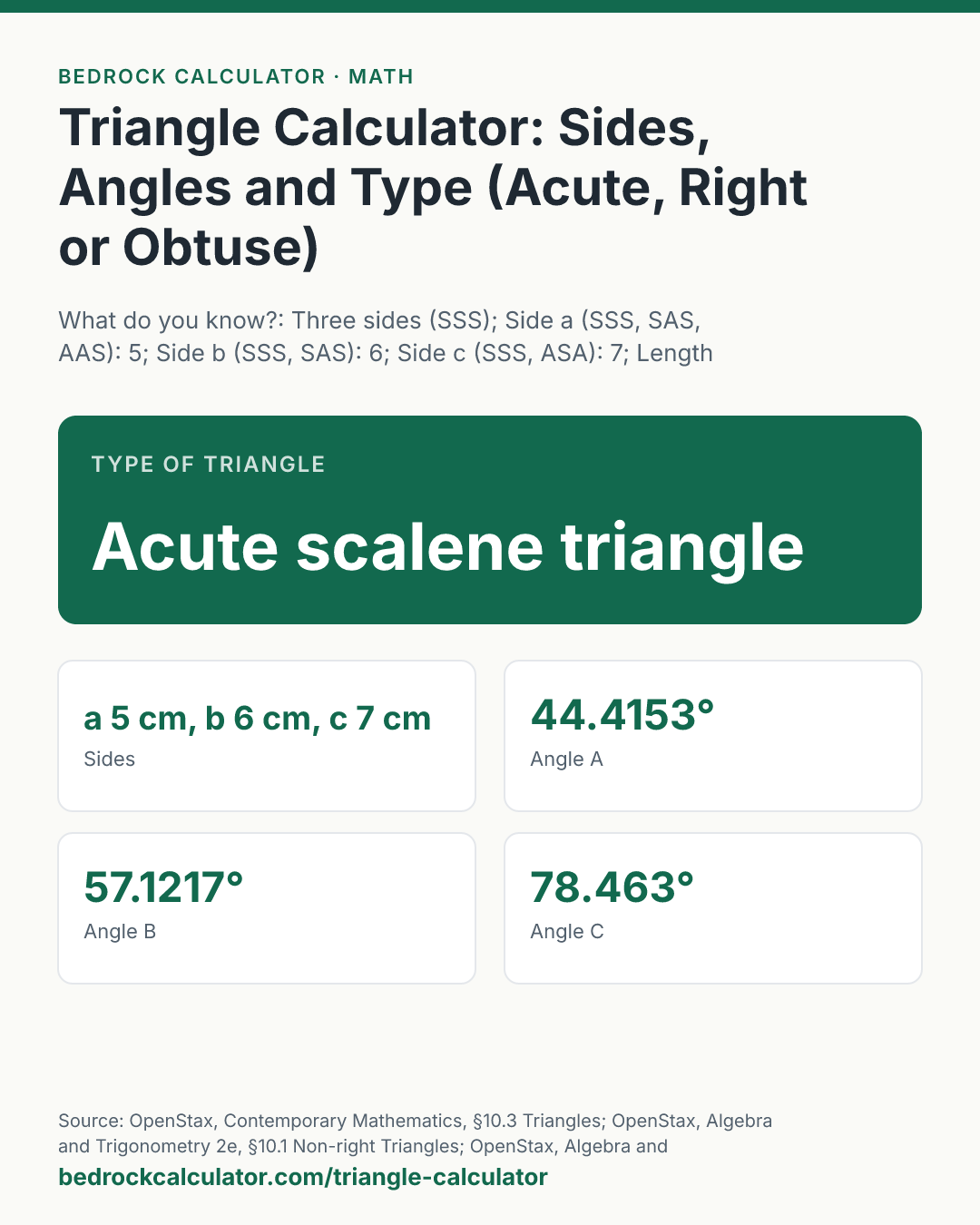
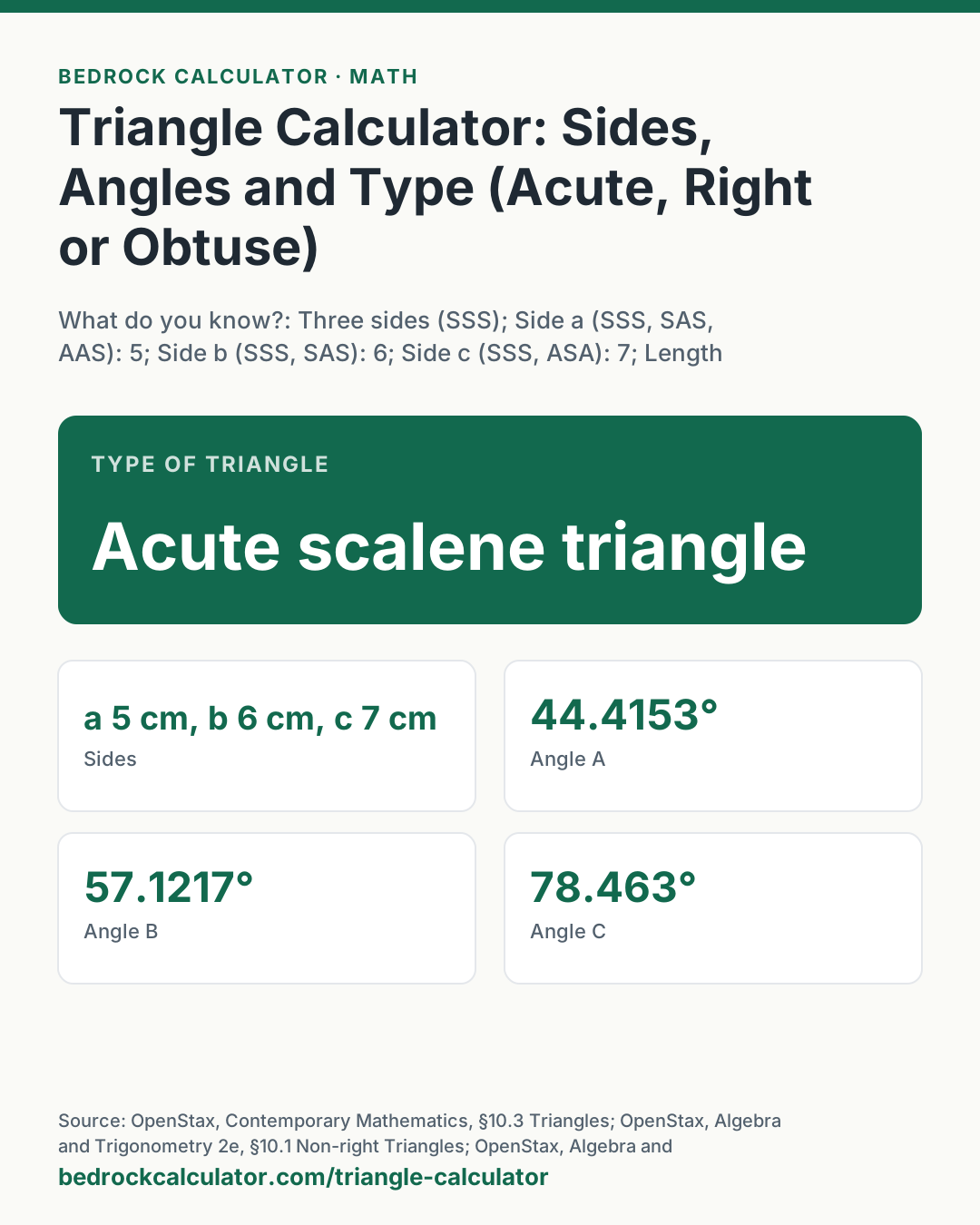
Quick Answer: Sides of 5, 6 and 7 make an acute scalene triangle: no two sides are equal, and its largest angle is 78.463°, under 90. A triangle is acute when every angle is below 90 degrees, right when one is exactly 90, and obtuse when one is over 90.
What does this calculator do?
This triangle calculator solves a whole triangle from three pieces of information and tells you what kind of triangle it is. Give it three sides, two sides and the angle between them, or two angles and a side, and it returns all three sides, all three angles, the area and the perimeter.
It also names the triangle by its angles (acute, right or obtuse) and by its sides (equilateral, isosceles or scalene).
Three facts are enough because three facts pin a triangle down. That is the content of the congruence rules you may remember as SSS, SAS, ASA and AAS: two triangles that agree on those three measurements are identical. The calculator uses exactly those four cases. Three angles alone are not enough, since they fix the shape but not the size.
Side a is always opposite angle A, b opposite B and c opposite C. Lengths may be in any unit, as long as they are all in the same one, and the area comes back in that unit squared. The working runs at 34-digit precision and is rounded to four decimal places for display.
Using the Triangle Calculator
- Pick the case you have: SSS, SAS, ASA or AAS.
- Fill in the boxes the case names. For SAS, angle C is the angle between sides a and b. For ASA, side c is the side between angles A and B. For AAS, side a is opposite angle A.
- Choose your unit.
The headline names the type of triangle. The cards list the three sides, each angle, the area and the perimeter. The presets load an obtuse triangle with sides 4, 5 and 8, two sides of 6 and 8 with a right angle between them, and two angles of 50 and 60 degrees with 10 between them. The table below the calculator classifies sixteen common sets of sides.
How is this calculated?
- Three sides (SSS). The calculator first checks the triangle inequality: each side must be shorter than the other two together. It then finds angles A and B from the law of cosines, takes C as 180 degrees minus the other two, and gets the area from Heron's formula.
cos A = (b² + c² − a²)/2bc; A_area = √(s(s − a)(s − b)(s − c)), s = (a + b + c)/2
- Two sides and the included angle (SAS). The third side comes from the law of cosines. Angle A follows from the law of cosines again, and angle B is 180 minus A and C.
c² = a² + b² − 2ab cos C
- Two angles and a side (ASA and AAS). The third angle is 180 minus the two you gave. The law of sines then scales every side from the one you know: each side divided by the sine of its opposite angle gives the same number.
C = 180^∘ − A − B; a/sin A = b/sin B = c/sin C
- Area for SAS, ASA and AAS is half of two sides times the sine of the angle between them.
A_area = 1/2ab sin C
- Classify. By angles: right if the largest angle is 90 degrees to within a hundred-quintillionth of a degree, obtuse if it is larger, acute otherwise. By sides: equilateral if all three match, isosceles if two do, scalene if none do. Sides worked out with sines and square roots are compared to a tiny relative tolerance, so a triangle that is equilateral in exact arithmetic is not called isosceles because of the 34th digit.
- Round for display to four decimal places, half up.
Worked Example
The default triangle has sides 5, 6 and 7 cm.
- Angle C, opposite the longest side: cos C = (25 + 36 − 49) ÷ (2 × 5 × 6) = 12 ÷ 60, so C is 78.463°.
- Angles A and B: 44.4153° and 57.1217°. The three add up to 180.
- Area by Heron: s = 9, and the square root of 9 × 4 × 3 × 2 is 14.6969 cm². Perimeter 18 cm.
- The largest angle is under 90 and no sides match: an acute scalene triangle.
With sides 4, 5 and 8, the long side is too long for the angle opposite it to stay at or under 90 degrees. Angle C comes out at 125.0996°, so it is an obtuse scalene triangle with an area of 8.1815 cm².
With two angles of 50° and 60° and a side of 10 cm between them, the third angle is 70°. The law of sines gives the other sides as 8.1521 cm and 9.216 cm, and the area is 35.2995 cm².
What Is an Acute Triangle?
An acute triangle has all three angles less than 90 degrees. You can test this from the sides alone: square the longest side and compare it with the sum of the squares of the other two. If the longest side's square is smaller, the triangle is acute; equal, it is right; larger, it is obtuse.
That is the law of cosines read backwards, and it is why 5, 6, 7 is acute (49 is less than 61) and 4, 5, 8 is obtuse (64 is more than 41). Every equilateral triangle is acute, with three angles of 60 degrees.
How Many Degrees Are in a Triangle?
The angles of every flat triangle add up to 180 degrees. Draw a line through one corner parallel to the opposite side, and the three angles fit exactly along that straight line. This is why two angles are enough to find the third, and why a triangle can have at most one right or obtuse angle.
What does this calculator not account for?
- Two sides and a non-included angle (SSA). When the angle is not between the two known sides, there can be two different triangles, one or none. This case is left out rather than answered with one triangle when two exist.
- Coordinates of the vertices. The calculator does not take corner points. Find the three side lengths with the distance formula and use SSS.
- Curved surfaces. On a sphere, such as the Earth over long distances, triangle angles add up to more than 180 degrees. Everything here is flat, Euclidean geometry.
- Angles in radians. Angles are entered and shown in degrees.
- Unit conversion. All lengths must be in the same unit.
What mistakes do people make with this?
- Labelling sides and angles inconsistently. Side a must face angle A. Swapping one pair gives a different triangle, or an impossible one.
- Putting the SAS angle in the wrong place. Angle C must be the angle where sides a and b meet.
- Angles that use up 180. Two angles that already total 180 or more leave nothing for the third. The calculator says so.
- Sides that only just fail. Lengths of 2, 3 and 5 lie flat: 2 + 3 equals 5 exactly. A triangle needs the sum to be strictly larger.
- Expecting a right triangle from rounded sides. Sides of 1, 1 and 1.4 look like an isosceles right triangle, but 1.4 is not quite the square root of 2, and the largest angle is 88.854°. The calculator calls that acute, which is correct.
Frequently Asked Questions
What are the vertices of a triangle?
What is the volume of a triangle?
Can a triangle have two right angles?
How do I find the third side of a triangle?
What is a scalene triangle?
Is a right triangle acute or obtuse?
Sources
- OpenStax, Contemporary Mathematics, §10.3 Triangles: classification by angles and sides, and the 180 degree angle sum. openstax.org/books/contemporary-mathematics/pages/10-3-triangles
- OpenStax, Algebra and Trigonometry 2e, §10.1 Non-right Triangles: Law of Sines (ASA and AAS). openstax.org/books/algebra-and-trigonometry-2e/pages/10-1-non-right-triangles-law-of-sines
- OpenStax, Algebra and Trigonometry 2e, §10.2 Non-right Triangles: Law of Cosines (SAS, SSS and Heron's formula). openstax.org/books/algebra-and-trigonometry-2e/pages/10-2-non-right-triangles-law-of-cosines
- NIST Digital Library of Mathematical Functions, §4.14 Definitions and Periodicity of the trigonometric functions. dlmf.nist.gov/4.14