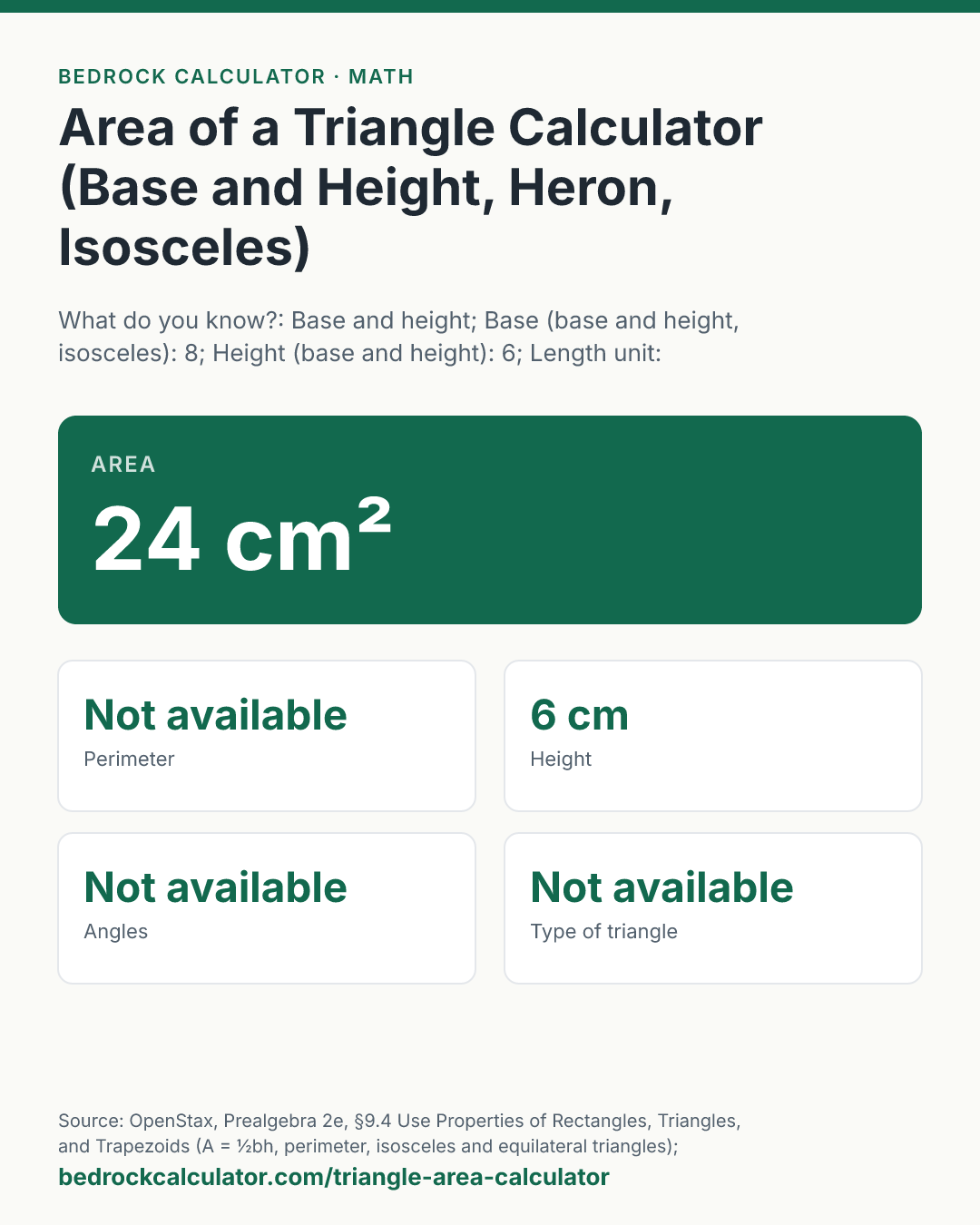

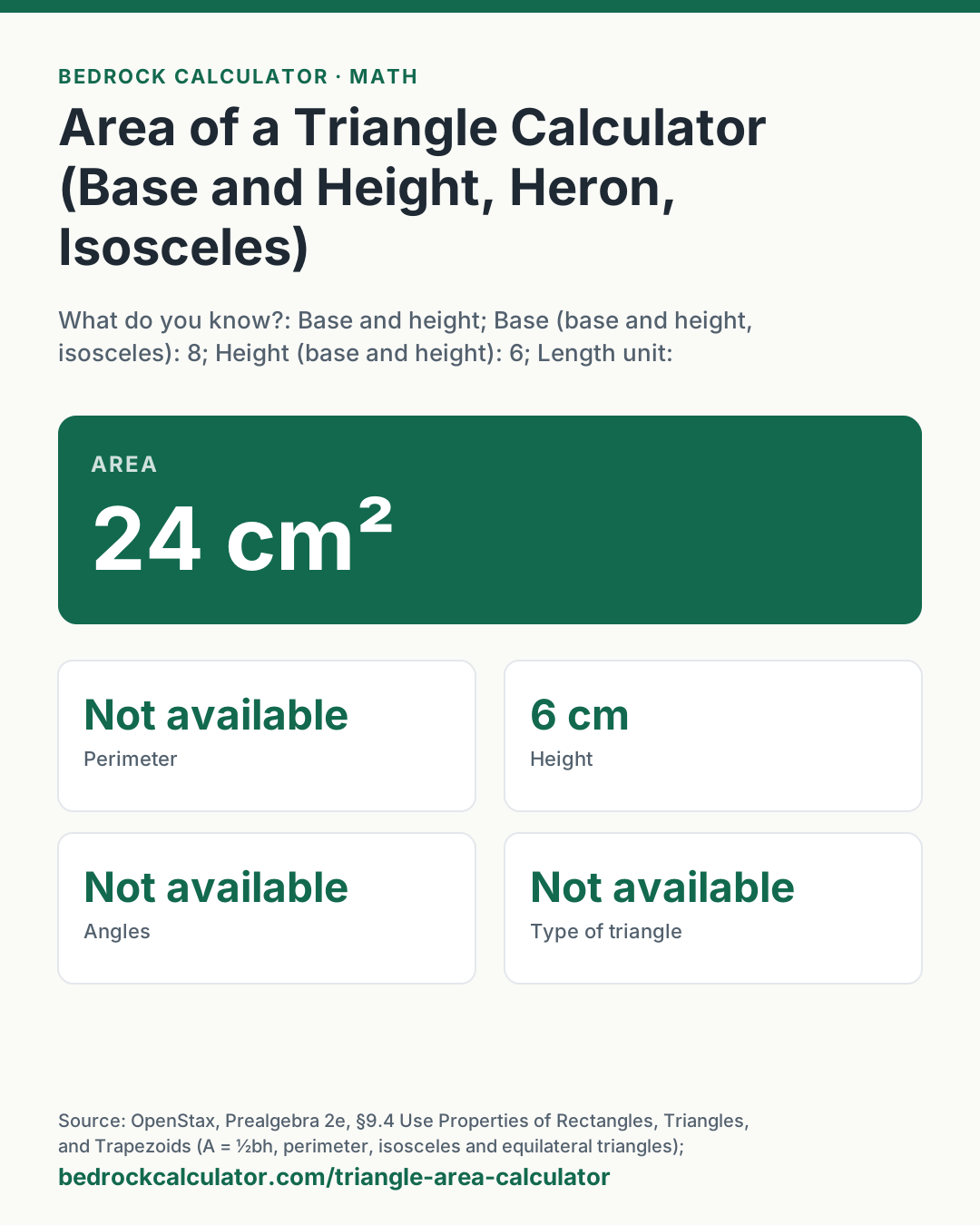
Quick Answer: The area of a triangle is half the base times the height, so a triangle with a base of 8 cm and a height of 6 cm covers 24 cm². Without a height, use the three sides (Heron's formula) or two sides and the angle between them.
What does this calculator do?
This calculator finds the area of a triangle from whatever you have measured. The usual school formula needs a base and a perpendicular height. When you only have the three side lengths, it uses Heron's formula. When you have two sides and the angle between them, it uses the sine of that angle.
And for an isosceles triangle, it works out the height from the two equal sides and the base, then the area.
Every method gives the same answer for the same triangle, because they are all ways of finding half of base times height. They differ only in what you need to know. The three-sides and two-sides methods also return the perimeter, all three angles and the type of triangle, since once those are fixed the whole triangle is.
Lengths can be in any unit, as long as all of them are in the same one. The area comes back in that unit squared. The working runs at 34-digit precision and is rounded to four decimal places for display.
Using the Area of a Triangle Calculator
- Pick what you know: base and height, all three sides, two sides and the angle between them, or an isosceles triangle's equal side and base.
- Fill in the boxes named for that method. Only the boxes that method uses are shown.
- Choose your length unit.
The presets load the 3-4-5 triangle, two sides of 5 and 7 with a 60 degree angle between them, and an isosceles triangle with sides 5, 5 and 6. Below the calculator, one table gives the area of an equilateral triangle for sides from 1 to 100, and another gives the height and area of isosceles triangles whose equal sides are 10.
How is this calculated?
- Base and height. Half the base times the perpendicular height.
A = 1/2bh
- Three sides (Heron's formula). The calculator first checks the triangle inequality: each side must be shorter than the other two together, or the three lengths do not close into a triangle. It then takes the semi-perimeter s and applies Heron's formula. The angles come from the law of cosines, with the third angle as 180 degrees minus the other two.
s = (a + b + c)/2; A = √(s(s − a)(s − b)(s − c)); cos A = (b² + c² − a²)/2bc
- Two sides and the included angle. The height on side a is b times the sine of the angle, so the area is half of a times that. The third side comes from the law of cosines, and the remaining angles follow.
A = 1/2ab sin C; c² = a² + b² − 2ab cos C
- Isosceles. A line from the apex to the middle of the base is the height, and it splits the triangle into two right triangles with hypotenuse equal to the leg and one side equal to half the base. Pythagoras gives the height, and then the area is half base times height. The base angles come from their cosine, half the base over the leg, and the apex angle is what is left of 180.
h = √(ℓ² − (b/2)²); A = 1/2bh
- Classify. For three sides or two sides and an angle, the triangle is named by its largest angle (acute, right or obtuse) and by its sides (equilateral, isosceles or scalene).
- Round for display to four decimal places, half up.
Worked Example
The default is a base of 8 cm and a height of 6 cm: half of 8 × 6 is 24 cm².
The 3-4-5 triangle by Heron's formula: the semi-perimeter is 6, and the square root of 6 × 3 × 2 × 1 is 6 cm². Its perimeter is 12 cm, its angles are 36.8699°, 53.1301° and 90°, and the calculator names it a right scalene triangle. The same triangle entered as base 3 and height 4 also gives 6, as it should.
Two sides of 5 and 7 with a 60 degree angle between them: half of 5 × 7 × sin 60° is 15.1554 cm². The third side is 6.245 cm and the perimeter 18.245 cm.
An isosceles triangle with equal sides of 5 and a base of 6: half the base is 3, so the height is the square root of 25 − 9, 4 cm, and the area is half of 6 × 4, 12 cm². Each base angle is 53.1301° and the apex is 73.7398°.
What Is the Formula for Finding the Area of a Triangle?
Half the base times the height, A = ½bh. The base can be any side; the height must be measured at right angles to it, from the base (or the base extended) to the opposite corner.
A triangle is half of a parallelogram with the same base and height, which is where the half comes from: two copies of any triangle, one flipped, fit together into a parallelogram whose area is base times height.
How Do You Find the Area of an Isosceles Triangle?
If you know the height, use half base times height as for any triangle. If you only know the two equal sides and the base, find the height first: square the equal side, subtract the square of half the base, and take the square root. Then halve the base times that height.
In the isosceles table below the calculator, equal sides of 10 on a base of 12 give a height of 8 and an area of 48. The area is largest when the apex is a right angle; with sides of 10 that happens when the base is a little over 14, and the table shows the area peaking near 50 there before it falls away.
How Do You Find the Base of a Triangle from the Area?
Rearrange the formula: the base is twice the area divided by the height. For the default triangle, twice 24 is 48, and 48 divided by the height of 6 is 8, the base you started with. The same rearrangement gives the height from the area and the base.
What does this calculator not account for?
- Slanted sides as heights. In base-and-height mode the height must be perpendicular to the base. Entering the length of a sloping side gives too large an area.
- Ambiguous two-side cases. The two-sides mode needs the angle between the two sides. If your angle is opposite one of them, the triangle may not be unique, and this mode does not handle that case.
- Coordinates. A triangle given by the coordinates of its corners is not a mode here. Work out the three side lengths with the distance formula and use Heron.
- Unit conversion. Lengths in different units must be converted to one unit before entry.
- Surface area of solids. A triangle is flat and has only an area. For the surface of a triangular prism or pyramid, use the prism or pyramid calculators.
What mistakes do people make with this?
- Forgetting the half. Base times height is the area of a rectangle or parallelogram; a triangle is half of it.
- Using the wrong height. The height goes with the base it is perpendicular to. Pair a base with the height drawn to that side.
- Sides that cannot meet. Lengths of 1, 2 and 3 lie flat in a line; they enclose no area. The calculator says so instead of returning zero.
- Angle in the wrong place. In two-sides mode the angle must be the one between the two sides you entered, not one of the others.
- Rounding sides first. With Heron's formula, small rounding in the sides is magnified when the triangle is long and thin. Enter the sides as precisely as you have them.
Frequently Asked Questions
What is the area of a triangle with sides 3, 4 and 5?
What is the area of an equilateral triangle?
Can I find the area of a triangle with only the angles?
What does "surface area of a triangle" mean?
Why does Heron's formula work?
Is an equilateral triangle also isosceles?
Sources
- OpenStax, Prealgebra 2e, §9.4 Use Properties of Rectangles, Triangles, and Trapezoids (A = ½bh, perimeter, isosceles and equilateral triangles). openstax.org/books/prealgebra-2e/pages/9-4-use-properties-of-rectangles-triangles-and-trapezoids
- OpenStax, Algebra and Trigonometry 2e, §10.1 Non-right Triangles: Law of Sines (area as ½ab sin C). openstax.org/books/algebra-and-trigonometry-2e/pages/10-1-non-right-triangles-law-of-sines
- OpenStax, Algebra and Trigonometry 2e, §10.2 Non-right Triangles: Law of Cosines (and Heron's formula). openstax.org/books/algebra-and-trigonometry-2e/pages/10-2-non-right-triangles-law-of-cosines
- NIST Digital Library of Mathematical Functions, §4.14 Definitions and Periodicity of the trigonometric functions. dlmf.nist.gov/4.14