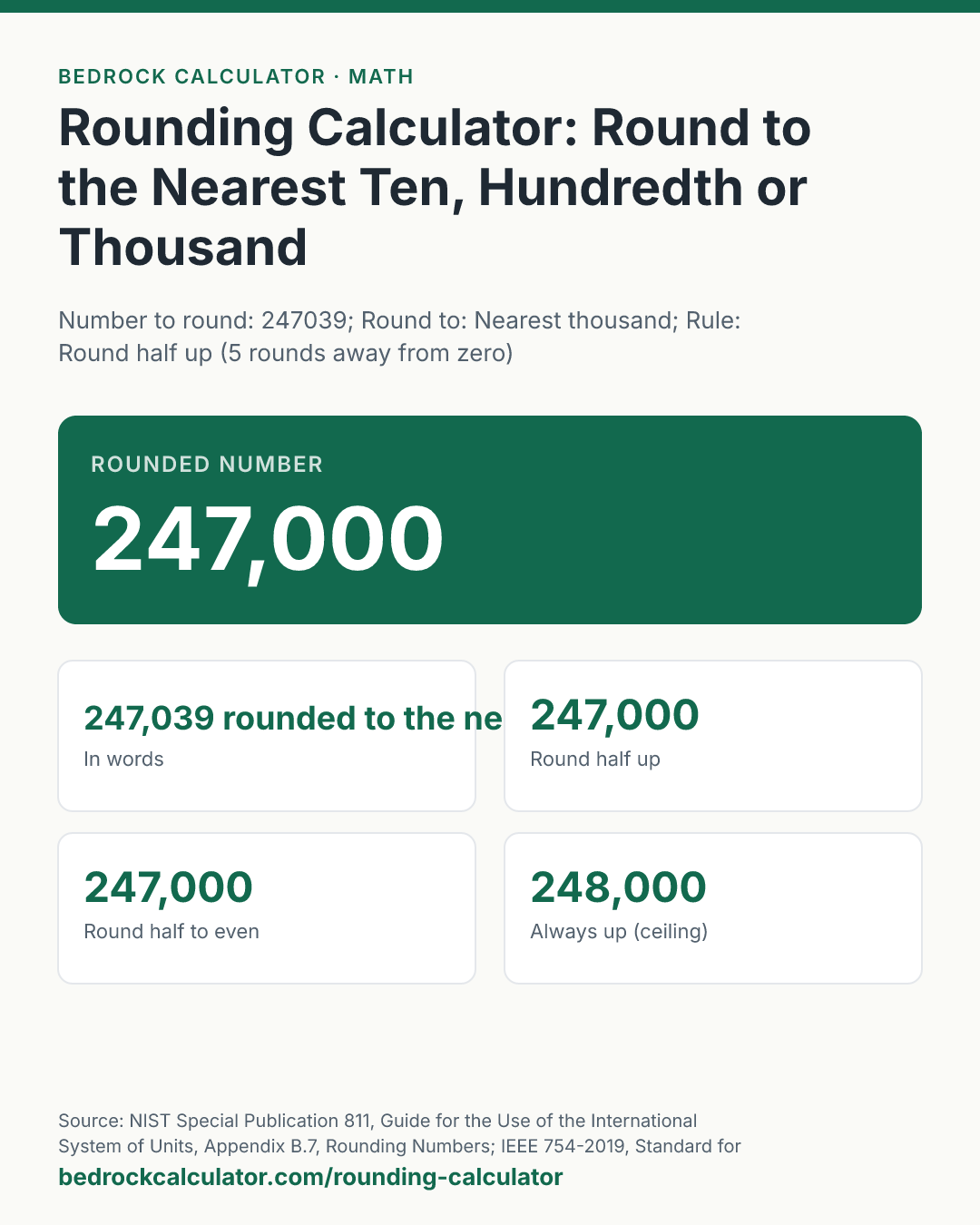

Quick Answer: 247,039 rounded to the nearest thousand is 247,000, because the part being dropped is less than half of a thousand. To the nearest ten it is 247,040.
What does this calculator do?
This rounding calculator rounds any number to the place you choose, from the nearest million down to the nearest ten-thousandth, and shows the answer under five rules at once: round half up, round half to even, always up, always down, and truncate.
Most of the time the rules agree. They part company in two situations. The first is a tie, where the part being dropped is exactly one half, such as 2.5 to the nearest whole number. School arithmetic rounds a tie up, to 3. The rule recommended by the NIST Guide to the SI, and used by default in computer floating point under IEEE 754, rounds a tie to whichever neighbour is even, giving 2. The second situation is when you want to round in one direction regardless, as with a ceiling for "how many boxes do I need" or a floor for "how many whole items can I afford".
The number is read exactly as you type it. A spreadsheet that stores 2.675 in binary actually holds a value a hair below it, which is why some programs round it to 2.67. Here 2.675 is exactly 2.675.
Using the Rounding Calculator
- Type the number. Leave out thousands commas; decimals and negatives are fine.
- Choose the place: nearest million, thousand, hundred, ten, whole number, tenth, hundredth, thousandth or ten-thousandth.
- Choose the rule for the headline. The cards show all five rules regardless, plus how much rounding changed the number.
How is this calculated?
- Read the number exactly. The text is read as an exact decimal. Anything that is not a plain number (a letter, a thousands comma) is rejected with a message rather than guessed at.
- Scale to the place. The number is divided by the place value, so that the digit you are rounding to becomes the units digit. For the nearest thousand, 247,039 becomes 247.039.
- Round to a whole number by the rule. The scaled value is rounded to an integer: - Half up: a fractional part below one half rounds down, above one half rounds up, and exactly one half rounds away from zero (2.5 to 3, -2.5 to -3). - Half to even: the same, except that exactly one half goes to the even neighbour (2.5 to 2, 3.5 to 4). This is rule 3 of NIST SP 811, section B.7.1. - Ceiling always moves up toward plus infinity, floor always down toward minus infinity, and truncate drops the fraction, moving toward zero.
- Scale back. The integer is multiplied by the place value: 247 × 1,000 = 247,000.
rounded = round(x/p) × p
- Show the result to the place. A result rounded to the nearest tenth always shows one decimal place, so 3.96 becomes 4.0, not 4. The trailing zero says the number is good to a tenth. The change card shows the rounded value minus the original.
Worked Example
Using the default, 247,039 to the nearest thousand, rounding half up:
- Scale: 247,039 ÷ 1,000 = 247.039.
- The fractional part, 0.039, is less than one half, so it rounds down to 247.
- Scale back: 247 × 1,000 = 247,000.
- Rounding changed the number by -39.
Every rule that rounds to the nearest value agrees here, because 39 is nowhere near half of a thousand. Only the ceiling rule differs, giving 248,000.
A tie, using the 0.0465 to the nearest thousandth preset: scaled, it is 46.5, exactly half way between 46 and 47. Rounding half up gives 0.047; rounding half to even gives 0.046, because 6 is even.
How Do You Round to the Nearest Hundredth?
Look at the third digit after the decimal point. If it is less than 5, keep the first two decimal digits as they are; if it is more than 5, add one to the second; if it is exactly 5 with nothing after it, the rule decides.
The 2.675 to the nearest hundredth preset is that tie: half up gives 2.68, and half to even also gives 2.68, because the 7 before the 5 is odd and rounds up to the even 8.
The same method rounds to the nearest thousandth (look at the fourth decimal digit) or the nearest tenth (look at the second). In the table, 3.14159 rounds to 3.1, 3.14, 3.142 and 3.1416 at those places.
How Do You Round to the Nearest Ten, Hundred or Thousand?
Look at the digit just to the right of the place you are keeping. For the nearest ten, that is the units digit; for the nearest thousand, the hundreds digit. Then replace every digit to the right of the kept place with zero.
247,039 is 247,040 to the nearest ten, 247,000 to the nearest hundred and to the nearest thousand, and 0 to the nearest million, since it is less than half a million.
Round Half Up Versus Round Half to Even
The second reference table puts the two tie rules side by side. Rounding half up always pushes ties away from zero, so over many roundings the total drifts upward in size. Rounding half to even sends half the ties up and half down, so the drift cancels out. That is why NIST recommends it for measurement data and why IEEE 754 uses it as the default for binary arithmetic. For a single homework answer the school rule is usually what is expected; for long columns of figures, half to even is fairer.
What does this calculator not account for?
- Significant figures. This tool rounds to a fixed place. To keep a number of significant figures instead, where the place depends on the size of the number, use the significant figures calculator.
- Rounding to multiples other than powers of ten. Rounding to the nearest 5, quarter or 0.05 is not offered.
- Thousands separators in the input. Type 247039, not 247,039; the answer is shown with separators.
- Chained rounding. Rounding to one place and then rounding that result again can give a different answer from rounding straight to the final place. The calculator always rounds the original number once.
What mistakes do people make with this?
- Rounding in stages. Rounding to a tenth first can create a new tie at the whole-number step that the original number never had, and push the final answer the wrong way. Round once, from the original.
- Dropping meaningful zeros. 3.96 to the nearest tenth is 4.0. Writing 4 loses the information that it is good to a tenth.
- Assuming all software rounds the same way. Spreadsheets, programming languages and calculators use different tie rules and store decimals differently. Check which one you need.
- Rounding negative numbers by habit. Half up as defined here sends -2.5 to -3, away from zero. Some textbooks send it to -2, toward plus infinity. If your course does that, read the ceiling card for ties.
- Rounding before calculating. Keep full precision through a calculation and round the final answer.
Frequently Asked Questions
What is 247,039 rounded to the nearest thousand?
Does 5 round up or down?
What is banker's rounding?
How do I round up to the next whole number?
What does rounding to one decimal place mean?
Why does my calculator round 2.675 to 2.67?
Sources
- NIST Special Publication 811, Guide for the Use of the International System of Units, Appendix B.7, Rounding Numbers: the three rounding rules, including the even rule for ties. nist.gov/pml/special-publication-811/nist-guide-si-appendix-b-conversion-factors
- IEEE 754-2019, Standard for Floating-Point Arithmetic: round to nearest, ties to even, as the default rounding attribute. standards.ieee.org/ieee/754/6210