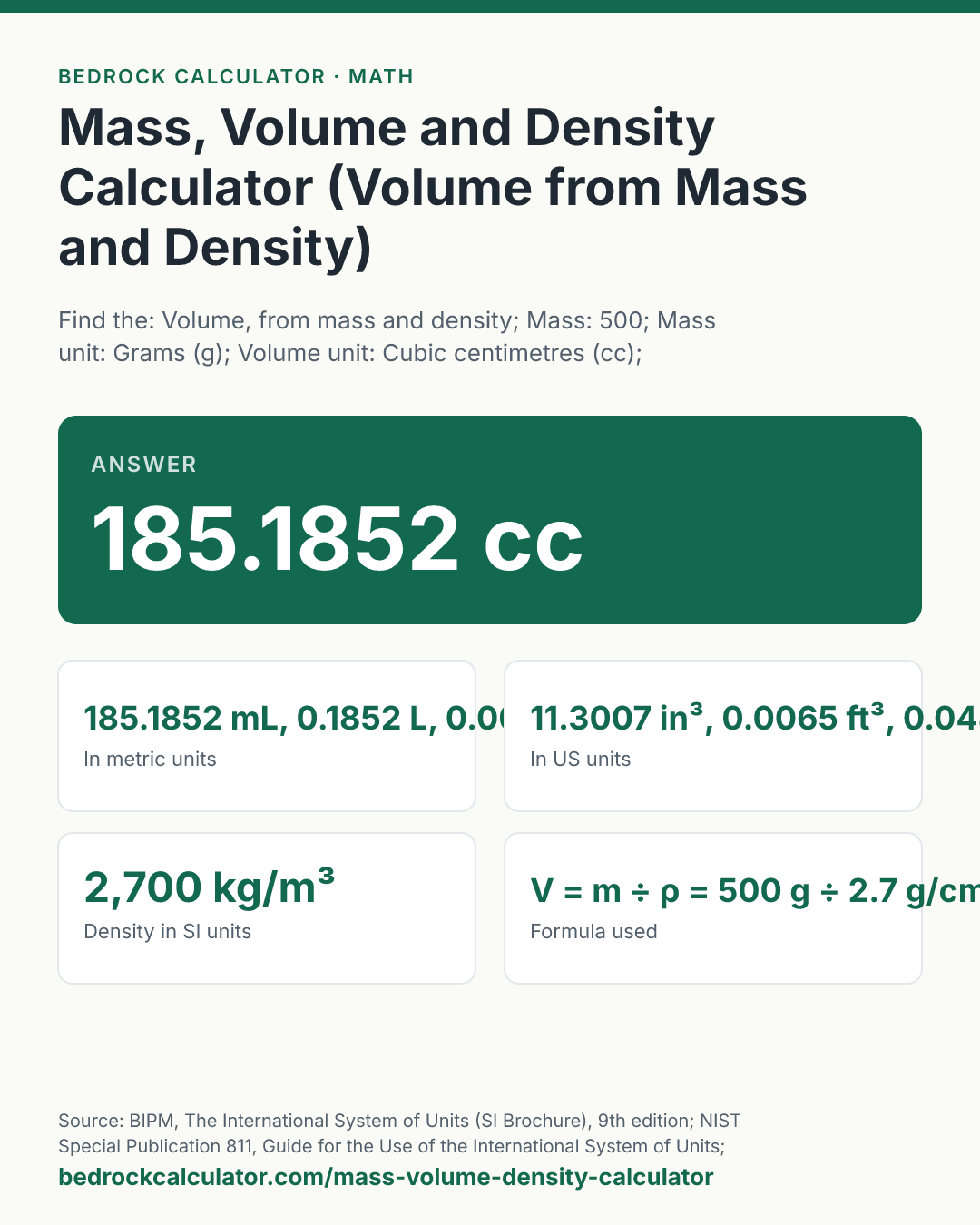
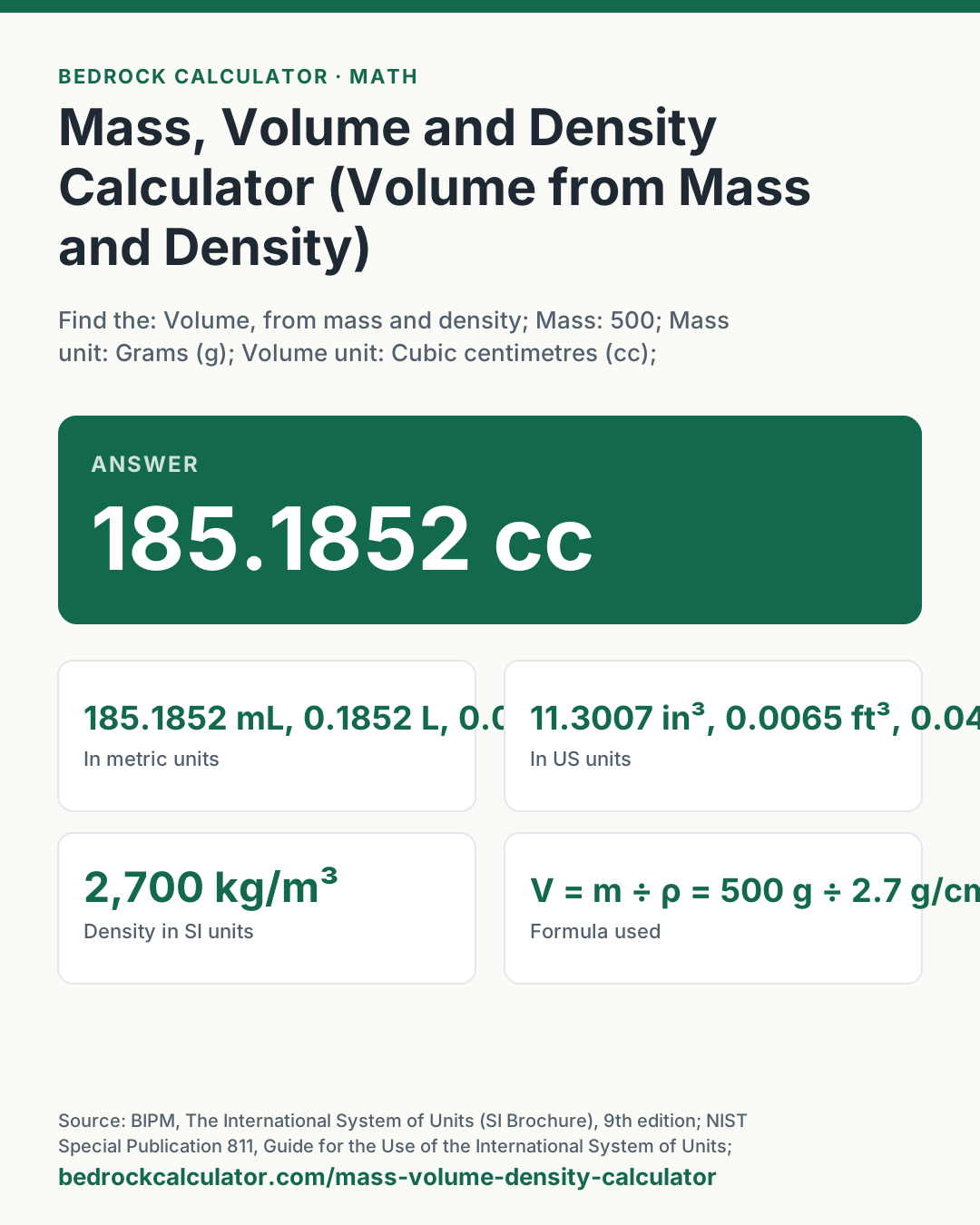
Quick Answer: To find volume from mass and density, divide the mass by the density: V = m ÷ ρ. Half a kilogram, 500 g, of a material with a density of 2.7 g/cm³ takes up 185.1852 cc (cubic centimetres).
What does this calculator do?
This calculator works the density relation in all three directions. Give it a mass and a density and it finds the volume. Give it a volume and a density and it finds the mass. Give it a mass and a volume and it finds the density.
Most people arrive with the first question, how to get the volume from mass and density, and the answer is a single division, but the units are where it goes wrong, so the calculator handles those too.
Density is mass per unit of volume. A density of 2.7 g/cm³ means every cubic centimetre of the material has a mass of 2.7 grams. Read that way, the three rearrangements are common sense: multiply density by volume to get mass, divide mass by density to get how many cubic centimetres it takes, divide mass by volume to get the mass in each one.
You can mix units freely: grams with cubic inches, pounds with litres. Every value is converted through the kilogram and the cubic metre using exact unit definitions, so 1 g/cm³ is exactly 1,000 kg/m³ and exactly 1 kg/L. The answer comes in the unit you pick, with the same quantity repeated in common metric and US units below. Results are rounded to four decimal places for display.
Using the Volume from Mass and Density Calculator
- Choose what to find: volume, mass or density.
- Enter the two values you know, each with its unit.
- Set the unit of the quantity you are finding. Its own box is hidden.
The cards show the rearranged formula with your numbers in it, the answer in metric and US units, and the density in kilograms per cubic metre, the SI unit. The presets find the mass of 2 litres of a liquid at 1 kg/L, the density of a 45 g object that displaces 5 cm³ of water, and the volume of 10 lb of a metal with a density of 490 lb/ft³. Below the calculator, one table lists the volume of 1 kg at densities from 0.1 to 21.5 g/cm³ and another converts densities between g/cm³, kg/m³ and lb/ft³.
How is this calculated?
- The relation. Density ρ is mass m divided by volume V. The calculator uses whichever rearrangement your choice needs.
ρ = m/V; V = m/ρ; m = ρV
- Convert to SI. The mass is converted to kilograms and the volume to cubic metres. A density unit is a mass unit over a volume unit, so it converts through its two parts: g/cm³ becomes kg/m³ by converting the gram to kilograms and the cubic centimetre to cubic metres.
- Solve. For volume, the mass in kilograms is divided by the density in kg/m³, giving cubic metres. For mass, the cubic metres are multiplied by the density, giving kilograms. For density, the kilograms are divided by the cubic metres.
- Convert back. The result is converted from SI into the unit you chose, and into the other units shown on the cards.
- Round for display to four decimal places, half up.
Worked Example
The default asks for the volume of 500 g of a material with a density of 2.7 g/cm³.
- Density in SI: 2.7 g/cm³ is 2,700 kg/m³.
- Volume: 500 ÷ 2.7 = 185.1852 cc, which is 185.1852 mL or 0.1852 L.
- In US units: 11.3007 in³.
The mass of 2 litres at 1 kg/L is 2 kg, which is 4.4092 lb. That is roughly what two litres of water weigh, since water's density is close to 1 kg/L at room temperature.
An object of 45 g that pushes 5 cm³ of water out of a full glass has a density of 45 ÷ 5 = 9 g/cm³, which is 9,000 kg/m³ or 561.8516 lb/ft³.
Ten pounds of a metal with a density of 490 lb/ft³ occupies 35.2653 in³, a block a little over three inches on each side.
How Do You Find the Volume with Density and Mass?
Divide the mass by the density, making sure the units match. If the density is in g/cm³, the mass must be in grams and the answer is in cubic centimetres. If the density is in kg/m³, use kilograms and get cubic metres.
The table below the calculator shows the pattern: 1 kg at a density of 2.5 g/cm³ takes up 400 cm³, and at 10 g/cm³ only 100 cm³. Doubling the density halves the volume.
What Is the Density Formula?
Density equals mass divided by volume, ρ = m ÷ V. The Greek letter rho is the usual symbol. In SI the unit is the kilogram per cubic metre; in labs, grams per cubic centimetre or grams per millilitre, which are the same thing; in US engineering, pounds per cubic foot or pounds per gallon.
How Do You Find Mass from Density and Volume?
Multiply the density by the volume. A density of 1 kg/L and a volume of 2 L give 2 kg. As with volume, make the units agree first, or let the calculator convert them.
What does this calculator not account for?
- Material densities. The calculator does not look up densities. Enter the density of your material from a reliable reference; it varies with temperature, alloy, moisture and how tightly a powder or soil is packed.
- Temperature and pressure. Gases change density enormously with temperature and pressure, and liquids a little. The figure you enter is taken as fixed.
- Hollow objects and mixtures. For an object with air inside, or a mixture of materials, the result is an average density, not the density of any one part.
- Weight versus mass. Masses here are masses. A pound is the avoirdupois pound of mass, 0.45359237 kg exactly.
- Volume flow rate. Flow rate (volume per unit of time, cross-section area times speed) is a different quantity and is not computed here.
What mistakes do people make with this?
- Mismatched units. Dividing grams by kg/m³ gives a number a million times off. Convert first, or use the unit boxes.
- Inverting the formula. Volume is mass over density, not density over mass. A heavier object of the same material takes up more room, so mass must be on top.
- Confusing mL and cm³. They are the same volume. A litre is 1,000 of either.
- Using weight scales for density in water. Displacement gives volume only if the object sinks fully and does not absorb water.
- Fluid ounces and cups. The volume units here are US customary; a US cup is 236.5882365 mL, not the 250 mL metric cup.
Frequently Asked Questions
How do I find the volume of an object with mass and density?
How do I find the density of an irregular object?
Is g/mL the same as g/cm³?
How do I convert g/cm³ to kg/m³?
What is specific gravity?
Why does a heavier object sometimes take up less space?
Sources
- BIPM, The International System of Units (SI Brochure), 9th edition: the kilogram and the metre, from which the SI density unit kg/m³ is derived. bipm.org/en/publications/si-brochure
- NIST Special Publication 811, Guide for the Use of the International System of Units: conversion factors for mass, volume and density units. nist.gov/pml/special-publication-811
- NIST Handbook 44, Appendix C, General Tables of Units of Measurement: the avoirdupois pound, the inch, the US gallon and cup. nist.gov/pml/owm/nist-handbook-44-current-edition