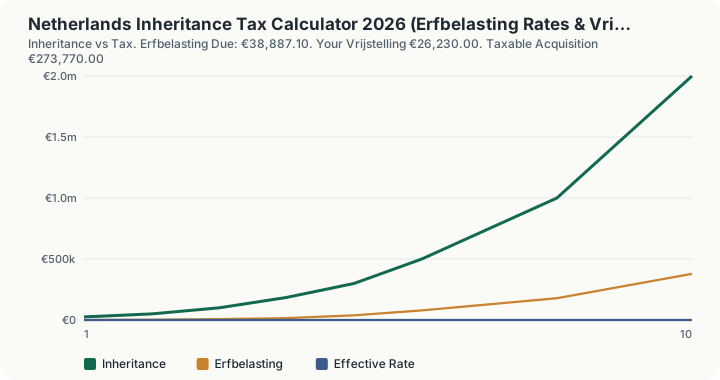
Quick Answer: A €300,000 share passing to a child carries €38,887.10 of 2026 erfbelasting, leaving €261,112.90 net. The €26,230 child exemption comes off first, leaving a taxable acquisition of €273,770; the first €158,669 of that is taxed at 10% (€15,866.90) and the remaining €115,101 at 20% (€23,020.20). That is an effective rate of 12.96% on the gross share, against a 20% marginal rate on the next euro.
What does this calculator do?
Dutch inheritance tax is charged on what each heir receives, not on the estate as a whole, and the relationship to the deceased sets two independent things that do not move together: the exemption (vrijstelling) and which of three rate ladders applies.
That independence is the point most descriptions miss. A grandchild and a child have exactly the same €26,230 exemption but face different rate schedules, 18% and 36% against 10% and 20%. A parent has more than twice a child's exemption at €62,110 but is taxed on the harshest ladder of all, 30% and 40%, the same one that applies to siblings, nieces, nephews and friends.
Which axis dominates depends on the size of the inheritance. The exemption is a fixed euro amount, so it matters most on small shares. The rate schedule is proportional, so it matters most on large ones.
The order of operations is fixed by the Belastingdienst's own instruction: subtract the exemption first, then apply the €158,669 bracket boundary to what is left. That means the gross value at which an heir's marginal rate doubles is the exemption plus €158,669, and it differs by heir. For a child it is €184,899; for a partner it is €986,704.
How is this calculated?
Tax = r_low⋅ min(V − E, 158,669)⁺ + r_high⋅(V − E − 158,669)⁺
where $V$ is the share, $E$ the exemption and (r_low, r_high) the ladder for that relationship.
Step 1: Look up the exemption from the relationship. Partner €828,035; child, stepchild or foster child €26,230; child with a disability €78,671; grandchild €26,230; great-grandchild €2,769; parent €62,110; anyone else €2,769.
Step 2: Look up the rate ladder. Partners and children (including a child with a disability) take 10% and 20%. Grandchildren and great-grandchildren take 18% and 36%. Everyone else, including parents, takes 30% and 40%.
Step 3: Subtract the exemption from the share. Floored at zero. This is the taxable acquisition (verkrijging).
Step 4: Split the taxable acquisition at €158,669. The lower band is the taxable acquisition up to that boundary; the upper band is whatever remains above it. The boundary is applied to the taxable acquisition, never to the gross share.
Step 5: Charge the lower band rate.
Step 6: Charge the upper band rate.
Step 7: Add the two. That is the erfbelasting due.
Step 8: Report the net and the effective rate. The share less the tax, and the tax as a percentage of the gross share.
Step 9: Report the marginal rate. The upper rate if the taxable acquisition exceeds the boundary, otherwise the lower rate, and zero if the exemption covers the whole share.
Step 10: Compute the doubling point. The exemption plus €158,669, which is the gross value at which the marginal rate steps up.
Worked Example
A child inherits a €300,000 share.
Step 1: Exemption. Child, so €26,230.00
Step 2: Rate ladder. Partner-or-child schedule, so 10% and 20%
Step 3: Taxable acquisition. €300,000.00 - €26,230.00 = €273,770.00
Step 4: Lower band. min(€273,770.00, €158,669) = €158,669.00
Step 5: Upper band. €273,770.00 - €158,669.00 = €115,101.00
Step 6: Tax in the lower band. €158,669.00 x 10% = €15,866.90
Step 7: Tax in the upper band. €115,101.00 x 20% = €23,020.20
Step 8: Total erfbelasting. €15,866.90 + €23,020.20 = €38,887.10
Step 9: Net inheritance. €300,000.00 - €38,887.10 = €261,112.90
Step 10: Effective rate on the share. €38,887.10 / €300,000 = 12.96%
Step 11: Marginal rate. The taxable acquisition exceeds the boundary, so 20%
Step 12: Gross value at which the rate doubles. €26,230 + €158,669 = €184,899.00
The same €300,000 share to a grandchild costs €69,996.78, because the exemption is identical but the ladder is 18% and 36%. Skipping a generation therefore costs €31,109.68 on this share, entirely from the rate schedule and not at all from the exemption. To someone unrelated, the same share costs €103,025.50: a €2,769 exemption and the 30%/40% ladder.
What does this calculator not account for?
- The reduction of the partner exemption by an inherited pension is not modelled. Under art. 32 lid 2 SW 1956 the surviving partner's exemption is reduced by the actuarial value of a pension accruing to them, subject to a minimum. The Belastingdienst reduces the exemption by half the value of the future pension payments, and in 2026 it cannot fall below €213,915. Modelling that would need your pension's annual amount and your age, so the mechanism is left out. For a surviving partner with significant pension entitlements, the €828,035 exemption used here will be too generous.
- The bedrijfsopvolgingsregeling (business succession relief) is not modelled. For an estate containing a trading business, this relief can remove most of the tax and its absence makes this figure materially too high.
- ANBI and SBBI exemptions are not modelled. Bequests to qualifying charities and social-interest organisations are exempt.
- The 30-day rule is not modelled. Where an heir dies within 30 days of the deceased, special provisions apply to avoid a double charge.
- Only one heir's share is computed. Dutch inheritance tax is per acquirer. A multi-heir estate needs one run per heir, and the calculator does not divide an estate.
- Debts and estate liabilities are not deducted. Enter the net share you actually receive.
- The "value of your exemption in cash" figure compares against the 'anyone else' position, so it mixes both axes. It is the difference between the tax an unrelated heir would pay on the same share and the tax you pay. That gap reflects both the larger exemption and the gentler rate ladder, not the exemption alone.
- Lifetime gifts and their aggregation are not modelled. Schenkbelasting has its own exemptions and interactions that this page does not cover.
- Non-resident and cross-border situations are out of scope, including the deemed-residence rules for Dutch nationals who have emigrated.
What mistakes do people make with this?
- Assuming a bigger exemption means a gentler rate. A parent has €62,110 of exemption, more than twice a child's, and is then taxed at 30% and 40%. The two axes are set independently.
- Applying the €158,669 boundary to the gross inheritance. The Belastingdienst instruction is explicit: subtract the exemption first, then apply the percentage from the table to what is left. Using the gross value moves the boundary and overstates the lower-band relief.
- Thinking the exemption is a cliff. It is a true allowance. Exceeding it by one euro taxes that one euro, not the whole inheritance. This is the opposite of, say, Irish rent-a-room relief.
- Treating skip-a-generation planning as cost-free. Leaving a share directly to a grandchild rather than a child costs an extra €31,109.68 on a €300,000 share, purely from the harsher rate ladder, since the exemption is identical.
- Quoting the headline percentages as your rate. Because the exemption comes off first and the lower band is taxed at half the upper rate, the effective rate on a gross share climbs continuously from zero. On the worked example it is 12.96%, not 20%.
- Forgetting the partner exemption can be reduced. A surviving partner with a substantial inherited pension may have far less than €828,035 of exemption available. This calculator does not model that reduction.
- Assuming siblings get a family rate. They do not. Siblings, nieces, nephews and friends all sit on the 30%/40% ladder with a €2,769 exemption.
Frequently Asked Questions
What are the Dutch inheritance tax rates for 2026?
What is the inheritance tax exemption in the Netherlands?
Is the exemption subtracted before or after the bracket?
Why does a parent pay more than a child on the same inheritance?
Does leaving money directly to grandchildren save tax?
Is the partner exemption really over €800,000?
Sources
- Belastingdienst, "Tarieven erfbelasting 2026", belastingdienst.nl/wps/wcm/connect/nl/erfbelasting/content/tarieven-erfbelasting, read 2026-08-30: the bracket boundary of €158,669 and the three rate ladders (10/20 partner and children, 18/36 grandchildren, 30/40 everyone else), and the instruction "Trek de vrijstelling eerst van uw erfenis af en neem daarna het percentage dat voor u geldt uit de tabel".
- Belastingdienst, "Hoeveel vrijstelling heb ik in 2026 voor de erfbelasting?", belastingdienst.nl/wps/wcm/connect/nl/erfbelasting/content/vrijstelling-erfbelasting, read 2026-08-30: the seven exemption amounts used here.
Also consulted: Successiewet 1956 art. 32 lid 2: the reduction of the partner exemption by an inherited pension. Deliberately not modelled; see the note above; Belastingdienst, "Lijfrente- of pensioenuitkering na overlijden partner": the 2026 minimum partner exemption of €213,915 after pension imputation. belastingdienst.nl/wps/wcm/connect/nl/erfbelasting/content/lijfrente-of-pensioen-na-overlijden-partner-betaal-ik-erfbelasting